
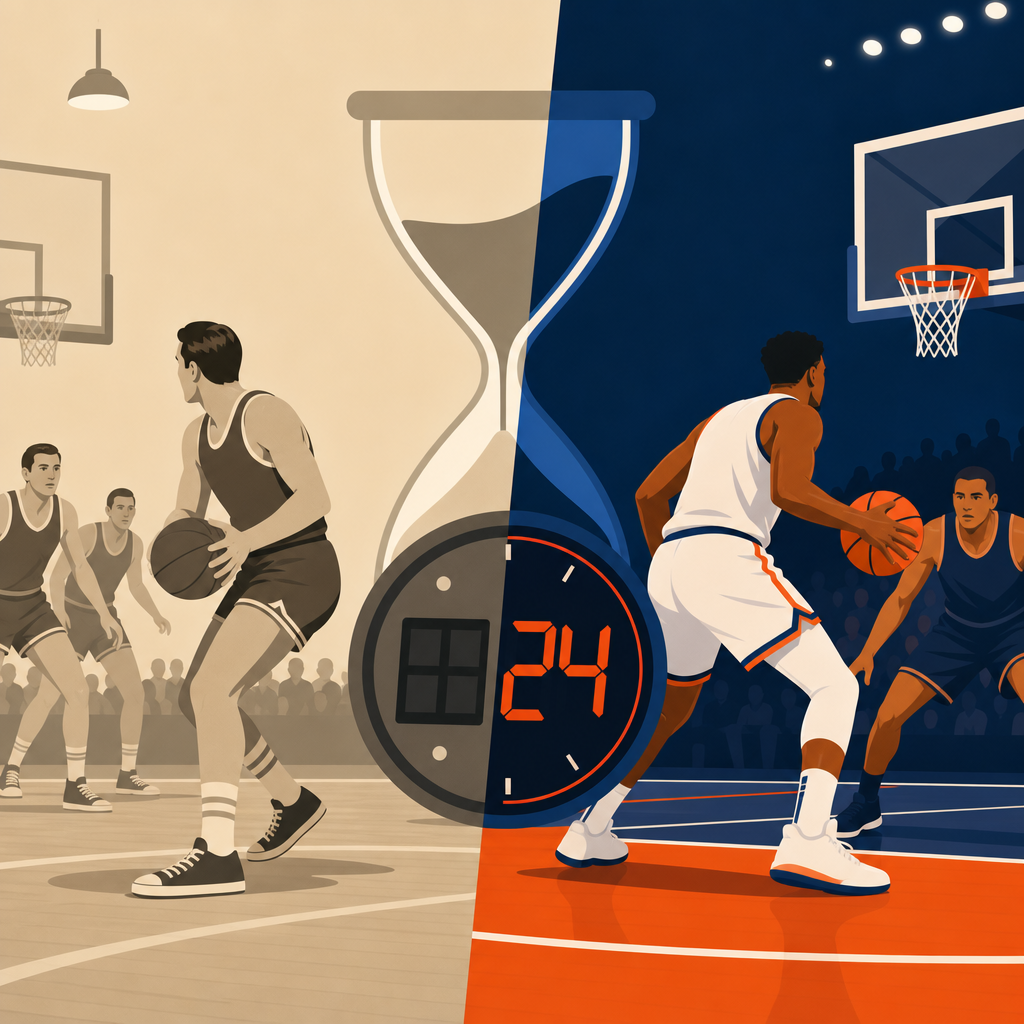
Basketball did not become the fast, high-scoring game fans recognize today by accident; it changed because the shot clock forced it to. The history of the shot clock in basketball is really the history of how leagues solved one of the sport’s oldest problems: what happens when a team with the lead simply stops trying to score. Before a possession timer existed, games could slow into long stretches of stalling, with players holding the ball, passing aimlessly, or freezing action to protect a narrow advantage. The 24-second rule ended that style at the highest level and reshaped strategy, coaching, roster construction, television appeal, and the economics of professional basketball.
In simple terms, a shot clock is a countdown that limits how long an offense can control the ball before attempting a field goal that hits the rim. In the NBA, that limit is 24 seconds, and the offense must move the ball across half court within eight seconds. If the team fails to attempt a legal shot in time, possession changes. Today that mechanism feels inseparable from the sport, but for the first several decades of organized basketball, no such rule existed. Understanding shot clock history means tracing the path from low-scoring stall ball to the modern pace-and-space era and seeing how one rule altered nearly every layer of league history.
This matters well beyond trivia. The shot clock helped rescue the NBA’s entertainment value in the 1950s, influenced college and international rules, and established the rhythm that defines modern offensive basketball. It also serves as a lens for the wider history of the league: early competitive imbalance, postwar business pressures, the rise of broadcast-friendly formatting, and the constant push to balance fairness with spectacle. I have worked through old game logs, rule books, and broadcast archives while researching league history, and few rule changes show clearer cause and effect. If you want one turning point that explains why pro basketball evolved the way it did, start with the 24-second clock.
Basketball Before the Shot Clock: Why Stalling Became a Crisis
To understand why the 24-second rule changed everything, you have to picture professional basketball before 1954. Teams were not required to shoot within any fixed time, so late-game strategy often revolved around ball control rather than shot creation. If a stronger favorite held a small lead, it could spread the floor and wait. If an underdog wanted to shorten the game, it could do the same from the opening tip. Coaches called it patience; fans often experienced it as paralysis. Possession counts dropped, shots disappeared, and many contests became tactical dead zones.
The problem was especially severe because defenses could not always force action without fouling. There was no practical timer pushing the offense into a decision. One notorious example came on November 22, 1950, when the Fort Wayne Pistons defeated the Minneapolis Lakers 19-18. That score remains a symbol of the pre-clock era. The Pistons, facing George Mikan and a dominant Lakers team, intentionally reduced possessions to a crawl. The tactic made competitive sense, but it produced one of the least watchable games in league history. It also exposed a structural flaw: the rules allowed teams to avoid the very act the sport is built around, shooting.
Other ugly games reinforced the point. In 1953, the Boston Celtics beat the Syracuse Nationals 111-105 in six overtimes, a marathon remembered not only for length but for repeated stalling once teams gained slim edges. Fans booed, newspapers criticized the product, and league officials worried about gate revenue. During that period, the NBA was still far from secure. It was competing for attention in crowded sports markets, television was becoming more important, and the league could not afford games where players simply held the ball for minutes at a time. The shot clock became necessary because the sport’s incentives were misaligned.
Who Invented the 24-Second Shot Clock and Why 24 Seconds?
The most important figure in shot clock history is Daniel Biasone, owner of the Syracuse Nationals, working with general manager Leo Ferris. Biasone did not just identify the problem; he proposed the mathematical solution that still governs the NBA. His logic was elegant and practical. He believed the best games featured roughly 120 total field goal attempts, split between two teams over 48 minutes. Since 48 minutes equals 2,880 seconds, dividing 2,880 by 120 produced 24. That gave each possession enough time to organize offense but not enough time to stall indefinitely.
This was not abstract theorizing. Biasone watched his own team and others, studying games with strong tempo and crowd energy. He noticed that the most compelling contests naturally involved frequent shooting, transition opportunities, and manageable possession lengths. The 24-second number was designed to preserve those qualities. It was long enough for a post entry, pick-and-roll action, weak-side movement, or a reset after pressure. It was short enough to force initiative. In that sense, the shot clock is one of the cleanest examples in league history of a rule tailored directly to fan experience without distorting core basketball skill.
The NBA adopted the 24-second clock for the 1954-55 season. That decision was revolutionary because it addressed not a fringe loophole but the tempo of every possession. Many rule changes influence edge cases; the shot clock transformed routine play. It immediately increased pace, scoring, and late-game urgency. It also reduced the strategic value of pure delay tactics. Teams could still use clock management, of course, but they now had to attack within a fixed window. That single constraint gave basketball a dependable cadence, and cadence is what made the professional game more compelling to attend, easier to broadcast, and more consistent from night to night.
How the NBA Changed Immediately After the Rule Was Adopted
The early results were dramatic. In the final pre-clock season, NBA teams averaged 79.5 points per game. In the first season with the shot clock, scoring jumped to 93.1 points per game. That increase was not cosmetic; it represented a fundamental shift in the number of possessions and the style of play. More possessions meant more shots, more rebounds, more transition chances, and more opportunities for stars to shape games through skill rather than patience contests. Attendance improved as well, supporting the league’s financial stability at a critical moment.
The 1954-55 Syracuse Nationals became the ideal symbol of the new era when they won the NBA championship. Biasone’s franchise had not only helped create the rule but also demonstrated how effective modernized offense could be under it. Players had to make decisions faster, and coaches had to think beyond simple lead protection. Offensive systems became more dynamic. Fast breaks gained value. Shot selection, spacing, and timing started to matter in new ways because possessions were no longer endless. The clock rewarded teams that could create advantages efficiently and punished those that relied on passive control.
From my review of early box scores and contemporary reporting, another immediate change stands out: games became more narratively coherent. Fans could follow a visible rhythm of possession, attack, rebound, and reset. Broadcasters had a cleaner product to describe. Writers could focus on execution instead of complaining about dead time. This is an underappreciated part of shot clock history. The rule did not merely increase scoring; it standardized the flow of play. In league history terms, that made the NBA more legible to casual audiences, and that accessibility mattered as the sport expanded into national media.
How the Shot Clock Reshaped Strategy, Positions, and Coaching
Once the 24-second rule took hold, it started affecting every basketball decision. Offensive sets needed a first action, a counter, and often a last-second option. Coaches could no longer tolerate lineups full of players who only functioned in static half-court scenarios. Guards who could initiate offense quickly became more valuable. Big men still mattered enormously, especially in the post, but they had to score decisively or pass out of double teams without wasting time. The rhythm of “get organized whenever ready” disappeared from the professional game.
Defensively, the clock changed pressure tactics. Teams learned they did not need to steal the ball immediately if they could disrupt timing and force a rushed late-clock shot. This logic still shapes elite defenses today. Watch any strong NBA unit and you will see it trying to push an offense deeper into the clock before conceding a contested attempt. The shot clock therefore created a second layer of strategy: not just stopping the shot, but controlling when the shot occurs. That temporal pressure gave rise to concepts such as two-for-one opportunities, end-of-quarter possession math, and the value of initiating sets early enough to survive a first denial.
| Era or Rule Context | Typical Offensive Effect | League-Wide Impact |
|---|---|---|
| Pre-1954, no shot clock | Teams could hold the ball almost indefinitely | Low possession counts, stalling, uneven entertainment value |
| 1954 NBA adoption of 24 seconds | Quickened decisions and mandatory shot attempts | Higher scoring, better pace, stronger fan appeal |
| Modern 24-second NBA with 14-second reset after offensive rebound | Less full reset, more rapid second-chance offense | Faster games, more spacing, greater premium on quick reads |
Modern adjustments built on the same philosophy. The NBA’s use of a 14-second reset after offensive rebounds, adopted in 2018-19, is a perfect example. A full 24-second reset after every offensive board slowed tempo and encouraged reorganization. The 14-second reset kept pressure on the defense while preventing the offense from effectively getting a brand-new possession. FIBA had already used a similar approach, and the NBA followed because it fit the sport’s broader direction. This shows that shot clock history is not frozen in 1954. The league continues refining possession timing to preserve flow without compromising fairness.
Shot Clock History Beyond the NBA: College, High School, and Global Basketball
The NBA may have made the 24-second rule famous, but the idea spread gradually and unevenly across the sport. International basketball under FIBA uses a 24-second shot clock, aligning the global professional game with the NBA’s tempo principles. That consistency helps players transition across leagues and has made modern international tournaments feel familiar to NBA audiences. You can see the results in Olympic play and the World Cup, where possession structure, late-clock execution, and offensive spacing increasingly mirror top professional standards.
College basketball took much longer to adopt a shot clock, which tells its own league history story. The NCAA men’s game introduced a 45-second shot clock in 1985, largely in response to severe stalling tactics that culminated in highly criticized games and widespread frustration. The clock was reduced to 35 seconds in 1993 and then to 30 seconds in 2015. Women’s college basketball also moved to 30 seconds. Each reduction aimed to encourage offense while preserving the college game’s distinct style. The pace still differs from the NBA because a 30-second possession allows more set-based action and more deliberate half-court play.
High school rules vary by state in the United States, and that inconsistency affects player development. States using a shot clock often produce guards and wings more accustomed to processing under time pressure, while no-clock environments can reward slower, control-based systems. I have seen this directly in player evaluation discussions: coaches talk about whether a prospect makes decisions early in possessions or relies on extended setup time that disappears at higher levels. The broader lesson is clear. Once a sport adopts possession timing, it changes not only games but also the skills coaches prioritize and the habits players build over years.
Why the 24-Second Rule Still Defines Modern League History
The shot clock remains foundational because almost every major phase of NBA history depends on it. The Russell and Chamberlain era’s rebounding battles mattered more because there were more shot attempts. The fast-break identity of the 1960s and 1970s needed frequent possessions. The Showtime Lakers, Michael Jordan’s triangle offense, the Nash-era Suns, and the Warriors’ motion-heavy three-point attack all thrived within the clock’s demand for timely creation. Remove the rule and those styles either disappear or become far less potent. The clock is not a background detail; it is the container that gives the league its competitive shape.
It also remains central to how the NBA balances sport and entertainment. A possession limit prevents anti-competitive delay while still leaving room for creativity, tactical diversity, and endgame tension. That balance is why the rule has endured for more than seventy years. Not every pace-related reform works, and leagues must be careful not to overengineer scoring. But the 24-second rule solved a genuine structural problem and continues to support the best qualities of basketball: movement, decision-making, shot-making, and dramatic late-clock execution. For a hub page on league history, no rule better illustrates how administrative decisions can redirect an entire sport.
The key takeaway is straightforward. Shot clock history in basketball is the story of a league identifying a product problem, applying a clear rule, and permanently improving the game. Daniel Biasone and Leo Ferris gave the NBA a framework that lifted scoring, increased pace, sharpened strategy, and made professional basketball sustainable in a crucial era. Everything from superstar offense to broadcast rhythm still carries that legacy. If you are exploring NBA history, use the shot clock as your entry point into wider league evolution, then continue into related topics such as scoring eras, rules changes, expansion, and the rise of modern offensive systems.
Frequently Asked Questions
What was basketball like before the shot clock was introduced?
Before the shot clock, basketball could look dramatically different from the modern game. Teams that gained a lead often had little incentive to keep attacking, so they would slow the pace on purpose, hold the ball for long stretches, and force opponents to chase without any guarantee that a shot would ever come. In close games, especially late in the second half, this created long, frustrating periods of stalling. Players might stand near midcourt, pass harmlessly around the perimeter, or simply avoid any risky offensive action while the clock continued to run.
This style was not just boring for fans; it also created a competitive problem for the sport itself. If one team could protect a lead by refusing to play offense, the game became less about skill, shot-making, and strategy under pressure and more about clock manipulation. Some pre-shot-clock games became notoriously low-scoring and uneven in rhythm, with whole stretches of action that featured almost no real basketball. That hurt entertainment value, but it also made the sport harder to sell to spectators, media, and television audiences.
In that sense, the shot clock was introduced to solve both a tactical issue and a popularity issue. Basketball needed a rule that required teams to try to score within a reasonable amount of time. Once that happened, the entire character of the game changed. Pace increased, possessions became more meaningful, and fans could expect a more continuous, competitive flow instead of long periods of deliberate inactivity.
Why was the 24-second shot clock created in the first place?
The 24-second shot clock was created because basketball desperately needed a practical solution to stalling. As the sport grew in popularity, league officials and team owners realized that games were becoming too easy to manipulate once a team got ahead. Rather than continuing to attack, players could simply run time off the game clock by keeping possession and avoiding shots. That strategy might have been effective, but it made games less exciting, less watchable, and in some cases almost unrecognizable compared with the fast-moving sport fans expected.
The most famous force behind the change was Danny Biasone, owner of the Syracuse Nationals in the NBA, who is widely credited with helping develop the 24-second formula. The logic was straightforward: if a typical entertaining game featured a healthy number of field-goal attempts by both teams, the game should be structured to encourage that same rhythm every night. Dividing the total game time by the desired number of possessions led to the now-famous 24-second limit. That number was short enough to prevent stalling but long enough to allow teams to run real offense.
The result was revolutionary. The new rule did not merely speed games up a little; it fundamentally changed incentives. Instead of rewarding teams for sitting on the ball, the shot clock rewarded ball movement, quick decisions, shot creation, and offensive execution. It forced action. That is why the 24-second rule is often described as one of the most important rule changes in basketball history: it preserved the competitive integrity of the game while making it far more exciting to play and watch.
How did the shot clock change the way basketball is played?
The shot clock changed basketball by turning every possession into a timed challenge. Once teams had only 24 seconds to attempt a shot, they could no longer drift through offense without urgency. Coaches had to design quicker sets, players had to read defenses faster, and offenses had to create quality looks under pressure. The game became more dynamic because every possession now had a built-in deadline. That one rule pushed basketball toward the faster, more aggressive identity it has today.
It also changed roster value and playing style. Ballhandlers who could initiate offense quickly became more important. Big men had to make decisions faster in the post. Shooters gained value because spacing and rapid shot creation became central to beating the clock. Defenses, in turn, had to become more organized and disciplined, because they knew they only needed to survive for a limited time before the offense was forced into a shot. In other words, the shot clock sharpened the tactical battle on both ends of the floor.
Over time, the rule helped establish the modern flow of basketball: more possessions, more scoring opportunities, more transition play, and more late-clock drama. Fans now expect teams to attack, create, and respond under time pressure, but that expectation exists because the shot clock made it unavoidable. It did not eliminate strategy; it improved strategy by making teams execute within a structure that rewarded skill, pace, and decision-making instead of passivity.
Did the shot clock immediately improve scoring and fan interest?
Yes, the shot clock had an immediate and visible effect on both scoring and entertainment. Once teams were required to shoot within 24 seconds, possessions increased, stalling decreased, and the overall rhythm of games improved. Scores rose because teams were taking more shots, and more shots naturally created more points. Just as importantly, games felt alive again. There was a sense of momentum, continuity, and pressure that had often been missing in the pre-shot-clock era.
For fans, that change was enormous. Basketball became easier to follow and more fun to watch because there were fewer dead stretches where one team simply refused to engage offensively. Every possession carried urgency, and every trip down the floor had a clearer purpose. That made the sport more appealing not only to arena crowds but also to broadcasters and advertisers, who benefited from a more action-oriented product.
Historically, this is one reason the shot clock is seen as a turning point rather than a minor adjustment. It helped rescue the game from a style that threatened its popularity. While other rules and innovations also shaped basketball’s growth, few had such a direct and immediate impact. The shot clock did not just increase scoring totals; it made the sport more compelling, more marketable, and more aligned with the qualities that define basketball at its best.
Why is the 24-second rule still considered one of the most important innovations in basketball history?
The 24-second rule is still considered one of basketball’s most important innovations because it solved a foundational problem without damaging the essence of the sport. Great rule changes do more than fix a flaw; they strengthen the game’s identity. That is exactly what the shot clock did. It removed the worst excesses of stalling while preserving the need for teamwork, timing, shot selection, and strategy. Instead of letting teams avoid offense, it required them to participate in it.
Its importance also comes from how deeply it shaped every level of basketball culture and tactics. Modern fans think of basketball as a game of pace, rhythm, possession value, and late-clock execution. Coaches build systems around timing. Players train to create under pressure. Analysts evaluate efficiency in part through possession-based thinking. All of that is tied, directly or indirectly, to the shot clock’s influence. It gave the sport a reliable structure that encouraged action and made performance easier to measure.
Most of all, the 24-second rule changed what basketball feels like. It created urgency, suspense, and a constant push toward resolution. Every countdown adds tension. Every possession carries a beginning, middle, and end. That drama is now so essential to the sport that it is hard to imagine basketball without it. The shot clock did not just change strategy on paper; it transformed the experience of the game for players, coaches, and fans alike.