

Last-second inbound plays in basketball decide games, shape reputations, and reveal a coach’s clearest thinking under pressure. In the final seconds, an offense must create a clean shot after the ball is advanced, the defense knows a set play is coming, and everyone in the arena understands that one mistake ends the possession. That combination makes inbound strategy one of the sport’s most studied and most misunderstood subjects. The details matter: where the inbounder stands, how much time remains, whether the team needs three or two, how many fouls are available, and which defender is weakest at navigating screens.
In practical terms, a last-second inbound play is a designed action run from the sideline or baseline with limited clock, usually after a timeout. Coaches use these plays to manufacture an immediate scoring chance, often on the catch, on the second action, or on a quick counter if the first option is denied. I have sat in film sessions where one half-second difference between 1.2 and 1.7 seconds changed the entire play call. At 0.3, you need a tip. At 0.8, a catch-and-shoot is still possible. At 2.5, a dribble handoff or decoy into a drive enters the menu.
This topic matters because end-of-game possessions are high leverage. A team may only run a handful of true buzzer-beater inbound sets across a season, yet those possessions can swing playoff seedings, series outcomes, and coaching evaluations. They also showcase pure strategy. Unlike open-play offense, where randomness creeps in, an after-timeout inbound lets a staff dictate spacing, timing, matchup targets, and contingency reads. Great coaches do not merely draw a clever route map on a clipboard. They sequence options, anticipate switch rules, build counters against top-locking, and position personnel according to shooting profile, release speed, screening discipline, and passing angle.
To understand how coaches draw up buzzer beaters, you need a few key terms. A stack places multiple offensive players aligned together to create screening ambiguity. A box set starts with four players arranged like a rectangle around the lane. A zipper cut runs a player up the lane line toward the perimeter. A hammer action sends weak-side help away from a corner shooter. A screen-the-screener set uses one pick to free the next screener. Coaches also distinguish between catch-to-shoot time and catch-to-dribble time, because the clock and defender proximity dictate which outcomes are realistic.
What coaches evaluate before drawing the play
The clipboard drawing is the final step, not the first. Coaches begin with constraints. Score and time are obvious, but the finer points are just as important. Is the ball on the sideline or baseline? Under NBA rules, how far can the inbounder run after a made basket or timeout advance? Does the defense have a foul to give? Which lineups are on the floor, and can the offense substitute without helping the defense match up? In my experience, the best staffs begin with a decision tree rather than a favorite pet play.
If a team is down three with 2.1 seconds left on a sideline inbound, the highest value outcome is usually a catch-and-shoot three by the quickest-release shooter, not a slip for two. If the team is tied with 1.4 on the baseline, the ideal look may be a lob at the rim because a dribble is unrealistic and help defenders are often pinned by starting position. If the defense is switching everything, the offense may seek a screen angle that forces a small defender onto a big finisher, or may use no screen at all and win with deception. Personnel drives every choice.
Passing geometry is another nonnegotiable factor. The inbounder needs a safe window, and coaches know certain angles shrink against length. A great set on paper fails if the passer cannot see over the first line of defense. That is why bigger passers often inbound in these moments. Nikola Jokic, LeBron James, and Luka Doncic can trigger actions because height expands sightlines. Teams also value inbounders who stay calm, pivot legally, and can fake one side before delivering the other. A turnover on the throw is the fastest way to waste a timeout.
Core structures coaches use to create separation
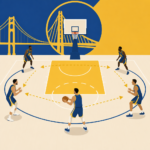
Most winning buzzer-beater inbound plays are built from a small family of structures. The first is the stack, often used on baseline out-of-bounds sets. Two or three players align close together, making it difficult for defenders to anticipate who is screening and who is cutting. Brad Stevens used stack actions effectively in Boston to free shooters with layered movement. The first cutter may sprint to the rim as a decoy, the second may flare to the corner, and the third may curl to the wing. The defense has to process multiple threats instantly.
The second common structure is the box set. With four players spread around the lane area, coaches can send cutters in opposite directions and create natural traffic. This shape is ideal when the offense wants to disguise the primary option until the last beat. A box can flow into a cross-screen for a big, a stagger for a shooter, or a quick slip if defenders jump to the obvious route. Because each player starts from a balanced spot, the offense can also pivot into counters without destroying spacing.
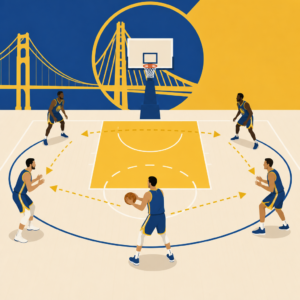
The third structure is screen-the-screener, a staple because it punishes defenders who ball-watch. One player sets a screen, then immediately receives a screen from a teammate and pops into space. Golden State has long used this principle because Stephen Curry and Klay Thompson draw panic help, which opens the second cut. Another staple is the elevator concept, where two screeners close a gate around a shooter cutting between them. It works best when timing is exact and the shooter can rise instantly on the catch.
| Structure | Best use | Main strength | Common counter by defense |
|---|---|---|---|
| Stack | Baseline, under 3 seconds | Creates confusion with layered cuts | Switching and top-locking the shooter |
| Box | Sideline or baseline, multiple options | Balanced spacing for decoys and counters | Blowing up timing with physical denial |
| Screen-the-screener | Need a catch-and-shoot look | Forces late communication | Pre-switching and switching both screens |
| Lob setup | 0.3 to 1.2 seconds near the rim | Removes need for a dribble | Fronting the target and weak-side rim help |
How timing, spacing, and decoys turn a diagram into a shot
A play call is only as good as its timing. Coaches teach these actions in counts: first cut clears at one, screen lands at two, primary target breaks at three, emergency release comes at four. When the rhythm is off, defenders recover. I have seen a beautiful set fail because the decoy cutter jogged instead of sprinting, allowing his defender to tag the real option. In last-second situations, speed and commitment matter more than surprise alone. Every cut must sell a credible scoring threat.
Spacing is just as critical. If two offensive players drift too close, one defender can guard both. If a shooter catches inside the arc with no room to pivot, a good action still produces a bad attempt. Coaches often mark exact landing spots in practice: corner above the break, slot at twenty-eight feet, dunker spot outside the lane. Those landmarks preserve passing lanes and prevent accidental congestion. The best late-game offenses look free because the geometry has been rehearsed until it feels instinctive.
Decoys are what separate advanced play design from simple route running. The first option is often not intended to score; it is intended to move the best helper, occupy the shot blocker, or force a switch rule to activate. A classic example is using the star as a decoy. Defenses load toward famous closers, so a hard sprint by that star can drag two defenders away from a weak-side shooter. Teams with elite gravity exploit this constantly. Miami under Erik Spoelstra has repeatedly used star attention to free a secondary option for the actual shot.
Coaches also script what happens if the first read is denied. Good out-of-bounds offense has an outlet, then a reset, then a broken-play principle. If the shooter is top-locked, the cut becomes a backdoor. If the lane is clogged, the screener slips out for space. If everything stalls, the inbounder must know which teammate can catch safely and create with one bounce. These are not improvised in the huddle. They are installed as part of the package, because late-clock panic usually rewards the prepared defense.
How offenses attack specific defensive coverages
Elite coaches do not call plays in a vacuum; they call them against expected coverages. If the defense switches everything, the offense can bunch players to create confusion, force two defenders onto one cutter, or slip the screener early before contact. If the defense top-locks a shooter to prevent him from using a screen, the answer is often a back cut to the rim. If the defense zones up the paint, coaches may send a cutter through first just to pin the low man before the real target flashes open.
Against aggressive denial, the inbounder’s fake becomes part of the scheme. A quick look to the corner can freeze the defender guarding the wing. Against teams that put a long athlete on the ball, offenses sometimes use the biggest passer available to negate deflections. Some staffs also target poor communicators. In film preparation, assistants identify which defenders are late on exchange calls or tend to open their stance the wrong way. The final play may be drawn to force that specific player into the decision point.
Foul strategy changes everything. If the defense has a foul to give, the offense must avoid slow-developing actions because any catch can be disrupted before the shot. In that case, coaches often prefer a direct lob, an immediate catch-and-shoot, or a movement pattern that makes the foul costly near the release. Conversely, if the offense knows the defense is terrified of fouling, cutters can use sharp stops and sudden changes of direction to exploit that hesitation. Understanding the whistle environment is part of end-game design.
Famous examples and what they teach
One of the most instructive examples is the 2013 playoff baseline set that freed Chris Bosh for a jumper against San Antonio. The action worked because Miami used initial movement to occupy help defenders, then delivered the pass to a reliable midrange shooter in rhythm. Another classic is Derek Fisher’s 0.4 shot in 2004. With only four-tenths available, the design had to produce a catch-and-release with no extra motion. That play remains a benchmark for understanding how little time is needed if the pass location and footwork are perfect.
At the college level, Villanova’s championship-winning set for Kris Jenkins in 2016 is frequently cited because it blended transition flow with after-timeout precision. The key lesson was not merely the final open three; it was the decision to trust practiced spacing and a trailing shooter rather than force the ball to the biggest name. In the NBA, Toronto’s use of stacked screening actions under Nick Nurse often demonstrated the same principle: make the defense guard multiple decisions, and the eventual opening may belong to the second or third option.
These examples show that buzzer-beater success is rarely random. It comes from matching clock to action, personnel to role, and deception to defensive habit. The best coaches are not searching for magic. They are solving a constrained problem with disciplined details.
Why this strategy matters across NBA analysis
Last-second inbound plays are a gateway to wider basketball strategy because they compress the sport into one possession. They reveal how a coach values spacing, shooting gravity, screening angles, mismatch hunting, and risk management. They also connect to lineup construction. A roster with one elite shooter, one smart screener, one accurate passer, and one vertical lob threat gives a coach far more late-game flexibility than a roster built only on isolation scoring. That is why teams study these moments so intensely throughout the season.
For anyone building a broader understanding of NBA analysis, this subtopic acts as a hub. It links naturally to film study, late-game decision-making, defensive communication, timeout usage, and player archetypes. Watch enough final possessions and patterns emerge: the same coaches return to familiar structures, stars influence plays even as decoys, and the smallest timing edge can decide outcomes. If you want to evaluate coaching sharply, start with the final play package, then follow how those principles appear in the rest of the offense. Rewatch a week of close finishes, chart the sets, and the strategic logic becomes impossible to miss.
Frequently Asked Questions
What makes a last-second inbound play so difficult to execute in basketball?
Last-second inbound plays are difficult because they compress decision-making, timing, spacing, and execution into just a few seconds, usually against a defense that is fully prepared for what is coming. Unlike a normal half-court possession, there is no time to recover from a small mistake. If one cutter leaves early, if one screener is a step out of position, or if the inbounder hesitates for even a moment, the play can collapse before the ball is ever released. The defense also has a major advantage in awareness. Everyone in the gym knows the offense wants a quick, high-quality shot, so defenders can load up on likely options, switch aggressively, deny star scorers, and force the inbounder to make a difficult pass under pressure.
The challenge is also shaped by the exact game situation. The location of the inbound, whether on the baseline or sideline, changes passing angles and the number of realistic options. The amount of time remaining determines whether the offense needs a catch-and-shoot, a catch-and-dribble move, or a quick touch to the rim. Score margin matters too. A team down one may prioritize a direct attack to the basket, while a team down three may need a clean perimeter look immediately. Coaches must account for all of this while predicting how the defense will react. That is why buzzer-beater plays often look simple on television but are actually the product of layered planning, counters, and precise communication.
How do coaches decide which player should take the final shot on an inbound play?
Coaches do not simply choose the best scorer and tell everyone else to clear out. In a true last-second inbound situation, the best option is often the player most likely to get open cleanly, catch the ball on balance, and release quickly under pressure. That may be the team’s star, but not always. Coaches study personnel, defender matchups, the shooting ability of each player from specific spots on the floor, and how comfortable certain players are with catch-and-shoot timing versus catch-and-drive decisions. A great late-game target is not just someone who can make a tough shot, but someone who can create a makeable shot in a crowded, scripted moment.
Just as important, coaches think in terms of primary, secondary, and tertiary options. The star might be used as a decoy to pull the defense, while a second shooter curls into space for the real attempt. A big man might set the key screen and then slip to the rim if defenders overplay the perimeter. Coaches also consider who can make the inbound pass. A smart, tall inbounder with vision can dramatically improve the chances of success, so sometimes a team’s best scorer stays on the floor as a receiver while another trusted player handles the pass. In the best-designed late-game sets, the final shot goes not merely to the most famous player, but to the player whose route, timing, and matchup give the offense the cleanest possible opportunity.
Why are screens, decoys, and spacing so important in buzzer-beater inbound plays?
Screens, decoys, and spacing are the backbone of successful inbound offense because the defense is trying to deny the first pass before the play can even begin. Without structure, defenders can simply top-lock shooters, switch freely, and sit on obvious routes. Screens create momentary separation, which is often all that is needed in a last-second situation. A single well-timed pin-down, cross-screen, or elevator action can free a shooter for half a step, and half a step is enough for a catch-and-shoot opportunity at the buzzer. Good spacing then turns that brief advantage into a usable shot by giving the receiver room to catch, square, and release.
Decoys matter because defenses are trained to overreact to stars and familiar late-game patterns. Coaches use that instinct against them. A leading scorer may sprint off a screen as if the play is designed for a corner three, only to draw two defenders and open a slipping screener at the rim. Likewise, a player who begins the action near the ball can pull attention away from a weak-side cutter arriving late into the real target area. Spacing ties all of it together by preventing defenders from helping too easily. If offensive players are bunched together, the defense can guard multiple actions with one rotation. If they are spread with purpose, help defenders must cover more ground, and every switch becomes harder. In short, the best inbound plays are not random improvisations; they are carefully staged sequences built to manipulate defensive eyes and create one narrow window for a clean shot.
How does the amount of time left change the design of a last-second inbound play?
Time on the clock changes everything about the play call. With under one second remaining, the offense usually needs a direct catch-and-shoot or tip attempt because there is no time to gather, dribble, or make a second move. In that situation, coaches design actions that free a player moving toward the ball or the rim, often using quick screening angles to produce immediate separation. When there are one to two seconds left, the offense can still prioritize a catch-and-shoot, but it may also have room for a quick turn, one-dribble pull-up, or fast attack into the lane depending on the player receiving the ball. As the clock stretches to three or four seconds, the playbook expands significantly. Now the offense can include a reversal, a handoff, or a designed drive after the inbound, which means the defense has more to worry about.
Coaches also think about how time affects shot quality versus shot security. With almost no time left, simply getting the ball to a capable shooter may be enough. With a little more time, the offense can demand a better look and build in counters if the first option is covered. The timeout huddle often includes very specific instructions tied to the clock: catch and rise immediately, catch and drive middle, or if nothing is there, throw to the safety valve. Elite coaches teach players to understand these time-based rules instinctively, because confusion over whether there is time to dribble or pass can ruin the possession. In close games, that awareness is often the difference between a composed finish and a rushed, low-percentage attempt.
What do great coaches emphasize when drawing up a game-winning inbound play?
Great coaches emphasize clarity, simplicity under pressure, and answers for likely defensive reactions. Even the most creative late-game design must be executable by tired players in a loud arena with the season’s biggest moment on the line. That means the instructions have to be clear: where each player starts, what screen is being set, who the first option is, where the release valve stands, and what the inbounder should do if the initial read is denied. The best coaches are excellent teachers in these moments. They do not just call a play; they explain the timing, the spacing, and the specific read that unlocks the action.
They also prepare for counters. If the defense switches everything, the coach may build in a slip to the rim. If the opponent face-guards the star, the play may turn that pressure into a back-screen opportunity for someone else. If the inbounder is heavily pressured, there may be a safety pass to avoid a five-second violation. Great late-game coaches understand that a buzzer-beater is rarely about drawing a magical line on a whiteboard. It is about organizing players around a high-percentage idea, anticipating the defense’s best response, and giving the team a calm, repeatable structure in a chaotic moment. That is why some coaches develop reputations for late-game excellence: they consistently combine tactical creativity with practical execution, and their teams know exactly what they are trying to accomplish when the final possession arrives.