
Kareem Abdul-Jabbar career history is the story of how one player connected multiple NBA eras, defined winning across two franchises, and built a standard for longevity that still shapes discussions about basketball greatness. As the central hub for NBA History coverage on legends and eras, this guide explains the full arc of Abdul-Jabbar’s rise, from his transformation from Lew Alcindor into a cultural force, to the skyhook that became the league’s most reliable signature shot, to the six championships and twenty seasons that made him one of the sport’s foundational figures. When people ask why Kareem matters, the answer is simple: he excelled in every major category that defines a legend, including production, efficiency, team success, durability, and influence.
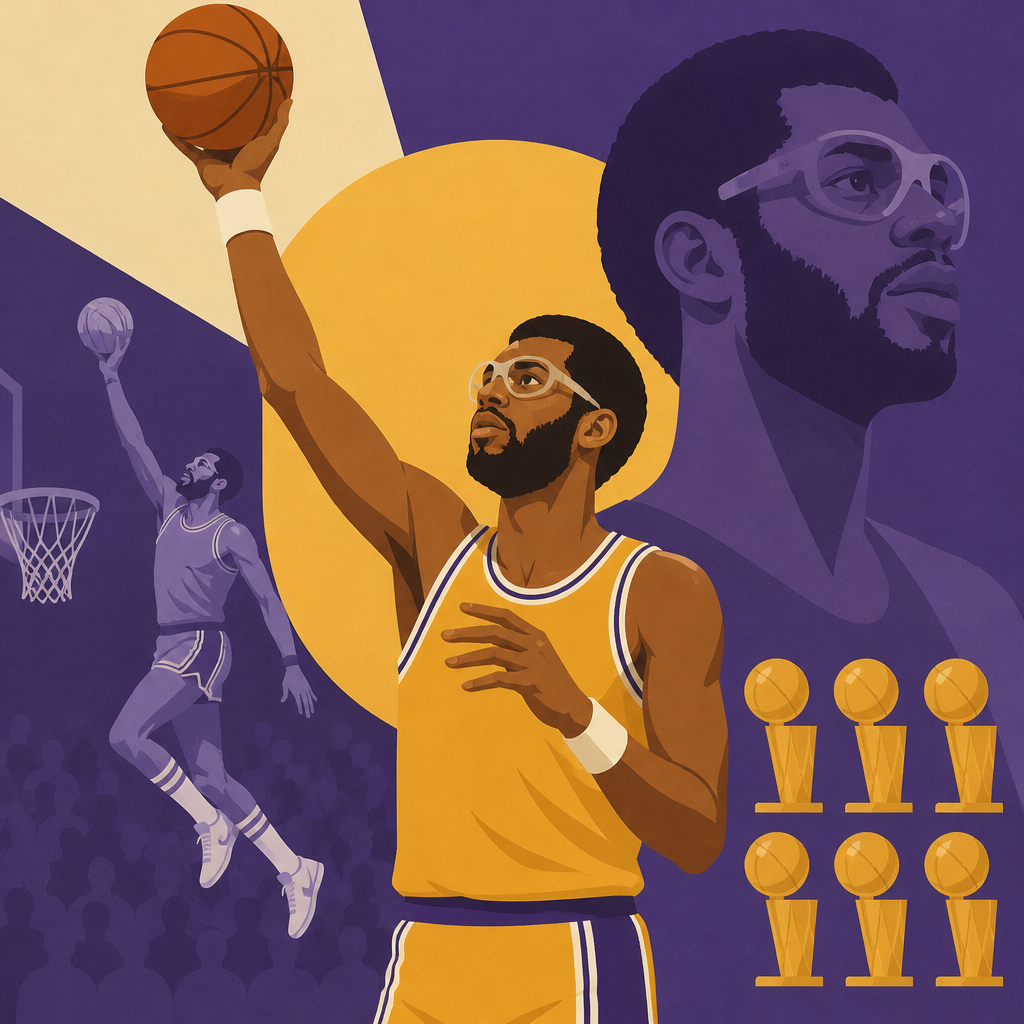
Any serious review of legends and eras begins with context. Abdul-Jabbar played from 1969 to 1989, a span that crossed the end of the Russell-Wilt age, the rise of the 1970s big men, the ABA-NBA merger period, and the television-fueled explosion of the 1980s. He won Rookie of the Year, six Most Valuable Player awards, six NBA titles, two Finals MVPs, and retired as the league’s all-time leading scorer with 38,387 points, a record that stood for nearly four decades. Those achievements are not isolated milestones. They show sustained dominance through rule changes, stylistic shifts, coaching changes, and radically different supporting casts. In practical terms, Kareem was elite with Milwaukee’s power game and equally essential to the fast-breaking Showtime Lakers.
Defining key terms helps explain his place in NBA history. The skyhook was a one-handed sweeping hook shot released high above defenders, usually off one leg, creating angle, touch, and near-impossible contest conditions. Longevity means more than playing a long time; it means remaining productive, durable, and strategically valuable deep into a career. Dominance means controlling outcomes on both ends, not merely posting large scoring totals. Abdul-Jabbar checked all three boxes. I have always found that when you study his film closely, the most striking detail is not just that he scored so much, but how repeatable his scoring process was. He got to preferred spots, read help defenders early, and punished coverage with calm precision.
From Lew Alcindor to Kareem Abdul-Jabbar: the making of a legend
Before his NBA career began, Abdul-Jabbar had already become one of basketball’s most decorated players. At Power Memorial Academy in New York, he turned high school games into national events. At UCLA under John Wooden, he led the Bruins to three national championships and was so dominant that the NCAA banned the dunk for a period, a rule widely understood to be a response to his physical advantage. That detail matters because it demonstrates a recurring theme in his career: when opponents or institutions tried to reduce his strengths, he adapted with skill. The refinement of touch, footwork, and timing that later defined the skyhook was shaped by those early adjustments.
Selected first overall by the Milwaukee Bucks in 1969, he changed the franchise almost immediately. The Bucks had won 27 games the previous season. With Alcindor as a rookie, they jumped to 56 wins. That kind of single-player impact is rare in any era. By his second season, paired with Oscar Robertson, he led Milwaukee to the 1971 championship over the Baltimore Bullets and won both league MVP and Finals MVP. He averaged 31.7 points per game that season, confirming that his college dominance would translate fully against NBA size and speed. In 1971, there was no mystery about who the best young big man in basketball was.
His name change and religious conversion are inseparable from his public identity. In 1971 he adopted the name Kareem Abdul-Jabbar after converting to Islam. For NBA history, that moment matters beyond biography. It reflects the way athlete influence expanded during the 1970s, as stars increasingly asserted control over identity, speech, and image. In an era often simplified as a bridge between the 1960s and the Magic-Bird revival, Kareem stands as one of the defining cultural figures. He was not merely a scorer and rebounder; he was an intellectual public figure navigating race, faith, media expectations, and the burdens of superstardom.
The skyhook: why it became the most unguardable shot in basketball
The skyhook is the signature skill most closely tied to the Kareem Abdul-Jabbar career, and it deserves precise explanation. Unlike a standard jump hook, Kareem’s version created separation with body angle, long reach, and a high release point that often began with his back or side to the basket. He used either shoulder, though he was most associated with the right-handed version sweeping toward the lane. The shot was difficult to block because defenders had to beat his footwork before the release, then extend through his frame and length while maintaining legal position. Even elite rim protectors usually arrived a fraction late.
Its effectiveness also came from repetition and counters. Kareem set up the skyhook with drop steps, baseline spins, face-up looks, and quick seals in transition. If a defender sat on the middle, he could hook baseline. If help came early, he passed out cleanly. If teams fronted the post, he used his wingspan to catch over the top. In film study, the beauty of the move is how little wasted motion it contained. Every part of it, from the pivot to the arm extension to the soft wrist finish, served a practical purpose. That efficiency is why the shot aged so well as his athleticism changed.
| Element | Why it mattered | Game impact |
|---|---|---|
| High release point | Used elite reach and timing to avoid blocks | Made contests ineffective even from tall centers |
| Body shielding | Kept defenders behind his shoulder and hip | Created clean shooting angles in traffic |
| Either-block versatility | Worked from left or right low post positions | Reduced predictable scouting tendencies |
| Soft touch | Allowed bank or direct-rim finishes | Maintained efficiency under pressure |
| Counter options | Paired with spins, passes, and quick seals | Punished double teams and overplays |
Many great players have iconic moves, but very few build an entire championship offense around one foundational shot for two decades. That is what separates Kareem. The skyhook was not a novelty; it was a strategic system. Coaches could feed him late in games, on second-side action, after cross screens, or in semi-transition and trust that he would generate a quality possession. Even when the Lakers evolved into a faster team with Magic Johnson orchestrating the break, the skyhook remained their half-court anchor. His famous junior skyhook in Game 4 of the 1985 Finals against Boston is remembered because it distilled a career of technical mastery into one decisive moment.
Milwaukee dominance and the path to a first championship
Abdul-Jabbar’s Milwaukee years are sometimes overshadowed by his later fame in Los Angeles, but they are essential to understanding his peak. From 1969-70 through 1974-75, he was already one of the most dominant players the league had ever seen. He won three MVP awards as a Buck and routinely posted scoring and rebounding numbers that drove elite team performance. The 1971 title run showed how quickly a franchise could be transformed by a generational center. Milwaukee finished 66-16, swept the Bullets in the Finals, and looked every bit like a dynasty in progress.
His partnership with Oscar Robertson was especially important. Robertson brought pace control, decision-making, and veteran stability. Kareem brought interior scoring, rim protection, and relentless efficiency. Their styles fit because Robertson understood how to feed the post without disrupting team structure. For readers exploring legends and eras, this duo illustrates a broader NBA history lesson: great centers often reach full effect when paired with elite perimeter organizers. Russell had Cousy and later Havlicek-led systems, Shaq had Kobe and Wade, and Kareem had Oscar first, then Magic later. Dominant big men change games, but the best dynasties pair them with high-level playmaking.
Even his 1974 Finals loss to the Boston Celtics adds important context. Milwaukee pushed a strong Boston team to seven games, and Kareem produced one of the most famous shots in Finals history with a double-overtime skyhook in Game 6. The series showed his brilliance but also the limits of one superstar against a deeper, more balanced opponent. That tradeoff would resurface throughout the 1970s. He remained the league’s most consistent force, yet roster instability and franchise circumstances complicated title runs. This is one reason raw ring counting can miss the reality of a player’s impact.
The Lakers years: Showtime, adaptation, and five more rings
After requesting a trade, Abdul-Jabbar arrived in Los Angeles in 1975. The move reshaped league history. Early Lakers seasons were productive but uneven, largely because the roster had not yet become a title machine. Kareem still won MVP awards in 1976 and 1977, proving his individual standard had not slipped. The full transformation came in 1979 when the Lakers drafted Magic Johnson. With Magic pushing tempo, creating early offense, and elevating everyone around him, Abdul-Jabbar gained the perfect late-career partner. Their collaboration became one of the defining engines of the 1980s NBA.
The 1980 Finals remain a crucial chapter. Kareem dominated the series against Philadelphia, averaging 33.4 points, 13.6 rebounds, and 4.6 blocks, but an ankle injury kept him out of the clinching Game 6. Magic’s famous start at center and 42-point masterpiece became the headline, yet the Lakers do not reach that point without Kareem controlling the series. This is a useful reminder when studying legends and eras: narrative attention and actual value do not always align. Abdul-Jabbar was the Lakers’ best player that postseason, even if the iconic image belonged to his rookie teammate.
Los Angeles won additional titles in 1982, 1985, 1987, and 1988. What stands out is how Abdul-Jabbar adapted each time. In the early 1980s, he was still a primary scoring star. By the mid and late 1980s, he was more selective but still devastating in key possessions. Pat Riley’s Lakers used him as a stabilizer when pace slowed and defenses tightened. Against Boston in 1985, he answered criticism from the 1984 Finals with a brilliant series and won Finals MVP at age 38, still the oldest player to do so. That award was not sentimental. It reflected command, timing, and two-way intelligence at the highest stage.
How Kareem compares across NBA legends and eras
Placing the Kareem Abdul-Jabbar career within the broader map of NBA legends requires comparison without distortion. Against Wilt Chamberlain, Kareem had less raw statistical shock but more sustainable championship translation across different rosters. Against Bill Russell, he had greater scoring volume and offensive versatility, while Russell maintained unmatched defensive leadership and team title count. Against Shaquille O’Neal, Kareem was less physically overwhelming but more durable and technically adaptable over time. Against Michael Jordan and LeBron James, he offers the strongest case for a big man as an all-era candidate because he combined peak value with extreme longevity and elite team success.
His six MVP awards remain the most in league history. That matters because MVP voting reflects how contemporaries understood value in real time. He was not honored once in a brief peak and then carried by reputation. He won across multiple roster contexts and strategic environments. He also made 19 All-Star teams and 15 All-NBA teams, evidence of how long he stayed near the top of the league. Modern analytics strengthen rather than weaken his case. While advanced metrics are incomplete for earlier decades, available efficiency data, win shares estimates, and on-off logic all support the eye test: Kareem reliably improved elite teams at both ends.
For the NBA History hub on legends and eras, Kareem also works as a connective figure. Study him, and you can branch into the Knicks and Bucks of the early 1970s, the post-merger talent boom, the Celtics-Lakers rivalry, Magic Johnson’s playmaking revolution, and the changing role of the center. His career is effectively a timeline of the modern league’s first twenty years after the 1960s. Few players serve as a better gateway for readers who want one biography that opens into multiple eras, rivalries, and tactical evolutions across basketball history.
Longevity, leadership, and the legacy that still shapes the NBA
The final reason the Kareem Abdul-Jabbar career remains central to NBA history is longevity with purpose. He did not simply last twenty seasons; he stayed useful, efficient, and feared. In his final season, he was 41 years old and still a starting center on a Finals team. That is exceptional workload management before modern sports science became standard. He maintained value through conditioning, economy of movement, technical excellence, and a clear understanding of role. In an age now obsessed with career length, his example remains one of the clearest proofs that skill development can preserve greatness longer than raw explosiveness alone.
His legacy also extends beyond the court. He became an author, essayist, and public intellectual whose influence broadened what basketball stardom could look like. For younger fans, he can be reduced to statistics or highlight clips. That misses the full picture. Kareem helped define the serious athlete as thinker, advocate, and historian of the game itself. Inside basketball, his fingerprints are everywhere: in post footwork clinics, in discussions of all-time rankings, in every debate about whether peak or longevity matters more, and in every comparison involving great centers from Hakeem Olajuwon to Nikola Jokic.
Kareem Abdul-Jabbar career analysis ultimately leads to one clear conclusion: very few players have ever matched his combination of skill, production, championships, and durability. The skyhook gave him a weapon nobody solved. The six rings proved he could lead and adapt within different title formulas. The twenty seasons of dominance showed that greatness is not a moment but a sustained standard. If you are building a deeper understanding of NBA History, start here, then continue through the connected stories of rival dynasties, transformational superstars, and the eras Kareem helped define. That is how you see his place clearly: not just as a legend, but as one of the pillars of the league.
Frequently Asked Questions
Why is Kareem Abdul-Jabbar’s career considered one of the most important in NBA history?
Kareem Abdul-Jabbar’s career is considered one of the most important in NBA history because it combines elite performance, historic longevity, cultural significance, and sustained winning across multiple eras. He entered the league in 1969 after a dominant amateur career and immediately changed the balance of power in professional basketball. As the former Lew Alcindor, he arrived with enormous expectations, then exceeded them by becoming the centerpiece of championship teams in both Milwaukee and Los Angeles. That alone would make his résumé exceptional, but Kareem’s impact goes much deeper.
He was the rare superstar who bridged generations. He won titles in the 1970s and 1980s, played against legends from different basketball ages, and remained productive long after most big men declined. His six NBA championships, six MVP awards, 19 All-Star selections, and all-time scoring record that stood for decades reflect not just greatness, but durability and adaptability at a level few players have ever matched. He could dominate as a physically overwhelming force in his younger years and then evolve into a more technical, efficient veteran who still anchored elite teams.
Just as important, Kareem represented more than box score dominance. His transformation from Lew Alcindor into Kareem Abdul-Jabbar marked a profound personal and cultural statement during a period of major social change in America. He became one of the league’s most intellectually serious and socially aware figures, showing that a basketball icon could also be a public thinker and cultural force. When people discuss the greatest careers ever, Kareem’s name stays near the top because his story includes nearly every category that defines historical importance: individual excellence, team success, innovation, longevity, and influence beyond the game.
How did the skyhook make Kareem Abdul-Jabbar so dominant for so long?
The skyhook was the signature weapon that made Kareem Abdul-Jabbar nearly impossible to defend and allowed him to remain effective deep into his 40s. Unlike many star scorers whose games relied heavily on explosion, speed, or brute force, Kareem built his offensive dominance around skill, touch, timing, footwork, reach, and repetition. The skyhook was not just a memorable shot; it was one of the most reliable and unguardable scoring moves in basketball history.
What made it so devastating was the combination of Kareem’s size and mechanics. At over seven feet tall with extraordinary length, he released the ball high above defenders, often from angles that made contests almost meaningless. Even elite shot blockers struggled to affect it because the shot began from a balanced post position, flowed into a sweeping one-handed release, and finished with soft touch off the fingers. It could be used over either shoulder depending on the situation, and Kareem was disciplined enough to execute it consistently under pressure.
The skyhook also aged well, which is a major reason his dominance lasted 20 seasons. Athleticism tends to fade, but refined technique travels. As Kareem got older, he did not need to reinvent himself because his most effective weapon was already built for longevity. Defenses knew it was coming and still had trouble stopping it. That kind of predictable yet unstoppable excellence is the mark of an all-time great signature move. In many ways, the skyhook symbolizes Kareem’s entire career: elegant, efficient, deeply practiced, and almost impossible to solve.
What were the biggest differences between Kareem’s years with the Bucks and his years with the Lakers?
Kareem’s time with the Milwaukee Bucks and Los Angeles Lakers represents two different but equally important chapters of his career. In Milwaukee, he was the immediate franchise-changing centerpiece. The Bucks drafted him first overall in 1969, and he quickly turned a young team into a champion. Paired with Oscar Robertson, Kareem led Milwaukee to the 1971 NBA title and established himself as the most dominant interior force in the league. His Bucks years were defined by peak individual control, statistical dominance, and his emergence as the NBA’s premier big man.
During that period, he was often the unquestioned focal point of everything his team did. He won MVP awards, controlled games on both ends, and played with the force of a player entering his athletic prime. Milwaukee Kareem is sometimes slightly overlooked because it came before the bright spotlight of Showtime, but those seasons are central to understanding how overwhelming he was at his absolute peak. He was not simply productive; he was transformational.
With the Lakers, Kareem’s career became broader, longer, and even more historically visible. After arriving in Los Angeles in 1975, he continued to post elite numbers and eventually became the anchor of one of the most famous dynasties in sports. His Lakers years included five championships and a partnership with Magic Johnson that helped define 1980s basketball. This version of Kareem was still dominant, but he also became more adaptive. He played in a faster, more public, more star-driven environment and learned how to thrive within a team identity that evolved over time.
The key difference is that Milwaukee showcased Kareem as the singular unstoppable force at the center of a rising contender, while Los Angeles displayed his ability to sustain greatness, share the stage with other stars, and keep winning across a much longer arc. Together, those two franchise chapters show the full range of his career: first the apex superstar, then the enduring championship pillar.
How did Kareem Abdul-Jabbar win six championships across such a long span of time?
Kareem Abdul-Jabbar won six championships because he combined elite talent with remarkable adaptability, discipline, and basketball intelligence. His first title came with the Milwaukee Bucks in 1971, early in his career, when he was already one of the most dominant players in the league. That championship reflected his raw peak as a two-way force who could overwhelm teams with scoring, rebounding, rim protection, and control of tempo.
His later five championships with the Los Angeles Lakers came in a different context and prove a different kind of greatness. By the 1980s, Kareem was no longer just a physically dominant young center; he had become a master technician and veteran leader. He understood spacing, timing, matchups, and how to conserve energy for the biggest moments. On a Lakers team loaded with talent, he remained essential because he could still score efficiently in the half court, protect the paint, rebound, and provide stability in playoff basketball.
Another major factor was his ability to fit into changing team structures without losing his value. Some stars decline when they are asked to share responsibility, but Kareem’s game translated beautifully alongside playmakers, wings, and transition-heavy offenses. His partnership with Magic Johnson is the clearest example. Magic elevated the pace and creativity of the Lakers, while Kareem gave the team structure, interior scoring, and dependable execution when games tightened.
Winning across two decades is never accidental. It requires health, preparation, resilience, and a game built to survive shifting styles. Kareem had all of that. His six rings are not just evidence of being on strong teams; they are evidence that he was the kind of player strong teams could build around for an exceptionally long time. That is why his championship résumé remains one of the most respected in basketball history.
What is Kareem Abdul-Jabbar’s legacy when people debate the greatest basketball players ever?
Kareem Abdul-Jabbar’s legacy in greatest-of-all-time debates is that of a player whose case is almost impossible to dismiss if the standard includes peak value, longevity, individual awards, championships, and historical influence. Few players can match the totality of his accomplishments. He won six MVP awards, more than any player in NBA history. He won six championships. He was an elite college player before arriving in the NBA, then spent 20 professional seasons performing at an extraordinary level. For decades, he held the NBA’s all-time scoring record, which reinforced just how durable and productive he was over the long term.
What strengthens his GOAT case is that his greatness was not limited to one style or one era. He could dominate as the focal point of an offense, thrive in slower and faster systems, and remain elite as younger stars entered the league. He succeeded in the early 1970s, then remained a championship centerpiece in the 1980s. That kind of historical range matters because it shows his game was fundamentally scalable and timeless.
His legacy also includes the way he changed how people think about longevity. Before modern sports science became a major part of athlete development, Kareem had already shown that discipline, technique, conditioning, and intelligence could extend superstardom far beyond the usual curve. Today, whenever fans discuss players who combined prime dominance with extraordinary endurance, Kareem is one of the first names that comes up.
Ultimately, Kareem’s place in basketball history rests on both numbers and meaning. The numbers are overwhelming, but the broader legacy is just as important: he connected eras, authored one of the sport’s most iconic signature moves, won at the highest level in multiple contexts, and remained culturally significant beyond the court. That is why any serious debate about the greatest players ever has to treat Kareem Abdul-Jabbar not as a fringe inclusion, but as a central figure in the conversation.