
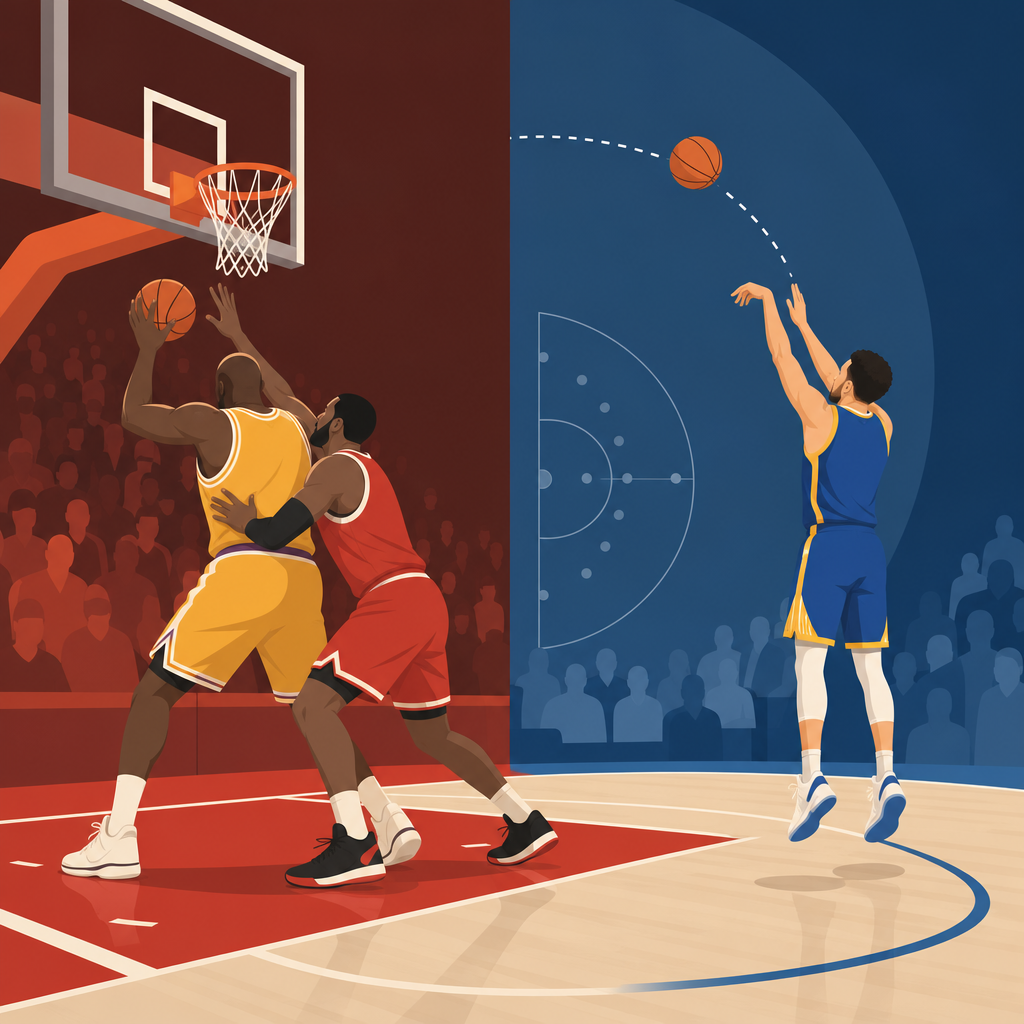
Inside vs outside basketball defines one of the biggest strategic shifts in NBA history: a long move from paint-first offense built on post play, offensive rebounding, and midrange shot creation to perimeter-oriented attacks built on spacing, three-point volume, and rim pressure. In league history, this change did not happen overnight, and it was not caused by one superstar or one rule tweak alone. It emerged through decades of tactical experimentation, roster evolution, analytics, and changes in how coaches valued efficiency. For anyone studying NBA history, this topic works as a hub because it connects era-defining questions about stars, systems, rules, player development, and front-office philosophy.
When people say inside basketball, they usually mean offenses centered on low-post touches, cuts into the lane, putbacks, and physical control near the basket. The classic examples are George Mikan’s early dominance, Wilt Chamberlain and Bill Russell battling around the rim, Kareem Abdul-Jabbar’s skyhook, Hakeem Olajuwon’s footwork, Shaquille O’Neal’s deep seals, and the bruising playoff style of the 1990s. Outside basketball, by contrast, emphasizes floor spacing, pull-up shooting, catch-and-shoot threes, pick-and-roll reads, and quick ball movement that stretches defenses horizontally. Stephen Curry is the clearest symbol, but the roots also run through Larry Bird, Reggie Miller, Steve Nash, Ray Allen, Mike D’Antoni, and the spread concepts that changed the geometry of the court.
This history matters because style shapes everything else. It affects which prospects teams draft, what skills young players train, how referees interpret contact, and how championships are built. It also explains why older fans talk about physical paint battles while newer fans discuss shot charts and spacing. The NBA did not simply abandon the interior; it redefined the value of each area on the floor. The modern game still prizes layups, dunks, and free throws, but it now reaches them through spacing and pace rather than constant back-to-the-basket play. Understanding that evolution helps explain every major era of league history, from the early center-led years to the current positionless game.
In my experience reviewing game film across eras, the most important insight is simple: the shift from inside to outside basketball was really a shift in decision-making. Teams learned that not all two-point shots were equal, not all post-ups created efficient offense, and not all jump shooting was low percentage if it came from behind the three-point line or from open actions. Once teams measured that truth consistently, the league changed fast.
The early NBA was built around size, territory, and control of the paint
For much of early league history, the paint was the center of offensive and defensive strategy because the sport itself rewarded proximity. Before the three-point line arrived in the NBA in 1979, long jumpers counted the same as short ones, making interior attempts inherently more valuable because they were converted at higher rates and produced more fouls. In the 1950s and 1960s, dominant big men shaped entire franchises. Mikan gave the Minneapolis Lakers a blueprint for playing through a center. Russell anchored the Celtics with defense, rebounding, and transition outlets. Chamberlain turned post scoring and paint finishing into an overwhelming force.
The rulebook also evolved in response to inside dominance. The lane was widened to reduce the advantage of huge centers camping near the basket. Offensive goaltending and defensive three-second interpretations reflected a league repeatedly trying to balance interior power with watchability. Even then, outside shooting existed, but mostly as a complement. Guards initiated offense, wings cut and spot-up from shorter distances, and half-court possessions often aimed to feed the block or generate a close-range attempt through patience and physicality.
By the 1970s, stars like Kareem and Bob McAdoo represented different forms of scoring skill, yet the interior still held the highest status. Kareem’s skyhook was technically a finesse shot, but it functioned as elite inside offense because it was created from deep position and impossible angles near the lane. The logic of the era was clear: establish the paint, control the glass, slow the game when needed, and force defenses to collapse.
The three-point line changed scoring math, but not immediately
The adoption of the three-point line in 1979 introduced the most important structural incentive in modern basketball, yet teams were slow to treat it as a primary weapon. Early NBA coaches often saw the shot as situational rather than foundational. In the first seasons after adoption, teams attempted only a handful of threes per game. The idea of building an offense around them seemed reckless because shooting percentages were lower, spacing concepts were underdeveloped, and many rosters lacked specialists trained for high-volume range shooting.
Still, the line gradually changed player value. Chris Mullin, Dale Ellis, Craig Hodges, and later Bird and Miller showed that range could bend defenses before the analytics era had language for expected value. Bird was especially influential because he combined elite shooting with playmaking and late-game control, proving that perimeter excellence could be central to winning basketball rather than decorative skill. Miller then weaponized movement shooting, sprinting through screens to punish defenders even when he touched the ball for only seconds.
The ABA had already demonstrated that the three-pointer could energize offense and widen the floor, but the NBA remained conservative for years. Coaches were partly rational: the average roster did not yet have four or five credible shooters, and defenses could still load the paint against stars. The line offered new math, but the personnel pipeline and tactical imagination required time to catch up.
The 1980s and 1990s balanced perimeter stars with interior power
Many fans remember the 1980s as a fast-break decade, but half-court identity still depended heavily on interior creation. Magic Johnson’s Lakers ran in transition, yet Kareem remained a half-court anchor. The Celtics used Bird’s shooting and passing, but Kevin McHale and Robert Parish did huge amounts of work inside. The Pistons, Knicks, Rockets, Spurs, and Jazz all leaned on post touches, paint protection, and rebounding as playoff necessities. Michael Jordan transformed perimeter scoring, but even his Bulls won titles with triangle principles that emphasized post entries, cuts, and mid-post creation for Jordan and Scottie Pippen.
In the 1990s, expansion, slower pace, and rugged defensive schemes pushed the league toward grind-it-out possessions. Illegal defense rules at the time limited zone concepts, which meant isolation and post play were often the cleanest ways to attack. Hakeem’s Rockets surrounded him with shooters in ways that now look modern, but the offense still began with his post gravity. Shaq’s Lakers overwhelmed teams by forcing double-teams on the block. Patrick Ewing, David Robinson, Karl Malone, Alonzo Mourning, and Charles Barkley all represented versions of interior leverage.
This era is important because it shows the league did not choose between inside and outside in absolute terms. The best teams already used both. What changed later was not the existence of perimeter play, but the proportion of possessions devoted to it and the efficiency standards used to judge every shot.
Rule changes, analytics, and player development accelerated the move outward
The modern shift took shape in the 2000s and became undeniable in the 2010s. Several forces combined. First, the NBA removed illegal defense restrictions in 2001, allowing more zone principles and stronger help positioning. That made static post-ups less efficient because defenses could crowd stars earlier and recover smarter. Second, hand-checking restrictions in 2004 gave ball handlers and quick guards more freedom, increasing the value of perimeter creation. Third, analytics departments quantified what sharp coaches already suspected: shots at the rim and open threes generally produced better expected returns than contested long twos.
Mike D’Antoni’s Phoenix Suns became a major turning point. Steve Nash orchestrated spread pick-and-roll, Amar’e Stoudemire pressured the rim, and shooters occupied help defenders. The Suns did not invent pace or spacing, but they turned those ideas into a sustainable identity. Later, the Houston Rockets under Daryl Morey pushed shot selection even further, prioritizing layups, free throws, and threes while minimizing midrange attempts. Not every team copied the model perfectly, but the league absorbed the core lesson.
| Era | Primary Offensive Focus | Typical Shot Profile | Representative Teams |
|---|---|---|---|
| 1950s–1970s | Post play and paint control | Close twos, putbacks, hook shots | Lakers, Celtics, Bucks |
| 1980s–1990s | Balanced inside scoring with selective perimeter threats | Post-ups, midrange, limited threes | Lakers, Celtics, Bulls, Rockets, Jazz |
| 2000s | Pick-and-roll growth and spacing experiments | Rim attempts, midrange, rising threes | Suns, Mavericks, Spurs |
| 2010s–present | Spacing, three-point volume, rim pressure | Threes, layups, free throws | Warriors, Rockets, Celtics, Nuggets |
Player development also changed. Big men started learning guard skills earlier, while guards trained pull-up shooting off the dribble. International influence mattered too. Dirk Nowitzki normalized the shooting big. Stretch forwards and stretch fives pulled rim protectors away from the basket. By the time youth basketball embraced skill training for all positions, the league had a steady supply of players suited for outside-oriented systems.
The Warriors turned outside basketball into a championship model
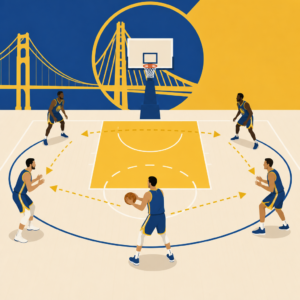
Golden State did not invent perimeter offense, but the Warriors proved it could anchor a dynasty without sacrificing defense. Curry’s unprecedented shooting range forced defenses to pick him up far beyond the arc. Klay Thompson added movement shooting and instant scoring bursts. Draymond Green operated as a short-roll playmaker, connecting screening, passing, and defensive versatility into one system. Under Steve Kerr, the Warriors paired three-point volume with cutting, screening, and elite decision-making, preventing the common mistake of treating outside basketball as simple chucking.
Their greatness came from geometry. When Curry moved without the ball, defenders stretched farther than ever before. That created driving lanes, slips to the rim, and back cuts that functioned like layup generators. In other words, the Warriors were an outside team that still dominated the inside by creating cleaner access to it. This distinction matters historically. The best perimeter offenses do not reject the paint; they manipulate defenses so the paint opens on favorable terms.
Other contenders adapted in different ways. The Cleveland Cavaliers used LeBron James as a downhill engine with shooters spaced around him. The Boston Celtics built five-out structures that let nearly anyone attack a closeout. The Denver Nuggets, with Nikola Jokić, fused old and new basketball by using a center as the league’s smartest passing hub, creating both interior efficiency and perimeter quality. Modern league history is full of hybrids, not pure types.
What was gained, what was lost, and why the debate still matters
The shift from inside to outside basketball improved offensive efficiency and widened the range of viable stars. Smaller guards and multipositional wings gained more influence because spacing increased the value of ball handling, passing, and shooting. Team offenses became harder to guard when every player could pass, dribble, or shoot. Comebacks also became more common because three-point variance allows quicker scoring swings.
Still, some tradeoffs are real. Fans who prefer classic post play miss the physical duel of low-block scoring and the stylistic variety of big-man counters. When too many teams imitate the same shot chart without equal skill, games can feel repetitive. Analytics can be misapplied if teams treat all midrange shots as bad, even though elite creators like Kevin Durant, Devin Booker, Kawhi Leonard, and Jokić still punish defenses from that area. The lesson of league history is not that one zone of the floor is always superior. The lesson is that efficiency depends on who is shooting, what advantage created the shot, and how the defense is forced to react.
That is why this hub topic sits at the center of NBA history. It links rule changes, player archetypes, coaching trees, front-office thinking, and championship identity across eras. If you want to understand the early dominance of centers, the rise of Bird and Miller, the triangle Bulls, the Nash Suns, the Morey shot-profile revolution, or the Curry-era Warriors, you are really studying the same long argument about where offense should begin and how defenses can be stretched.
The NBA’s move from the paint to the arc was not a rejection of old basketball but a refinement of it. The league learned that space creates better drives, better passing angles, and more efficient scoring than crowding the block on every trip. Yet the interior still decides outcomes, because layups, rebounds, rim protection, and physical finishes remain the bedrock of winning. Modern champions simply reach those interior advantages through wider spacing, faster reads, and more shooting threats than earlier generations could consistently field.
For readers exploring league history, the clearest takeaway is this: every era reflects the incentives of its rules, talent pool, and strategic knowledge. Early teams dominated inside because that was where value concentrated. Later teams expanded outward because the three-point line, freedom of movement, and analytics revealed hidden advantages. The most successful franchises did not cling blindly to one style. They adapted sooner, taught the right skills, and built rosters that matched the evolving map of the court.
If you are building your understanding of NBA history, use this inside-versus-outside lens as a guide for every related topic, from dynasties and rule changes to star comparisons and coaching philosophy. Follow the shot chart, study why it changed, and the broader story of the league becomes much easier to read.
Frequently Asked Questions
What is the difference between inside and outside basketball in the NBA?
Inside basketball refers to an offensive style built around scoring and creating advantages near the basket. Historically, that meant post-ups, low-block isolations, offensive rebounding, interior passing, and a steady diet of shots in the paint or from short midrange areas. Teams playing this way often featured dominant centers and power forwards who could command double teams, draw fouls, and control tempo through physical play. The goal was not just to score at the rim, but to force defensive collapse, which then opened cutting lanes and kick-out passes to shooters.
Outside basketball, by contrast, emphasizes spacing the floor, attacking from the perimeter, and generating efficient shots through three-point attempts and drives to the rim. Instead of building everything through the post, modern teams often initiate offense with guards and wings using pick-and-rolls, dribble penetration, and rapid ball movement. The idea is to stretch the defense horizontally with shooters and vertically with rim-running bigs, making it much harder for defenders to help without conceding open threes or layups. In practical terms, the shift from inside to outside basketball reflects a larger change in how teams value efficiency, pace, shot distribution, and positional versatility.
Why did the NBA shift from paint-first offense to perimeter-oriented play?
The NBA’s move from paint-first offense to perimeter-oriented basketball happened because several trends converged over time. One of the biggest factors was the growing understanding of shot value. Analytics helped teams see clearly that, in many situations, a three-pointer or a shot at the rim produced better long-term returns than a contested two-point jumper. That realization did not instantly erase post play, but it did reshape how coaches and front offices thought about spacing, shot selection, and roster construction.
Rule changes also mattered. Hand-checking restrictions made it easier for ball handlers to create space on the perimeter, and defensive rules evolved in ways that changed how teams could load up against stars. At the same time, player development changed dramatically. Big men became more skilled as passers, ball handlers, and shooters, while guards grew more comfortable launching from deep off the dribble. As youth basketball increasingly emphasized skill and versatility, the NBA talent pipeline began producing players better suited for pace-and-space systems.
Another reason for the shift was tactical evolution. Coaches discovered that five-out spacing, spread pick-and-roll, and drive-and-kick offense could force defenses into constant rotation. That style created a higher volume of efficient looks and made lineups more adaptable in high-pressure playoff settings. Rather than relying on one dominant post scorer to anchor every possession, teams could attack mismatches, move defenders side to side, and leverage shooting gravity across all five positions. The result was not the complete disappearance of interior basketball, but a rebalancing of priorities: the paint still matters, yet many teams now attack it from the outside in rather than from the block out.
Did one player or one team cause the NBA’s three-point revolution?
No single player or team caused the NBA’s transformation, even though certain stars and dynasties accelerated it. The league’s strategic shift was the result of decades of gradual experimentation. Earlier eras already contained important building blocks: teams that used motion offense, spread pick-and-roll concepts, stretch forwards, and high-volume perimeter shooting all helped push the game in a new direction. Over time, those ideas became more refined as analytics departments, coaching staffs, and front offices collected more evidence about what worked most efficiently.
That said, some players and teams clearly became symbols of the change. Elite shooters expanded what defenses considered dangerous range, while versatile playmakers showed how devastating it could be to pair off-the-dribble shot creation with floor spacing. Certain championship teams proved that a perimeter-centric system could hold up not just in the regular season, but at the highest levels of playoff competition. Those teams normalized high three-point volume, small-ball lineups, and switching defenses, making what once seemed unconventional look sustainable and repeatable.
The better way to understand the three-point revolution is as a league-wide ecosystem shift. Innovators introduced new ideas, stars demonstrated what was possible, and the rest of the league adapted in response. As more franchises copied the spacing principles and personnel models that produced wins, the style spread. So while iconic shooters, offensive masterminds, and title-winning teams deserve major credit, the full transformation came from cumulative change across scouting, coaching, skill development, analytics, and rules.
Does the rise of outside basketball mean post play and interior scoring are no longer important?
Not at all. Interior scoring remains essential in modern NBA offense, but its role has changed. The biggest misconception about the perimeter era is that teams no longer care about the paint. In reality, many of the best outside-oriented systems are designed specifically to create paint touches. The difference is that those touches now often come from drives, cuts, rolls, slips, and transition attacks rather than traditional back-to-the-basket possessions. Getting into the lane still bends defenses, draws help, and creates efficient offense; it simply happens through different methods than in earlier eras.
Post play also still matters, especially when a team has a uniquely skilled interior scorer or a size advantage worth exploiting. In the playoffs, where defenses are better prepared and half-court execution becomes more important, the ability to throw the ball inside for a reliable bucket or force a double team can still be extremely valuable. Modern post offense often looks more selective and strategic than constant low-block pounding, but that does not make it irrelevant. Instead, it functions as one weapon within a broader offensive ecosystem.
Defensively and physically, the interior remains just as important as ever. Rim protection, defensive rebounding, screen setting, and finishing through contact still shape winning basketball. Even the most perimeter-focused teams usually need players who can anchor the paint on one end and threaten the rim on the other. So the shift from inside to outside basketball should not be viewed as the death of the interior game. It is better understood as a redefinition of how the paint is accessed, how often the post is used, and how interior pressure fits into an efficiency-driven modern offense.
How did analytics, spacing, and roster construction work together to reshape NBA strategy?
Analytics, spacing, and roster construction became powerful because they reinforced one another. Analytics provided the evidence: shots at the rim and shots from three generally offered better expected value than many midrange attempts, especially contested ones. Once teams accepted that premise, spacing became the tactical solution. By placing multiple credible shooters around the floor, offenses could pull defenders away from the paint, widen driving lanes, and create cleaner reads in pick-and-roll or isolation situations. This was not just about taking more threes; it was about building a geometry that made every action harder to guard.
Roster construction then translated those ideas into actual basketball. Front offices increasingly prioritized wings who could shoot and defend, guards who could create off the dribble, and big men who could either stretch the floor or finish efficiently as roll threats. The most valuable lineups became those with fewer offensive weak points, because one non-shooter could allow defenses to clog the lane and neutralize spacing principles. As a result, versatility turned into a premium skill. Players who could switch defensively, pass on the move, and function in space became more useful than specialists who only fit one style.
This interaction changed the entire league. Coaches had more freedom to run spread actions because rosters were built for them. Players trained differently because NBA demand rewarded shooting, mobility, and decision-making. Defenses also evolved in response, becoming faster, more switchable, and more scheme-flexible. In that sense, the shift from paint-dominant offense to arc-oriented basketball was not just a trend in shot charts. It was a structural transformation in how teams identified talent, taught the game, and pursued competitive advantage across every level of the organization.