
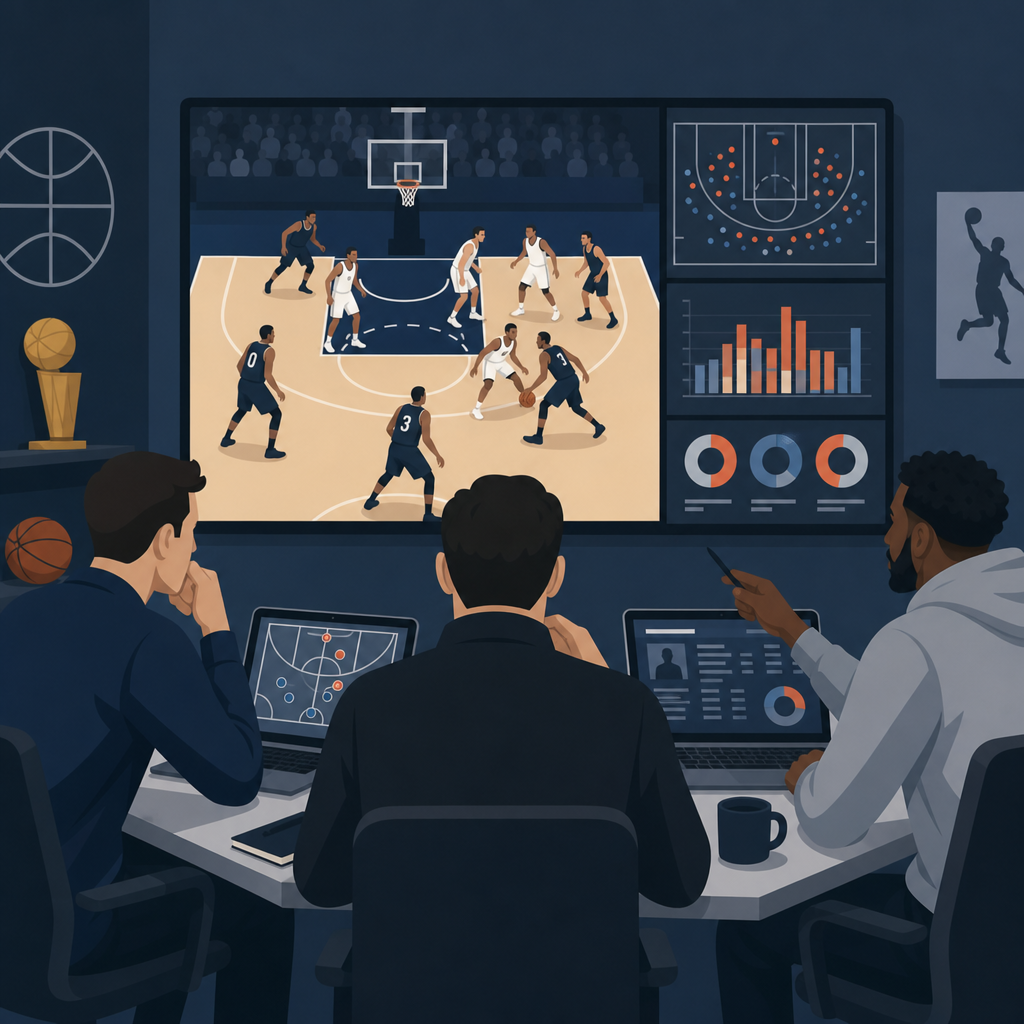
Video analysis sits at the center of modern playoff preparation because it turns thousands of possessions into patterns coaches can trust. In every NBA series, teams build a detailed scouting process that blends film review, tracking data, play classification, and coaching judgment. The goal is simple to describe and difficult to execute: identify what an opponent does most often, what it does best, where it is vulnerable, and how those tendencies change from game to game. When people talk about film and analytics in basketball training, this is the practical intersection. Film shows context, spacing, timing, and decision-making. Analytics measures frequency, efficiency, shot value, lineup impact, and matchup outcomes. Used together, they help staffs design coverages, practice plans, substitution patterns, and late-game counters before a series even tips off.
I have seen this process up close in scouting workflows that begin the moment a matchup looks likely. Assistants are not just watching random highlights. They are clipping every important possession type, tagging actions in software such as Synergy Sports, Second Spectrum, Hudl, and Sportscode, and organizing those clips by player, lineup, quarter, score margin, and game state. A single report might answer very specific questions: How often does a team run empty-corner pick-and-roll with its second unit? Which side does a star prefer when rejecting a screen? What happens after timeouts? Which inbound set appears most often under five seconds? Those answers matter because playoff basketball is repetitive by design. Teams strip away weak options and lean harder into their best actions, so recognizing the patterns early can swing an entire series.
For a basketball training audience, understanding how NBA teams scout opponents through video analysis explains more than pro strategy. It shows how coaches teach reads, how players prepare individually, and why practice reps are built around realistic game actions rather than generic drills. Film and analytics are not separate silos. They are the language teams use to translate information into executable habits. This article serves as the hub for that subtopic by outlining the full workflow: collecting film, tagging actions, building opponent reports, combining video with data, training players with clips, adjusting between games, and separating useful evidence from noise. If you want to understand why some teams seem one step ahead during a seven-game series, the answer usually begins in the film room long before the opening jump ball.
How teams collect and organize opponent film before a series
The first phase of opponent scouting is collection and classification. Every NBA team has access to full-game video, broadcast angles, and increasingly rich optical tracking tied to each possession. Staffs begin by selecting the sample. That usually includes all regular-season meetings, the opponent’s most recent ten to fifteen games, games against similar defensive schemes, and any playoff contests already played. The reason is straightforward: a season-long average can hide meaningful tactical shifts. A team that played at one pace in January may use a tighter eight-man rotation, more switching, and more post mismatches in May.
Once the sample is chosen, assistants tag possessions into categories that will be useful to coaches and players. Common tags include transition, early offense, side pick-and-roll, high pick-and-roll, Spain pick-and-roll, stagger, floppy, zoom action, post-up, elbow split, horns, ghost screen, handoff, baseline out-of-bounds, sideline out-of-bounds, and after-timeout sets. Defensive tags matter just as much: drop, at-the-level, switch, ice, weak, top-lock, peel switch, zone, box-and-one, and late-clock scramble. Good tagging creates retrieval speed. If the head coach asks for every clip where the opponent ran a guard-guard screen into a slip against switching, the video coordinator needs that answer immediately.
Teams also organize film by context, because playoff basketball is situational. A possession in the first quarter with benches on the floor does not carry the same tactical weight as a final two-minute possession with a star creating against the closing lineup. Staffs isolate clutch possessions, after-timeout plays, end-of-quarter sets, and nonstandard lineups. They note which actions are used to free a primary scorer, which counters appear after a defense takes away the first option, and which role players become decision points. This is where film and analytics begin to merge. The film clip shows what happened. The data shows how often it happens and how efficient it is.
What coaches look for when breaking down offensive and defensive tendencies
The core purpose of film study is to uncover repeatable tendencies. Coaches are not searching for one spectacular play. They want habits. On offense, they study initiation points, spacing rules, preferred screening angles, automatic reads, and the order of progressions within a set. For example, a team may enter its offense through a dribble handoff on the right side, then flow into a ball screen if the handoff is denied. That sequence matters because defenders can prepare not only for the first action but for the likely second and third actions that follow.
Individual tendencies are equally important. Scouts track which hand a ball handler prefers, whether a scorer likes to snake screens, where a post player turns over each shoulder, and how willingly a shooter fires off movement versus off the catch. They also note what a player does under pressure. Some stars split traps. Others retreat and reset. Some bigs short roll into floaters, while others immediately hit the weak-side corner. Tiny details decide playoff possessions because defenses are designed to force the least comfortable read.
Defensively, coaches study shell principles and exceptions. Does the opponent protect the rim with a deep drop or bring the big up to the level? Will they switch only one through four, or can they switch five across? How do they guard empty-corner actions, double drags, and Spain pick-and-roll? Are low-man rotations early and decisive, or is the weak-side corner vulnerable? The film room reveals these truths faster than numbers alone because spacing and timing explain why a coverage succeeds or fails. A lineup might allow a modest points-per-possession figure in isolation, but film can show that the success actually comes from aggressive nail help and elite rear contests from a specific wing, not from individual stoppers winning one-on-one.
How video analysis and analytics work together in playoff scouting
The strongest playoff scouting reports do not treat film and numbers as competing viewpoints. They use numbers to prioritize where film study should go deeper, then use film to explain what the numbers mean. Suppose tracking data shows an opponent scores 1.18 points per possession on corner pick-and-rolls but only 0.92 on middle pick-and-rolls. That difference is a clue. Analysts pull the clips, and the coaches may find that the corner alignment empties the help side, forcing a tag from a weak shooter’s defender less often than expected because the screener is also a pop threat. The adjustment then becomes teachable: influence the ball middle, pre-rotate from a nonshooter, and trust a late peel switch behind the play.
NBA staffs commonly combine possession type efficiency, shot-location data, lineup net rating, on-off splits, and tracking metrics such as touch time, average dribbles, catch-and-shoot frequency, and defender distance. None of those numbers should stand alone. A high-efficiency action with a tiny sample can mislead. An average-looking lineup may be dangerous if it has barely played together and now features a healthy star. Film protects against overreaction, while analytics protects against anecdotal bias.
| Scouting question | What video shows | What analytics shows | Likely coaching adjustment |
|---|---|---|---|
| How does a star create threes? | Screen angle, spacing, help timing, preferred counter | Frequency, shot value, defender contest rate | Top-lock off-ball actions, switch selective screens, shrink driving lanes |
| Is the second unit vulnerable? | Who initiates, where turnovers start, weak defenders targeted | Lineup net rating, turnover percentage, rim rate allowed | Stagger stars, pressure ball handlers, hunt one matchup repeatedly |
| Which coverage hurts their pick-and-roll most? | Ball handler comfort, short-roll reads, weak-side passing quality | Points per possession by coverage and shot zone | Mix drop and blitz, disguise pre-switches, deny easy pocket passes |
| What happens after timeouts? | Play design, decoy action, favorite inbound options | Conversion rate on after-timeout possessions | Switch rehearsed counters, communicate first option loudly |
The most effective reports translate this combined evidence into clean decisions. Coaches rarely hand players a spreadsheet. They condense the findings into a few defensible priorities, such as no strong-hand drives, show crowds early on post catches, and force pick-and-rolls toward the sideline against the second unit. Behind each bullet is a stack of clips and numbers, but the player message stays concise. That clarity is one reason great scouting staffs create an edge.
How players use film to prepare for individual matchups and team schemes
Players do not consume film the same way coaches do. A coaching staff might review an entire game in sequence, but players usually receive customized edits tied to their role. A point-of-attack defender studies the ball handler he will guard: setup dribbles, favorite pickups, hesitation timing, and escape routes against pressure. A rim protector reviews lob threats, dump-off patterns, and the shooter locations he must track when rotating. A wing scorer looks at which defenders open their stance too early, top-foot tendencies on closeouts, and where help comes from when he drives middle versus baseline.
Personalized film has two benefits. First, it reduces information overload. Second, it ties scouting directly to skill execution. If a shooter sees ten clips of an opponent tagging the roller aggressively from the low man, he knows corner relocation and one-more passing may be available. If a backup guard sees that the opposing reserve unit struggles to contain pace drag screens in transition, he can attack before the defense is set. Film becomes a rehearsal tool rather than a history lesson.
In my experience, the best player edits are short, repetitive, and paired with on-court walk-throughs. A five-minute clip package showing the same weak-side stunt three times is often more useful than a twenty-minute montage of everything. Teams reinforce the clips in practice with shell drills, special-situation segments, and scout-team possessions that mimic exact opponent spacing. This is where basketball training and playoff scouting fully connect. The clips define the read, and the practice rep builds the habit under pressure.
How teams adjust between games during a playoff series
Series scouting does not end once Game 1 starts. In many ways, the most important video analysis happens between games, when teams identify what held up under playoff pressure and what failed. Coaches review not just makes and misses, but process. Did the intended matchup survive screening? Did help arrive from the right place? Did the offense generate the target shots, even if they did not fall? Postgame reports often separate controllable outcomes from shooting variance because overreacting to randomness can damage the next plan.
Adjustments usually happen on three levels. The first is tactical: changing a pick-and-roll coverage, altering transition match rules, switching who guards the star, or using more zone to disrupt rhythm. The second is personnel-based: tightening the rotation, staggering stars differently, or benching a player whose weakness the opponent can repeatedly target. The third is communicative: simplifying terminology, emphasizing one nonnegotiable, or showing players clearer clips of the same mistake. Great staffs understand that a perfect tactic fails if players cannot execute it at speed.
Real playoff examples often follow this pattern. A team opens a series in drop coverage, then sees the opponent’s pull-up guard get comfortable at the nail. By Game 2, the big is higher and the low man is earlier. Or a team begins by switching off-ball screens only to discover that slips and seals are creating deep catches. The next adjustment is a pre-switch with more top-side denial. These are not guesses. They are video-backed changes tested against actual possession evidence from the series.
Common mistakes in film study and what effective staffs do differently
The biggest mistake in video analysis is confusing volume with insight. Watching six games without a tagging system often produces vague impressions instead of actionable answers. Effective staffs start with questions, build reliable labels, and cross-check clips against data. Another common error is overweighting recent highlight plays. A spectacular late-game set may stand out, but if the opponent ran it once all month, it should not dominate the report. Frequency matters.
Bias is another problem. Coaches can fall in love with a preferred coverage and search film only for supporting examples. Strong analysts push back by showing the full possession distribution, not just memorable failures. Sample quality matters too. Garbage-time lineups, back-to-backs, and injury-affected rotations can distort conclusions if they are treated like standard playoff conditions. This is why context tagging is so valuable.
The best staffs also know when to stop. A report with fifteen defensive keys is not more advanced than a report with four. In the playoffs, usable information wins. The ideal scouting package is accurate, specific, and deliverable. It tells players what the opponent wants, how the staff plans to disrupt it, and which counters are most likely to appear next. That is the true value of film and analytics as a basketball training hub topic: they turn complexity into preparation that players can actually use.
NBA teams use video analysis to scout opponents before every series by combining tagged film, tracking data, and role-specific teaching into one decision-making system. They gather the right sample, classify actions, isolate situational possessions, and study tendencies that repeat under pressure. Then they pair those clips with efficiency metrics, lineup data, and shot-location trends to decide which coverages to play, which matchups to target, and which counters to expect. Players receive concise edits tied to their responsibilities, and coaches reinforce those lessons in practice so the film room leads directly to execution on the floor.
The main benefit of this process is clarity. In a playoff series, both teams know the opponent’s strengths. The edge comes from identifying the few patterns that matter most and preparing responses before those moments decide games. Film shows context, analytics shows scale, and together they create smarter adjustments between Games 1 and 7. For anyone studying basketball training, this subtopic is essential because it explains how teaching, strategy, and performance connect at the highest level.
Use this hub as your starting point for deeper study of film breakdown, lineup analytics, pick-and-roll coverage, player development edits, and postseason game planning. If you coach, train, or simply want to understand why playoff basketball looks so precise, start watching possessions the way NBA staffs do: by asking what repeats, what works, and what can be taken away next.
Frequently Asked Questions
How do NBA teams use video analysis to prepare for an opponent before a playoff series?
NBA teams use video analysis to turn a massive volume of possessions into a practical scouting plan. Before a series begins, coaching staffs, video coordinators, and analytics personnel sort through recent games, season-long trends, and lineup-specific clips to identify how an opponent prefers to play. They study offensive actions such as pick-and-rolls, handoffs, post entries, flare screens, corner spacing, transition habits, and late-clock counters. On the defensive side, they look at coverages, help rotations, switching patterns, closeouts, rim protection, and how the opponent responds to star players in different matchups.
The work is not just about collecting clips. It is about organizing those clips into patterns coaches can trust. Teams tag possessions by play type, player involvement, score situation, lineup combination, quarter, and game context. That allows them to answer highly specific questions: What does this team run after timeouts? Which actions does it favor in crunch time? How does it attack against switching defenses? What happens when its second unit is on the floor? By the time the series starts, coaches are not simply watching film for general impressions. They are building a detailed map of tendencies, strengths, counters, and weaknesses that can be translated into game plans, practice sessions, and in-game adjustments.
What kinds of opponent tendencies are coaches looking for when they study film?
Coaches look for repeatable habits that reveal how an opponent creates advantages and where those advantages break down. Offensively, they want to know who initiates sets, where key players like to catch the ball, which side of the floor actions begin on, how often the team uses certain screen angles, and what the preferred first option is versus the emergency option when a play stalls. They also track individual player behavior closely. Some scorers reject screens more often than expected, some shooters relocate to the same spots after drive-and-kick actions, and some big men always short roll to a specific passing window. Those details can become the difference between a clean defensive possession and a breakdown.
Defensively, teams study which lineups switch, which ones drop, how aggressively the weak side tags rollers, whether defenders stunt at shooters or fully rotate, and how the opponent protects the paint without giving up threes. They also pay close attention to foul tendencies, transition communication, and rebounding position after contests. Just as important, coaches compare what a team usually does with what it does under pressure. An opponent may play one style in the regular flow of a game but shift to a much tighter rotation, different defensive coverage, or star-centered offense in high-leverage moments. Video analysis helps identify both the baseline identity of a team and the changes that appear when the stakes rise.
How do video analysis and tracking data work together in NBA scouting?
Video analysis and tracking data are most effective when they support each other rather than compete. Tracking data can quickly show where shots come from, how often certain actions occur, which lineups are most effective, how defenders perform in different coverages, and what kinds of possessions produce the best offensive results. That information helps a staff decide where to focus its film study. If the numbers show an opponent scores efficiently when using double drag screens with a certain lineup, coaches can pull the matching clips and see why it works. If data suggests a player struggles against top-side pressure or against switching bigs, film can confirm whether that trend is real, situational, or misleading.
Film is essential because numbers alone do not explain decision-making, timing, spacing quality, or hidden context. A possession classified as a simple pick-and-roll might actually include a decoy cut, a weak-side exchange, and a defensive miscommunication that made the result possible. Video reveals those layers. It also helps teams distinguish between sustainable patterns and statistical noise. In playoff prep, the strongest scouting reports are built by combining measurable tendencies with visual proof. Data points a staff toward meaningful questions, and film provides the basketball detail needed to answer them with confidence.
How often do NBA teams update scouting reports during a series?
Scouting reports are updated constantly during a playoff series. The first version is built from broad study of the opponent’s recent games, season profile, and likely rotation patterns, but that report is only the starting point. After each game, teams review every possession to see what held up and what changed. They evaluate whether the opponent introduced new actions, altered screen locations, changed substitution timing, targeted a different defender, or shifted its defensive coverage in response to the original game plan. Even subtle adjustments matter, because playoff basketball is built on solving and re-solving the same problems over and over.
This is why video work becomes even more intense once a series begins. Coaches often cut fresh clips immediately after games and again the next morning to isolate new trends. They may create separate reels for successful opponent actions, possessions where the defense executed correctly, and possessions where breakdowns came from communication rather than scheme. The goal is to avoid overreacting to a single result while still recognizing meaningful adaptation. In a long series, the team that identifies new patterns fastest often gains a major edge. Video analysis gives staffs a way to make those adjustments with evidence instead of guesswork.
Why is video analysis so important in the playoffs compared with the regular season?
Video analysis matters all year, but its value increases dramatically in the playoffs because teams face the same opponent repeatedly and every detail gets magnified. In the regular season, preparation can be broad because schedules are compressed and opponents change constantly. In a playoff series, there is time and incentive to study everything more deeply. Coaches can focus on one roster, one set of matchups, and one evolving chess match. That allows film work to become much more targeted, from how a specific guard handles late traps to how a specific forward rotates when the ball is driven from the wing.
The playoff environment also strips away many distractions and forces teams to win in the margins. Opponents know each other’s favorite sets, so success often depends on counterpunches, disguise, execution, and identifying weak points that are not obvious on a box score. Video analysis helps teams prepare for those margins by showing where offensive rhythm starts, where defensive cracks appear, and how lineups behave under stress. It also gives players visual reinforcement, which is often more effective than verbal instruction alone. When a staff can show exactly where a rotation was late, where a screen should be forced, or where a scorer prefers to spin back to the middle, preparation becomes clearer and more actionable. That is why film sits at the center of modern playoff scouting: it turns information into decisions teams can use possession by possession.