
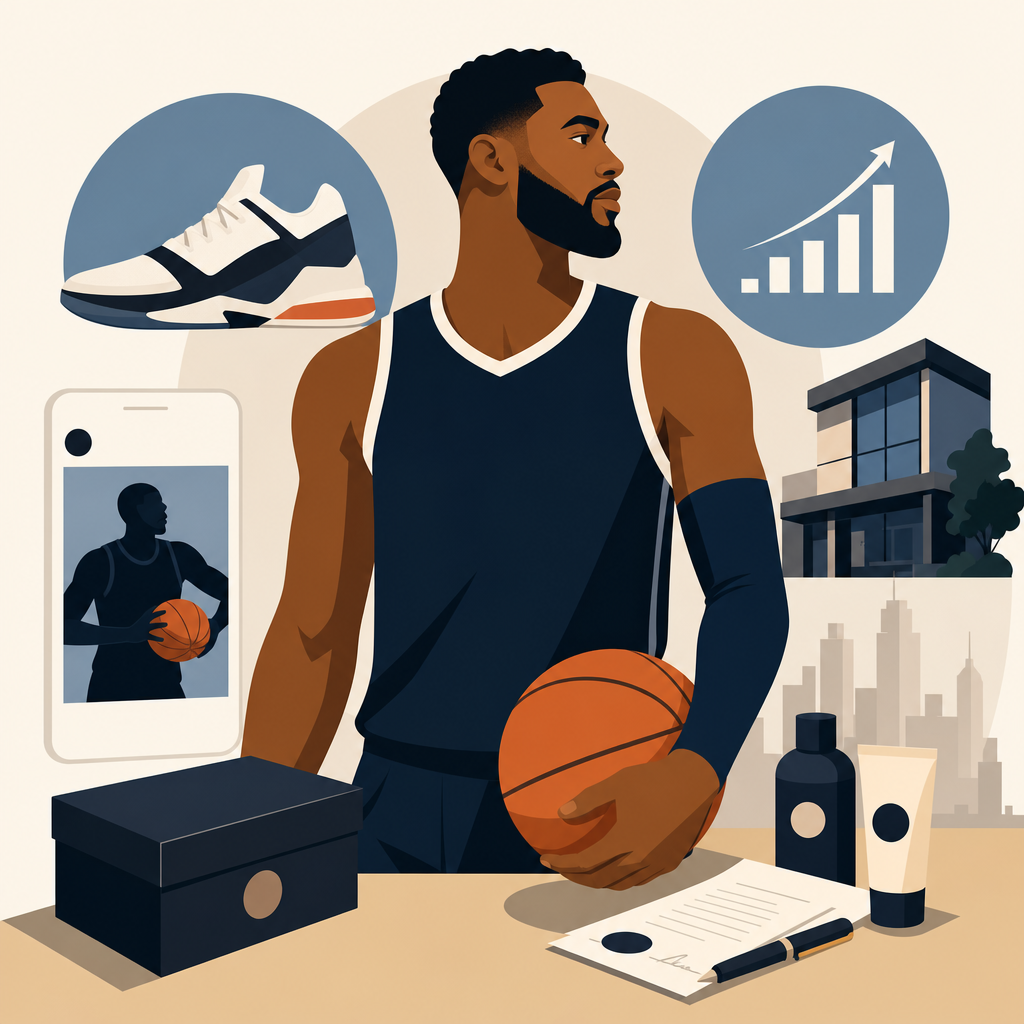
NBA players are no longer defined only by points, rebounds, and championships. They are also media properties, equity partners, startup investors, fashion tastemakers, and global marketing engines. Understanding how NBA players became brands means understanding a major shift in sports business: athletes moved from being endorsers in advertisements to becoming owners of intellectual property, distribution channels, and commercial narratives.
In practical terms, a player brand is the public identity that turns athletic performance into economic value beyond salary. It includes image, story, style, social media presence, community impact, business ventures, and the trust audiences place in the athlete. Endorsements are the most visible piece of that system, but they are only one layer. Licensing deals, signature shoes, production companies, podcast networks, equity stakes, apparel labels, and carefully managed personal platforms are now central to player culture across the league.
This matters because the NBA has become the most personality-driven major sports league in the United States. The league’s global reach, player visibility, fashion integration, and year-round media cycle create ideal conditions for personal branding. Fans do not just follow teams; they follow lifestyles, viewpoints, and ecosystems built around individual stars. For younger players, brand strength can influence All-Star voting, sponsorship demand, and post-career opportunities. For teams, a marketable player can lift ticket sales, local attention, and international fan growth. For companies, an NBA player can offer cultural credibility that a traditional ad campaign cannot replicate.
I have worked on sports content and marketing strategy long enough to see a clear pattern: the players who build lasting brands do not rely on fame alone. They align performance, authenticity, and business structure. Michael Jordan did not simply appear in commercials; he became the template for athlete-led product empires. LeBron James did not stop at endorsements; he built a corporate portfolio spanning media, health, and ownership pathways. Stephen Curry translated a relatable image and elite skill into long-term partnerships and a broader family-friendly commercial footprint. These examples explain why player culture deserves to be treated as a serious business subject, not celebrity trivia.
The Shift from Athlete Endorser to Independent Business Entity
For decades, the standard model was simple: a company paid an NBA player to wear its shoes, appear in television ads, or promote a product. The player’s job was to lend visibility and aspiration. That model still exists, but it no longer captures the full value elite players can create. Today, many players act more like independent companies with management teams handling brand strategy, content production, licensing, legal review, and investment sourcing.
The change accelerated for three reasons. First, the NBA’s media environment expanded from network television to cable, streaming, social platforms, and direct-to-consumer channels. Second, athletes gained leverage as their cultural influence began to outpace that of many franchises. Third, new wealth-building strategies made cash endorsement fees look limited compared with royalties, equity, and ownership. A player who accepts a flat sponsorship payment may earn well, but a player who negotiates revenue share, stock, or long-term licensing can create generational wealth.
Jordan remains the defining case. His partnership with Nike became more than an endorsement because the Air Jordan line developed into a standalone business with recurring revenue, product extensions, and multigenerational appeal. LeBron followed a modern variation by combining Nike lifetime value with investments in SpringHill, Blaze Pizza, and Fenway Sports Group. Kevin Durant used on-court excellence and a trusted business circle to build Thirty Five Ventures, blending media, investments, and partnerships. The lesson is clear: the strongest NBA brands are organized systems, not random deals.
Why the NBA Creates Stronger Personal Brands Than Most Leagues
NBA player branding benefits from the structure of the sport itself. Basketball places individual athletes at the center of every possession, and they play without helmets, making faces and expressions fully visible. A star can influence a game more directly in basketball than in football or baseball, so fans naturally attach outcomes to individuals. That visibility translates into commercial value because sponsors prefer personalities audiences can recognize immediately.
The league also embraced personal style earlier and more completely than most sports properties. Tunnel fashion became content. Sneaker culture became a parallel media category. Postgame interviews, All-Star weekend, offseason training clips, and international tours all create opportunities for identity building. When Russell Westbrook entered arenas in distinctive outfits, that was not superficial attention; it was brand signaling. When Shai Gilgeous-Alexander became associated with luxury fashion and understated cool, it strengthened an image that sponsors could package. When Allen Iverson changed dress, language, and attitude norms, he altered the commercial relationship between authenticity and marketability.
Global audience behavior matters too. The NBA’s popularity in China, Europe, Africa, and Latin America means a player can become a cross-border brand even without winning multiple titles. Giannis Antetokounmpo’s story, for example, connects immigration, family sacrifice, and international aspiration. Luka Doncic entered the league with a preexisting European fan base. Victor Wembanyama arrived with international media infrastructure already attached to his name. In branding terms, the NBA supplies both intimacy and scale, a rare combination.
The Real Mechanics of Endorsements
Endorsements work because brands buy transfer of meaning. A company wants the traits associated with a player—discipline, coolness, explosiveness, reliability, leadership, or innovation—to attach to its product. The best deals therefore depend on strategic fit, not merely follower count. A defensive specialist with deep community credibility may be better for a youth initiative than a higher-scoring player with a less defined public image.
In negotiations, brands typically evaluate performance level, audience demographics, social engagement quality, media exposure, risk profile, and storytelling potential. Agents and business managers then push for favorable terms: guaranteed fees, bonuses for awards, appearance commitments, category exclusivity, creative approval, royalties, and sometimes equity. Signature shoe contracts are especially important because they can move a player from campaign talent to product architecture. That is why shoe free agency generates so much attention. The deal can shape identity for years.
Not every endorsement succeeds. I have seen campaigns fail because the product did not match the athlete’s actual life, the creative felt generic, or the player’s team accepted too many partnerships in conflicting categories. Consumers notice when a player promotes sports drinks, recovery tools, headphones, crypto, and insurance in a way that feels transactional rather than coherent. The strongest endorsement portfolios look curated. Chris Paul’s reputation for precision and professionalism made State Farm memorable because the brand positioning and player image reinforced each other.
| Brand Path | How It Works | NBA Example | Main Advantage |
|---|---|---|---|
| Flat endorsement fee | Player is paid to appear in campaigns or wear products | Traditional apparel or beverage partnerships | Predictable income with low complexity |
| Royalties | Player earns a percentage of product sales | Signature sneakers and apparel lines | Upside if the product gains traction |
| Equity stake | Compensation includes ownership in the company | LeBron James and Blaze Pizza | Potential for outsized long-term returns |
| Joint venture | Player and partner build a business together | Media and content companies tied to athletes | Greater control over brand and revenue |
Signature Shoes, Apparel, and the Power of Product
No category illustrates NBA brand economics better than footwear. Signature shoes turn athlete identity into a physical product fans can buy, collect, and wear as self-expression. The model became iconic with Air Jordan, but it remains central today through players such as LeBron James, Kevin Durant, Giannis Antetokounmpo, James Harden, Damian Lillard, Jayson Tatum, Ja Morant, and Sabrina Ionescu in the broader basketball market. A signature line is not just a sneaker; it is recurring content, seasonal storytelling, design language, retail placement, and consumer community.
Product matters because it extends attention beyond game night. A fan may not watch every national broadcast, but they can still engage with a launch calendar, colorway drop, or limited collaboration. This is where scarcity strategy, lifestyle positioning, and performance technology intersect. Nike, Adidas, Under Armour, Puma, New Balance, and Anta all understand that basketball consumers buy narrative as much as cushioning systems. Curry’s Under Armour line, for instance, built around precision shooting, family image, and training discipline. Kyrie Irving’s shoes became popular partly because of on-court style and partly because the product performed well for actual hoopers.
Apparel broadens the model further. Players launch capsule collections, collaborate with luxury houses, or back streetwear labels to reach audiences who care about culture more than sport. These products can be smaller businesses than major shoe lines, but they sharpen identity. In player culture, what someone wears entering the arena can be as strategic as what they wear on the court.
Social Media Turned Players into Publishers
Before Instagram, YouTube, TikTok, X, and athlete podcasts, brands depended heavily on broadcasters and journalists to shape public perception. That gatekeeping has weakened. NBA players now speak directly to millions of followers, which means they can launch ideas, defend themselves, test content, and build communities without waiting for a network slot. In branding terms, distribution is power.
This shift changed endorsement value because companies no longer buy only a player’s image; they buy access to the player’s owned audience. A sponsored post can be measured through reach, saves, comments, clicks, and conversion. More importantly, social media reveals whether a player can hold attention outside of highlights. Mikal Bridges may not generate the same engagement patterns as Anthony Edwards, and that difference affects commercial positioning even if both are excellent players.
Direct publishing also raises the stakes for authenticity and risk management. Fans quickly detect overly scripted content. They also punish tone-deaf messaging, especially around social issues, labor disputes, or speculative investments. Several athletes across sports learned this during the crypto boom, when promotion outpaced due diligence. The players with durable brands usually have disciplined content habits: they share enough personality to feel human, but they protect long-term trust by avoiding every trend.
Business Moves Beyond Endorsements
The most important development in modern player culture is diversification beyond sponsorships. Endorsements monetize attention; business ownership monetizes strategy. Players now invest in startups, acquire real estate, launch production companies, build fitness and recovery brands, create youth sports platforms, and pursue franchise ownership pathways. These moves matter because athletic careers are short, injury risk is real, and salaries alone do not guarantee long-term financial security.
LeBron James offers the clearest case study. His business rise was not accidental. He built a close advisory circle, chose sectors with cultural and distribution overlap, and expanded from endorsement income into equity and content ownership. SpringHill demonstrated that athlete stories could be packaged and sold at scale. Durant and Rich Kleiman used Thirty Five Ventures to balance venture investing with media production. Carmelo Anthony became active in wine, media, and startup investing. Junior Bridgeman, a former NBA player from an earlier era, proved the ownership model on a massive scale through fast-food franchises and bottling operations, becoming one of the wealthiest former athletes in America.
Not every player needs a venture capital profile. Solid brand building can also mean opening a training business, launching a camp network, investing in local commercial property, or creating a niche product with credible demand. The principle is the same: move from paid promoter to asset holder.
What Makes a Player Brand Last
Lasting player brands usually share five traits: elite competence, a recognizable story, visual consistency, selective partnerships, and credible off-court substance. Performance still comes first. A brand can amplify talent, but it cannot permanently replace it. Fans forgive a slow season more readily than they forgive perceived phoniness.
Story is equally important. Jimmy Butler’s relentless path, Giannis’s family-centered humility, Curry’s underdog-to-revolutionary arc, and Kawhi Leonard’s low-key detachment all created distinct commercial lanes. Visual consistency helps too, whether through a logo, color language, fashion signature, or content style. Selective partnerships prevent dilution. And substance—philanthropy, thoughtful interviews, entrepreneurial seriousness, or community investment—gives the brand weight beyond aesthetics.
There are tradeoffs. Overexposure can create fatigue. Excessive activism can alienate some audiences while deepening loyalty among others. A controversial media persona can drive attention but limit family-friendly sponsors. That is why strong athlete branding is strategic rather than maximalist. The goal is not to be everywhere. The goal is to be believable, valuable, and durable.
NBA players became brands by mastering a simple but powerful transition: they turned visibility into ownership. Endorsements opened the door, but the real transformation happened when players gained control over products, stories, investments, and distribution. In today’s NBA culture, player identity is an economic engine that can outlast a contract and even a career.
The key patterns are consistent. The league’s structure makes individuals highly visible. Social media lets players speak without intermediaries. Signature products convert fandom into revenue. Smart endorsement strategy depends on fit, not volume. Long-term wealth usually comes from equity, licensing, and businesses that players can influence directly. The best examples, from Jordan to LeBron to Durant to Curry, show that branding works when athletic excellence, authenticity, and disciplined decision-making reinforce each other.
For fans, this helps explain why player culture feels so central to the modern NBA. Shoes, tunnel fits, podcasts, community work, and investments are not side stories; they are part of how basketball power now operates. For anyone building out an understanding of NBA Culture, this player-focused hub is the foundation. Explore the related subtopics next, from sneaker culture and fashion to athlete media, philanthropy, and entrepreneurship, to see how the full ecosystem connects.
Frequently Asked Questions
1. What does it mean to say an NBA player has become a brand?
When people say an NBA player has become a brand, they mean the athlete is no longer viewed only through game statistics, highlights, or championships. Instead, the player functions as a full commercial identity with recognizable values, style, voice, audience appeal, and business potential. That identity can be monetized across endorsements, licensing, media appearances, social platforms, fashion collaborations, investments, and original business ventures. In other words, the player is not just participating in marketing campaigns created by others; the player is the central asset around which those campaigns, products, and partnerships are built.
A player brand usually includes several layers. First, there is performance credibility, which still matters because elite play creates visibility and legitimacy. Second, there is personality: fans connect to a player’s story, confidence, work ethic, humor, activism, or lifestyle. Third, there is visual and cultural consistency, including signature looks, logos, catchphrases, or off-court interests that make the athlete instantly recognizable. Finally, there is commercial strategy, which determines how that identity is packaged and extended into long-term business opportunities.
This shift is important because it changes the athlete’s role in the sports economy. Historically, many players were mainly endorsers who lent their image to a product for a fee. Today, top NBA players often negotiate for equity, creative control, intellectual property rights, and direct ownership stakes. That means the brand is not just a public image to be rented out; it is a business platform the athlete can develop, protect, and grow over time.
2. How did NBA players move from simple endorsements to full-scale business empires?
The transition happened gradually, but several forces pushed it forward at the same time. One major factor was the globalization of the NBA. As the league’s audience expanded beyond the United States, star players gained international recognition, which dramatically increased their marketing value. Shoe companies, apparel brands, media firms, and consumer products companies began to see elite NBA players as global ambassadors rather than local celebrities. That widened the scale of endorsement deals and opened the door to larger, more strategic partnerships.
Another major factor was the growth of athlete empowerment. Over time, players gained more influence over their careers, their public messaging, and their off-court opportunities. Rather than accepting one-off sponsorships, they began building teams around themselves that included agents, brand managers, lawyers, publicists, investment advisers, and content strategists. With stronger representation and more business sophistication, players could negotiate deals that included royalties, product lines, licensing rights, and equity positions instead of only appearance fees.
Digital media accelerated the shift even further. Social media gave players direct access to millions of fans without needing traditional gatekeepers. That changed everything. A player with a large and engaged audience became more valuable because brands could tap into built-in distribution. At the same time, athletes realized they could create and own their own content through podcasts, production companies, YouTube channels, and social platforms. Instead of waiting to be featured in someone else’s campaign, they could control the narrative and build businesses around that attention.
The final piece was a mindset change. Many NBA players began to think like entrepreneurs, not just entertainers or endorsers. They studied ownership, investing, media economics, and long-term wealth creation. As a result, the modern player brand often evolves into a larger portfolio that can include venture capital, restaurants, tech investments, health and wellness brands, fashion labels, and entertainment companies. The endorsement deal became the starting point, not the finish line.
3. Why are endorsements still important if players are now focused on ownership and equity?
Endorsements still matter because they remain one of the fastest and most visible ways for NBA players to build commercial reach. A major endorsement deal can introduce a player to new audiences, strengthen legitimacy with corporate partners, and generate substantial income early in a career. For many athletes, especially rising stars, endorsements are the bridge between on-court fame and broader brand development. They create exposure, provide marketing support, and help establish the player’s image in categories such as footwear, apparel, beverages, technology, finance, or lifestyle products.
What has changed is the strategic purpose of endorsements. Instead of being treated only as paycheck opportunities, they are now often evaluated as brand-building tools. The key questions are no longer just “How much does the deal pay?” but also “Does this fit the player’s identity?” “Will this increase long-term value?” and “Can this relationship expand into deeper business involvement?” A well-chosen endorsement can reinforce a player’s positioning, whether that means performance excellence, luxury appeal, social impact, family credibility, innovation, or youth culture relevance.
Endorsements also serve as proof of marketability. When respected companies invest in an athlete, it signals trust to other brands, investors, and business partners. That validation can help a player attract opportunities in sectors far beyond sports marketing. In many cases, a traditional endorsement becomes the first step toward co-branded products, signature collections, advisory roles, or equity participation. So while ownership and entrepreneurship are now central to athlete branding, endorsements remain a foundational part of the business model because they amplify visibility and often create the momentum needed for bigger moves later.
4. What kinds of business moves help NBA players grow beyond the court?
NBA players now expand their brands through a wide range of business strategies, and the most successful ones usually combine visibility with ownership. One common move is investing in startups or established companies, especially in technology, consumer goods, fitness, media, and wellness. These investments allow players to participate in upside beyond salary and endorsement income. If the company grows, the athlete benefits not only financially but also reputationally as a savvy businessperson.
Another major move is launching proprietary businesses. Some players create production companies, apparel labels, beverage brands, personal care lines, training platforms, or media ventures. This matters because proprietary businesses give athletes direct control over intellectual property, messaging, product development, and revenue streams. Rather than promoting someone else’s company, they build assets they can own, scale, and potentially sell or expand globally.
Media is another powerful area. By producing documentaries, podcasts, interview shows, and digital series, players become storytellers as well as subjects. That shift is especially important because narrative control is central to modern branding. If an athlete owns the platform, the athlete can shape public perception, deepen audience loyalty, and create recurring content-based revenue. Media ownership also extends a player’s influence well beyond active playing years.
Fashion and cultural positioning play a role too. Many NBA players are trendsetters, and the tunnel-walk era turned pregame arrivals into branding opportunities. Partnerships in sneakers, streetwear, luxury fashion, and accessories can transform a player into a lifestyle figure with relevance outside basketball. That broader cultural footprint makes the athlete more attractive to non-sports audiences and premium advertisers.
Finally, community and purpose-driven initiatives often strengthen a player brand in meaningful ways. Philanthropic work, education efforts, social justice advocacy, and local development projects can deepen credibility and trust when they are authentic and sustained. In today’s market, a strong brand is not just about fame; it is about identity, consistency, and values. The most durable NBA player brands are built at the intersection of performance, business acumen, cultural presence, and purpose.
5. What makes some NBA player brands more successful and longer-lasting than others?
The strongest NBA player brands tend to be built on authenticity, consistency, and strategic discipline. Talent and fame may create the initial spotlight, but they do not guarantee a durable brand. Fans and business partners respond most strongly when a player’s public image actually matches the way the player presents themselves across interviews, social media, partnerships, and personal ventures. If a player endorses products or launches businesses that feel disconnected from their identity, the brand can seem forced or overly commercial. Authentic alignment is what turns attention into trust.
Consistency is equally important. Successful player brands usually communicate a clear set of themes over time, whether that is excellence, innovation, leadership, style, resilience, community commitment, or entrepreneurial ambition. That does not mean the player never evolves. It means the evolution feels coherent. A player who carefully builds a recognizable story is easier for fans to follow and easier for companies to invest in. Clarity helps turn a personality into a marketable platform.
Another key factor is infrastructure. Top athlete brands are rarely built alone. They are supported by experienced teams that handle negotiations, legal issues, communications, licensing, partnerships, investments, and long-term planning. Smart infrastructure helps players avoid short-term decisions that may generate money now but weaken the brand later. It also helps them identify the difference between publicity opportunities and true asset-building opportunities.
Longevity often comes down to ownership and adaptability. Players who own intellectual property, content channels, equity stakes, or standalone businesses are generally better positioned after retirement because their brand value does not disappear when the playing career ends. At the same time, adaptability matters because media trends, consumer habits, and cultural expectations change quickly. The most successful NBA player brands evolve with the market while staying true to the core identity that made them resonate in the first place. That is why the modern athlete brand is not just a fame machine; it is a long-term business ecosystem.