
Basketball players need more than a generic gym routine because the sport demands acceleration, deceleration, vertical power, lateral movement, trunk control, and repeatable conditioning in the same game. The best exercises for basketball players are the ones that improve full-body force production while protecting joints that take constant stress, especially the ankles, knees, hips, and lower back. When I build a basketball workout program, I do not separate strength from movement quality or conditioning from skill readiness. Court performance comes from how well the entire system works together.
A full-body program for court performance means training every major movement pattern across the week: squatting, hinging, lunging, pushing, pulling, rotating, bracing, sprinting, jumping, and landing. It also means matching exercises to basketball realities. A guard who changes direction twenty times in a possession needs eccentric strength and ankle stiffness. A wing who absorbs contact on drives needs single-leg stability and trunk strength. A post player fighting for rebounds needs positional power and shoulder durability. All three still need speed, resilience, and recovery capacity.
This matters because basketball is one of the most physically mixed sports. Players sprint, shuffle, backpedal, jump, and wrestle for space, often with limited rest. Research from basketball performance settings consistently shows that force production, reactive strength, sprint ability, and lower-body strength all connect with game actions such as first-step quickness, rebounding, shot contesting, and finishing through contact. At the same time, overuse issues can build quickly if programs lean too hard on volume, poor landing mechanics, or repetitive high-impact drills. The right basketball training program improves athletic output without burying the athlete in fatigue.
As a sub-pillar hub for basketball training programs and workouts, this guide covers the core exercise categories every serious player should understand. It explains what to train, why each category matters, and how to organize the week so gym work transfers to the floor. Think of it as the central map for your basketball strength and conditioning plan. From here, players can go deeper into strength phases, vertical jump work, off-season training, in-season maintenance, mobility routines, and position-specific adjustments. The foundation, however, stays the same: build a durable, explosive athlete from the ground up.
Lower-Body Strength Exercises That Build Power for the Court
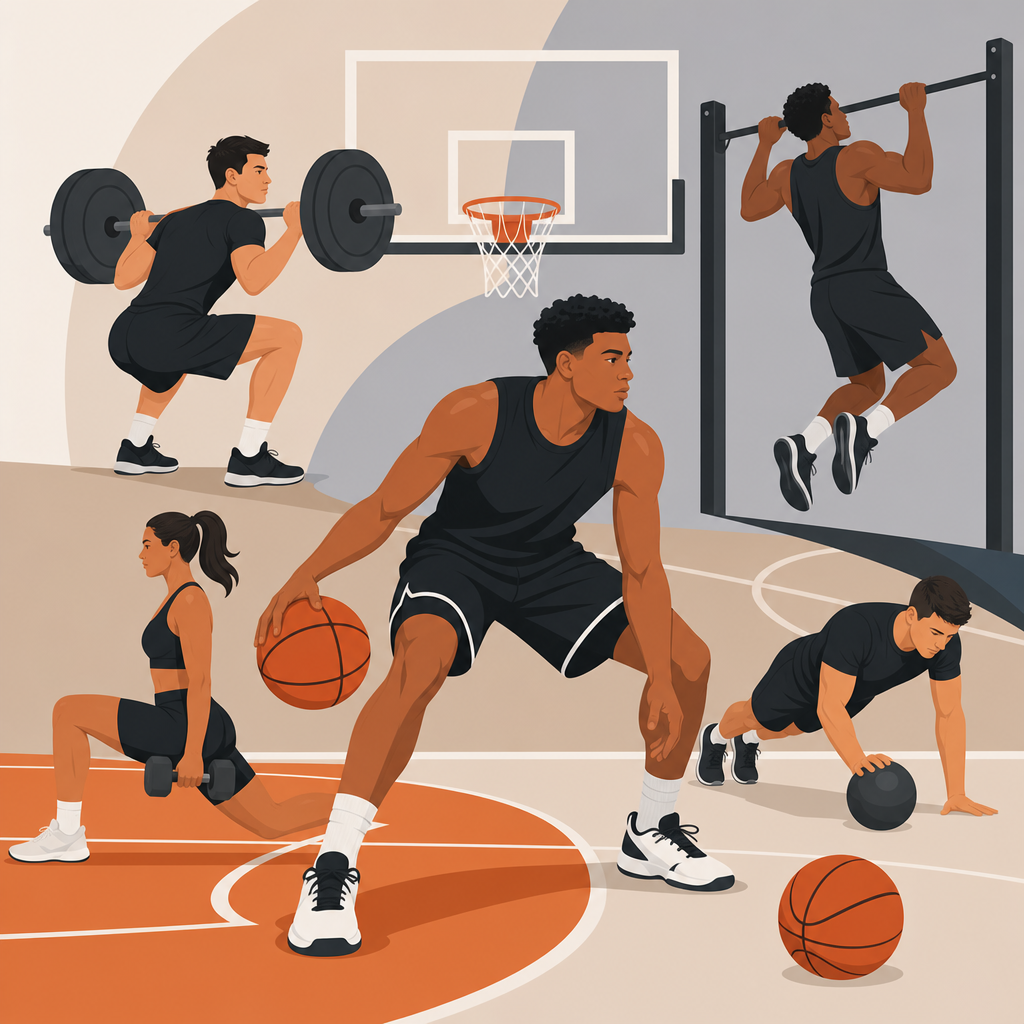
Lower-body strength is the backbone of basketball performance because nearly every explosive action starts with force into the floor. Strong legs and hips improve acceleration, braking, jumping, and contact balance. The best lower-body exercises for basketball players are back squats, front squats, trap-bar deadlifts, Romanian deadlifts, split squats, and lateral lunges. These cover bilateral force production, posterior-chain strength, and single-leg control, which are all required in games.
Squats are valuable because they train coordinated extension through the ankles, knees, and hips. Front squats are especially useful for basketball players who need trunk stiffness and quad strength without as much spinal loading as heavy low-bar variations. Trap-bar deadlifts are one of the safest high-return options for many athletes. They build force rapidly, reinforce hinge mechanics, and usually feel more natural for taller players than straight-bar pulls. Romanian deadlifts target the hamstrings and glutes, which matter for sprinting speed and deceleration. If a player cannot control the eccentric phase of an RDL, that weakness often shows up in poor landing positions and slower change of direction.
Single-leg work matters just as much. Basketball is played one leg at a time during layups, closeouts, cuts, and rebounds in traffic. Bulgarian split squats, walking lunges, step-ups, and rear-foot-elevated split squats improve unilateral strength and reduce side-to-side asymmetries. Lateral lunges add frontal-plane strength that many weight-room plans miss. That is important because defenders rarely move only forward and backward. In practice, I often use split squats early in an off-season block to rebuild tissue tolerance, then push heavier bilateral lifts once movement quality is stable.
Upper-Body Strength for Finishing, Screening, and Durability
Upper-body training for basketball is not bodybuilding. The goal is to create enough strength and structural balance to handle contact, protect the shoulders, and support shooting mechanics instead of interfering with them. The best upper-body exercises for basketball players include push-ups, dumbbell bench press, landmine press, pull-ups, chest-supported rows, single-arm cable rows, and face pulls. Together, these exercises build pressing power, scapular control, and pulling strength that keeps the shoulders healthy.
Dumbbells are often better than barbells for basketball athletes because they allow freer shoulder motion and help clean up left-right imbalances. Landmine presses are another excellent choice because the angled path is shoulder-friendly and teaches force transfer through the trunk. Pull-ups and rows are non-negotiable. Players who only press and neglect upper-back work often develop rounded posture, reduced shoulder stability, and irritation from repeated overhead activity. Face pulls, band external rotations, and Y-T-W raises are small exercises with big value because they reinforce the rotator cuff and scapular stabilizers.
Real-world transfer is easy to see. Stronger upper backs help players hold position on box-outs and absorb drives without folding. Better pressing strength helps with finishing through contact and creating space on cuts. More importantly, balanced upper-body work helps athletes stay available. In-season, I usually cut pressing volume before I cut pulling volume because shoulder durability is a priority when games and shooting reps are high.
Explosive Exercises for Vertical Jump, First-Step Speed, and Reactive Power
Strength creates potential, but explosive exercises teach players to use that strength quickly. Basketball is full of short windows: a rebound tip, a chase-down block, a split-second driving lane. The best power exercises for basketball players include countermovement jumps, box jumps, broad jumps, pogo jumps, medicine ball scoop tosses, rotational throws, trap-bar jump shrugs, and low-volume Olympic-lift derivatives such as hang power cleans when coaching is available.
Plyometrics work because they improve rate of force development and the stretch-shortening cycle. That means the athlete can absorb and redirect force faster. Pogo jumps build ankle stiffness and rhythm, which matter for repeated jumping and quick contacts. Countermovement jumps train vertical power directly. Broad jumps build horizontal force useful for acceleration. Medicine ball throws are underrated because they train intent without adding heavy eccentric stress, making them useful during dense practice weeks.
Volume and quality are critical. More jumps are not better if ground contacts get sloppy. I would rather see eight crisp maximal jumps than thirty tired ones with poor landings. For youth players especially, landing mechanics come first. Teach quiet feet, stacked posture, and knee tracking before chasing jump-test numbers. Power training should leave the athlete feeling sharp, not exhausted.
| Training Goal | Best Exercise Options | Why It Helps Basketball Performance |
|---|---|---|
| Max strength | Front squat, trap-bar deadlift, split squat | Improves force production for jumping, contact balance, and acceleration |
| Explosive power | Countermovement jump, broad jump, medicine ball scoop toss | Builds vertical pop, first-step burst, and reactive athleticism |
| Change of direction | Lateral lunge, deceleration drop, skater jump | Strengthens frontal-plane control and braking capacity |
| Upper-body durability | Pull-up, chest-supported row, landmine press | Supports shoulder health, screening strength, and finishing through contact |
| Core control | Pallof press, dead bug, farmer carry | Improves force transfer, balance, and posture under speed and contact |
Core Training, Change of Direction, and Injury-Reduction Work
Core training for basketball should focus on resisting movement before creating it. Players need to transmit force from the lower body to the upper body while staying organized during cuts, bumps, and off-balance finishes. The most useful exercises are dead bugs, Pallof presses, side planks, Copenhagen planks, farmer carries, and half-kneeling chop and lift patterns. These build anti-extension, anti-rotation, and anti-lateral-flexion strength, which is exactly what the torso does in live play.
Change of direction training should include both technique and strength. Deceleration drills, snap-downs, lateral bounds, skater jumps, and planned cutting drills teach athletes to lower the center of mass, create shin angles, and control braking forces. This is where many non-basketball programs fall short. Players may get stronger in the weight room yet still leak force on the court because they cannot decelerate efficiently. Good brakes make good speed useful.
Injury-reduction work also belongs here. Ankles need calf raises, tibialis raises, and balance progressions. Knees benefit from split squats, Spanish squats, and controlled landing drills. Hips respond well to adductor work and full-range strength. Hamstrings need both sprint exposure and eccentric loading like Nordic hamstring curls or sliding leg curls. None of these eliminate injury risk, but they improve tissue capacity and movement options. In my experience, the athletes who stay healthiest are not the ones doing the fanciest drills; they are the ones doing the basics consistently.
How to Build a Basketball Workout Program Across the Year
The best basketball workout program changes with the calendar. Off-season training is for building strength, addressing weaknesses, and adding power with enough recovery to adapt. Preseason shifts toward speed, reactivity, and sport-specific conditioning while maintaining strength. In-season training is maintenance work: lower volume, high quality, enough intensity to keep strength and power from falling off, and careful monitoring around games.
A practical off-season setup is three or four lifting sessions per week with two dedicated power exposures and one or two conditioning sessions that do not interfere with skill work. A common weekly structure is Day 1 lower-body strength plus jumps, Day 2 upper-body strength plus tempo conditioning, Day 3 recovery or skills only, Day 4 total-body power plus speed, and Day 5 unilateral strength plus mobility and trunk work. During preseason, total volume drops while movement speed rises. During the season, many players do best with two short lift sessions built around a main lower-body lift, a pull, a press, trunk work, and a few jumps.
Exercise selection should also fit age and training history. A middle school athlete may need bodyweight squats, push-ups, medicine ball throws, and landing drills more than loaded barbell work. A college player with years in the weight room can benefit from higher force outputs, advanced plyometric progressions, and individualized accessory work. The principle is progression, not imitation. The best program is the one the athlete can execute well, recover from, and sustain for months.
Sample Full-Body Weekly Structure and Common Programming Mistakes
A simple full-body program for basketball performance can work extremely well. Session one can feature front squats, Romanian deadlifts, push-ups or dumbbell bench press, pull-ups, countermovement jumps, and Pallof presses. Session two can center on trap-bar deadlifts, split squats, landmine press, chest-supported rows, medicine ball throws, and calf work. Session three can include lateral lunges, step-ups, single-arm rows, incline dumbbell press, skater jumps, and farmer carries. Reps generally stay lower for power, moderate for strength, and controlled for accessory work. Rest periods should be long enough to preserve quality.
The biggest mistake I see is stacking too much fatigue. Players do hard practices, pickup games, conditioning, and then add random internet workouts on top. That usually leads to sore knees, flat legs, and no measurable progress. Another mistake is chasing vertical jump gains with endless jumps while ignoring strength and landing skill. Others copy football-style lifting plans that emphasize mass and bilateral grinding but overlook lateral movement and reactive demands. Basketball training must respect the sport’s rhythm.
Finally, do not ignore recovery. Sleep, hydration, carbohydrate intake, and sensible scheduling affect performance as much as exercise choice. Monitoring jump height, bar speed, resting soreness, and general readiness can help athletes adjust before fatigue becomes a problem. A smart basketball strength program is not just hard. It is targeted, repeatable, and built to make the player better on the court, not merely tired in the gym.
The best exercises for basketball players are the ones that improve full-body strength, explosive power, movement efficiency, and durability at the same time. That means building the program around proven lower-body lifts, shoulder-friendly upper-body work, high-quality plyometrics, trunk stability, deceleration training, and year-round planning. Basketball is too dynamic for isolated training. Players need an integrated system that connects the weight room to sprinting, jumping, cutting, landing, and absorbing contact.
If you remember one principle, make it this: train movements and qualities, not just muscles. Squat and hinge for force. Lunge and carry for control. Jump and throw for power. Pull and press for balance and durability. Progress the plan according to the season, the athlete’s age, and actual recovery capacity. That is how a basketball workout program becomes useful instead of decorative.
Use this hub as your starting point for basketball training programs and workouts, then build outward into off-season plans, in-season maintenance, vertical jump development, conditioning methods, mobility routines, and position-specific adjustments. Review your current routine, identify what is missing, and structure the week with intention. When the program fits the game, court performance improves.
Frequently Asked Questions
What are the best exercises for basketball players if the goal is full-body performance, not just muscle gain?
The best exercises for basketball players are the ones that improve strength, explosiveness, coordination, and resilience at the same time. Basketball is not a straight-line sport, and it is not a bodybuilding sport either, so the most useful training choices are movements that carry over to sprinting, jumping, landing, cutting, absorbing contact, and repeating those efforts for an entire game. That usually means building a program around lower-body strength exercises like squats, split squats, Romanian deadlifts, trap bar deadlifts, and step-ups; upper-body pushing and pulling like push-ups, dumbbell bench press, rows, chin-ups, and landmine press; and athletic power drills such as jumps, medicine ball throws, and controlled plyometrics. Core training also matters, but for basketball players it should focus less on endless crunches and more on trunk stiffness, rotation control, anti-rotation work, and force transfer through the hips and shoulders.
A smart full-body basketball program also includes movement quality. That means training the body to produce force efficiently while staying stable through the ankles, knees, hips, and spine. Single-leg work is especially valuable because basketball happens one leg at a time during sprinting, layups, closeouts, and changes of direction. Lateral lunges, rear-foot-elevated split squats, single-leg RDLs, and skater variations can help bridge the gap between weight room strength and on-court movement. In other words, the best exercise selection is not about chasing the longest list of flashy drills. It is about choosing movements that improve force production, landing mechanics, balance, deceleration ability, and durability so the athlete performs better and breaks down less often over a long season.
How should a basketball workout program balance strength, power, speed, and joint protection?
A basketball workout program should treat strength, power, speed, and joint health as connected qualities rather than separate goals. Stronger athletes generally have more potential for speed and explosiveness, but strength alone is not enough if they cannot express it quickly or control it when stopping, changing direction, and landing. That is why the best programs usually begin with some type of activation and dynamic warm-up, move into explosive work while the athlete is fresh, then transition into primary strength training, accessory work, and finally conditioning or recovery. This sequence lets the athlete train high-skill, high-speed movements before fatigue reduces quality.
Joint protection comes from programming, not from avoiding hard work. Ankles, knees, hips, and lower back take constant stress in basketball, so the program needs to build tissue capacity around those areas. That includes calf strength, tibialis work, hamstring strength, glute development, adductor strength, and trunk control. It also means emphasizing deceleration drills, landing mechanics, tempo control, and unilateral training instead of focusing only on bilateral lifting numbers. A good basketball training plan makes room for mobility where it is needed, stability where it is lacking, and enough recovery to let the athlete actually adapt. If every session is high impact, high volume, and high intensity, performance usually drops and overuse issues rise. The goal is not to train hard in random directions. The goal is to create athletes who can accelerate fast, stop safely, move laterally with confidence, and keep doing it deep into the fourth quarter.
Are plyometrics necessary for basketball players, and how should they be used safely?
Yes, plyometrics are important for basketball players because the sport depends heavily on explosive jumping, rapid force production, elastic rebound, and quick transitions between eccentric and concentric muscle actions. Every rebound, contest, first step, and finish at the rim involves some version of explosive intent. However, plyometrics are often misunderstood. More jumping is not automatically better, and advanced drills are not automatically more effective. The best plyometric training starts with landing control, posture, and force absorption before moving into higher-intensity jumps, bounds, and reactive work. If an athlete cannot stick a landing, keep the knee tracking well, and maintain trunk position, then depth jumps and repeated max-effort contacts are usually premature.
Safe and productive plyometric programming should be based on training age, body control, schedule demands, and current fatigue. Low-level pogo jumps, snap-downs, squat jumps, box jumps, lateral hops, and medicine ball power work can build a strong foundation. As athletes develop, they can progress into repeated broad jumps, single-leg bounds, depth landings, and more reactive drills. Volume should stay appropriate, especially during the season when practices and games already create a high impact load. Quality matters far more than exhaustion. A few crisp, powerful sets done with intent are typically more useful than long, sloppy jump circuits. When plyometrics are integrated correctly, they improve vertical power, coordination, stiffness through the lower leg, and the ability to produce force quickly without overwhelming the joints.
How many days per week should basketball players lift weights and train off the court?
The right number of training days depends on the athlete’s age, level, schedule, recovery ability, and time of year. In the off-season, most basketball players do very well with three to four structured strength and performance sessions per week. That is usually enough to build strength, improve power, and address weak links without piling on so much fatigue that movement quality starts to suffer. In-season, two well-designed lifting sessions per week are often enough to maintain strength and keep the athlete feeling athletic, assuming practices and games are already demanding. Younger athletes may need less total volume and more emphasis on technique, body control, and consistency, while advanced athletes can tolerate more targeted loading if recovery is managed properly.
The key is not just the number of days but what happens on those days. A full-body structure often works best because it allows frequent exposure to important movement patterns without destroying one area of the body. For example, an athlete might combine jumps, a lower-body strength movement, an upper-body push, an upper-body pull, single-leg training, trunk work, and short conditioning in the same session. That approach fits basketball better than old-school body-part splits because it develops the whole athlete in a more practical way. It is also important to coordinate off-court training with on-court demands. Heavy lower-body work the day before intense practices, scrimmages, or games can interfere with performance if not planned carefully. The best schedule is one that consistently improves athletic qualities while leaving the player fresh enough to actually play well.
What mistakes do basketball players make when choosing exercises for speed, jumping ability, and injury prevention?
One of the biggest mistakes is copying generic workout plans that look intense but do not match the actual demands of basketball. Many players spend too much time on isolation exercises, machine circuits, or random conditioning that creates fatigue without improving useful performance qualities. Others chase vertical jump gains with endless max jumps but neglect the strength foundation, landing mechanics, and tendon capacity that support explosive output. Another common mistake is treating soreness as proof of progress. Basketball players need to feel prepared to move well, not just beat up from training. If a program constantly leaves the hips tight, knees irritated, or lower back overloaded, it is probably not helping court performance the way it should.
Another major issue is ignoring deceleration, single-leg strength, and trunk control. Players love acceleration drills and highlight-reel jumping exercises, but games are often decided by who can stop, re-position, recover, and change direction efficiently. If training only focuses on producing force and never on absorbing it, the athlete may become more explosive without becoming more durable. Skipping warm-ups, rushing into advanced plyometrics, and failing to progress volume gradually are also common errors. Injury prevention in basketball is rarely about one magic exercise. It is about consistently building strong ankles, resilient knees, capable hips, and a stable trunk while organizing training loads intelligently. The best programs improve speed and jumping ability by making the athlete stronger, more coordinated, and better able to control force in every direction, not by relying on gimmicks or random exhaustion.