
A basketball warm-up routine should prepare your joints, muscles, nervous system, and decision-making before the first dribble, pass, or shot. Too many players still walk into the gym, jog one lazy lap, take a few static stretches, and head straight to the rack. That approach feels familiar, but it leaves performance on the table and raises injury risk. After years of building basketball training plans for high school guards, college wings, and adult rec players, I have seen the same pattern repeatedly: the athletes who respect the minutes before practice usually move better, learn faster, and last longer through a season.
In basketball training, a warm-up routine is not just “getting loose.” It is a structured progression that elevates core temperature, improves tissue extensibility, activates key muscle groups, rehearses movement patterns, and gradually increases intensity. A good routine also sharpens focus. Before you touch the ball, your body should already be ready to sprint, decelerate, cut, jump, land, rotate, and defend. Your mind should be ready to read space, react to cues, and communicate. That is why this topic sits at the center of programs and workouts: every skill session, strength day, team practice, open run, and game starts with preparation.
Basketball places unique demands on the body. Players accelerate in short bursts, brake hard, change direction under control, absorb contact, and repeat explosive efforts with incomplete recovery. Research and field data consistently show frequent issues at the ankles, knees, groin, hamstrings, and lower back, especially when workloads spike or movement quality drops. A proper basketball warm-up routine addresses those stress points directly. It can improve range of motion where athletes need it, create stiffness where joints need support, and switch on muscles that are often underused after long periods of sitting, including the glutes, trunk stabilizers, and upper back.
This hub article covers the full sequence and explains how warm-ups fit into broader basketball training. If you coach, it gives you a repeatable template. If you train alone, it helps you stop guessing. If you are building a weekly program, use this page as your starting point and connect it to related work in mobility, strength, conditioning, plyometrics, speed, and recovery. The central idea is simple: before you touch the ball, earn the right to move well. When the warm-up is designed with purpose, the rest of the session becomes more productive.
The Goals of a Basketball Warm-Up Routine
The best basketball warm-up routine has five clear goals. First, it raises body temperature and heart rate gradually. That improves muscle contraction speed and helps athletes feel springy rather than stiff. Second, it restores useful mobility at the ankles, hips, thoracic spine, and shoulders without creating instability. Third, it activates the muscle groups that control sprinting, lateral movement, jumping, landing, and posture. Fourth, it rehearses basketball movement patterns such as shuffles, backpedals, hip turns, closeouts, and decelerations. Fifth, it transitions the player from general preparation into high-speed, game-like intent.
Those goals matter because basketball is a stop-start sport with constant changes in direction and height. A player may go from standing in help position to exploding into a closeout, opening the hips to contain a drive, then rebounding through contact seconds later. If the warm-up only includes static toe touches and a few casual layups, the body has not practiced any of those demands. In my own programming, I treat warm-ups as the first training block of the day, not as empty time before the “real” work begins. That shift in mindset changes outcomes.
The Ideal Sequence Before You Touch the Ball
A simple sequence works best: pulse raise, mobility, activation, movement prep, and neural ramp-up. Pulse raise means one to three minutes of low-level work such as skipping, light jogging, marching, or bike work if you are in a performance facility. The goal is heat, not fatigue. Mobility comes next and should target the areas most relevant to basketball: ankle dorsiflexion, hip flexors, adductors, hamstrings, thoracic rotation, and shoulder motion. Activation should then wake up the glutes, calves, trunk, scapular stabilizers, and feet. Movement prep bridges the gap to sport with technical footwork and directional changes. The final phase includes short accelerations, snaps, hops, and quick reactions so the nervous system is ready for skill work.
The order matters. If you jump into maximal sprints before restoring mobility or rehearsing deceleration mechanics, you create unnecessary strain. If you spend ten minutes stretching passively on the floor and never increase intensity, you may feel relaxed but not explosive. The routine should progress from simple to complex and from low intensity to moderate-high intensity. For most players, ten to fifteen minutes is enough before a normal skill workout. Before games or demanding team practices, fifteen to twenty minutes is more realistic, especially for taller athletes, older players, or anyone with a history of ankle and hip issues.
| Warm-Up Phase | Primary Purpose | Typical Duration | Basketball Examples |
|---|---|---|---|
| Pulse Raise | Increase temperature and circulation | 1-3 minutes | Skipping, light jog, jump rope, lateral marches |
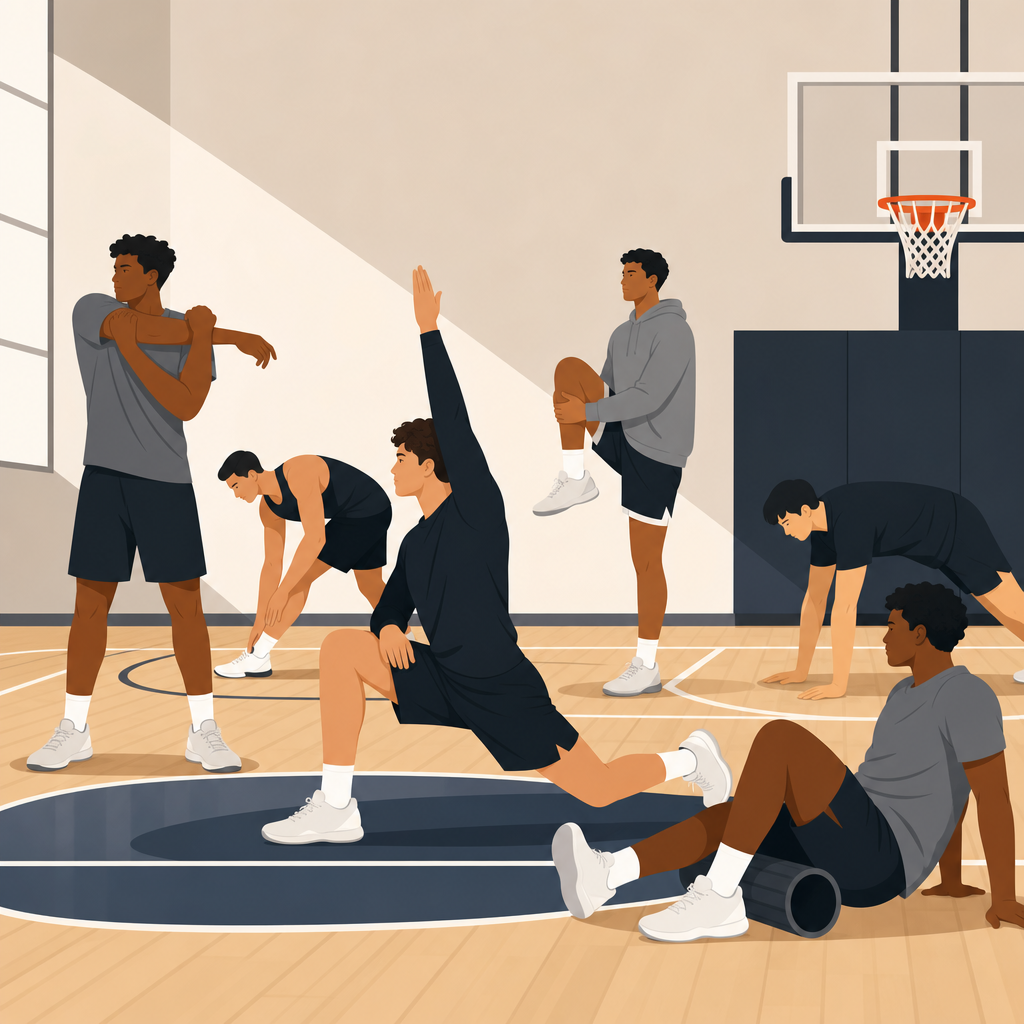
| Mobility | Restore usable range of motion | 3-4 minutes | Ankle rocks, world’s greatest stretch, T-spine rotation |
| Activation | Wake up key stabilizers and prime force production | 2-3 minutes | Glute bridge, mini-band walks, calf raises, dead bug |
| Movement Prep | Rehearse basketball footwork and deceleration | 3-5 minutes | Shuffles, backpedal to sprint, closeout steps, stick landings |
| Neural Ramp-Up | Prepare for explosive actions and reaction speed | 2-4 minutes | Pogo hops, short accelerations, snap downs, mirror cues |
Mobility and Activation That Actually Transfer to Basketball
Not all mobility work belongs in a pre-practice setting. Long static holds may have a place after training or in separate recovery sessions, but before basketball, the emphasis should be dynamic and controlled. For ankles, knee-over-toe rocks and split-stance ankle drives help players access dorsiflexion needed for squatting into stance, landing, and changing direction. For hips, adductor rocks, hip openers, and lunge variations improve the positions used in defensive slides and acceleration angles. Thoracic rotations matter because passing, shooting alignment, and defensive reaching all depend on the upper back moving well without the lower back doing too much.
Activation should be specific, brief, and technical. A set of glute bridges with full hip extension teaches athletes to use the posterior chain instead of living in the quads and low back. Mini-band lateral walks can help athletes feel the glute medius before shuffles and closeouts, provided the band is not so heavy that posture collapses. Calf raises and pogo patterns prepare the lower leg for repeated jumping and landing. Dead bugs, bear holds, and tall-plank shoulder taps organize the trunk so force can transfer from the floor through the hips and into the upper body. On upper-body dominant days, I often add scap push-ups or band pull-aparts because many players arrive rounded through the shoulders after school, work, or travel.
The key is dosage. Two high-quality sets beat six rushed sets every time. If a movement improves position and feel immediately, keep it. If it turns into a mobility circus with no visible carryover, remove it. Good basketball programs are selective.
Movement Prep for Speed, Defense, and Deceleration
Once mobility and activation are in place, the player needs to move like a basketball athlete. This is where many warm-ups become too linear. Basketball is not track sprinting in a straight lane. It is acceleration, braking, re-acceleration, crossover steps, lateral shuffles, drop steps, retreats, and hip turns in tight spaces. Movement prep should reflect that reality. I like to start with stance switches and snap downs to reinforce posture: ribs down, hips back, feet active, chest over the base. Then I layer in lateral marches, defensive slides with clean foot replacement, and shuffle-to-sprint transitions. These teach players to own the first step rather than reaching and losing balance.
Deceleration deserves special attention because many non-contact injuries happen when athletes cannot absorb force efficiently. Simple stick landings from a low hop, split stance drops, and two-step decels teach players to lower the center of mass, align the knee over the foot, and use the hips. For guards, I often include retreat dribb—before the ball, retreat footwork patterns—because the ability to stop and create space begins with braking mechanics. For forwards and centers, wider-base closeout patterns and rebound landing positions are useful because they face more contact and vertical contests around the paint.
This stage also helps coaches clean up technical habits. If a player’s knees cave inward on every landing, if the heels crash into the floor, or if posture collapses during shuffles, those are coaching opportunities before fatigue and competition hide them. Warm-ups are diagnostic as much as preparatory.
How to Build Warm-Ups Into Programs and Workouts
As a hub within basketball training, warm-ups should connect to the rest of the weekly plan. On a skill day, keep the routine efficient and movement-rich, then transition into finishing, shooting, or ball-handling. On a lower-body strength day, include more ankle, hip, and landing work because the session will demand force production. On a conditioning day, use the final ramp-up to introduce tempo and directional changes similar to what comes later. Before pickup or league games, shorten the floor-based mobility and prioritize movement prep, short accelerations, and a few explosive contacts so players do not feel flat.
Age and training level matter. Youth players need simpler language and more rehearsal. A middle school athlete may only need marching, skips, ankle rocks, glute bridges, shuffles, and short runs. Advanced high school and college players can handle more precise drills, including isometric split squat holds, low-amplitude plyometrics, and reactive cues. Return-to-play athletes need individualized modifications. Someone recovering from an ankle sprain may require extra foot intrinsic work, calf loading, and controlled decels before joining normal practice. A player with patellar tendon pain may benefit from isometric knee extension or Spanish squat variations before jumping volume increases.
Environment matters too. In crowded school gyms, you may have one sideline and six minutes. In that case, organization beats complexity. Build a routine that flows in lanes and can be repeated all season. Consistency creates buy-in. Players perform better when they know exactly how to get ready.
Common Warm-Up Mistakes and What to Do Instead
The most common mistake is going straight to shooting. Shooting feels productive, but form often degrades when ankles, hips, trunk, and shoulders are still stiff. Another mistake is overusing static stretching immediately before explosive work. Static stretching is not automatically harmful, but a pre-basketball routine built entirely around long holds usually misses the speed and coordination demands of the sport. A third mistake is making the warm-up exhausting. If players are winded before the workout starts, the routine has become conditioning rather than preparation.
I also see too much randomness. Coaches pull exercises from social media without asking whether they fit the session, the roster, or the available space. One day the team does yoga flows, the next day ladder drills, the next day random hurdle hops. Variety can help motivation, but the underlying structure should stay stable. Finally, many athletes skip the mental side. A useful warm-up includes attention cues: eyes up, active feet, quiet torso, stick the landing, communicate on slides. Those cues improve transfer because players are not just moving; they are practicing how to move.
The fix is straightforward. Standardize the sequence, choose drills that solve actual basketball problems, and measure success by movement quality and readiness, not by sweat alone. If the first live rep of practice looks better than it used to, the routine is working.
A Practical Pre-Ball Template You Can Use Today
Start with 60 to 90 seconds of skipping, light jogging, or jump rope. Move into ankle rocks, adductor rocks, and a lunge with thoracic rotation for five to six reps per side. Add glute bridges, mini-band lateral walks, and dead bugs for one to two controlled sets. Then perform snap downs, defensive slides, backpedal-to-sprint transitions, and stick landings. Finish with two or three short accelerations of 5 to 10 meters, a set of pogo hops, and one reactive movement such as mirroring a partner’s first step. At that point, touch the ball and begin your skill block.
This template works because it covers the main demands without wasting time. It also scales easily. Team coaches can run it for fifteen players. Individual athletes can complete it alone. Strength coaches can align it with force-plate testing, sprint timing, or jump monitoring if they want additional readiness data. The principle stays the same: preparation first, then performance.
A smart basketball warm-up routine is one of the highest-value pieces of any training program because it improves readiness without adding much fatigue or equipment. It helps players move cleaner, transition into skill work faster, and reduce the careless first-rep mistakes that often lead to strains, rolled ankles, and poor practice quality. More importantly, it creates continuity across programs and workouts. Whether the day’s goal is shooting, strength, speed, conditioning, or team tactics, the warm-up becomes the reliable bridge between daily life and basketball performance.
The main takeaway is not that every player needs the exact same drills. It is that every player needs a consistent sequence that raises temperature, restores key mobility, activates stabilizers, rehearses basketball movement, and ramps intensity before touching the ball. Keep it specific, keep it repeatable, and adjust it for age, role, injury history, and session demands. That is how warm-ups stop being filler and start becoming part of development.
If you are building your basketball training plan, start here. Audit your current routine, remove anything random, and create a ten-to-fifteen-minute progression you can follow before every workout. Then connect this hub to your next priorities: strength training, plyometrics, speed work, conditioning, and recovery. Do the warm-up well, and every rep that follows has a better chance to count.
Frequently Asked Questions
What should a basketball warm-up routine include before you touch the ball?
A complete basketball warm-up should do four things before you ever dribble, pass, or shoot: raise body temperature, improve joint mobility, activate key muscle groups, and sharpen your nervous system so your first explosive movement does not come as a surprise to your body. In practical terms, that means starting with light movement such as brisk walking, skipping, shuffles, or easy jogging to get warm, then moving into dynamic mobility work for the ankles, hips, thoracic spine, and shoulders. After that, the warm-up should include activation drills for the glutes, core, and upper back, because those areas help stabilize nearly every basketball action, from deceleration to jumping to changing direction. Finally, it should finish with short, progressive movement prep like skips, closeout steps, acceleration buildups, and low-volume jumps so the nervous system is ready for basketball speed. The goal is not to get tired. The goal is to feel loose, awake, coordinated, and ready to move well at game pace from the very first rep.
Why is jogging a lap and doing a few static stretches not enough before basketball?
That old routine is common because it feels simple and familiar, but it leaves major gaps. A lazy lap may raise your temperature slightly, and a couple of static stretches may make you feel like you did something productive, but basketball places much bigger demands on the body than straight-ahead jogging and passive stretching can prepare you for. The sport requires rapid stops, starts, cuts, jumps, landings, rotations, and reactions. Your warm-up needs to prepare the tissues and movement patterns that handle those demands, especially around the ankles, knees, hips, and trunk. Static stretching before intense play can also reduce the sense of stiffness without actually improving your readiness to produce force, control your body, or react quickly. More importantly, it does not teach your body to coordinate movement under speed. A proper basketball warm-up is active and progressive. It builds from general motion into sport-specific positions and efforts. That is what helps performance and lowers injury risk. If your first true acceleration, hard deceleration, or explosive jump happens after the warm-up is over, then your warm-up was incomplete.
How long should a proper basketball warm-up take?
For most players, a high-quality basketball warm-up takes about 10 to 20 minutes. The exact length depends on your age, training history, injury history, the intensity of the session, and how much time you have before practice or games. Younger players with good movement quality may be ready on the shorter end, while older athletes, players with previous ankle or knee issues, or anyone heading into a high-intensity workout usually benefits from a longer ramp-up. What matters most is not the clock alone but the sequence and intent. You should feel your body temperature rise first, then your joints should move more freely, then your muscles should feel switched on, and finally your feet and reaction speed should feel sharper. If you still feel stiff, sluggish, or disconnected, you are probably not done. On the other hand, if your warm-up turns into conditioning and you are sweating heavily before the real work starts, you have likely done too much. A good benchmark is finishing the warm-up feeling springy, focused, and physically prepared, not fatigued. In most cases, 12 to 15 well-structured minutes beats 25 minutes of random drills every time.
Which body areas matter most in a basketball warm-up?
The most important areas to address are the ankles, feet, hips, thoracic spine, shoulders, core, and glutes. Basketball is a ground-based sport, so everything starts with the feet and ankles. If those areas are stiff or unprepared, players often struggle to absorb force, change direction efficiently, or get into strong defensive positions. The hips matter because they drive sprinting, jumping, lateral movement, and deceleration. The thoracic spine and shoulders are often overlooked, but they help with posture, arm swing, rotation, passing mechanics, and overhead movement. The core matters because it transfers force between the lower and upper body and helps you stay balanced when you stop, cut, absorb contact, or finish at the rim. The glutes are especially important because they support hip stability and power production, and they help take pressure off the knees during athletic movement. A strong warm-up does not isolate these areas in a bodybuilding sense. It prepares them to work together through basketball patterns. That is why dynamic lunges, hip openers, ankle mobility drills, band activation, skips, and movement transitions tend to outperform random stretching when the goal is real game readiness.
Can a good warm-up really improve performance and reduce injury risk?
Yes, and that is one of the biggest reasons it deserves more attention from players at every level. A smart warm-up improves performance because it helps your muscles contract faster, your joints move more efficiently, and your nervous system react more quickly. That translates to better first-step speed, cleaner footwork, stronger jump mechanics, sharper defensive slides, and more control when decelerating. It also improves decision-making indirectly, because players who feel physically ready tend to process the game faster and move with more confidence. From an injury standpoint, a proper warm-up reduces the shock of going from cold to explosive. It gives your body a progressive build into the demands of sprinting, cutting, landing, and contact. While no warm-up can eliminate injury risk completely, it can lower the chances of preventable problems that often show up when players are stiff, underprepared, or mechanically sloppy in the opening minutes. In simple terms, a good warm-up gives you a better chance to move well before fatigue and chaos enter the picture. That is exactly when good preparation matters most.