
Basketball training gear in 2026 is no longer a grab bag of cones, bands, and whatever ball happens to be in the trunk; it is a defined system of equipment that improves skill development, movement quality, recovery, and durability when each piece is chosen for a specific job. Training gear includes the tools players use outside of game uniforms and team-issued hardware: basketballs for skill work, footwear support products, portable shooting aids, resistance tools, agility markers, recovery devices, wearable tech, and storage solutions that make practice repeatable. I have built home setups for youth guards, outfitted travel players for tournament weekends, and helped adult athletes stop wasting money on gimmicks, and the same pattern appears every time: the best results come from buying fewer items with clearer purpose. That matters because the modern player trains year-round. Offseason skill sessions, in-season maintenance workouts, driveway reps, and rehab-based return-to-play plans all depend on gear that is durable, portable, and safe on the surfaces where people actually practice. The market has also changed. Smart sensors, better foam materials, more accurate rebounding aids, and stronger compact racks have made serious training accessible at home, but price inflation means poor choices are expensive. A useful training gear guide must answer practical questions directly: what equipment makes the biggest difference, what can wait, what works for guards versus wings or post players, and what belongs in a home court, garage, or team bag. This hub does that by breaking down every category worth buying in 2026, with clear recommendations based on function rather than hype.
The core skill gear every player should buy first
If the budget is limited, start with the equipment that multiplies touches on the ball and quality of footwork. That begins with two basketballs, not one. A primary indoor or indoor-outdoor composite ball should match regulation size and weight for the player’s level, while a secondary ball handles outdoor wear and high-volume dribbling. Wilson Evolution remains the reference point for indoor feel in schools and rec centers, while Baden Elite Pro, Nike Elite All-Court, and The Rock continue to be credible alternatives depending on grip preference and budget. For outdoor use, a durable rubber or composite cover matters more than premium softness because rough concrete strips covers quickly. Two-ball dribbling, alternating pound series, and quick reload shooting reps become smoother when players are not chasing a single ball after every mistake.
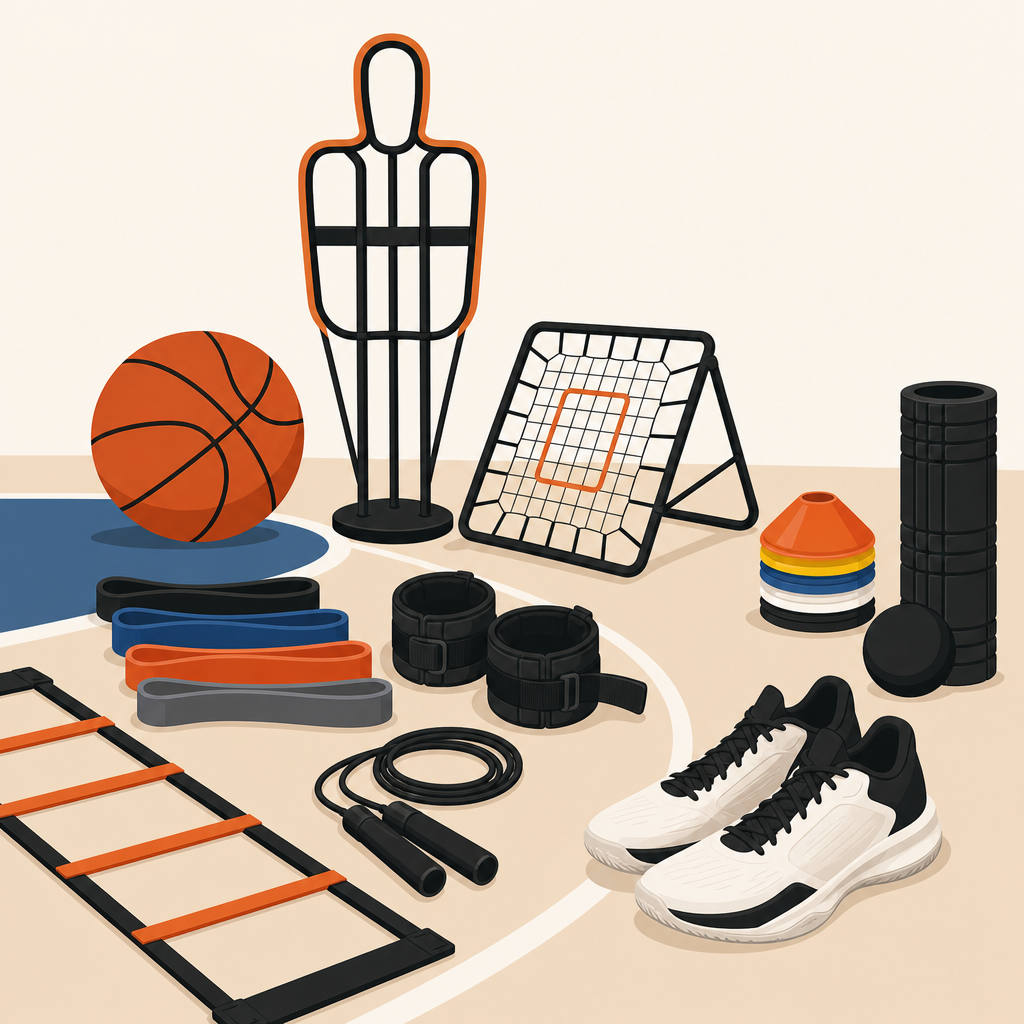
Next come cones, flat markers, and a quality jump rope. I prefer low-profile disc cones over tall traffic cones for basketball because players can safely step on them without rolling an ankle. They are better for closeout angles, change-of-direction patterns, and spot shooting maps. A speed rope with adjustable cable length develops rhythm, lower-leg stiffness, and conditioning with less space than almost any other tool. Add a pair of resistance minibands for glute activation and knee tracking work, and you have the foundation of a serious individual workout setup. None of these items are glamorous, but they are used constantly. Players who skip them usually end up improvising drills poorly, which lowers rep quality and increases dead time.
One more first-buy item deserves emphasis: a stable backpack or duffel built for basketball. Training falls apart when gear is scattered, pumps are missing, and bands are tangled under dirty shoes. Good bags now include ball sleeves, ventilated shoe compartments, laptop or tablet sleeves for film review, and water-resistant pockets for tape or recovery tools. Nike Elite, adidas Defender, and Under Armour Undeniable lines remain common because they solve basic organization problems well. In practical terms, consistency is a piece of equipment, and a bag that keeps the routine intact is worth the money.
Shooting and ball-handling tools that create more quality reps
The most valuable shooting accessory in 2026 is still a rebounding aid. A net-mounted return system such as the Dr. Dish Home Return, Goalrilla Yard Guard-style setup, or similar chute-based attachment saves enormous time for driveway and garage players. The benefit is not convenience alone; it preserves workout density. In a twenty-minute block, a player using a reliable return can often take dozens more game-speed attempts than a player chasing long misses. That difference compounds over months. A return system is especially useful for free throws, one-dribble pull-ups, and relocation shooting because it keeps the athlete near intended spots instead of turning every set into a sprint after the ball.
For ball handling, the market is crowded with gadgets, but only a few categories consistently deliver. Dribble goggles are useful when used sparingly to teach body position and reduce downward eye dependence, particularly for younger players who have not developed comfort handling under visual pressure. Weighted basketballs can help for brief strength-oriented segments, but they are often overused. A ball that is too heavy alters timing and wrist mechanics, so it should supplement, not replace, regulation-ball work. More reliable purchases are hand-placement wraps, tennis balls for reactive catches, and compact reaction lights that cue direction changes. BlazePod remains a recognizable option in skill studios because it combines color cues, timing, and randomization in one system, though cheaper timer-based alternatives can work for home users.
Passing targets are another underrated category. Wall-mounted target squares, numbered tape boxes, or portable nets give structure to solo passing sessions. Chest passes, hook passes, and one-hand push passes improve faster when the athlete has a precise visual aim point and can track hit percentage. I have seen players gain more from disciplined wall passing with targets than from expensive novelty dribble attachments. Basketball skill improves through repeatable constraints, not through equipment that tries to perform the skill for you.
Strength, speed, and movement gear worth owning
Basketball performance depends on force production, deceleration, and joint control, so training gear should support those qualities without pretending to replace a full weight room. Resistance bands are the most versatile buy in this category. Long loop bands handle assisted mobility, pull-aparts, rows, Pallof presses, and jump-prep work. Minibands support lateral walks, hip activation, and ankle stability circuits. Because bands wear over time, choose layered latex or fabric-covered options from established brands and inspect them regularly for tears. A broken bargain band under tension is not a minor inconvenience; it is a real injury risk.
Medicine balls and slam balls also earn their place when the training area allows overhead and rotational work. Basketball players benefit from scoop tosses, side throws, snap-downs, and catch-to-throw drills that teach force transfer from the floor through the torso. The key is choosing the right weight. Most guards and wings get more value from controlled speed with moderate loads than from grinding through throws that are too heavy. A 4- to 8-pound medicine ball often does more for athletic sequencing than a 12-pound ball moving slowly. For lower-body explosiveness, a plyometric box with non-slip surface is useful, but only if technique and landing mechanics are coached. Step-ups, low box jumps, depth-drop progressions, and split-squat variations are all productive; maximal box height contests are not training.
Sliders, suspension trainers, and lightweight adjustable dumbbells round out the home-friendly category. Sliders are excellent for adductor work, hamstring curls, and core anti-extension drills, all of which support change of direction. Suspension trainers allow rows, split squats, push-ups, and assisted single-leg patterns in small spaces. Adjustable dumbbells save room and make unilateral strength work practical for athletes who do not have a rack. These tools are less flashy than vertical jump gadgets, but they contribute directly to the qualities that actually show up on the court.
Recovery, support, and injury-prevention equipment that pays off
Players often overspend on training aids and underspend on the gear that keeps them available. The most worthwhile recovery purchase is a dense foam roller paired with a firm lacrosse or massage ball. Those two tools address calves, plantar fascia, glutes, thoracic spine, and posterior shoulder tissue with enough precision for daily use. A massage gun can help with short bouts of tissue work before practice or between games, but it should be viewed as a convenience tool, not a substitute for sleep, nutrition, and load management. Hyperice and Therabody remain prominent because their devices are reliable, though many mid-priced models are now strong enough for recreational athletes.
Ankle support deserves separate attention because basketball still produces a high number of inversion sprains. Semi-rigid braces from McDavid, Zamst, and ASO are worth buying for players with previous ankle injury history, especially during return-to-play phases or on crowded tournament schedules. Braces are not magic shields, and they do not replace strength, balance, and landing mechanics, but they can reduce exposure during vulnerable periods. Orthotic insoles are another smart purchase for some athletes, particularly those with recurring plantar pain or poor shoe fit. Brands like Move and Superfeet have become more common in basketball circles because they improve underfoot support without forcing players into entirely new shoes.
Hydration tools count as training gear too. An insulated bottle with clear volume markings helps athletes monitor intake across long sessions, and electrolyte tablets are useful during summer tournaments or double-session camps. Cramping is not always just a hydration problem, but fluid and sodium planning are basic performance habits. The same goes for tape, finger sleeves, blister patches, and nail clippers in a small medical pouch. The best-equipped players are rarely the ones with the fanciest accessories; they are the ones who are prepared for the ordinary issues that interrupt practice.
What to buy by budget, player type, and training space
The smartest basketball training gear purchase depends on who is using it and where. A middle-school ball handler in a driveway needs different tools than a college forward with weight-room access. Start with constraints. Ceiling height affects whether a rebounder, medicine ball, or jump rope is practical. Surface matters because concrete is hard on balls, knees, and portable bases. Storage matters because equipment that is annoying to set up usually goes unused. Use this framework when building a training kit in 2026.
| Situation | Best first purchases | Why they matter |
|---|---|---|
| Beginner youth player | Two balls, disc cones, jump rope, minibands, backpack | Builds basic coordination, organization, and high rep volume cheaply |
| Serious guard training at home | Rebound return, dribble goggles, reaction lights, sliders, foam roller | Supports shooting density, tighter handle work, deceleration, and recovery |
| Wing or forward with garage space | Adjustable dumbbells, long bands, plyo box, medicine ball, brace kit | Adds strength and power work without needing a full rack |
| Tournament travel player | Ankle braces, insoles, massage ball, bottle, organizer pouch | Improves durability and readiness during compressed game schedules |
Budget also changes the order of operations. Under $150, prioritize a ball setup, markers, bands, rope, and recovery basics. Between $150 and $500, add a rebounder or strength tools depending on whether skill work or physical development is the current bottleneck. Above $500, the best investments are usually durable systems with daily use value, not novelty tech. That might mean a quality return attachment, adjustable dumbbells, or a better portable hoop base rather than a single-purpose gadget that feels innovative for one week and then collects dust.
How to avoid bad purchases and keep gear useful longer
Bad basketball training gear usually fails in one of three ways: it breaks, it changes mechanics negatively, or it creates friction that reduces use. Avoid products with vague performance claims, no listed dimensions or materials, and no evidence of repeatable application. If a device promises instant vertical gain, perfect shooting form, or game-speed handles without coaching, it is almost certainly exaggerating. Read whether the item matches regulation conditions. A shooting aid that changes release path too aggressively can do more harm than good. A balance tool that is unstable on concrete may simply be unsafe.
Durability is easier to judge when you check simple details. Rubber feet on ladders and boxes reduce sliding. Reinforced stitching matters on bags and bands. Weather resistance matters for any item that will live near an outdoor hoop. Pumps should have spare needles. Braces should have replaceable straps. Smart devices should have clear battery life, app support history, and a usable experience without mandatory subscriptions. I have seen families spend heavily on connected training products only to abandon them because the setup took longer than the drill.
Maintenance is straightforward but often ignored. Rotate indoor and outdoor balls. Wipe sweat off bands and rollers. Air out shoes and braces. Store batteries and chargers in one pouch. Replace worn tape and cracked needles before a workout is blocked by something trivial. Most importantly, audit gear every few months. If an item has not supported a meaningful drill cycle, sell it, donate it, or remove it from the bag. Effective training spaces are not packed with equipment; they are built around tools that get used consistently. For readers exploring the wider Basketball Equipment category, this training gear hub should sit alongside your pages on basketballs, portable hoops, shoes, braces, and court accessories, because the best setup comes from choosing pieces that work together. Buy for function, train with intent, and build a kit that helps you get more quality reps every week.
Basketball training gear is worth buying in 2026 when it solves a real problem: increasing useful reps, improving movement quality, or helping the body hold up across a long season. The essentials remain clear. Start with regulation basketballs, flat markers, bands, a rope, and a bag that keeps practice organized. Add a rebound return when shooting volume is the priority. Add dumbbells, medicine balls, or sliders when strength and deceleration are limiting performance. Protect availability with foam rollers, massage balls, hydration tools, ankle support, and insoles when needed. The common mistake is treating every product as equally important. It is not. Some gear multiplies practice. Some gear preserves health. Some gear mainly markets aspiration.
The main benefit of a well-built training kit is consistency. When equipment matches the athlete’s age, position, budget, and space, sessions become easier to start and easier to repeat. That repeatability is what turns ten-minute driveway workouts into thousands of extra touches, and basic recovery habits into more games played without interruption. A strong sub-pillar hub should help readers move from broad interest to confident buying decisions, and this page is designed to do that for training gear within the broader Basketball Equipment topic. Use it as your baseline, then build outward into detailed guides on shooting aids, resistance tools, recovery devices, and travel essentials. Review your current setup, remove the gimmicks, and buy the next piece that will genuinely improve how you train.
Frequently Asked Questions
What basketball training gear is actually worth buying in 2026?
The best basketball training gear in 2026 is the equipment that solves a specific training problem, not the gear with the most hype or the longest feature list. For most players, the most worthwhile purchases fall into five categories: skill development tools, movement and footwork equipment, strength and resistance tools, recovery devices, and durability or support products. A high-quality basketball should always come first, because every player needs consistent feel, grip, bounce, and weight during ball-handling, shooting, and finishing drills. After that, simple tools like agility cones, floor markers, and resistance bands provide enormous value because they can be used for footwork patterns, closeout drills, change-of-direction work, and activation routines without taking up much space or requiring a big budget.
Portable shooting aids are also worth buying if they help you get more high-quality reps in less time. That could mean a return net, a shot arc trainer, or other tools that improve repetition and feedback. The key is whether the product supports mechanics and efficiency instead of becoming a gimmick. Recovery gear has also become a serious category in 2026, especially for players training year-round. Massage guns, foam rollers, mobility balls, compression tools, and other recovery devices can help reduce stiffness, improve tissue quality, and support better movement between sessions. Finally, support products such as performance insoles, ankle braces, compression sleeves, and shoe care items can protect your investment in footwear and help with comfort and durability. The smartest buying strategy is to build a system: one primary ball, one set of agility markers, a few resistance tools, one or two shooting aids, and a basic recovery setup. That combination covers most of what a player needs to train well and stay available.
How do I choose basketball training equipment based on my position, age, and skill level?
The right basketball training equipment depends heavily on how you play, how old you are, and what stage of development you are in. Guards typically benefit most from tools that improve handle efficiency, acceleration, deceleration, and shooting repetition. That means a premium game-feel basketball, dribble goggles, agility markers, mini hurdles, resistance bands, and shooting aids often make sense. Wings need a more balanced setup because they are usually training for ball-handling, perimeter shooting, transition movement, and finishing through contact. For them, a mix of ball skills equipment, footwork tools, resistance products, and recovery devices is usually the best approach. Bigs may place more value on equipment that supports footwork in tight spaces, balance, strength development, mobility, and finishing mechanics near the basket.
Age matters just as much. Younger players usually need simpler, more versatile equipment rather than advanced or expensive tools. A quality ball, cones, markers, a jump rope, and light resistance bands are often enough to build strong habits. At that stage, the goal is coordination, rhythm, body control, and repetition. High school and college players generally benefit from more specialized tools because their training becomes more position-specific and physically demanding. Recovery gear starts to matter more, and support products such as braces or insoles may become relevant depending on workload and injury history. Skill level also changes what is worth buying. Beginners should prioritize equipment that teaches fundamentals and encourages frequent use. Advanced players can justify investing in gear that delivers feedback, saves time, or targets smaller performance gaps. In other words, do not buy like a pro if your needs are still basic, and do not train with only beginner tools if your development now depends on precision and volume.
Are expensive basketball training gadgets better than basic gear?
Not necessarily. In fact, some of the most effective basketball training setups are built around basic gear used with intention. A great ball, a durable set of cones, resistance bands, a jump rope, and a foam roller can support elite-level work when the drills and programming are sound. Expensive gadgets only become worth the money if they improve feedback, increase training efficiency, or help maintain consistency over time. For example, a shooting return system can be a smart purchase because it reduces rebounding time and allows more shots per session. A recovery device may be worthwhile if it helps you stay loose enough to train well on back-to-back days. But products that promise dramatic results without requiring skill work, repetition, or good movement quality usually do not deliver meaningful value.
The best way to judge a product is to ask what job it does better than a lower-cost alternative. Does it help you get more reps, create measurable feedback, improve safety, or save enough time to justify the price? If the answer is yes, it may be a strong investment. If the answer is vague, it is probably a convenience item rather than a performance tool. In 2026, there is a bigger divide than ever between useful training technology and branded clutter. Players should be especially careful with products marketed as “must-have” performance hacks. Basic gear remains the foundation of serious training because it is portable, proven, and adaptable. Expensive equipment should be layered on top of that foundation only when it fills a clear gap in your current routine.
What recovery and durability gear should basketball players buy in 2026?
Recovery and durability gear has become one of the smartest areas to invest in because availability is a skill. If you are constantly sore, tight, or dealing with small overuse issues, your actual on-court development suffers no matter how good your workouts are. A basic recovery kit should include a foam roller, a massage ball or lacrosse ball for targeted soft tissue work, and a massage gun if you train frequently and tolerate percussion work well. These tools can help reduce stiffness in the calves, quads, glutes, hips, and upper back, which is especially valuable for players who jump often, sprint repeatedly, and spend a lot of time in low positions. Mobility bands and stretching straps are also useful for improving movement quality and maintaining joint range of motion between hard sessions.
Durability gear also includes support products that keep your body and footwear functioning well over time. Ankle braces or supportive taping alternatives can be helpful for players with a history of ankle sprains, while performance insoles may improve comfort, fit, and impact management depending on the shoe. Compression sleeves can offer warmth and light support, though they are not a substitute for strength or rehab. Shoe deodorizers, extra laces, grip wipes, and proper storage gear may sound minor, but they help preserve the condition and performance of expensive basketball shoes. Hydration tools, shaker bottles, and organized training bags also contribute more than people realize because they support consistency and readiness. The real takeaway is that recovery gear is not just about feeling better after workouts. It is about maintaining movement quality, reducing interruptions, and giving yourself a better chance to train hard week after week.
How should I build a complete basketball training gear setup without overspending?
The best way to build a complete basketball training gear setup is to buy in phases, starting with the tools that have the broadest impact. Phase one should cover essentials: a high-quality basketball, basketball shoes that fit well, a pump and needle, agility cones or floor markers, and a jump rope. That gives you enough equipment to work on ball skills, footwork, conditioning, and basic movement patterns right away. Phase two can add resistance bands, mini bands, a simple shooting aid, and a backpack or organizer that keeps your equipment ready to use. At that point, you have a strong practical system for individual training without buying anything excessive. Phase three is where recovery and support products come in, such as a foam roller, mobility ball, massage gun, ankle support, and insoles if needed.
The key to avoiding overspending is to match each purchase to a recurring use case. If a tool only works for one drill you rarely perform, it is probably not a priority. If a product can be used three or four times per week across multiple parts of training, it is usually worth stronger consideration. It also helps to think in terms of return on repetition. A better ball improves every dribble and shooting rep. Cones can be used in dozens of drills. Bands support warm-ups, strength work, and rehab. That is a much better value than novelty gear that sits in a closet after a week. In 2026, the smartest players are not buying more gear than ever; they are buying more intentionally. A lean, well-chosen setup nearly always outperforms a cluttered one, because it gets used consistently and fits into real training habits.