

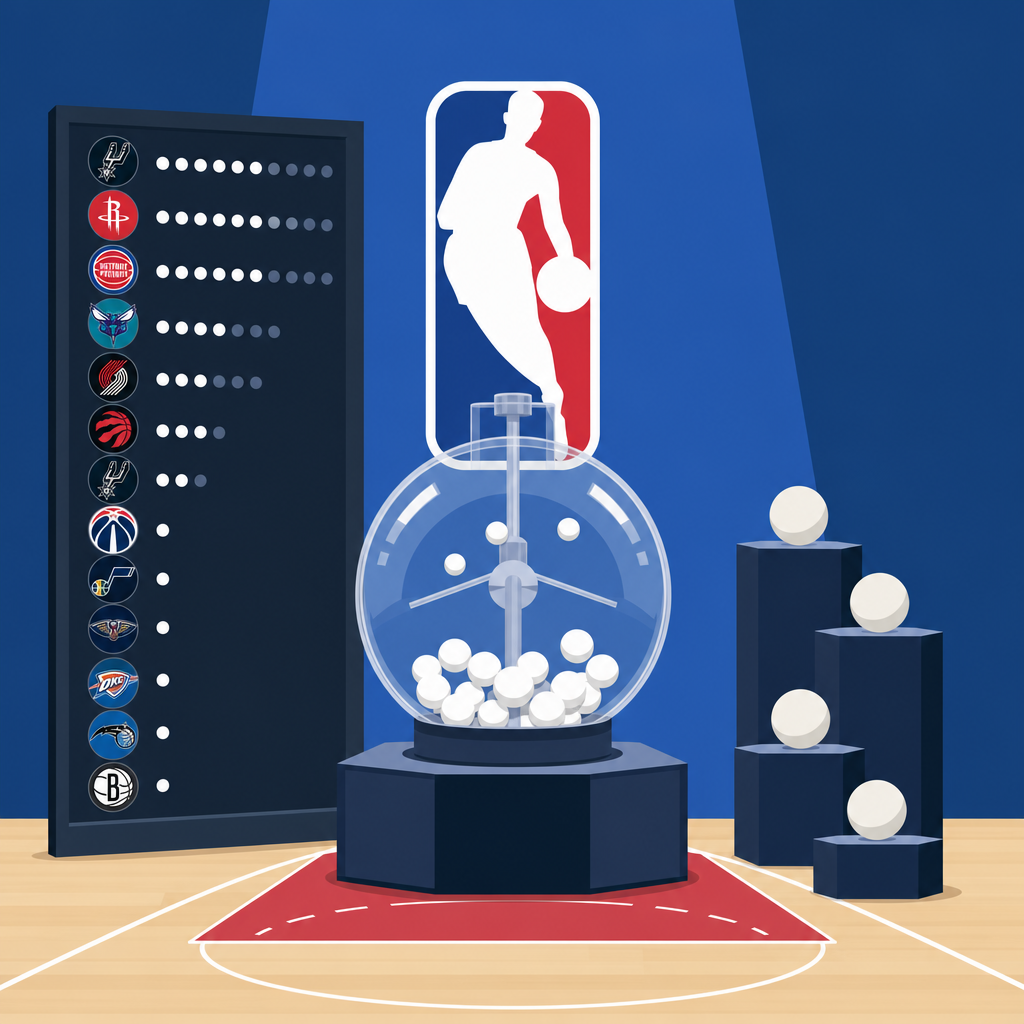
The NBA Draft Lottery determines the order of the first 14 picks in the NBA draft, but it does not simply reward the worst team with the No. 1 selection. Instead, it uses a weighted lottery system for the teams that missed the playoffs, combining probabilities, tie-breaking rules, and a formal drawing process overseen by accountants and league officials. For fans trying to understand why a team can finish with one of the league’s worst records and still land the fifth pick, or how a play-in hopeful can jump into the top four, the lottery is the key mechanism.
In practical terms, the NBA Draft Lottery exists to balance two competing goals. First, it gives weaker teams access to elite young talent. Second, it discourages outright losing by preventing the worst record from guaranteeing the top pick. I have covered draft cycles where front offices clearly weighed the short-term pain of losing against the possibility of landing a franchise player, and the lottery rules shape that calculation every season. The current system is designed to flatten the odds at the bottom, add uncertainty, and preserve competitive integrity while still helping struggling teams.
To understand how the NBA Draft Lottery works, you need to know four core ideas: which teams are eligible, how lottery odds are assigned, how the drawing itself is conducted, and how the remaining draft order is set after the top picks are selected. You also need to understand a few related concepts, including protections on traded picks, tie-breaking procedures, and the difference between regular-season record and actual lottery position. This article serves as a full Draft Explained hub for that process, so you can move from basic definitions to the exact step-by-step mechanics.
The lottery matters because the draft can alter a franchise for a decade. Winning the rights to select players like LeBron James, Tim Duncan, Victor Wembanyama, or Zion Williamson changed organizational timelines overnight. Even when the top class is less obvious, moving from the middle of the lottery into the top four can mean access to a higher tier of prospects, stronger trade leverage, and a clearer rebuilding plan. That is why the NBA Draft Lottery draws intense attention from team executives, agents, media, and fans every spring.
Which teams enter the NBA Draft Lottery
The 14 teams that do not qualify for the playoffs enter the NBA Draft Lottery. Since the play-in tournament affects who officially reaches the postseason bracket, lottery eligibility is determined by who misses the playoffs, not simply by regular-season rank before the play-in. Once the 16 playoff teams are set, the other 14 become lottery teams. Their regular-season records then establish their initial odds and their baseline order if they do not jump into the lottery-selected picks.
The lottery only decides the first four picks. That is the most important structural point for many fans, because older explanations often referred to the first three picks under prior rules. Under the current system, drawings are held for picks one through four. After those four slots are assigned, the remaining lottery teams are ordered by regular-season record, from worst to best, subject to any tie-breakers and any pick-trade obligations already in place.
Eligibility can become confusing when traded picks are involved. A team may technically enter the lottery, but another team may own its first-round pick outright or conditionally. For example, if Team A traded its first-round pick to Team B with top-10 protection, Team A’s lottery position still exists, but who ultimately receives the pick depends on where it lands. If it lands in the protected range, Team A keeps it. If it falls outside the protected range, Team B receives it. This is why lottery broadcasts often show both the team by record and the team that controls the selection.
One more nuance matters: the NBA uses regular-season record, not projected team strength, injuries, or future outlook, to assign lottery odds. A 22-win roster devastated by injuries is treated the same as a 22-win roster in a full rebuild. The system is objective by design, even if context changes how observers judge the fairness of the result.
How lottery odds are assigned
The NBA Draft Lottery uses 1,000 possible number combinations to distribute the top four picks among the 14 lottery teams. The league assigns those combinations based on regular-season record, with worse teams receiving more combinations and better non-playoff teams receiving fewer. Since the 2019 reform, the three worst teams each receive the same top odds for the No. 1 pick: 14.0 percent. This flattened structure reduced the incentive to finish with the single worst record.
Here is the basic odds ladder used in the modern lottery for the No. 1 pick, and the same combination structure also drives the chances of landing anywhere in the top four. The worst, second-worst, and third-worst teams each have 14.0 percent odds at No. 1. The fourth-worst team has 12.5 percent, the fifth-worst 10.5 percent, the sixth-worst 9.0 percent, the seventh-worst 7.5 percent, the eighth-worst 6.0 percent, the ninth-worst 4.5 percent, the tenth-worst 3.0 percent, the eleventh-worst 2.0 percent, the twelfth-worst 1.5 percent, the thirteenth-worst 1.0 percent, and the fourteenth-worst 0.5 percent.
| Lottery Position by Record | Chance at No. 1 Pick | Chance at Top 4 Pick |
|---|---|---|
| 1st worst | 14.0% | 52.1% |
| 2nd worst | 14.0% | 52.1% |
| 3rd worst | 14.0% | 52.1% |
| 4th worst | 12.5% | 48.1% |
| 5th worst | 10.5% | 42.1% |
| 6th worst | 9.0% | 37.2% |
| 7th worst | 7.5% | 31.9% |
| 8th worst | 6.0% | 26.3% |
| 9th worst | 4.5% | 20.2% |
| 10th worst | 3.0% | 13.9% |
| 11th worst | 2.0% | 9.4% |
| 12th worst | 1.5% | 7.1% |
| 13th worst | 1.0% | 4.7% |
| 14th worst | 0.5% | 2.4% |
Those percentages matter because they explain why dramatic jumps happen every year. A team with the tenth-worst record still has a meaningful 13.9 percent chance at a top-four pick. A team with the best record among lottery teams has only a 0.5 percent shot at No. 1, but that is not zero. When viewers call a result a surprise, it is usually surprising emotionally, not mathematically. The system is built to allow movement.
The flattening of odds was a direct policy choice. Before the rule change, the worst team had a significantly stronger chance at the top pick, and the league believed that structure encouraged aggressive losing. Under the current format, dropping from fourth-worst to third-worst does not create the kind of overwhelming advantage that once made late-season losses more strategically valuable.
Step by step: how the drawing actually works
The NBA Draft Lottery drawing is not a television gimmick. The actual process takes place in a secure room before the public reveal, with team representatives, league officials, and an independent accounting firm present. The firm traditionally associated with the process is Ernst & Young, which helps oversee procedural integrity. In the room, 14 ping-pong balls numbered 1 through 14 are placed in a lottery machine. Four balls are drawn to create a four-number combination.
Because four balls are selected from 14, there are 1,001 possible four-number combinations. The NBA assigns 1,000 of those combinations to the 14 lottery teams based on their odds. One combination is left unused. Before the drawing starts, every team knows which combinations belong to which lottery slot by record. This is why the process is auditable and rule-bound rather than discretionary.
The first drawing determines the No. 1 pick. The machine mixes the balls, four are drawn, and the resulting combination is matched to the team assigned that combination. That team wins the first overall pick. The same procedure is then repeated for the No. 2, No. 3, and No. 4 picks. If a combination is drawn for a team that has already won one of the prior top-four spots, or if the unused combination appears, the league simply redraws until a valid new team is selected for that slot.
After four teams have been chosen, the rest of the first-round order among lottery teams is set by inverse regular-season record. For example, if the fifth-worst team jumps to No. 1 and the ninth-worst team jumps to No. 3, the teams that did not move into the top four slide or hold accordingly. Importantly, a team cannot drop endlessly. The worst-record teams can fall only so far because only four picks are drawn. Under the current system, the worst team can drop no lower than fifth.
Television coverage usually reveals the results in reverse order of suspense rather than showing the live ball draws. That presentation often confuses new viewers. The envelopes or placards shown on broadcast are not the actual mechanism selecting teams. They are the public unveiling of results already determined in the supervised drawing room. Reporters in attendance later publish the exact combination outcomes, which helps verify the sequence.
Tie-breakers, pick protections, and traded selections
Tied records create an extra layer of procedure. When two or more lottery teams finish with the same regular-season record, the NBA conducts a random drawing to determine their order for lottery odds purposes if necessary. If the tied teams have equal odds, the assigned combinations are split as evenly as possible. The pre-lottery tie-break drawing also determines the order for positions outside the top-four results, which can matter for where teams land if neither jumps.
For example, if two teams tie for the sixth-worst record, they combine the odds for the sixth and seventh slots and divide the lottery combinations as evenly as possible. A separate random draw resolves who is considered sixth and who is seventh for any uneven remainder and for post-lottery ordering. This is a technical point, but it affects both probability and final placement.
Pick protections are equally important in understanding who benefits from lottery movement. Protections can be top-1, top-4, top-10, lottery-protected, or carry multiple future conditions. A top-4 protected pick means the original team keeps the selection only if it lands at No. 1 through No. 4. If it becomes No. 5 or lower, the receiving team gets it. This creates situations where a franchise can root both for a jump and for a miss, depending on the exact protected range.
Real front offices track these scenarios constantly. During the season, I have built lottery trackers that modeled not just where a team might pick, but whether it would keep the pick at all. That is why draft reporting often distinguishes between “own pick,” “swap rights,” and “conveyed pick.” A lottery result can reshape two franchises at once when a selection changes hands.
Why the lottery system exists and what it changes
The NBA Draft Lottery was created in 1985 to address concerns that teams had too much incentive to lose games intentionally for a guaranteed path to the top pick. Over time, the league repeatedly adjusted the format as teams adapted. The modern version reflects a broader league strategy: reduce the value of bottoming out without stripping rebuilding teams of access to elite prospects.
In practice, the lottery changes team behavior, but it does not eliminate strategic losing entirely. Franchises still know that worse records produce better odds and better worst-case outcomes. However, the difference between the very worst record and the next few slots is no longer large enough to make every extra loss overwhelmingly valuable. That is a meaningful shift. Executives still manage minutes, prioritize development, and weigh shutdown decisions late in the season, but the lottery adds enough uncertainty to blunt the payoff.
The system also affects trade markets. A pick from a struggling team is more valuable when it carries a realistic chance of becoming top four, but protections can sharply change that value. Teams and agents model these probabilities using public data, historical outcomes, and simulation tools. On draft night, that probabilistic value can turn into a franchise-altering asset or disappear because a protected pick stays with its original club.
Critics of the lottery argue that it can punish the very weakest teams by letting better teams jump them. Supporters argue that this is exactly the point: poor performance should be helped, not guaranteed. Both views have merit. The league has chosen uncertainty over certainty because it believes competitive balance depends not only on assisting bad teams, but also on avoiding a system that openly rewards deliberate losing.
How to read lottery results like a draft expert
When the lottery order is announced, start with three questions. First, which teams moved into the top four? Second, which teams slid relative to their record? Third, which traded picks changed hands because of protections? Those answers explain almost every major consequence of the event.
Next, separate the result from the class strength. Winning the lottery in a draft with a clear generational prospect is different from winning a year with a flatter board. The same jump in slot value can mean dramatically different basketball value depending on the talent tier. Scouts, front offices, and media evaluators use terms like “top-heavy class,” “star tier,” and “starter depth” for this reason. The lottery determines access; the draft class determines what that access is worth.
It also helps to remember that lottery luck does not end a rebuild by itself. The right player, developmental infrastructure, coaching stability, cap management, and patient roster construction still matter. The lottery opens a door. It does not guarantee the franchise walks through it correctly.
For anyone following the NBA Draft closely, understanding the lottery is essential because it frames every mock draft, every pick-protection discussion, and every rebuilding strategy debate. Learn the eligibility rules, memorize the top-four drawing structure, and pay attention to protections and tie-breakers. Then the event stops looking random and starts looking like what it is: a structured probability system with enormous consequences. If you are building out your broader NBA Draft knowledge, use this lottery guide as the foundation and keep tracking how each result shapes team strategy heading into draft night.
Frequently Asked Questions
What is the NBA Draft Lottery, and which teams are included in it?
The NBA Draft Lottery is the process the league uses to determine the draft order for the first 14 picks of the NBA draft. It only involves the teams that did not qualify for the playoffs, often called the lottery teams. Rather than automatically giving the No. 1 pick to the team with the worst regular-season record, the NBA uses a weighted drawing system designed to balance competitive fairness and discourage deliberate losing, commonly referred to as tanking. That means the teams with the worst records have the best chances at landing a high pick, but no team is guaranteed the top selection simply because it finished last.
The lottery primarily decides the top four picks. Once those four positions are drawn, the remaining non-playoff teams are slotted in based on regular-season record, with the worst records picking earlier unless lottery movement changes the order above them. This is why a team can finish near the bottom of the standings and still end up drafting fifth or lower. In practical terms, the lottery affects every fan base that misses the postseason, because each of those teams enters the offseason with some level of hope that luck could move them up the board.
How do the NBA Draft Lottery odds work?
The lottery uses a weighted odds system, which means not all teams have the same chance of getting the No. 1 pick. Teams with worse records receive better odds, while teams with better records among the non-playoff group receive lower odds. The NBA assigns combinations out of a fixed pool to each lottery team, and those combinations reflect each team’s chances of winning one of the top four selections. The three teams with the worst records share the best odds for the No. 1 pick, while teams closer to the playoff line receive much smaller chances.
Those odds apply to the drawing for the top four picks, not necessarily to every draft slot individually in the way many fans assume. Once the top four positions are determined, the rest of the lottery order falls into place according to record. That is why odds charts often list both a team’s chance at No. 1 and the probabilities for finishing in other positions. A team may have a realistic shot at moving into the top four, but it may still be statistically more likely to stay near its original slot or even slide back if other teams jump ahead. Understanding that distinction is the key to understanding why the lottery can produce results that feel surprising but are still completely within the expected mathematical range.
Why doesn’t the worst team automatically get the first overall pick?
The NBA does not automatically award the first pick to the worst team because the league wants to reduce incentives for teams to intentionally lose games in pursuit of top draft talent. If the team with the league’s worst record were guaranteed the No. 1 selection every year, the system would make tanking much more attractive. The lottery is intended to preserve some competitive integrity by making the bottom of the standings important without making the reward absolute. The worst teams still receive the strongest odds, so poor records matter, but chance remains part of the outcome.
This structure creates a middle ground. Struggling teams are still given the best opportunity to improve through the draft, but they do not control the process completely. That is why a franchise can endure a terrible season and still end up with the fifth pick if multiple teams jump into the top four. It can feel harsh from a fan perspective, especially when a team badly needs a franchise player, but that uncertainty is built into the system by design. The league’s view is that a weighted lottery better serves long-term fairness than a guaranteed reward for finishing last.
How is the actual NBA Draft Lottery drawing conducted step by step?
The drawing itself is highly structured and closely monitored. The NBA uses ping-pong balls numbered 1 through 14, creating 1,001 possible four-number combinations, though one combination is not used, leaving 1,000 valid combinations to distribute among the 14 lottery teams based on their odds. Before the drawing begins, each team has already been assigned a specific number of those combinations. The process is conducted in a secure room with independent oversight, typically including representatives from an accounting firm, league officials, and selected team personnel.
To determine a lottery winner, four balls are drawn from the machine, and the resulting combination corresponds to one of the assigned teams. That team wins one of the top four picks. The process is then repeated until all four lottery positions are determined, with redraws if a combination repeats or if an invalid combination appears. Once the top four are set, the rest of the draft order for lottery teams is arranged by record. Later, the results are publicly revealed in reverse order for dramatic effect, but the actual drawing has already taken place before the televised announcement. This combination of mathematical odds, physical drawing equipment, and formal auditing is meant to make the lottery both transparent and credible.
What happens if teams have the same record, or if a lottery team was close to making the playoffs through the play-in?
When teams finish with identical regular-season records, the NBA applies tie-breaking procedures to determine lottery odds and draft position. In some cases, tied teams split the total odds for the positions they occupy, and a random drawing may be used to decide order for certain purposes if the tie matters after the lottery. For example, if two teams are tied in the standings, they may share the average of the lottery odds assigned to those slots. If neither team moves into the top four, a tiebreaker can then determine which one picks first among the remaining positions. These rules help the league handle ties consistently without changing the overall structure of the lottery.
The play-in tournament can also create confusion, but the rule is straightforward: only teams that officially miss the playoffs are eligible for the lottery. A team can remain in postseason contention through the play-in and still end up in the lottery if it fails to secure a playoff berth. On the other hand, if a team advances from the play-in and reaches the playoffs, it is no longer part of the lottery pool. That matters because the lottery is strictly for the 14 non-playoff teams, not simply the teams that had weak records. So when fans wonder how a team that nearly made the postseason still had a lottery pick, the answer usually comes down to one thing: it did not ultimately qualify for the playoff bracket.