
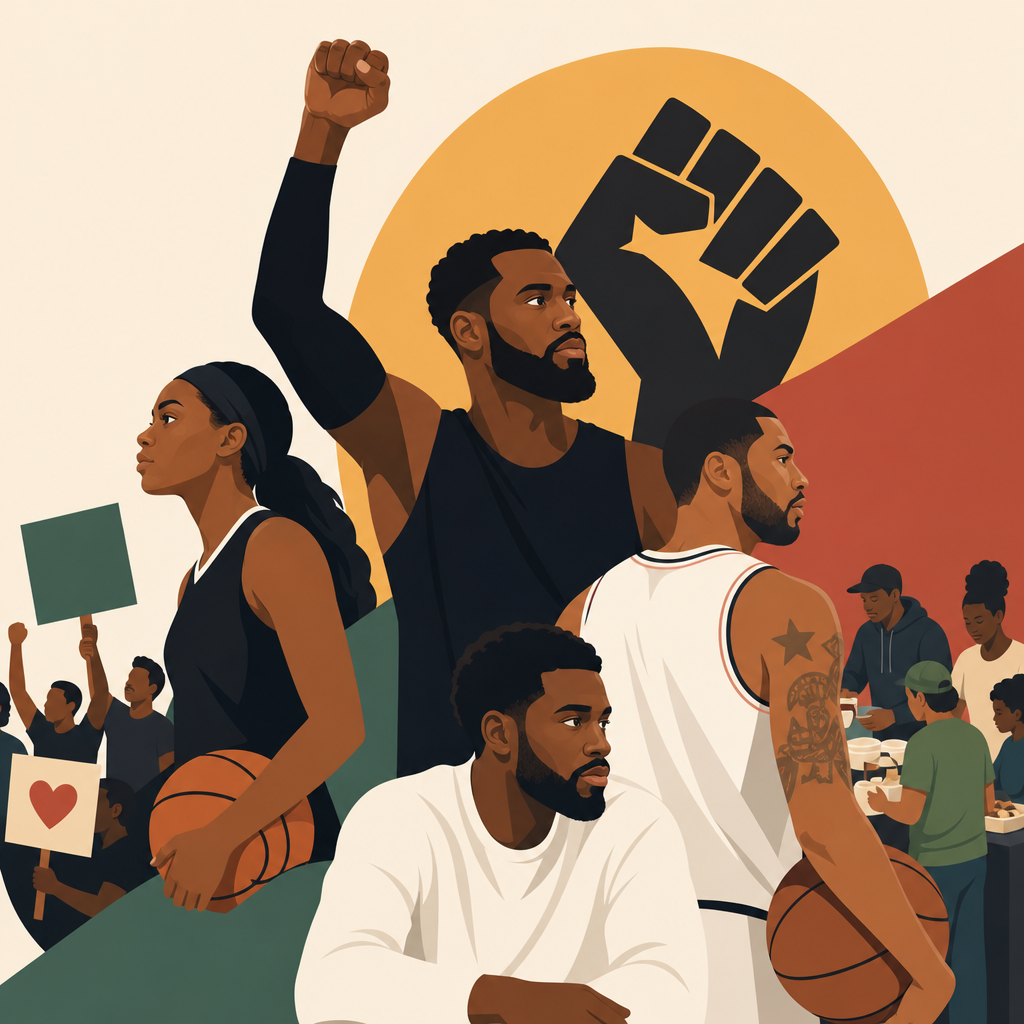
NBA players have never been only entertainers, and the history of player culture is impossible to understand without examining how athletes have used fame, money, and public attention to support social causes. In the NBA, a social cause can mean civil rights advocacy, labor organizing, voting access, education funding, criminal justice reform, public health messaging, or community investment. A player platform includes interviews, endorsements, union activity, team relationships, media reach, and now personal channels on Instagram, X, podcasts, and production companies. When those tools are used strategically, basketball influence extends well beyond the court.
This matters because the NBA sits at the intersection of sport, race, labor, celebrity, and commerce more visibly than any other North American league. Its players are globally recognizable, its stars are unusually outspoken, and its audience expects personalities, not faceless uniforms. I have worked on basketball content and athlete brand analysis long enough to see a consistent pattern: public conversations about the league eventually lead back to player culture, and player culture repeatedly leads back to activism. The same forces that made stars like Bill Russell, Kareem Abdul-Jabbar, Magic Johnson, Michael Jordan, LeBron James, and Maya Moore culturally significant also made them influential messengers on issues larger than games. Understanding that continuum helps explain why current debates over player expression are not new episodes but part of a long tradition.
For readers exploring NBA culture, this article serves as a hub for the player culture branch because activism touches leadership, identity, style, media training, sponsorships, locker-room dynamics, fan expectations, and the business of modern basketball. Some athletes have marched, some have donated, some have negotiated policy changes, and some have simply spoken when silence would have been easier. Their methods differ, and outcomes vary, but the through line is clear: NBA players have repeatedly turned visibility into leverage. To see how that happened, it helps to trace the evolution from the civil rights era to today’s digital, global league.
The civil rights foundation of NBA player activism
The modern history of NBA players and social causes begins with athletes who acted when public support was uncertain and professional consequences were real. Bill Russell remains the clearest example. Long before athlete advocacy became standard coverage, Russell spoke directly about segregation, attended the 1963 March on Washington, supported Muhammad Ali after Ali refused military induction, and challenged racist treatment in Boston while winning eleven championships. His activism mattered not because it was branded well, but because it carried personal cost. That distinction is essential when evaluating player culture historically.
Kareem Abdul-Jabbar, first as Lew Alcindor and later under his Muslim name, expanded that template. He boycotted the 1968 Olympics to protest racial injustice, aligned himself with major civil rights thinkers, and later built a public voice through essays, books, and appearances that connected sports to education, history, religion, and race. His approach showed that athlete activism could be intellectual as well as symbolic. These early figures also operated during a period when league marketing was weaker and television reach less fragmented. Their choices were not amplified by social media algorithms; they were amplified by moral clarity and sustained commitment.
One lesson from that era is that basketball activism did not start as a marketing strategy. It started as citizenship under pressure. That foundation still shapes how many fans and journalists judge current players: authenticity matters, and historical memory rewards consistency over slogans.
From individual statements to organized player power
As the league matured, social advocacy increasingly moved from isolated statements to organized action. The National Basketball Players Association became one of the central vehicles for that shift. Labor rights are social issues, and NBA player culture cannot be separated from union history, revenue sharing, workplace protections, and the ability of athletes to speak collectively. Oscar Robertson’s antitrust lawsuit against the NBA in the 1970s is often discussed as a business landmark, but it also changed the power relationship between owners and players. By constraining restrictive labor practices, it helped create the modern framework in which athletes had more autonomy, mobility, and bargaining leverage.
That increase in player power mattered for social causes because speech is easier when workers have protection. Collective bargaining agreements, grievance procedures, and a strong union do not guarantee activism, but they reduce the threat of retaliation. I have seen this point missed in casual discussions of player expression. Fans often focus on star courage alone, yet structural support is what allows activism to scale across a league. When teams wear coordinated messages, when players negotiate scheduling changes around elections, or when arenas become polling sites, those outcomes usually reflect infrastructure, not just personal conviction.
Magic Johnson’s public disclosure of his HIV diagnosis in 1991 offers another important transition point. Though not activism in the classic protest sense, his announcement changed public health awareness. At a time when misinformation about HIV/AIDS was widespread, Johnson used his reputation to humanize the disease, encourage testing, and challenge fear. This broadened the definition of social impact within player culture. Advocacy was no longer only about marches or speeches; it could also involve disclosure, education, philanthropy, and long-term foundation work.
The Jordan era, visibility, and the politics of restraint
Michael Jordan’s career reshaped the economics of athlete branding, and that changed the context for social causes even when Jordan himself was often cautious politically. The famous line about Republicans buying sneakers, whether simplified or not in popular memory, became shorthand for the commercial pressures facing superstars. Jordan donated generously and supported private causes, but he rarely centered public political confrontation during his playing prime. That choice is part of player culture history because restraint can be as revealing as activism. It shows how endorsement structures, league expansion, and global marketing sometimes discourage direct advocacy.
At the same time, Jordan’s era normalized the idea that a basketball player could become a worldwide cultural force. That expansion of celebrity later gave younger stars a much larger platform to deploy. In practical terms, the Jordan model built the commercial architecture that later activists inherited: signature shoes, international media tours, corporate partnerships, and nonstop visibility. The tradeoff was obvious. Greater reach brought greater leverage, but also greater pressure from sponsors, broadcasters, and political audiences who preferred athletes to remain apolitical.
Understanding this period prevents simplistic judgments. Not every player with influence uses it the same way, and public silence can reflect calculation, fear, generation, or strategy. The broader trend, however, was unmistakable: by the late 1990s and early 2000s, NBA players possessed platforms large enough to shape civic conversations if they chose to use them.
The social media era transformed athlete activism
The biggest structural change in modern player culture was digital disintermediation. Before social media, players mostly relied on beat reporters, national television, or formal interviews to communicate. Platforms like X, Instagram, YouTube, and athlete-owned media let them bypass traditional gatekeepers and speak directly to millions. LeBron James, Dwyane Wade, Chris Paul, Carmelo Anthony, Stephen Curry, and others entered an environment where a statement could move globally within minutes, without waiting for a press conference or newspaper column.
This changed both speed and stakes. A player could amplify a cause, share a fundraising link, highlight a local issue, or challenge an elected official instantly. It also meant every post was archived, scrutinized, and politicized. In my experience covering athlete messaging, digital tools reward clarity and punish vagueness. The players who are most effective usually pair visibility with action: donations, partnerships, legal advocacy, educational initiatives, or sustained community work. Empty signaling rarely survives close attention.
The 2016 ESPYS opening, where James, Wade, Paul, and Anthony addressed gun violence and racial injustice together, captured the collaborative nature of this era. So did team-level gestures such as hoodies in support of Trayvon Martin, “I Can’t Breathe” shirts after Eric Garner’s death, and coordinated in-arena statements following police shootings. These actions worked because digital distribution magnified them, but their significance came from the visible solidarity of players acting in concert.
| Era | Key players | Primary causes | Main platform used | Lasting impact |
|---|---|---|---|---|
| 1950s–1970s | Bill Russell, Kareem Abdul-Jabbar, Oscar Robertson | Civil rights, labor rights, anti-discrimination | Speeches, marches, print media, union action | Established legitimacy of athlete activism |
| 1980s–1990s | Magic Johnson, Michael Jordan, Craig Hodges | Public health, racial equity, community philanthropy | Television, endorsements, press conferences | Expanded athlete influence but exposed commercial constraints |
| 2000s–2010s | LeBron James, Chris Paul, Carmelo Anthony, Dwyane Wade | Voting, policing, education, youth opportunity | Social media, televised events, foundations | Made coordinated player advocacy mainstream |
| 2020s | NBA and WNBA player leaders across teams | Voting access, criminal justice, local organizing, mental health | Digital media, podcasts, collective bargaining channels | Integrated activism into league operations and public expectations |
LeBron James and the blueprint for modern civic engagement
No discussion of NBA players and social causes is complete without LeBron James, because he combined all major forms of modern athlete influence: star power, sustained public commentary, business scale, school-based philanthropy, and political mobilization. The “More Than A Vote” initiative in 2020 is a useful case study. Rather than stopping at generic encouragement, the campaign focused on voter education, poll worker recruitment, and practical access. It also pushed arenas to serve civic functions. That is what effective athlete advocacy looks like: a recognizable face attached to operational goals.
James’s I PROMISE School in Akron, created with the LeBron James Family Foundation and local partners, illustrates another dimension often overlooked in hot-take coverage. Community impact is usually more durable when it is local, measurable, and institutionally grounded. School support, family services, scholarships, and wraparound resources do not generate the same quick reaction as a viral quote, but they often produce deeper results. From a player culture perspective, this matters because it reframes activism as governance and stewardship, not just protest.
James has also shown the risks. Speaking on contentious issues invites backlash from political commentators, overseas business critics, and segments of the fan base. Yet the consistency of his engagement has made him the defining example of the modern NBA superstar as civic actor. Whether one agrees with every position he has taken, his model changed expectations for what a franchise player can publicly attempt.
2020, the bubble, and collective action as a league-wide force
The most dramatic recent chapter came in 2020 after the police shooting of Jacob Blake in Kenosha, Wisconsin. The Milwaukee Bucks chose not to play a playoff game in the Orlando bubble, prompting a wider postseason stoppage. This was not a symbolic pregame gesture; it was a labor action with immediate financial and scheduling consequences. Players then used negotiations with the league and team governors to secure practical commitments, including converting arenas into voting sites and increasing support for social justice initiatives.
I remember how clearly that moment demonstrated the maturation of NBA player culture. Activism had moved from individual conscience to collective leverage. The bubble itself had already featured social justice messages on jerseys and the court, but the stoppage showed players understood the strongest platform is sometimes the game itself. Refusing to perform can be more powerful than speaking during performance.
This period also highlighted the NBA’s unusual openness relative to other leagues. The partnership between players, the NBPA, and league leadership did not erase disagreement, but it created room for visible action. The limitation is worth stating plainly: symbolic messaging inside a controlled entertainment environment can never substitute for public policy. Still, the 2020 actions proved that player coordination can translate attention into institutional concessions.
Beyond protests: philanthropy, education, and community investment
Focusing only on protests understates how broadly NBA players contribute to social causes. Many of the most effective efforts are long-term philanthropic projects that receive less daily attention than controversial quotes. Chris Paul has supported HBCUs and voting initiatives. Stephen Curry has funded educational programs, backed gender equity in youth sports, and used his media company to influence representation. Jrue and Lauren Holiday committed the remainder of his 2020 salary to social justice organizations and Black-owned businesses. These examples matter because they show range: direct aid, institutional support, narrative change, and economic development are all forms of activism.
Players also influence culture through quieter mentorship and local credibility. A veteran funding recreation spaces in his hometown, a star underwriting scholarships, or a bench player organizing food distribution may not trend nationally, but those actions often have immediate community value. In practice, the most successful athlete-led cause work usually combines three elements: authentic personal connection, trusted nonprofit or municipal partners, and measurable follow-through. Without those, even well-meaning efforts can become publicity events with thin impact.
For an NBA culture hub, this is the key takeaway: player culture includes fashion, music, language, entrepreneurship, and media, but it is also a network of community obligations. Social causes are not an add-on to that identity. They are one of the clearest ways players define leadership, legacy, and belonging.
NBA players have used their platform throughout history in ways that reflect the era, the technology, and the risks in front of them, but the underlying pattern has remained consistent. From Bill Russell and Kareem Abdul-Jabbar to Magic Johnson, LeBron James, and today’s player-led coalitions, athletes have treated visibility as a form of leverage. Sometimes that has meant protest. Sometimes it has meant union action, public health education, school building, voting access work, or direct investment in underserved communities. The methods changed; the purpose did not.
For anyone studying NBA culture, player culture is the essential subtopic because it explains how identity, labor, media, and morality intersect in the league. The most important point is not that every player becomes an activist. It is that the NBA created conditions where player voices can influence public life at scale, and many athletes have chosen to use that power with intention. Their impact is strongest when words connect to structure, partners, and measurable goals.
If you are building a deeper understanding of basketball beyond scores and transactions, start here: follow the history, track the organizations players support, and pay attention to what they do when the cameras are not centered on the game. That is where NBA player culture becomes real, and where its social influence is easiest to see.
Frequently Asked Questions
How have NBA players historically used their platform to support social causes?
NBA players have used their platform in ways that go far beyond postgame interviews or symbolic gestures. Historically, their influence has come from a combination of visibility, credibility, and access to resources. Because professional basketball players are public figures with large audiences, their words can shape public conversations around civil rights, labor rights, education, public health, voting access, and criminal justice reform. In earlier eras, that often meant speaking out despite significant personal and professional risk. Players who aligned themselves with controversial causes could lose endorsements, face criticism from fans and media, or be labeled as distractions rather than leaders.
Over time, the methods have expanded. Some players have used press conferences, magazine interviews, and television appearances to advocate for policy changes or call attention to inequality. Others have worked through the players’ union, team relationships, and business partnerships to push for structural reforms. Many have funded scholarships, built community centers, supported youth programs, invested in underserved neighborhoods, or donated to social impact organizations. In more recent decades, social media has made player advocacy faster and more direct, allowing athletes to communicate with millions of people without relying on traditional gatekeepers. The most important point is that NBA activism has never been limited to one style. It has included protest, philanthropy, institution-building, labor organizing, education efforts, and sustained civic engagement.
Which social causes have been most closely associated with NBA player activism?
The causes most closely associated with NBA player activism reflect the major social and political issues of their time. Civil rights has been one of the most enduring themes, especially as Black athletes used their prominence to challenge racism, segregation, discrimination, and unequal treatment in public life. Labor organizing has also been central, particularly through the National Basketball Players Association, where athletes have fought for fair compensation, workplace protections, player rights, and greater influence over league conditions. That kind of advocacy matters because it shows that social action in sports is not only about public statements; it can also involve changing the power structure within the profession itself.
In addition, NBA players have frequently supported voting access initiatives, education funding, public health campaigns, and criminal justice reform. Some have backed voter registration drives and encouraged turnout in local and national elections. Others have addressed school inequality by funding academic programs, creating scholarship opportunities, and supporting literacy and mentorship efforts. Public health messaging has also become increasingly important, with players using their visibility to promote awareness during health crises or to encourage healthier communities. Criminal justice reform has been another major focus, with athletes speaking about policing, incarceration, sentencing disparities, and community safety. Community investment ties many of these efforts together, because players often channel their money and attention into long-term local projects rather than one-time charitable appearances. The range of causes shows that NBA player activism is broad, practical, and deeply connected to real community needs.
Why is player activism such an important part of NBA history and culture?
Player activism is essential to NBA history because it helps explain how the league’s culture developed both on and off the court. The NBA has long been shaped by athletes who understood that fame creates responsibility as well as opportunity. Many players recognized that their public standing gave them a rare chance to speak for communities that were often ignored or misrepresented. As a result, the story of the NBA is not just about championships, rivalries, and statistics; it is also about how players responded to the political and social realities around them. Ignoring that dimension would leave out a major part of what the league has represented to fans, especially in communities where basketball stars are seen as role models, entrepreneurs, and civic leaders.
This activism also influenced the broader identity of the league. Compared with many other sports, the NBA became known as a place where player voices mattered and where personality, expression, and public engagement were more visible. That reputation did not appear overnight. It was shaped through decades of athlete leadership, public pressure, union activity, and cultural change. Players helped redefine what it meant to be a professional athlete by showing that success could include advocacy, institution-building, and direct engagement with urgent issues. In that sense, activism is not a side note to NBA culture. It is one of the forces that made the league what it is today: highly visible, globally influential, and closely connected to conversations about race, citizenship, opportunity, and justice.
How have modern media and social platforms changed the way NBA athletes advocate for causes?
Modern media has transformed NBA advocacy by giving players more control over their message. In earlier generations, athletes often depended on reporters, broadcasters, or league-controlled channels to communicate with the public. That meant their views could be filtered, shortened, or framed by others. Today, social media platforms, podcasts, player-produced media, and direct digital publishing allow athletes to speak in their own voice and respond in real time. This has made activism more immediate, more personal, and often more organized. A player can now raise awareness, share educational resources, announce donations, promote events, and coordinate with advocacy groups almost instantly.
That said, greater access also brings greater scrutiny. Modern athletes face nonstop reaction cycles, political polarization, and the pressure to respond quickly to major events. Their statements are analyzed by fans, media outlets, sponsors, and critics within minutes. Even so, the expanded reach has made advocacy more powerful in many cases. Players can turn local concerns into national stories, draw attention to grassroots organizations, and sustain public interest long enough to influence institutions. They can also connect activism to business, philanthropy, and media strategy in ways that earlier generations could not. The result is a more visible and multidimensional form of engagement, where a player’s platform includes not just celebrity status but also ownership of audience, content, and networks of influence.
What is the difference between symbolic activism and lasting social impact among NBA players?
Symbolic activism usually refers to visible acts that communicate support for a cause, such as wearing a message, making a statement, participating in a demonstration, or using a high-profile appearance to call attention to an issue. These actions can be meaningful because symbols help shape public awareness, validate community concerns, and push topics into mainstream conversation. In many cases, a symbolic act is the moment that gets people to pay attention. It can create a shared language around injustice and signal that an athlete is willing to take a public stand. That matters, especially in sports, where silence has often been rewarded more than dissent.
Lasting social impact, however, usually requires sustained effort beyond visibility alone. That includes funding organizations over time, building educational programs, investing in neighborhoods, supporting policy reform, organizing voter outreach, strengthening union protections, or creating institutions that continue serving people long after headlines fade. The most effective NBA advocates often combine both approaches. They use symbolic actions to generate awareness and moral clarity, then follow through with resources, partnerships, and long-term commitment. This distinction is important because it shows how athlete activism can move from expression to results. A statement may start the conversation, but durable impact is usually created through consistency, strategy, and investment in real-world change.