
A technical foul in basketball is a rules violation involving unsportsmanlike conduct, illegal bench behavior, delay tactics, or administrative infractions that do not arise from legal play on the ball. For fans learning NBA rules, a technical foul sits at the center of “fouls explained” because it bridges game management, player discipline, free-throw penalties, ejection standards, and league review. I have covered games where one careless outburst changed momentum faster than any turnover, and that is why understanding technical fouls matters: they affect scoring, substitutions, coach strategy, suspensions, and public perception. In the NBA, one technical foul usually awards one free throw to the opposing team and keeps possession according to the point of interruption, but the context matters. College, high school, FIBA, and youth rules handle technicals differently, so anyone searching what is a technical foul in basketball needs the league-specific answer. The broad definition is simple: technical fouls punish behavior and procedural violations, while personal fouls usually punish illegal physical contact during live play. That distinction sounds neat, yet real games create gray areas, especially when taunting, hanging on the rim, bench decorum, or excessive timeout requests are involved. This article serves as a complete hub for fouls explained, with a focus on NBA technical fouls, ejections, common misconceptions, and famous incidents that still shape how officials call games today.
To define the term precisely, the NBA rulebook places technical fouls under conduct that is detrimental to the game. That includes disrespectfully addressing an official, overt reactions to calls, fighting-related non-contact acts, delay of game actions, and violations by coaches, players, substitutes, trainers, or other bench personnel. A technical foul can be assessed whether the ball is live or dead. It can be assessed to an individual or, in some situations, to the bench. It can also be non-unsportsmanlike, such as a delay technical, or unsportsmanlike, such as profanity directed at a referee. The consequences can extend beyond one possession because players and coaches are automatically ejected after accumulating two technical fouls in the same game, and players who pile up technicals across the season face automatic suspensions under NBA discipline policies. For a sport with constant emotional swings, that framework exists to protect competitive fairness and keep games from escalating into chaos. If you want the short answer, here it is: a technical foul is basketball’s formal penalty for conduct or procedural behavior that violates sportsmanship or game administration rules rather than ordinary contact rules.
How a technical foul works in the NBA
In the NBA, when officials assess a technical foul, the opposing team receives one free throw. Any player in the game may attempt that free throw, which is a notable difference from many personal-foul situations where the shooter is determined by who was fouled. After the shot, play resumes from the point of interruption unless another rule changes possession. This is why a technical foul can be so damaging: the other team gets a point opportunity without using clock or needing to create offense. In a close game, one technical can erase the value of a good defensive sequence.
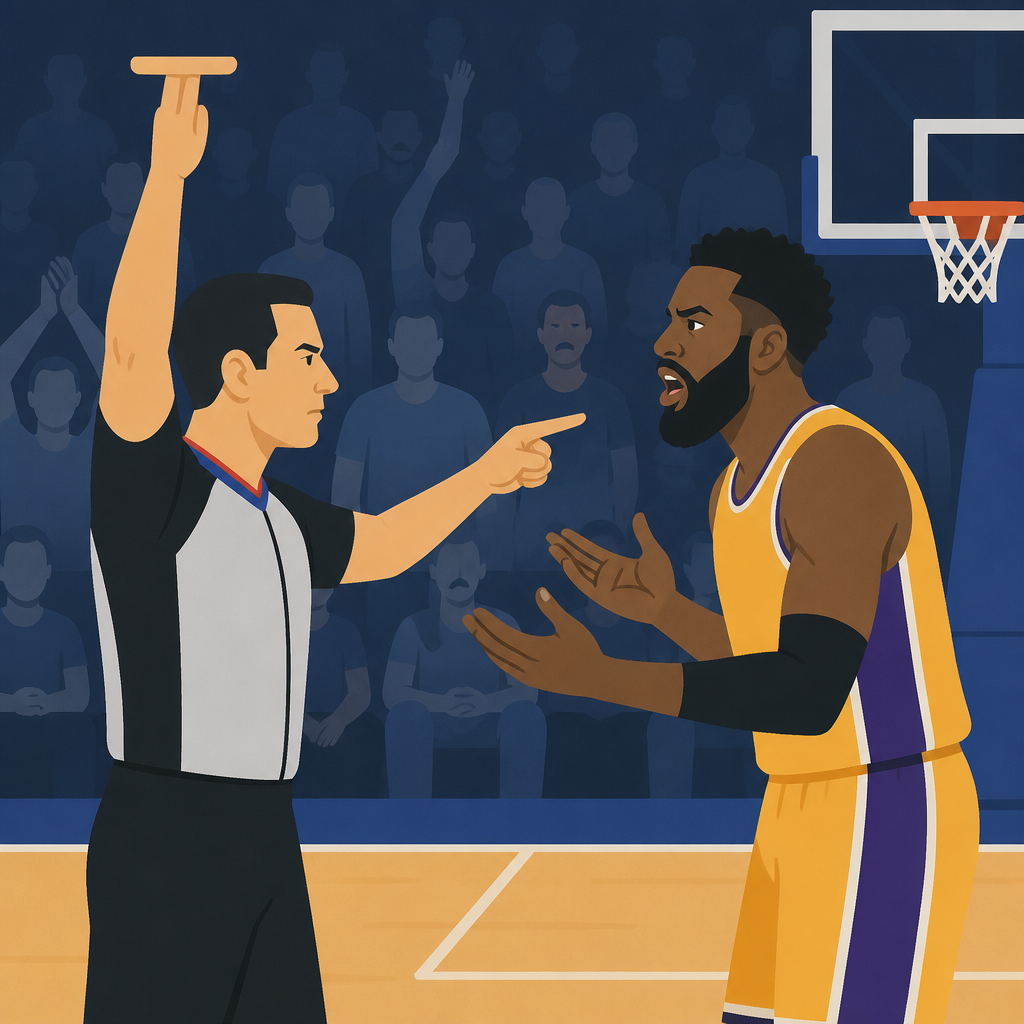
Officials call technicals for several broad categories. The first is unsportsmanlike conduct, including arguing excessively, using profanity, taunting, making aggressive gestures, or throwing the ball in frustration. The second is bench conduct, such as leaving the coaching box improperly, stepping onto the court, or players on the bench mocking opponents. The third is delay-related behavior: touching the ball after a made basket, preventing a quick inbound, interfering with game administration, or requesting timeout when none remain. The fourth is fighting-related conduct short of an actual punch, including escalating an altercation. In practice, the line officials enforce most often is behavior that shows up, prolongs, or intensifies dissent.
The NBA also distinguishes between direct technical fouls and delay-of-game warnings. A team can receive one delay warning for certain actions before a technical is assessed for a repeat offense. Examples include a defender crossing the boundary line to interfere with an inbound, a player touching the ball after a score to slow the restart, or huddling overlong in a way that delays resumption. Fans sometimes think every minor annoyance is an immediate technical, but officials often use warnings first when the rule permits it.
Technical foul vs personal foul, flagrant foul, and double technical
For anyone using this page as a fouls explained hub, the cleanest way to separate categories is by asking what the rule punishes. A personal foul punishes illegal contact. A shooting foul affects a shot attempt. An offensive foul punishes illegal contact by the offense. A flagrant foul punishes unnecessary or excessive contact and carries heavier penalties. A technical foul punishes conduct or administration violations, usually without illegal contact as the central issue. A double technical occurs when opponents commit unsportsmanlike acts against each other at the same time, offsetting the free throws but still counting as technicals toward ejection and season totals.
Real games blur these categories. Suppose two players chest each other after a hard legal screen, exchange words, and one shoves lightly. Officials may review for a personal foul, a technical foul, a double technical, or a flagrant depending on the force and context. If there is unnecessary contact, a flagrant can apply. If there is no meaningful illegal contact but clear taunting, a technical is more likely. If both players escalate equally, a double technical often restores control without rewarding either side. That judgment is why replay and crew communication matter so much in modern NBA officiating.
| Foul type | What triggers it | Typical penalty | Ejection risk |
|---|---|---|---|
| Technical foul | Unsportsmanlike conduct or procedural violation | One free throw | Two in one game can eject |
| Personal foul | Illegal physical contact | Free throws or team foul consequences | Six personals disqualify in NBA |
| Flagrant 1 | Unnecessary contact | Free throws plus possession | Possible after review if severe pattern exists |
| Flagrant 2 | Unnecessary and excessive contact | Free throws, possession, automatic ejection | Immediate ejection |
| Double technical | Offsetting unsportsmanlike acts | No free throw advantage | Still counts toward two-tech limit |
What actions usually draw a technical foul
The most common NBA technical foul triggers are visible and emotional. Arguing a call by demonstratively waving off an official, clapping sarcastically, or continuing after a warning often earns one. So does profanity that is heard and judged directed or excessive. Throwing the ball into the stands, slamming it at the stanchion, kicking it away, or striking the air near an official are textbook examples. Taunting an opponent after a basket, staring someone down in a confrontational way, or mimicking contact can also qualify. Hanging on the rim is legal only when a player needs to protect themselves or another player from injury; otherwise it can become a technical.
Bench behavior is a major source of technicals that casual fans overlook. Assistants who run too far onto the floor, players who step from the bench during an altercation, or coaches who persistently leave the coaching box to confront officials are all vulnerable. The NBA pays close attention to non-player conduct because benches can inflame a situation quickly. During nationally televised games, the camera often catches only the argument at center court, while the actual technical may be assessed because someone on the sideline crossed a line first.
Administrative technicals matter too. Calling timeout when the team has none remaining results in a technical. Deliberately delaying resumption after a made basket can produce a warning followed by a technical. Before recent rule adjustments across different levels of basketball, illegal uniform or lineup issues were more visible sources of technicals; today professional leagues usually catch those before tipoff, but scorer’s table and substitution procedures still matter. These quieter technicals rarely make highlight reels, yet coaches obsess over them because they are avoidable points.
Ejections, season accumulation, and league discipline
An NBA player or coach is ejected after receiving two technical fouls in the same game, unless one is later rescinded by league review. That standard makes emotional control a tactical skill. I have seen players pick up a first technical in the second quarter, spend the rest of the night biting back every reaction, and become less effective because they are managing officials as much as opponents. Coaches face a similar challenge. A well-timed technical can energize a team, but a second one forces an ejection and removes the head coach from in-game control.
Season accumulation raises the stakes further. Under NBA policy, players who reach set technical foul thresholds are automatically suspended one game, with additional suspensions at later intervals. The exact threshold framework has changed over time, but the core principle is stable: repeated unsportsmanlike conduct costs availability. The playoffs have their own accumulation standards, which is why star players nearing the limit often become a talking point in postseason coverage. Fines are also routine. Technical fouls are not just symbolic discipline; they carry direct financial and competitive consequences.
League review introduces nuance. The NBA can rescind a technical foul after the game if it determines the call was incorrect. That matters for reputation, season totals, and future suspension risk. At the same time, not every controversial technical is overturned. Officials are granted discretion to judge context, tone, and escalation in real time. Fans often search for a bright-line test, but officiating standards always include judgment. The best way to understand ejections is simple: one technical is a warning with a point attached, two technicals remove the offender, and repeated technicals across the season can cost games through suspension.
Famous NBA technical fouls that still get discussed
Rasheed Wallace remains the classic example when people discuss famous NBA technical fouls. He set the single-season record with 41 technicals in 2000-01, a total so extreme it helped define the league’s later emphasis on emotional restraint and referee respect. Wallace was a brilliant defender and passer, but his constant battles with officials became part of his identity. His case shows how technical fouls can shape public narrative around a player as much as points or rebounds.
Tim Duncan’s 2007 ejection against Dallas is remembered for a different reason: he received a second technical while laughing on the bench. Joey Crawford assessed the tech, the incident drew heavy criticism, and the NBA later suspended Crawford. That moment remains one of the clearest examples of why consistency and composure from officials are scrutinized just as closely as player behavior. It also demonstrated that league discipline can extend to referees when game management fails.
Draymond Green has become a modern case study in the strategic and destructive power of technical fouls. His emotional edge drives elite defense and communication, but it has also produced suspensions and postseason storylines. In the 2016 Finals, Green’s accumulation of flagrant points, not technicals, led to a suspension, yet his technical foul history made his on-court judgment a constant topic. The lesson is broader than one player: competitive fire helps, but once it repeatedly costs points, possessions, or games, it becomes a team liability.
Other notable technical moments include coaches intentionally taking one to spark a lifeless team, stars reacting to what they believe is inconsistent officiating, and benches clearing verbally without punches thrown. These incidents endure because technical fouls are never only about one free throw. They expose pressure, leadership, officiating philosophy, and how thin the line is between intensity and self-sabotage.
How technical fouls differ in college, high school, and FIBA
If you watch more than the NBA, this is where confusion usually starts. NCAA men’s basketball, NFHS high school rules, and FIBA competitions all define and penalize technical fouls with meaningful differences. In many non-NBA settings, a technical foul can mean two free throws rather than one. Possession after the free throws may also differ. Some levels classify bench technicals, indirect technicals, and administrative technicals more formally than the NBA does in broadcast language. The result is that a fan who learned the rule during March Madness may misunderstand what happens in an NBA game.
FIBA rules also use the unsportsmanlike foul category differently from the NBA’s flagrant structure, which changes how international viewers interpret confrontations. High school rules tend to emphasize sportsmanship and bench decorum more rigidly because educational settings prioritize behavior as much as competition. That does not make one system better; it reflects different goals. Professional leagues balance discipline with entertainment and the practical reality that elite players operate in a faster, more physical, and more emotionally charged environment.
When searching what is a technical foul in basketball, the safest answer is to identify the league first. The universal idea is misconduct or procedural violation. The penalty details are not universal. For a complete fouls explained study path, readers should pair this hub with league-specific breakdowns on personal fouls, flagrant fouls, bonus situations, and disqualifications.
Why technical fouls matter to teams, bettors, and fans
Technical fouls influence more than one box-score line. Coaches plan around player temperament, especially for stars who handle the ball constantly and speak to officials on nearly every possession. A first-half technical can alter substitution patterns because a coach may sit a frustrated player to avoid a second. Teams also scout referee tendencies, not to manipulate outcomes, but to understand how quickly a crew addresses demonstrative complaints, bench activity, or post-whistle contact. That is practical game preparation.
For bettors and fantasy players, technical fouls matter because they affect minutes, availability, and momentum. An ejection destroys prop bets. A suspension from season accumulation removes a player from the slate entirely. For fans, technicals often become the emotional hinge of a game. One call can wake up a home crowd, derail a comeback, or create a narrative that dominates postgame coverage. Understanding the rule turns a confusing interruption into a readable strategic moment.
The key takeaway is straightforward: a technical foul in basketball is the sport’s mechanism for policing conduct and procedure when behavior threatens fairness, pace, or control. In the NBA, it usually means one free throw, possible escalation to ejection after a second tech, and season-long consequences if the pattern continues. Learn the common triggers, recognize the difference from personal and flagrant fouls, and famous NBA techs start to make sense as rule applications rather than random drama. If you are building your knowledge of NBA rules, use this hub as your starting point and continue with the rest of the fouls explained guides to understand how every whistle changes the game.
Frequently Asked Questions
What exactly is a technical foul in basketball?
A technical foul is a penalty for behavior or violations that do not come from a normal attempt to play the ball. In other words, it is not the same as a shooting foul, a blocking foul, or a reach-in during live basketball action. Instead, a technical foul covers conduct that disrupts the game’s order, sportsmanship, or administration. In the NBA and other levels of basketball, that can include arguing excessively with officials, using abusive language, taunting, delay-of-game actions, hanging on the rim without justification, stepping onto the court from the bench during an altercation, or committing certain procedural violations.
The easiest way to understand it is to think of the technical foul as the rulebook’s tool for game management. Officials use it when a player, coach, bench member, or even team staff member crosses a line that affects control of the game. Some technicals are about sportsmanship, such as disrespectfully addressing a referee. Others are about mechanics and administration, such as an illegal lineup issue or a delay tactic designed to interrupt flow. That is why technical fouls are so important in any “basketball fouls explained” discussion: they sit at the intersection of discipline, penalties, momentum, and officiating authority.
Technical fouls can be assessed against players on the floor, players on the bench, coaches, or the team bench area as a whole. Because they often happen after the whistle or away from a basketball play, they can feel sudden to fans, but they are governed by specific standards. One careless outburst, one prolonged complaint, or one unnecessary act can shift the entire emotional temperature of a game. That is a big reason technical fouls get so much attention from broadcasters, coaches, and fans trying to understand NBA rules.
What actions can lead to a technical foul in the NBA?
A wide range of actions can trigger a technical foul in the NBA, but most fall into a few major categories: unsportsmanlike conduct, illegal bench behavior, delay-of-game violations, and administrative infractions. Unsportsmanlike conduct is the category fans recognize most. It includes aggressively arguing with referees, directing profanity at an official, demonstrative complaints such as waving off a call in a confrontational way, taunting an opponent, or making gestures that the league considers disrespectful or inflammatory. Not every visible frustration earns a technical, but when conduct becomes prolonged, public, or hostile, officials can step in immediately.
Illegal bench behavior is another major source. Bench players and coaches are expected to remain within certain boundaries. If a player leaves the bench during a confrontation, enters the court at the wrong time, or behaves in a way that escalates tension, a technical foul can be called. Coaches can also receive technicals for excessive arguing, stepping too far outside the coaching box where applicable, or continuing to challenge officials after being warned. Team staff are not immune either if their conduct interferes with game administration.
Delay-of-game technicals often confuse newer fans because they are less emotional and more procedural. These can involve intentionally touching the ball after a made basket to prevent a quick inbound, interfering with a throw-in, failing to be ready to resume play, or other tactics that slow the game unnecessarily. In many cases, teams may first receive a delay warning before a formal team technical is assessed, depending on the exact action and league rules.
There are also administrative or special-situation technicals. Examples may include having too many players involved in a situation, improper uniform or substitution issues, or unauthorized conduct during dead-ball periods. The details can vary by league and era, which is why it helps to look at the NBA rulebook language when a controversial technical is called. The broad principle stays the same: if the act is not a legitimate basketball play and it harms sportsmanship, order, or fairness, it may qualify as a technical foul.
What is the penalty for a technical foul, and does it count toward ejection?
The standard penalty for a technical foul in the NBA is one free throw for the opposing team, plus possession is handled according to the situation and league rules in effect. The free throw is often taken by any player on the opposing team who is eligible to shoot it, which means coaches can choose a strong free-throw shooter to maximize the penalty. While one free throw may sound minor, the real impact can be much larger because technicals often come in emotionally charged moments. A single point, a stopped run, and a fired-up crowd can dramatically change momentum.
Yes, technical fouls can absolutely count toward ejection. In the NBA, a player or coach who receives two unsportsmanlike technical fouls in the same game is generally ejected. That is why the first technical matters so much. Once a player is “on one tech,” every later argument, gesture, or reaction becomes more dangerous. Officials know it, coaches know it, and veteran players usually know when they need to walk away to avoid losing themselves for the rest of the game.
It is also important to understand that not all technicals function identically in every context. Some technicals are classified differently from fighting-related violations or bench-clearing situations, and some administrative technicals may not carry the same ejection consequences as overt unsportsmanlike acts. The exact ruling depends on the type of infraction and league interpretation. In addition, flagrants are separate from technical fouls, though both can lead to ejection under different standards. A flagrant foul deals with excessive or unnecessary contact during play, while a technical typically deals with behavior or non-ball-related violations.
Beyond the game itself, technical fouls can have season-long consequences. In the NBA, players accumulate technical fouls over the regular season, and after passing certain thresholds they can face automatic fines and eventually suspension. The league may also review technicals after the game and rescind some if it believes the call was not justified. That review process matters because one technical can affect a player’s future availability, finances, and reputation, not just one night’s box score.
How many technical fouls does it take to get ejected or suspended in the NBA?
In a single NBA game, two unsportsmanlike technical fouls on a player or coach usually result in an automatic ejection. That is the in-game standard most fans hear about. A player who receives one technical for arguing a call and later picks up another for taunting, for example, will normally be sent to the locker room. The same principle applies to coaches who continue to challenge officials after crossing the acceptable boundary. The rule is designed to give officials a clear escalation path: warn through the first penalty, then remove the person if the behavior continues or worsens.
Over the course of the season, the NBA also tracks accumulated technical fouls for disciplinary purposes. Once a player reaches the league’s designated threshold, he can face an automatic suspension, with additional suspensions triggered by further totals. The exact threshold and financial penalties are set by league policy, and they are a major storyline late in the season for emotional stars who play on the edge. This is why fans often hear analysts mention “tech count” in March and April. It is not just trivia; it can affect lineup decisions, playoff seeding races, and player behavior.
That said, context matters. The league office can review assessed technical fouls and, in some cases, rescind them afterward. If a technical is rescinded, it no longer counts toward a player’s season accumulation. This postgame review process exists because technicals are often judgment calls made in fast, heated moments. A referee may interpret an action as disrespectful in real time, while later video review may show the player was reacting generally rather than directing comments at the official. That review system helps preserve fairness, especially when suspensions and fines are on the line.
It is also worth noting that not every ejection requires two technicals. A player or coach can be ejected immediately for especially severe conduct, including highly abusive language, fighting-related actions, or behavior that seriously threatens game control. So while “two technicals and you are out” is the common rule of thumb, it is not the only path to removal from a game.
What are some famous NBA technical fouls, and why do they matter?
Some of the most famous technical fouls in NBA history are remembered not because of the single free throw, but because of what they revealed about pressure, personality, officiating, and momentum. Technical fouls often become iconic when they occur in playoff games, rivalries, or emotionally charged superstar moments. A star arguing after a no-call, a coach taking a deliberate technical to energize his team, or a veteran crossing the line in a close fourth quarter can become part of a game’s permanent narrative. Fans remember those moments because they usually signal that the contest has become more than strategy and execution; it has become emotional combat.
Rasheed Wallace is one of the most well-known examples in any conversation about NBA technical fouls. He became almost synonymous with the technical foul because of his frequent clashes with officials and his record-setting accumulation of technicals. His career illustrates how repeated technical fouls can shape a player’s image and force league-level responses. Draymond Green is another modern example, often discussed because his emotional intensity can fuel his team while also putting him