
A clear-path foul in the NBA is a transition foul that occurs when a defender illegally stops an offensive player who has an open route to the basket and no defender is ahead of the play. It is one of the league’s most misunderstood rules because the call depends on specific criteria involving ball position, player position, and the location of defenders at the moment of contact. For fans trying to understand NBA rules, and especially the broader category of fouls explained, clear-path fouls matter because they can instantly change momentum, produce free throws plus possession, and punish teams for grabbing or bumping a player to erase a fast break.
In practice, this rule exists to protect scoring opportunities created by steals, long outlet passes, and quick transition attacks. I have seen the confusion firsthand while reviewing game clips and officiating breakdowns: many viewers assume any take foul on a fast break is automatically a clear-path foul, but that is not true. The NBA applies a checklist. Officials review where the ball was, whether the offensive player was ahead of the pack, and whether any defender stood between the player and the rim. If the conditions are met, the penalty is severe by design.
As a hub article under NBA Rules and the wider fouls explained subtopic, this guide defines the clear-path foul, shows how referees determine it, contrasts it with common, flagrant, and transition take fouls, and revisits famous calls that shaped public understanding. It also answers the questions most fans ask: What is the penalty? Does intent matter? Can it happen off the ball? Why does replay get involved? Once you understand the rule language and the game situations that trigger it, clear-path decisions become much easier to read in real time.
The official NBA definition and why the rule exists
The NBA rulebook treats a clear-path foul as illegal personal contact committed against an offensive player during transition when that player has a clear path to the basket. The modern purpose is straightforward: defenders should not be rewarded for deliberately fouling to prevent an uncontested scoring chance. Basketball has always tolerated strategic fouls in some contexts, but the league draws a line when a defender simply grabs, wraps, or bumps a player from behind or from the side with no legitimate rim protector ahead.
Historically, the NBA tightened transition foul enforcement because coaches taught players to “take the foul” the moment a turnover created a numbers disadvantage. That tactic killed pace and erased exciting fast-break plays. The clear-path provision, along with later transition take foul changes, reflects the league’s larger effort to preserve open-court offense. If a player earns a breakaway layup by anticipation, speed, and positioning, the defense should have to contest legally rather than commit a cheap foul with little downside.
The key point is that clear-path is not judged by drama or appearance alone. A play can look like a breakaway and still fail the test if a defender is legally ahead of the ball or if the offensive player is not sufficiently in front of the defense. Conversely, slight contact that seems ordinary can become a clear-path foul if all rule elements are present. That precision is why announcers often wait for replay before declaring whether the call should be upgraded.
How referees decide whether a foul is a clear-path foul
Officials use a structured set of factors. First, there must be a personal foul against the offensive team’s scoring chance in transition. Second, the ball must be ahead of the tip of the circle in the backcourt or in the frontcourt depending on the sequence of the play. Third, no defender can be between the offensive player and the basket at the time of the foul. Fourth, the offensive player must have an opportunity to advance unobstructed toward the rim. In officiating reviews, crew chiefs focus heavily on relative positioning when contact occurs, not on where players end up a second later.
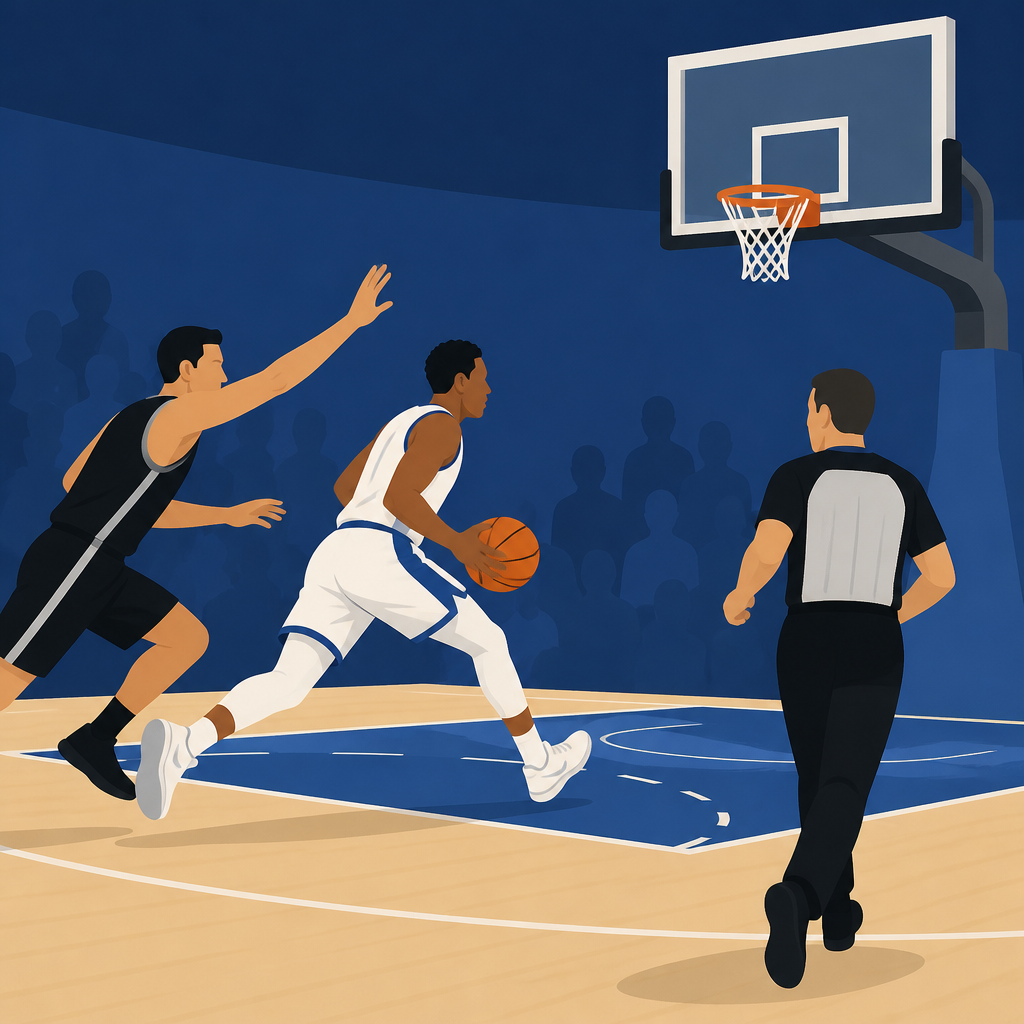
The easiest way to visualize the rule is to imagine a steal near midcourt. If the ballhandler races ahead and the trailing defender reaches in from behind while every other defender is behind the play, that is the classic clear-path foul. If one defender is back near the free-throw line and squarely between the dribbler and the basket, the foul is usually not clear-path because the lane is not truly clear. Officials also track whether the foul happened before a gather, during a dribble push-ahead, or as the player tried to receive a lead pass.
Replay review is central because these plays unfold fast. The NBA Replay Center and on-floor referees can examine freeze frames to determine exact locations of the ball, the foul, and the nearest defenders. This is one reason fans sometimes see a common foul upgraded after review. The standard is technical, and centimeters matter. A defender’s foot position relative to the ball and to the basket can change the ruling.
What is the penalty for a clear-path foul?
The penalty is stronger than for a standard personal foul. The offended team receives one free throw attempt by any player in the game at the time of the foul, and it also retains possession. That combination is the whole deterrent. A team that commits a clear-path foul gives away an immediate scoring chance at the line and still has to defend the next possession. By comparison, a normal non-shooting foul in transition might only stop play for a side out, especially before the bonus.
This penalty distinguishes clear-path fouls from many other entries in fouls explained. A shooting foul usually yields two or three free throws depending on the shot. A flagrant foul adds severity because of unnecessary or excessive contact. A transition take foul, under current rules, also results in one free throw and possession, but its trigger is different. Clear-path is tied to open-court positioning and an unobstructed path; the transition take foul is broader and can apply even when the path is not completely clear.
For coaches, the practical lesson is simple: if the defense is beaten, reckless reaching can cost more than conceding the layup attempt. For players, awareness matters. Veteran defenders often sprint to establish legal position ahead of the ball rather than swipe from behind, specifically to avoid a clear-path ruling.
Clear-path foul vs. take foul, common foul, and flagrant foul
Fans often group several concepts together, but the distinctions matter. A common foul is the default category for illegal personal contact. A clear-path foul is a special transition ruling based on open-court geometry. A transition take foul addresses intentional fouls used to stop fast breaks even when the offense does not meet every clear-path requirement. A flagrant foul concerns the nature and severity of contact, not merely the scoring chance.
In recent seasons, the transition take foul rule changed strategy across the league. Before that change, teams frequently accepted a routine foul to stop a developing break. Now officials can penalize deliberate “wrap-up,” “grab,” or “body-check” fouls in transition with one free throw and possession even if a defender remains ahead of the play. That means not every transition foul discussion should start with clear-path. Sometimes the correct ruling is a take foul, not clear-path, because the offensive lane was not fully open.
Here is a plain-language comparison of the most relevant categories within fouls explained:
| Foul type | Main trigger | Typical penalty | Key distinction |
|---|---|---|---|
| Common foul | Standard illegal contact | Side out or free throws depending on team foul situation | No special transition or severity element |
| Clear-path foul | Illegal contact on a player with an unobstructed path to the basket | One free throw plus possession | Depends on player and ball position relative to defenders |
| Transition take foul | Intentional foul to stop transition | One free throw plus possession | Broader than clear-path; does not require a fully open lane |
| Flagrant foul | Unnecessary or excessive contact | Free throws plus possession, with possible ejection | Judged by force and danger, not by transition spacing |
Famous NBA clear-path foul calls and what they taught fans
Some of the most memorable clear-path rulings came in nationally televised games where replay changed the call after live action moved on. One recurring pattern involved a defender fouling immediately after a turnover, assuming the team foul was harmless, only to watch officials upgrade it because no teammate was ahead of the ball. Those moments educated viewers more effectively than any rulebook excerpt because the broadcast showed the freeze-frame logic.
A widely discussed example type involves a star guard jumping a passing lane, pushing the ball ahead, and getting clipped from behind near the center circle. When replay confirms that the last backline defender was still even with or behind the ballhandler, the ruling becomes clear-path. These calls have happened to elite transition players such as LeBron James, Russell Westbrook, and Giannis Antetokounmpo over the years because they generate so many open-floor attacks. The exact game may fade from memory, but the template is consistent: speed exposes lazy recovery angles, and the rule punishes them.
Another important class of famous calls features controversy rather than clarity. Fans often protested when a defender appeared “close enough” to contest, but replay showed that he was not actually between the scorer and the basket at contact. That distinction taught an essential lesson: potential pursuit is irrelevant if legal defensive position ahead of the play is missing. The rule is not about whether a chasedown block might have happened; it is about whether the offensive player had a clear path at the time of the foul.
Edge cases, replay reviews, and common misconceptions
The biggest misconception is that any foul from behind on a fast break is clear-path. It is not. If another defender is ahead of the play, even off to one side but functionally between the ball and the rim, the call can remain a common or transition take foul. Another misconception is that intent decides everything. Intent matters more for transition take fouls and flagrants. Clear-path can be called even when the defender was making a genuine play on the ball, as long as the positional criteria are satisfied and the contact is illegal.
Off-ball scenarios also create confusion. The league can call clear-path on a foul committed against a player moving to receive the ball in transition if that player would otherwise have had a clear route to score. In reviews, officials look at where possession and opportunity were developing, not only at who was dribbling. This is why savvy offensive teams throw advance passes early; a defender who grabs the receiver before the catch may still trigger the rule.
Replay exists because these edge cases are impossible to judge perfectly at full speed. Broadcast angles can mislead, especially when perspective compresses spacing. The best way to analyze a candidate play is to pause at contact and ask three questions: Where is the ball? Who, if anyone, is ahead of the offensive player? Is there a defender between the player and the basket? That framework resolves most debates quickly.
Why clear-path fouls matter in the broader fouls explained hub
Clear-path fouls sit at the intersection of rules knowledge and game strategy, which is why they belong at the center of any fouls explained hub. Understanding them helps fans decode transition defense, late-game coaching choices, and replay procedures. They also connect naturally to related topics such as blocking fouls, charging, shooting fouls, flagrant fouls, loose-ball fouls, and the transition take foul. Once you learn how the NBA classifies contact by context rather than by contact alone, the full foul system makes more sense.
From a team perspective, this rule changes behavior. Coaches teach “sprint back, don’t reach” because one bad transition foul can swing expected points dramatically. Analysts often estimate that one free throw plus retained possession is worth more than the average fast-break attempt prevented, making an impulsive grab a losing play. Offensively, players are trained to advance the ball quickly and run wide lanes because spacing increases the chance that an illegal stop meets clear-path criteria.
The simplest takeaway is that a clear-path foul protects earned transition advantage. When a player wins the race and the defense has no one properly back, the rules favor basketball over grabbing. If you are building your understanding of NBA rules, start here and then continue through the rest of the fouls explained subtopic. The more examples you watch with this framework in mind, the easier it becomes to spot the call before the referee signals it.
Frequently Asked Questions
What is a clear-path foul in the NBA?
A clear-path foul is a specific type of transition foul called when a defender illegally stops an offensive player who has a clear route to the basket during a fast-break opportunity. In simple terms, it applies when the offense is ahead of the defense, the ball is moving toward the scoring basket, and there is no defender between the offensive player and the rim at the moment of the foul. The NBA created this rule to discourage defenders from intentionally grabbing, bumping, or wrapping up players just to prevent an exciting open-floor scoring chance. When officials review for a clear-path foul, they are not just asking whether the player was on a fast break. They are looking at exact positioning: where the ball was, where the foul occurred, and whether any defender was ahead of the play. Because those details matter so much, this rule often confuses fans, especially when a common foul in one transition situation becomes a clear-path foul in another that looks very similar.
What criteria do referees use to determine whether a foul is a clear-path foul?
NBA referees use a defined set of criteria rather than a general impression of whether a player “probably would have scored.” First, the foul must be committed against the offensive team during a transition scoring opportunity. Second, the offensive player must have possession of the ball, or the offensive team must control the ball, at the time of the foul. Third, the offensive player must have a clear path to the basket he is attacking, meaning no defender is ahead of the play and in legal guarding position between the ball-handler and the rim. Fourth, the location of the players and the ball matters: officials examine whether the defender who committed the foul was behind or to the side of the play rather than properly positioned in front. The NBA may also use replay review to confirm these details. This is why clear-path rulings can feel technical. A single defender barely ahead of the ball, or a teammate positioned between the dribbler and the basket, can eliminate the clear-path element and turn the play into an ordinary personal foul instead.
What is the penalty for a clear-path foul in the NBA?
The penalty is more severe than for a standard personal foul because the NBA wants to remove the incentive for intentional transition take fouls. When a clear-path foul is called, the offensive team receives one free throw, and the team retains possession of the ball. The free throw may be attempted by any player who was on the floor when the foul occurred, according to NBA rules governing this situation. After the free throw, the offense gets the ball on the sideline, allowing it to continue the possession. That combination makes a clear-path foul especially costly: the defense not only gives up an immediate point opportunity at the line, but also has to defend another full possession. This is a major reason coaches and players try to avoid committing these fouls once a fast break has clearly developed. It turns a potentially smart “stop the break” foul into one of the most punishing whistle outcomes for a defense in transition.
How is a clear-path foul different from a regular fast-break foul or a take foul?
All clear-path fouls are transition fouls, but not every transition foul qualifies as a clear-path foul. A regular fast-break foul may happen when a defender reaches in, grabs, or bumps an offensive player in the open court, yet the offense does not meet the strict clear-path requirements. For example, if another defender is already ahead of the play, or if the ball-handler does not truly have an unobstructed route to the basket, referees may simply call a common foul. A take foul is a broader term fans often use for an intentional foul designed to stop transition before it becomes a layup or dunk. Depending on league rule updates and the exact game situation, some take fouls carry their own separate penalties. The clear-path foul is narrower and more technical. It focuses on whether the offensive player had a genuine, undefended path to score at the moment of contact. That is why two plays that look equally intentional can be ruled differently once replay shows a defender was or was not ahead of the ball.
What are some famous or controversial clear-path foul calls in NBA history, and why do they matter?
Many of the most memorable clear-path foul moments are not famous because they changed the final score by themselves, but because they sparked debate about how precise and sometimes frustrating the rule can be. High-profile games have featured replay reviews where players, coaches, and broadcasters initially disagreed with the whistle, only for slow-motion angles to show that the defender was slightly behind the play or that no help defender was between the ball and the basket. In other cases, fans have been stunned when an obvious-looking breakaway was ruled only a common foul because another defender was technically ahead of the play, even if that defender seemed too far away to actually stop the scorer. These moments matter because they reveal how the NBA prioritizes objective criteria over guesswork. The rule is designed to be consistent, not emotional. Famous clear-path discussions have also helped educate fans on transition defense, replay review, and the league’s larger effort to preserve open-court scoring opportunities. In that sense, the most controversial calls have made the rule better known, even if they remain some of the most misunderstood whistles in basketball.