
The 2026 NBA title picture starts with one question: which teams combine elite roster talent, lineup balance, health, and playoff adaptability well enough to survive four rounds. Power rankings are not just win-loss lists. In serious NBA analysis, power rankings weigh current form, underlying efficiency, star reliability, depth, coaching, age curves, and postseason matchups. A team can own a glossy regular-season record and still sit behind a more dangerous contender if its half-court offense stalls, its rim protection slips, or its second unit cannot hold leads in playoff minutes. That distinction matters because the best roster is not always the best team in October, and the cleanest path to the title is not always available to the most talented group.
When I build power rankings, I start with the same factors front offices use internally: shot creation at multiple positions, defensive versatility, availability, lineup optionality, and closing five credibility. Then I test those traits against playoff realities. Can this team punish switching. Can it survive a zone look. Can it defend pick-and-roll without giving up corner threes. Can the coach play nine usable men in a conference finals series. Those questions separate true contenders from attractive regular-season stories. For fans searching for the top NBA teams in 2026, the goal is not just to identify star names, but to understand why certain rosters are better built for the championship grind.
This hub covers the NBA teams most likely to shape the 2026 championship race. It also serves as a central guide to deeper team-by-team analysis under the broader NBA Teams topic, because power rankings only make sense when roster construction and context are clear. A team’s path to the title depends on conference competition, health variance, schedule load, trade flexibility, and whether its core can solve the same opponent four times in seven games. The most important takeaway is simple: the best roster in 2026 will be the one that can create efficient shots late, defend without fouling, and adjust faster than everyone else.
What makes an NBA team a true 2026 title contender
A real contender usually checks five boxes. First, it has a top-ten offense or defense by efficiency and a realistic path to the other side of the ball reaching league-average or better. Second, it has at least one player who can bend a playoff defense every possession. Third, it has enough size and mobility to rebound and protect the rim without sacrificing spacing. Fourth, it has a trustworthy closing lineup with two-way credibility. Fifth, it has health depth, meaning the eighth and ninth men can survive high-leverage minutes. In practice, this is why balanced teams often outperform top-heavy teams when the postseason slows down.
There are also warning signs that matter more in April than in January. Teams that rely heavily on transition offense can hit walls when possessions get compressed. Teams with one elite creator and limited secondary playmaking become easier to trap. Small teams that switch everything can be punished on the glass. Heavy drop coverage can work for months, then get targeted by pull-up shooting guards and stretch fives. I have seen contenders look dominant in the regular season and unravel because they could not toggle between coverages or because their non-shooters cramped the floor in closing time. Power rankings should reward solutions, not just strengths.
Coaching and continuity deserve more respect in these discussions. The best staffs install structure but also build counters. They know when to junk up a game with zone, when to cross-match, and when to shorten the rotation. Continuity matters because players who have defended together for two seasons communicate earlier and make fewer playoff mistakes. That is one reason veteran contenders often open the season lower than expected, then rise by spring. Their baseline habits remain intact. The teams at the top of the 2026 NBA power rankings are the ones with bankable systems, stars who travel in any matchup, and enough depth to absorb inevitable absences.
2026 NBA power rankings: best rosters and clearest championship paths
At the top tier, three profile types usually emerge: the reigning standard with continuity, the younger challenger with two-way ceiling, and the star-laden team whose health determines everything. The best roster in basketball is usually the one with the fewest weak links. That means lineups where the fourth and fifth starters can shoot, defend, and process actions quickly. It also means a bench that does not force the coach into impossible choices. In recent seasons, the league has rewarded teams that can play big or small, pressure the point of attack, and still generate paint touches late in games without becoming turnover-prone.
| Tier | Team profile | Why the title path is strong | Main risk |
|---|---|---|---|
| 1 | Established contender with top-five net rating traits | Stable star core, playoff-tested rotation, scheme flexibility | Fatigue, injuries, diminished bench scoring |
| 2 | Ascending two-way team with prime-age stars | Improving defense, multiple creators, upward development curve | Limited conference finals experience |
| 3 | High-end talent team with uneven depth | Can win any series if stars stay healthy and shotmaking spikes | Injuries, matchup-specific roster holes |
| 4 | Regular-season force with playoff questions | Excellent floor over 82 games, strong system, clear identity | Half-court stagnation, exploitable defensive coverage |
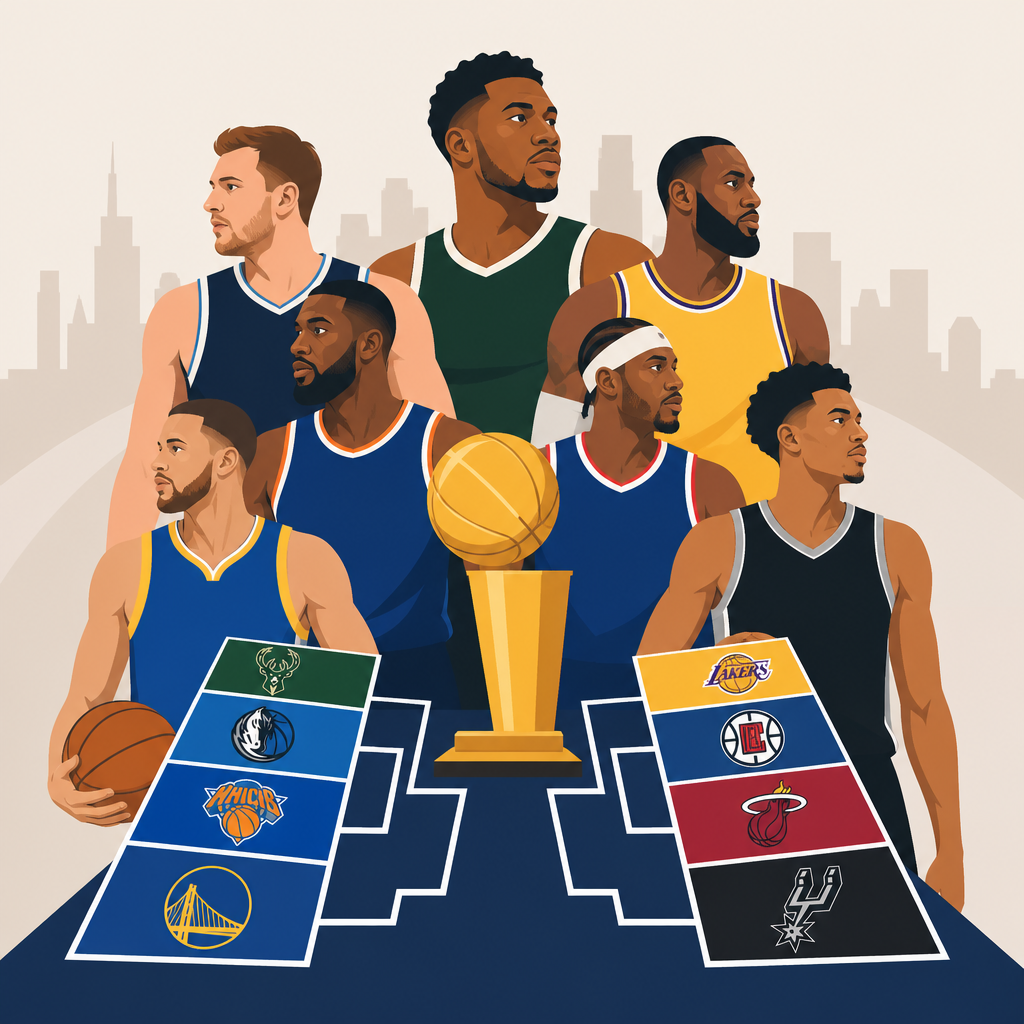
Oklahoma City belongs near the top of any 2026 conversation because its modern roster architecture is exactly what contenders chase. A primary star who can score at all three levels, long defenders around him, secondary creators, and enough shooting to stretch weak-side help is a championship template. Their path is strongest if their half-court offense continues to mature against switching defenses and if their interior size holds up against bruising frontcourts. Boston remains a benchmark whenever healthy because lineup balance is so hard to attack. If a team can space five out, defend multiple actions, and keep turnover rates low, it forces opponents into almost perfect basketball.
Denver’s path always begins with the solvability problem Nikola Jokic creates. If the league’s most dependable offensive engine has enough shooting and defensive support around him, Denver can beat anyone. Minnesota deserves high placement if its offense continues improving around elite defensive infrastructure, because playoff series often swing when one team can remove easy paint points. New York, meanwhile, looks stronger when its wings are healthy and its bench creation is stable; the roster has more edge than finesse, but edge wins in May if the spacing holds. The Los Angeles teams and Dallas sit in the high-variance group: their stars can win a series almost alone, yet depth and availability shape whether their path is realistic or merely dangerous.
Which rosters are built best for playoff basketball
Playoff basketball strips away superficial strengths. The best rosters share two traits: they can generate efficient offense after the first option is taken away, and they can defend without overhelping. Boston’s model is the cleanest example. Multiple ballhandlers reduce the burden on any one star, while shooting at every spot punishes aggressive tags and stunts. On defense, having interchangeable wings allows the team to switch, peel, and recover without opening easy kickout threes. That is playoff proofing. It is not about being perfect; it is about forcing opponents to attack your second-best answer rather than your weakest player.
Oklahoma City’s roster construction is similarly strong because it layers creation, length, and pace without sacrificing skill. The reason this matters in a seven-game series is simple: if one creator has an off night, another can start actions, and the defense still has to guard space honestly. I value that more than raw scoring averages. Minnesota has a different advantage. When a team can protect the rim at an elite level and still contest pull-up shooting with rangy perimeter defenders, it raises the degree of difficulty on every possession. The question is whether the offense can avoid long droughts against elite help schemes.
Denver remains unique because the roster is optimized around a singular hub. That can be devastating when cutters, screeners, and shooters remain precise. It can also be stressed if the supporting cast loses athletic pop or if perimeter containment forces too many scramble rotations. New York’s best version works because it can overwhelm smaller teams on the glass and defend wings physically, but it still needs enough shooting gravity to keep the lane open. Cleveland, Philadelphia, and Milwaukee all have routes into this discussion if their cores stay healthy and two-way balance improves, yet each enters 2026 with clearer structural questions than the teams above them.
How conference strength shapes each team’s path to the NBA Finals
The path to the title is never just about internal quality. Conference density matters. In the West, a contender may need to beat three fifty-win level teams just to reach the Finals. That means the margin for error is thinner, especially for clubs managing veteran stars. A team like Denver can be top-four in the league and still draw a brutal second-round matchup against an opponent with elite length and shot creation. Oklahoma City’s path can be cleaner if it secures home-court advantage, because younger teams often benefit more from game-control environments and officiating familiarity. Seeding is not cosmetic; it changes rest, travel, and matchup sequence.
The East can look easier from a distance, but that reading often ignores matchup extremes. Boston may have the broadest dominance profile, yet New York’s physicality, Milwaukee’s star power, Cleveland’s defense, and Philadelphia’s top-end talent can all create volatile series conditions. A contender with a thin bench can survive one taxing series and still arrive compromised in the conference finals. That is why path analysis should include load management, back-to-back exposure, and trade deadline flexibility. Teams that can add a backup center, another point-of-attack defender, or one more spacer often improve their path more than teams adding a redundant scorer.
Health interacts with conference strength in obvious but important ways. If two contenders are close on quality, the one in the lighter bracket deserves the edge. I have seen excellent teams spend so much energy in round one and round two that their execution drops a tier by the Finals. That is not an excuse; it is roster reality. The cleanest path belongs to teams that can secure top-two seeding, avoid a nightmare first-round opponent, and enter each series with one decisive advantage, whether that is best player control, superior spacing, or a defense that consistently wins the possession battle.
What to watch during the season as the power rankings change
Power rankings should move with evidence, not noise. Early in the season, focus on process metrics: shot profile, turnover rate, defensive rebounding percentage, half-court offensive efficiency, and free-throw differential. By December and January, lineup data becomes more useful, especially five-man groups with at least a few hundred possessions. I pay close attention to whether a team’s best units can survive against other contenders and whether bench-heavy stretches bleed points. A top NBA team in 2026 will almost certainly show a repeatable formula before the All-Star break, even if its record lags due to injuries or schedule quirks.
Watch for role clarity. Contenders rise when the third, fourth, and seventh men know exactly what shots they should take and what defensive jobs they own. Watch for playoff counters. Can the team punish switching with slips and seals. Can it beat blitzes with short-roll passing. Can it close games without hiding a weak defender. Named tools help here: Cleaning the Glass for efficiency splits, Second Spectrum for tracking trends, NBA Advanced Stats for lineup data, and Synergy for play-type results. The point is not to drown in numbers. It is to verify whether what looks dangerous is actually sustainable against elite opponents.
The most reliable late-season signals are simpler than people think. Does the star duo create quality looks in clutch time. Does the defense travel on the road. Can the coach trust eight or nine men. Are the bigs mobile enough for modern pick-and-roll coverage. If the answer is yes across those categories, the team belongs near the top of the 2026 NBA power rankings. If not, it may still be very good, but the path to the title is narrower than the standings suggest.
The 2026 championship race will reward teams that are complete, not just talented. The best roster is the one that can survive injuries, change styles, and still produce efficient offense in the final five minutes of a playoff game. Right now, the strongest title cases belong to balanced contenders with two-way depth, bankable stars, and defensive flexibility. Teams built around one overwhelming strength can still break through, but only if their weakness does not become the series story.
For readers using this page as a hub for NBA Teams analysis, the central lesson is clear: power rankings matter most when they explain why a team can actually win four rounds. Look beyond records and highlights. Study lineup fit, half-court creation, rim protection, and matchup resilience. Those are the variables that decide June. As the season unfolds, revisit the rankings with those factors in mind, then follow the deeper team pages to track how every contender’s roster and path to the title evolves.
Frequently Asked Questions
What makes an NBA team a true 2026 title contender instead of just a strong regular-season team?
A true contender in 2026 is judged by far more than record, highlight plays, or monthly power-ranking momentum. The best teams usually check several boxes at once: elite top-end talent, reliable secondary scoring, enough two-way size and versatility to survive different playoff matchups, and a half-court offense that can still create efficient looks when defenses tighten in late May and June. That last point matters because postseason basketball is less about pace and regular-season rhythm and more about solving set defenses over and over again. Teams that depend too heavily on transition, shooting luck, or one schematic advantage often look dominant from November through April and then run into trouble when opponents have a full series to attack their weaknesses.
Serious evaluations also focus on underlying indicators such as offensive and defensive efficiency, lineup data, turnover control, rim protection, shot creation under pressure, and whether a team can win in multiple styles. A contender should be able to play big or small, switch or drop depending on the matchup, and survive off nights from role players because its stars can still generate quality offense. Health is another major factor. A roster may look unbeatable on paper, but if its best players have recurring availability concerns, that affects its real championship odds. The teams with the best path to the title are the ones combining star reliability, lineup balance, defensive flexibility, and playoff-tested decision-making.
Why do roster balance and lineup fit matter as much as star power in the 2026 championship race?
Star power still drives the NBA, but championship teams are rarely built on names alone. Fit matters because playoff opponents are very good at exposing structural flaws. If a team has two or three stars but lacks spacing, point-of-attack defense, rebounding, or enough secondary playmaking, those issues become much harder to hide in a seven-game series. Balance is what allows a roster to keep functioning when one area is challenged. A team with shooting at multiple positions, switchable defenders, a dependable rim protector, and at least two trustworthy creators is much better equipped to handle the adjustments that define the postseason.
Lineup fit also determines whether a coach has real options. The strongest 2026 contenders are likely to be teams that can close games with several different five-man groups depending on the matchup. Maybe they need more size against a dominant interior scorer, or more speed against a perimeter-heavy opponent, or extra shooting to punish a defense that loads up on the stars. When a team’s pieces complement each other, those adjustments feel natural rather than desperate. In contrast, a top-heavy team may pile up regular-season wins through talent but become easier to scheme against in the playoffs if its non-star players cannot defend, pass, space the floor, or survive in high-leverage minutes.
How important are health and age curves when projecting the best NBA teams in 2026?
They are absolutely central. Health is often the difference between a favorite and a disappointment, and age curves help explain whether a team is rising, peaking, or living on borrowed time. In a title race as demanding as the NBA playoffs, even a minor injury can change a series by limiting burst, mobility, shooting lift, or defensive range. That is why analysts do not just ask whether a star is available; they ask whether that player is fully functional. A roster with elite talent but shaky durability is much harder to trust than one with slightly less top-end upside and far more dependable availability.
Age matters because it affects both ceiling and sustainability. Younger teams may have athleticism, depth, and internal improvement still ahead of them, but they can also be vulnerable to late-game execution mistakes or inconsistent playoff composure. Older teams often bring experience and half-court polish, yet they may struggle to maintain defensive intensity across four rounds or stay healthy under a heavy workload. The most dangerous 2026 contenders usually sit in the sweet spot: stars still playing near peak level, veteran role players who understand playoff basketball, and enough depth to manage minutes intelligently over the long season. When evaluating the best path to the title, availability and physical resilience are not side notes; they are foundational.
What role do coaching and playoff adaptability play in deciding which team has the best path to the title?
Coaching is one of the biggest separators among teams that already have championship-level talent. Once the playoffs begin, every possession becomes more strategic. Opponents target weak defenders, crowd primary creators, force stars into uncomfortable spots, and challenge coaches to find counters quickly. The teams with the best path to the title are not just talented; they are also well-prepared, disciplined, and flexible. Great coaching shows up in substitution patterns, timeout adjustments, late-game execution, defensive coverages, matchup hunting, and the ability to rework a rotation after one bad game without losing structure.
Adaptability matters because no team goes through four rounds facing the same problem. One series might demand extra size and rebounding, the next more switching and perimeter containment, and the next elite half-court shot creation. Coaches who can identify what is actually deciding a series, rather than just reacting to box-score noise, give their teams a real edge. This is why some squads rank higher than their record alone might suggest: they have a coaching staff capable of maximizing strengths, minimizing weaknesses, and making practical playoff adjustments. In a close title race, the best roster is not always the one with the flashiest names; it is often the one with the clearest identity and the smartest counters.
When comparing the top NBA teams in 2026, what should fans look for beyond win-loss record and seeding?
Fans should start by looking at how a team wins, not just how often it wins. A high seed is valuable, but record alone can hide a lot. Some teams dominate weaker opponents yet struggle against elite defenses. Others lean on unsustainably hot shooting, favorable injury luck, or regular-season depth that becomes less meaningful once rotations shorten. To judge true title potential, it helps to study whether a team can score efficiently in the half court, defend without fouling, protect the rim, limit turnovers, and create dependable offense late in close games. Those traits tend to carry into the playoffs far better than raw regular-season momentum.
Fans should also pay attention to lineup combinations, star consistency, and matchup resilience. Does the team have enough two-way wings? Can it survive when opponents force the ball out of its primary scorer’s hands? Is there a clear closing lineup, and are there backup options if one matchup breaks badly? Another useful question is whether the team’s best players raise the floor and ceiling at the same time. Some stars are brilliant in open-court regular-season settings but easier to contain in the postseason. Others remain effective no matter how physical or tactical a series becomes. Ultimately, the best 2026 team is likely to be the one that combines elite talent with structural soundness: real shot creation, real defensive versatility, reliable health, and enough tactical flexibility to answer four very different playoff challenges.