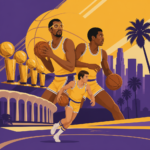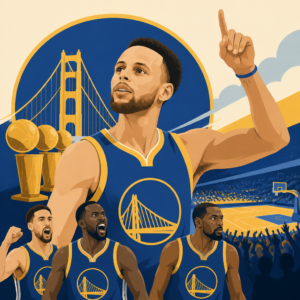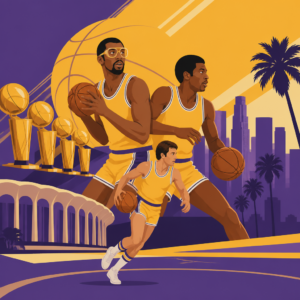

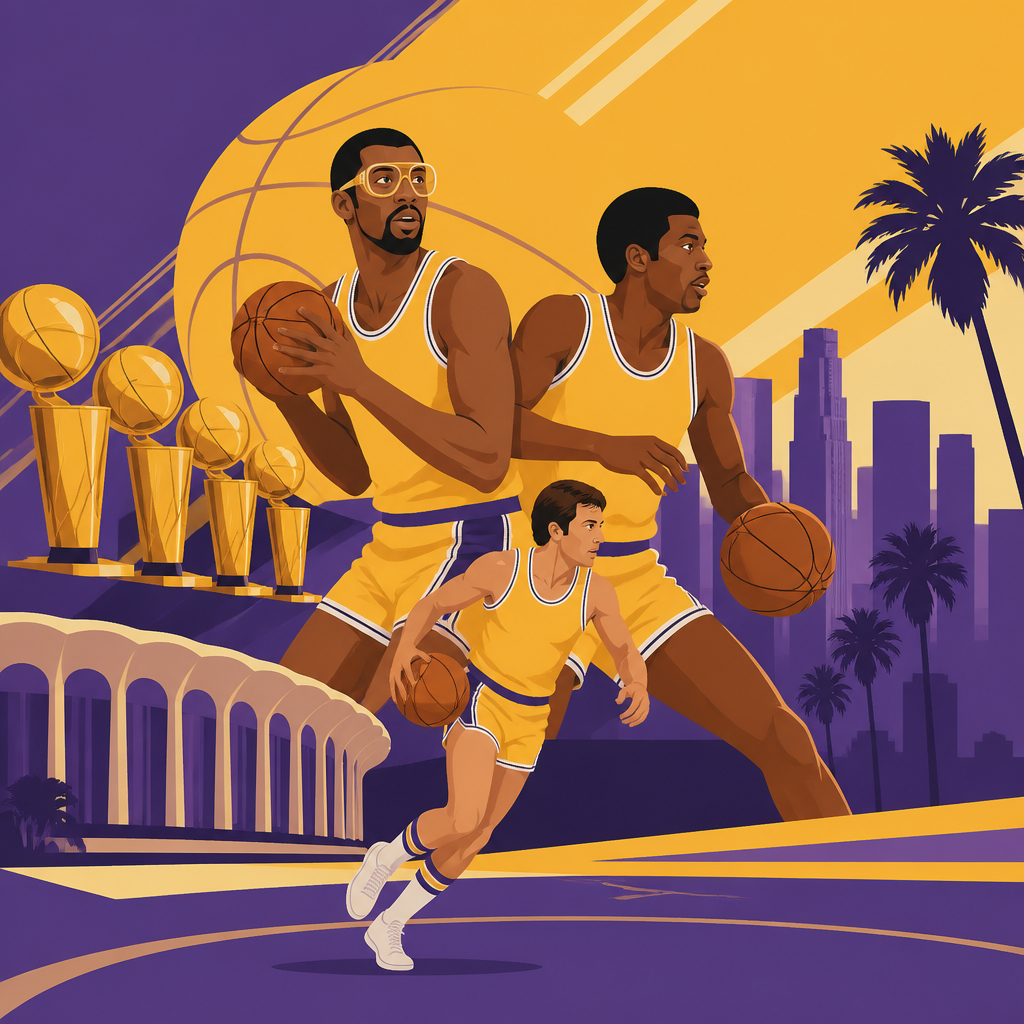
The Los Angeles Lakers history is one of the defining stories in American sports, blending championships, star power, market influence, and a style of play that reshaped professional basketball. For readers exploring NBA team histories, the Lakers are a natural hub because their timeline touches nearly every major phase of league development: the early years in Minneapolis, the move to Los Angeles, the bitter Celtics rivalry, the rise of modern television audiences, the Showtime era, the Shaquille O’Neal and Kobe Bryant dynasty, and the franchise’s continued relevance into the present day. Few teams can claim both sustained success and lasting cultural impact at this scale.
Understanding Los Angeles Lakers history starts with a few key terms. A championship refers to an NBA title won through the league’s playoff system. The Showtime era describes the fast-paced, entertainment-driven Lakers teams of the 1980s led by Magic Johnson, Kareem Abdul-Jabbar, James Worthy, and coach Pat Riley. A franchise era is a period defined by a core roster, coaching philosophy, and competitive identity. In the Lakers’ case, these eras are unusually clear because each one produced star players, tactical innovations, and championships. The team’s history matters not only because of how many titles it won, but because the Lakers repeatedly changed how basketball looked, felt, and was marketed.
I have worked through team history projects where the biggest challenge is separating mythology from what actually happened on the court and in the front office. With the Lakers, that distinction matters. Their reputation for glamour is real, but it can obscure how methodically the organization built winning teams. Minneapolis drafted George Mikan and established an early dynasty. Los Angeles executive Jerry West later assembled championship rosters with a sharp eye for fit and tempo. During the 1980s, ownership under Dr. Jerry Buss understood that basketball could be both elite competition and premium live entertainment. That combination turned the Lakers from a successful franchise into a global sports brand.
This hub article covers team histories through the Lakers lens by explaining how the franchise evolved, why the Showtime era became so influential, and where the team’s championships fit within broader NBA history. It also answers common questions directly: How many championships have the Lakers won? Why was Showtime so effective? Who were the most important figures in franchise history? What makes the Lakers different from other historic NBA teams? By the end, readers should have a complete foundation for understanding the Lakers as both a championship organization and a model for how team identity can shape an entire league.
From Minneapolis to Los Angeles: the foundation of a dynasty
The Lakers were founded in 1947 as the Minneapolis Lakers, taking their name from Minnesota’s nickname, “Land of 10,000 Lakes.” Before the NBA became the modern league fans recognize today, the franchise was already a powerhouse. George Mikan, the dominant big man of early professional basketball, led Minneapolis to five championships across the National Basketball League, Basketball Association of America, and early NBA years. Those titles came in 1949, 1950, 1952, 1953, and 1954. When historians discuss the first true basketball dynasty, the Mikan-led Lakers belong at the center of the conversation.
Mikan’s impact went beyond winning. His interior scoring and rim protection were so overwhelming that the sport changed around him. The league widened the lane to reduce his dominance near the basket. The introduction of the shot clock in 1954 also helped address the slow, stall-heavy style that teams used when protecting leads against dominant opponents. In practical terms, the early Lakers helped push pro basketball toward a more watchable product. That pattern would reappear later in Los Angeles, where another great Lakers team helped define a new style for a new generation.
Financial pressures and attendance issues eventually pushed the franchise to relocate. In 1960, owner Bob Short moved the team to Los Angeles, a decision that proved transformative for both the Lakers and the NBA. The city offered a larger media market, stronger commercial potential, and a stage suited to star athletes. Elgin Baylor and Jerry West became the faces of the new Los Angeles team, giving the franchise immediate credibility on the West Coast. Baylor brought aerial scoring and creativity before the above-the-rim game became common, while West set a standard for shot-making, toughness, and late-game execution that still defines elite guard play.
Despite that talent, the 1960s Lakers often ran into the Boston Celtics in the NBA Finals. They reached the Finals repeatedly but lost six times to Boston during the decade. Those losses matter because they shaped the franchise mindset. The Lakers were glamorous, talented, and visible, but not yet consistently able to finish on the biggest stage. That tension fueled later roster-building decisions and deepened the Lakers-Celtics rivalry into the NBA’s signature feud. In many ways, the pain of the 1960s created the urgency that powered the championships to come.
The first Los Angeles title and the path to Showtime
The breakthrough came in 1972. Coached by Bill Sharman and led by Wilt Chamberlain, Jerry West, and Gail Goodrich, the Lakers won 69 games, then an NBA record, and captured the franchise’s first championship in Los Angeles. That team also produced a 33-game winning streak, still the longest in major American professional team sports. The 1971-72 Lakers were not Showtime yet, but they represented a crucial bridge between the franchise’s early history and its modern identity. They were disciplined, deep, and devastating in transition when opportunities appeared.
Several structural changes inside the organization also set up the 1980s. Jerry West transitioned from superstar guard to influential executive, and his personnel judgment would become one of the franchise’s greatest competitive advantages. The Lakers also benefited from a turning point in ownership. In 1979, Dr. Jerry Buss bought the franchise and quickly changed its commercial direction. Buss understood the value of presentation: courtside celebrity culture, the Forum as an event space, the Laker Girls, and a polished entertainment experience all made attending games feel different from a standard night at the arena. Importantly, this was not cosmetic. It amplified a winning product rather than trying to substitute for one.
That same year, the Lakers drafted Earvin “Magic” Johnson first overall after acquiring the pick from the New Orleans Jazz in a prior trade. This was the single most important personnel move in shaping the Showtime era. Magic was a 6-foot-9 point guard with elite vision, rebounding instincts, and an uncommon ability to accelerate the game without losing control of it. He could throw outlet passes over the top of a defense, hit a wing runner in stride, or manipulate half-court help defenders with his eyes. His style fit perfectly with Kareem Abdul-Jabbar, who had joined the Lakers in 1975 and remained the league’s most reliable interior force through his skyhook, timing, and positional discipline.
The 1979-80 championship immediately signaled that a new era had arrived. As a rookie, Magic famously started at center in Game 6 of the Finals when Abdul-Jabbar was injured and delivered 42 points, 15 rebounds, and 7 assists against Philadelphia. The performance quickly became legend, but its deeper meaning is more important: the Lakers now had a player who embodied versatility, pace, and spectacle at championship level. From a team history perspective, this was the hinge point. The Lakers were no longer just a historic franchise. They were becoming the league’s most influential modern team.
Why the Showtime era worked
Showtime was not simply “fast basketball.” It was a complete system built on pace, spacing principles of the time, elite rebounding, positional versatility, and instant decision-making. The Lakers pushed the ball after makes and misses, trusted Magic to read numerical advantages, and turned defensive rebounds into immediate offense. Kareem’s outlet passing was underrated, and wings such as Michael Cooper and Jamaal Wilkes filled lanes with discipline rather than chaos. When opponents prevented the break, the Lakers could flow into half-court offense featuring Kareem on the block, weak-side cuts, and secondary actions for shooters and slashers. This is why Showtime lasted; it was not reckless. It had structure.
Pat Riley, who became head coach during the 1981-82 season, refined the team’s identity. Riley demanded conditioning, role clarity, and relentless tempo. Under him, the Lakers were glamorous in public but ruthlessly precise in preparation. Players knew their lanes, defensive assignments, and situational responsibilities. James Worthy, drafted first overall in 1982, gave the team another devastating transition weapon. His ability to sprint wide, catch on the move, and finish through contact made him ideal for the system. Byron Scott later added perimeter scoring and pace. Cooper provided elite point-of-attack defense, helping balance an offense-first public image with real championship-level stops.
The numbers support the eye test. The Lakers of the 1980s regularly ranked among league leaders in offensive efficiency and pace, even though advanced metrics were not discussed publicly then the way they are now. More importantly, they translated style into titles. Los Angeles won championships in 1980, 1982, 1985, 1987, and 1988 during the decade, reached eight Finals in the 1980s, and became the defining team of the period. The 1985 title was especially significant because it was the first time the Lakers defeated the Celtics in the Finals, overcoming years of frustration and a narrative that Los Angeles lacked Boston’s toughness.
| Era | Core figures | Championships | Why it mattered |
|---|---|---|---|
| Minneapolis dynasty | George Mikan, John Kundla | 1949, 1950, 1952, 1953, 1954 | Established the Lakers as the first dominant pro basketball franchise |
| Early Los Angeles | Elgin Baylor, Jerry West, Wilt Chamberlain | 1972 | Delivered the first title in Los Angeles and a record 33-game winning streak |
| Showtime era | Magic Johnson, Kareem Abdul-Jabbar, Pat Riley, James Worthy | 1980, 1982, 1985, 1987, 1988 | Defined 1980s basketball with pace, flair, and sustained Finals success |
| Three-peat era | Shaquille O’Neal, Kobe Bryant, Phil Jackson | 2000, 2001, 2002 | Reestablished dominance with elite interior force and triangle offense structure |
| Kobe-Gasol era | Kobe Bryant, Pau Gasol, Phil Jackson | 2009, 2010 | Extended the franchise legacy with a more balanced, tactical championship model |
| Modern resurgence | LeBron James, Anthony Davis, Frank Vogel | 2020 | Proved the Lakers could adapt and win in a radically different NBA environment |
Just as important, Showtime changed the NBA’s business trajectory. CBS broadcasts, national sponsorships, and the visual appeal of Lakers-Celtics Finals matchups helped transform the league from a struggling property into mainstream entertainment. Magic Johnson and Larry Bird are often credited together for reviving league interest, and that is accurate. But from the standpoint of team identity, the Lakers showed how a franchise could marry winning, aesthetics, and celebrity without weakening competitive standards. That blueprint still influences how major-market teams think about branding today.
Championship legacy beyond Showtime
Although Showtime is central to Los Angeles Lakers history, the franchise’s championship story did not end in 1988. After Magic’s 1991 retirement following his HIV announcement, the organization entered a transitional period. There were still strong teams and major stars, but the next dynasty required a new foundation. Jerry West, now a top executive, acquired Kobe Bryant in a 1996 draft-night trade and signed Shaquille O’Neal in free agency that same summer. Those two moves were franchise-altering. O’Neal gave the Lakers the most physically dominant center of his era, while Bryant developed into an elite perimeter scorer and one of the league’s fiercest competitors.
Under Phil Jackson, the Lakers won three straight championships in 2000, 2001, and 2002. The scheme was different from Showtime. Jackson’s triangle offense emphasized spacing through strong-side post entries, split actions, read-based cuts, and deliberate floor balance. Yet the underlying principle remained familiar: build around extraordinary talent, define roles clearly, and perform under playoff pressure. The 2001 title run, in which the Lakers went 15-1 in the postseason, stands as one of the most dominant playoff performances in NBA history. This era matters in a team histories hub because it shows the Lakers were never locked into one style. They won with speed in the 1980s and power in the early 2000s.
Kobe Bryant later led the franchise into another championship phase after the acquisition of Pau Gasol in 2008. With Gasol, Lamar Odom, Andrew Bynum, and Jackson’s return to the bench, the Lakers reached three consecutive Finals and won titles in 2009 and 2010. The 2010 championship over Boston was especially meaningful because it linked generations of Lakers history: another title, another Celtics chapter, and another proof point that the franchise’s identity includes resilience as much as glamour. More recently, the Lakers won the 2020 NBA championship behind LeBron James and Anthony Davis in the pandemic bubble, demonstrating adaptability under unprecedented conditions.
What defines the Lakers in NBA team histories
Across all eras, the Lakers stand out for three reasons. First, they sustain relevance across generations better than almost any franchise in North American sports. Second, they repeatedly attract or develop transformative stars, from Mikan to West, Baylor, Wilt, Kareem, Magic, Worthy, Shaq, Kobe, and LeBron. Third, they understand that team identity is strategic, not accidental. The Lakers are associated with stars and spectacle, but behind that image is a consistent willingness to invest in scouting, player development, coaching stature, and high-level roster construction. That combination is why their history works so well as a hub within NBA team histories.
For readers comparing franchises, the Lakers offer a useful case study in how success evolves. A team can dominate one era through size, another through pace, another through half-court precision, and another through star partnerships. The details change, but the standard does not. The Lakers expect to contend, and that expectation influences every major decision, from draft strategy to free agency to coaching hires. If you are building out knowledge of NBA teams, start here, then explore connected histories such as the Celtics rivalry, the Minneapolis years, the Magic-Kareem partnership, and the Kobe-Shaq dynasty. The Lakers are not just one franchise story. They are a map of NBA history itself.
The clearest takeaway from Los Angeles Lakers history is that championships matter most when they define an era, and the Lakers have done that repeatedly. The Minneapolis titles established early dominance. The 1972 team validated Los Angeles as a championship home. Showtime turned speed, skill, and entertainment into a basketball ideal. Later dynasties proved the franchise could reinvent itself without losing its standard. That is why the Lakers remain essential to any serious understanding of NBA team histories.
If you want a reliable way to study basketball history, follow the Lakers across each generation and note how the roster, coaching, and style changed with the league around them. You will see not only how titles were won, but how one franchise helped shape what the NBA became. Use this page as your starting point, then continue through the broader NBA Teams collection to compare the Lakers with every other major team history.
Frequently Asked Questions
What makes the Los Angeles Lakers one of the most important franchises in NBA history?
The Los Angeles Lakers are central to NBA history because their story runs through nearly every major era of professional basketball. The franchise began as the Minneapolis Lakers, where it first became a powerhouse behind George Mikan, one of the league’s earliest superstars. That early dominance helped establish the idea of the NBA dynasty before the league had fully matured. When the team relocated to Los Angeles in 1960, it carried that winning identity into a much larger media market, helping professional basketball grow in national visibility and cultural relevance.
The Lakers also became one of the league’s defining standard-bearers because they consistently paired elite talent with memorable style. Across different generations, the franchise featured iconic names such as Jerry West, Elgin Baylor, Wilt Chamberlain, Magic Johnson, Kareem Abdul-Jabbar, Shaquille O’Neal, Kobe Bryant, and LeBron James. Few teams in any sport can point to that kind of uninterrupted star power across so many decades. Just as important, the Lakers were rarely only about winning games; they often shaped how fans experienced basketball, from the glamour associated with Los Angeles to the way nationally televised games turned players into global celebrities.
Another reason the Lakers matter so much is their role in some of the NBA’s biggest rivalries and turning points. Their battles with the Boston Celtics helped define the emotional and competitive backbone of the league, especially in the 1960s and 1980s. The franchise also played a major part in ushering in the NBA’s modern entertainment era, particularly during Showtime, when pace, flair, and personality made the sport more marketable to mainstream audiences. In short, the Lakers are not just a successful team; they are one of the franchises most responsible for shaping the NBA’s identity, popularity, and long-term mythology.
How did the Lakers franchise begin, and why was the move from Minneapolis to Los Angeles so significant?
The franchise began in Minneapolis, Minnesota, where it was originally known as the Minneapolis Lakers. The name “Lakers” came from Minnesota’s identity as the “Land of 10,000 Lakes,” and the team quickly became one of the early powers in professional basketball. Led by George Mikan, the Lakers won multiple championships in the late 1940s and 1950s, helping establish the NBA during a period when the league was still fighting for stability and national attention. Mikan was such a dominant force that rule changes were made in response to his impact, which tells you how influential those early Lakers teams were.
The move to Los Angeles in 1960 was one of the most important relocations in sports history because it connected a winning franchise to one of the country’s largest and most influential media markets. At the time, professional basketball was still developing its national appeal, and moving to Southern California gave the franchise a chance to grow alongside the expanding television landscape. Los Angeles offered not just population and economic opportunity, but also a connection to entertainment culture that few other cities could match. That combination eventually helped the Lakers become a global brand rather than simply a successful team.
On the court, the move also set the stage for some of the most memorable eras in NBA history. The Los Angeles years brought stars like Jerry West and Elgin Baylor to a broader audience, later followed by Wilt Chamberlain and, in subsequent generations, Magic Johnson, Kareem Abdul-Jabbar, and others. While the team experienced both triumph and heartbreak after the relocation, the move positioned the Lakers to become one of the NBA’s flagship franchises. Without Los Angeles, the team might still have had a rich history, but it likely would not have developed the same cultural reach, commercial power, or enduring aura that defines the Lakers today.
What exactly was the Showtime era, and why is it still so celebrated?
The Showtime era refers primarily to the Lakers teams of the 1980s, built around Magic Johnson, Kareem Abdul-Jabbar, and a deep supporting cast that included stars and high-level role players such as James Worthy, Byron Scott, Michael Cooper, and others. The label “Showtime” captured more than just winning; it described a style of basketball that was fast, exciting, creative, and perfectly suited to television. These Lakers pushed the ball in transition, thrived on no-look passes, filled lanes with precision, and turned fast breaks into a kind of basketball theater. Under coach Pat Riley, the team blended flair with discipline, making it both entertaining and brutally effective.
What made Showtime so important is that it changed how many people saw the NBA. Before the league’s explosive growth in the 1980s, professional basketball did not occupy the same place in American sports culture that it does now. The Lakers helped change that by delivering games that felt like major events. Their style fit the era’s media expansion, and Magic Johnson’s charisma made the team accessible even to casual fans. Kareem provided a dominant interior anchor and one of the most unstoppable shots in basketball history with the skyhook, while Magic orchestrated everything with size, vision, and joy. The result was a product that appealed to hardcore basketball fans and newcomers at the same time.
Showtime is still celebrated because it represents the ideal combination of substance and spectacle. The Lakers were not merely flashy; they won championships, reached the NBA Finals repeatedly, and defined an entire decade. Their rivalry with Larry Bird’s Boston Celtics gave the NBA one of its greatest narrative engines, with contrasting styles, personalities, and coasts. For many fans and historians, Showtime stands as a turning point when basketball became more than a game on the court; it became a cultural event, a television draw, and a statement about pace, personality, and ambition. That is why the era remains one of the most beloved and influential chapters in NBA history.
How many championships have the Lakers won, and which title eras stand out the most?
The Lakers have won 17 NBA championships, tying them among the most successful franchises in league history. What makes that total especially impressive is the way it spans multiple eras, cities, and styles of basketball. Their championship story begins in Minneapolis, where George Mikan led the franchise to its earliest titles and helped build its identity as a winner. After the move to Los Angeles, the Lakers continued to contend, though some of their early decades in California were marked by painful Finals losses, particularly against the Celtics. Even so, the franchise never lost its sense of big-stage relevance.
Several title eras stand out. The 1972 championship team, led by Jerry West, Wilt Chamberlain, and Gail Goodrich, is remembered for finally delivering a title to Los Angeles after years of near misses and for setting a then-record 33-game winning streak. Then came the defining 1980s Showtime period, when Magic Johnson and Kareem Abdul-Jabbar led the Lakers to five championships and made the franchise synonymous with excellence and entertainment. That decade solidified the team’s global identity and gave the NBA some of its most unforgettable moments.
The next major championship wave came in the early 2000s, when Shaquille O’Neal and Kobe Bryant powered the Lakers to a three-peat from 2000 through 2002 under coach Phil Jackson. That run showcased overwhelming talent and reestablished the Lakers as the league’s dominant force. Later, Kobe Bryant led the team to back-to-back titles in 2009 and 2010, the latter coming in a dramatic Finals victory over Boston that added another emotional chapter to the franchise rivalry. Most recently, the Lakers won the 2020 NBA championship behind LeBron James and Anthony Davis, proving that even after generations of change, the franchise still knows how to reinvent itself around elite talent and championship expectations.
Why is the Lakers-Celtics rivalry so important to understanding Lakers history?
The Lakers-Celtics rivalry is essential to understanding Lakers history because it shaped the franchise’s identity through both heartbreak and triumph. In the 1960s, the Lakers, led by stars like Jerry West and Elgin Baylor, repeatedly ran into the Boston Celtics dynasty led by Bill Russell. Those losses were painful and frequent, and they created an emotional foundation that stayed with the franchise for decades. The rivalry was not simply about two talented teams meeting in the Finals; it became a clash of basketball philosophies, regional identities, and historical legacies. For the Lakers, Boston often represented the final obstacle between greatness and validation.
The rivalry reached even greater prominence in the 1980s, when Magic Johnson’s Lakers and Larry Bird’s Celtics helped transform the NBA into a mainstream national product. Their Finals meetings in 1984, 1985, and 1987 were loaded with symbolism: West Coast versus East Coast, speed versus toughness, glamour versus grit. The Lakers’ victory in the 1985 Finals was especially meaningful because it marked the franchise’s first championship series win over Boston, erasing one of its deepest psychological burdens. Those battles were not only high-level basketball; they were events that helped define the decade and elevate the profile of the league itself.
Even in later years, the rivalry continued to matter. The Lakers and Celtics met again in the NBA Finals in 2008 and 2010, renewing the historical tension for a new generation of fans. The Celtics won in 2008, but the Lakers answered with a title in 2010, giving Kobe Bryant one of the signature