
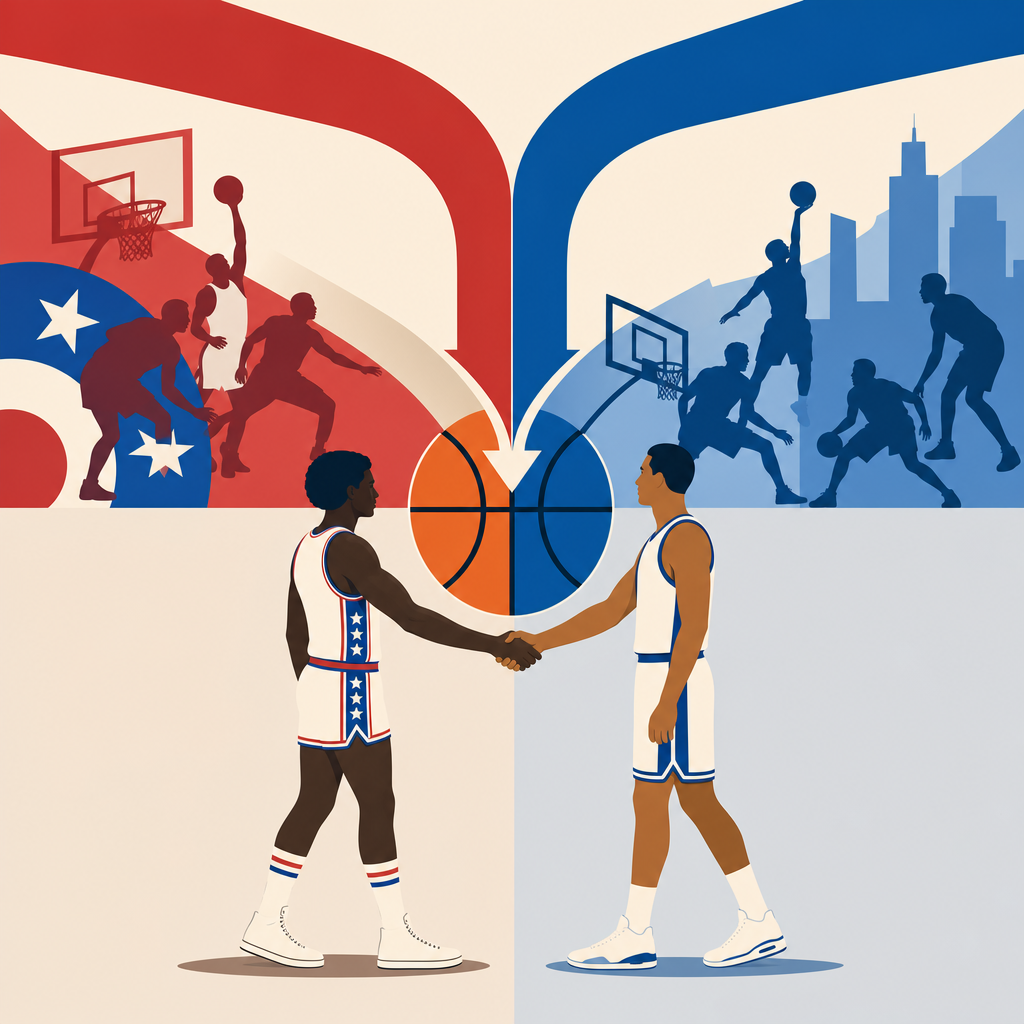
The ABA-NBA merger explained begins with a simple truth: the National Basketball Association did not merely absorb a smaller rival in 1976, it inherited ideas, markets, players, and a style that permanently reshaped professional basketball. The American Basketball Association, founded in 1967, challenged the older league with red, white, and blue basketballs, aggressive expansion, a flashier presentation, and a willingness to recruit talent the NBA undervalued or could not yet sign. When people ask what the merger was, the short answer is that four ABA franchises joined the NBA after years of competition, lawsuits, and financial strain. The fuller answer is that the rivalry accelerated change across scouting, player salaries, television appeal, offensive strategy, and league geography.
Understanding the ABA-NBA merger matters because it explains why modern pro basketball looks, feels, and pays the way it does. Many fans know isolated facts: Julius Erving came from the ABA, the San Antonio Spurs were once an ABA team, and the three-point shot was pioneered there. But league history makes more sense when those facts are connected. The merger was not a ceremonial handshake between equal partners. It was a negotiated settlement shaped by antitrust pressure, franchise instability, and intense battles over star players. It also produced winners and losers. Denver, Indiana, New York, and San Antonio entered the NBA. Kentucky and St. Louis did not. The Spirits of St. Louis disappeared, yet their owners secured one of the most remarkable sports business deals ever made.
In researching and writing about NBA history, I keep coming back to this period because it is one of the clearest examples of competition forcing innovation. The ABA operated with fewer resources, but it understood entertainment value, open-court offense, and player marketing before the NBA fully embraced them. It signed stars such as Erving, George Gervin, Artis Gilmore, David Thompson, and Moses Malone. It targeted college underclassmen and players from overlooked backgrounds, including those from historically Black colleges and from playground traditions that fit its looser style. Some ABA practices were unstable or unsustainable. Even so, the league changed what pro basketball could be.
This article serves as a hub for league history within NBA history by explaining the merger’s origins, timeline, business mechanics, cultural effects, and lasting legacy. If you want to understand franchise movement, labor relations, the rise of the three-point shot, or why certain teams carry deep ABA roots, this is the place to start. The ABA-NBA merger explained clearly means following the rivalry from launch to settlement, then tracing how its influence spread through every era that followed.
The ABA’s Founding and Why a Rival League Could Compete
The ABA was created in 1967 by owners who wanted entry into major professional basketball markets and saw an opportunity to challenge the established NBA. Rival leagues were not unusual in American sports, but most lacked a clear identity. The ABA did not. It differentiated itself immediately through branding, style, and recruitment. The red, white, and blue ball was a gimmick, but it worked because it signaled that this league was designed for visibility. More important, the ABA embraced a faster pace, freer offense, and a showman’s sensibility that appealed to younger fans and local media.
The NBA of the late 1960s was growing but still relatively compact, with limited television reach compared with football and baseball. That gave the ABA room to enter cities that wanted major league status or feared being left behind. Some ABA franchises were unstable from the start, yet the league proved there was pent-up demand for pro basketball in places the NBA had not fully prioritized. Indiana became a powerhouse. Denver built a strong fan base. San Antonio, after the Dallas Chaparrals moved, showed the viability of top-level basketball in Texas. New York, through the Nets, provided major-market visibility and credibility.
The ABA also competed by attacking labor market inefficiencies. Before full free agency transformed sports, leagues held substantial control over player movement. The ABA disrupted that structure by offering money and opportunity to players who wanted leverage. One key battleground involved underclassmen and stars whose rights were not yet fully locked down. Spencer Haywood’s legal challenge against the NBA helped alter entry rules for hardship cases. The ABA’s willingness to pursue talent outside traditional pathways pressured the NBA to adapt. In practical terms, the rival league made players more valuable by creating a second buyer.
The Talent War, Legal Battles, and Financial Pressure
The clearest reason the ABA mattered is talent. A rival league survives only if fans believe the players are real stars, and the ABA delivered enough of them to be taken seriously. Julius Erving became the face of the league because he combined elite production with visual spectacle. George McGinnis, Dan Issel, David Thompson, Artis Gilmore, and George Gervin gave the ABA All-NBA caliber depth. Moses Malone began his pro career there straight out of high school, a decision that would have been impossible in the NBA at the time. Rick Barry briefly played in the ABA as well, underscoring that established stars could use the new league as leverage.
These signings came at a price. The ABA and NBA fought bidding wars that raised salaries and signing bonuses. Owners filed lawsuits, disputed contracts, and challenged reserve-clause controls. By the mid-1970s, merger discussions intensified because both leagues were spending heavily and operating under uncertainty. The NBA wanted the threat contained. The ABA wanted survival and legitimacy. The obstacle was not simply agreement between owners. The settlement had to navigate antitrust concerns and, crucially, the views of NBA players who feared expansion by merger could dilute revenues.
The economics were uneven across ABA clubs. A few teams drew well and had momentum. Others struggled with attendance, arena issues, or ownership instability. Franchise movement became common, which hurt long-term planning. Yet instability should not be mistaken for irrelevance. The league’s pressure on wages was real, and its influence on style was obvious. In sports business terms, the ABA functioned as a disruptive competitor: undercapitalized overall, but innovative enough to force the incumbent to respond.
| Issue | ABA Approach | NBA Response | Long-Term Effect |
|---|---|---|---|
| Player recruitment | Aggressive bidding for stars and underclassmen | Higher salaries and revised entry practices | Stronger player leverage across pro basketball |
| Style of play | Fast pace, spacing, creativity, three-point shot | Gradual adoption of more open offense | Modern perimeter-oriented basketball |
| Market strategy | Expansion into nontraditional or underserved cities | More attention to national footprint | Broader geographic growth of the sport |
| Entertainment value | Flashy branding and star marketing | Improved presentation and promotion | Basketball as a television-friendly spectacle |
How the 1976 Merger Actually Happened
The ABA-NBA merger was finalized in June 1976 after years of on-and-off negotiation. Four ABA franchises entered the NBA: the Denver Nuggets, Indiana Pacers, New York Nets, and San Antonio Spurs. Two ABA teams were left out: the Kentucky Colonels and the Spirits of St. Louis. This is one of the most important points in league history, because “merger” can imply a full combination of organizations. That is not what happened. The NBA accepted selected ABA teams under terms that were financially punishing and politically complex.
The incoming clubs had to pay substantial entry fees, and they were initially denied a full share of certain television revenues. The Nets also faced an especially difficult territorial payment tied to the New York market and the Knicks. Those costs weakened the new entrants immediately. Indiana and San Antonio dealt with years of financial pressure after joining. Denver adjusted best competitively in the short term, reaching the playoffs in its first NBA season. The Pacers, despite their ABA dynasty status, struggled more in the transition because of finances and roster erosion.
Kentucky’s exclusion remains one of the great what-ifs in basketball history. The Colonels were among the ABA’s strongest franchises, with a stable fan base and championship credibility. But owner John Y. Brown chose a buyout rather than entry, then soon bought the NBA’s Buffalo Braves. The Spirits accepted a different arrangement. Their owners, Ozzie and Daniel Silna, surrendered the franchise in exchange for a share of future NBA television revenues tied to the former ABA clubs. Because media rights exploded in value over the following decades, that agreement became legendary. The Silnas earned far more than a conventional franchise buyout would have produced.
Another often overlooked factor was player opposition. NBA players, represented by the NBPA, challenged the merger in court because they believed it constrained labor opportunities. The Oscar Robertson suit, originally filed against the NBA’s reserve system, shaped the legal environment that delayed consolidation. The final resolution came only after enough barriers were cleared. So when historians explain the merger, they should frame it as a business settlement under legal pressure, not a simple celebration of basketball unity.
What the ABA Brought Into the NBA
The ABA’s most famous basketball innovation was the three-point line. The NBA did not adopt it immediately after the merger; that came in 1979. But the ABA proved the shot could add strategy, excitement, and comeback potential. At the time, many traditionalists considered it a novelty. In hindsight, it was a foundational change. Today, spacing, volume shooting, and efficiency models built through tools such as effective field goal percentage and points per shot all trace part of their lineage to the ABA’s willingness to rethink floor geometry.
The influence went beyond one rule. The ABA normalized a more expressive game. Players attacked in transition, threw creative passes, and used space differently. Julius Erving’s above-the-rim style helped redefine what fans expected from stars. George Gervin’s finger roll scoring artistry and David Thompson’s explosiveness made flair marketable without reducing substance. What I find most striking in old game film is how modern some possessions look: early offense, wide lanes, quick decisions, and freedom for individual creation.
Front offices and coaches also learned from the rivalry. Broad talent scouting became essential because the ABA had already shown that elite players existed outside the most conventional pipelines. The willingness to sign younger players, evaluate athletic upside, and market individual stars more aggressively all gained momentum in this era. Even the NBA Slam Dunk Contest, though officially launched later in NBA All-Star Weekend, owes part of its cultural DNA to the ABA contest first won by Erving in 1976.
Just as important, the merger imported durable franchises. The Spurs became one of the league’s model organizations, later building dynasties under Gregg Popovich and Tim Duncan while still honoring ABA roots through branding and community memory. The Pacers carried forward a proud basketball culture from Indiana’s ABA dominance. The Nuggets became a long-term Western Conference presence. The Nets linked ABA star power to later NBA eras in New Jersey and Brooklyn.
The Lasting Legacy on League History
The ABA-NBA merger changed pro basketball forever because it accelerated the NBA’s evolution from a more conservative league into a broader entertainment and talent marketplace. Salaries rose because competition proved players had alternatives. Expansion logic changed because rival leagues had revealed viable cities and fan bases. Playing style changed because speed, spacing, and perimeter skill were no longer fringe ideas. The sport’s visual culture changed because personality became central to promotion.
The merger also shaped how historians interpret later milestones. Magic Johnson and Larry Bird are often credited with helping rescue the NBA’s popularity in the 1980s, and rightly so, but they entered a league already altered by ABA pressure. By the time Michael Jordan became the global face of basketball, the pathway for high-flying athletic stardom had already been widened by Erving and Thompson. By the time Stephen Curry transformed shot selection, the three-point shot had an institutional foothold that began with ABA experimentation.
For anyone exploring league history, the main lesson is that rival leagues matter even when they do not survive intact. The ABA lost the corporate war, but it won many of the arguments about how basketball should look and where it could thrive. That is why this subject works as a hub for deeper reading on franchise history, player movement, rules evolution, labor battles, television growth, and the cultural rise of the modern NBA. If you want to understand today’s game, study the ABA not as a footnote, but as a force. Start with the teams, stars, and deals of 1976, then follow the evidence forward into every era that came after.
Frequently Asked Questions
What was the ABA-NBA merger, and why was it such a turning point in basketball history?
The ABA-NBA merger was the 1976 agreement that brought four American Basketball Association teams into the National Basketball Association: the Denver Nuggets, Indiana Pacers, New York Nets, and San Antonio Spurs. On the surface, it looked like a simple consolidation of two leagues, with the older and more established NBA outlasting a younger challenger. In reality, it was far more important than that. The merger marked the moment when the NBA stopped being shaped only by its own traditions and began fully absorbing the innovations, personalities, and playing style the ABA had spent nearly a decade developing.
The ABA had launched in 1967 as a direct rival to the NBA. It did not have the NBA’s stability or prestige, but it was bold, experimental, and willing to take risks. It embraced a faster pace, more open offense, stronger individual flair, and a more entertainment-driven presentation. It also aggressively competed for talent, signing stars and young prospects the NBA wanted. By the time the leagues combined, the ABA had already proven that fans responded to a more dynamic and creative version of professional basketball.
That is why the merger was such a turning point. The NBA gained much more than four franchises. It inherited major markets, influential players, innovative ideas, and a fresh style that would eventually help define the modern game. Many features fans now associate with pro basketball, including a more up-tempo style, emphasis on athletic creativity, and eventually the acceptance of the three-point shot, were pushed into the spotlight by the ABA first. In that sense, the merger did not just end a rivalry. It changed the direction of the sport permanently.
Why did the ABA and NBA merge instead of continuing to compete?
The leagues merged because prolonged competition had become expensive, unstable, and difficult to sustain. Both the ABA and NBA were fighting over the same fan attention, television opportunities, cities, and, most importantly, players. The ABA used aggressive signing tactics to challenge the NBA, often offering bigger contracts or more freedom to stars and promising young talent. That bidding war drove salaries up and put financial pressure on owners in both leagues.
For the ABA, the problem was especially severe. While the league was rich in ideas and talent, many of its franchises struggled with attendance, ownership instability, and uneven finances. Some teams were well run and successful, but others folded, relocated, or operated under constant uncertainty. The ABA had enough credibility to disrupt the NBA, but not enough stability to guarantee long-term survival in its existing form. As a result, merger talks increasingly made sense as a way to preserve the strongest ABA teams and end a costly battle.
The NBA also had practical reasons to agree. Even though it was the stronger league institutionally, it could not simply ignore the ABA’s influence. The rival league had attracted legitimate stars, entered important markets, and created legal and economic pressures that made endless competition unattractive. Bringing selected ABA teams into the NBA allowed the older league to neutralize its rival while absorbing valuable assets. The merger was therefore not an act of charity or surrender by either side. It was a strategic solution to a sports business war that had reached the point where coexistence was less practical than consolidation.
Which ABA teams joined the NBA, and what happened to the teams that did not?
When the merger was finalized in 1976, four ABA teams joined the NBA: the Denver Nuggets, Indiana Pacers, New York Nets, and San Antonio Spurs. These franchises were seen as the most viable additions based on market potential, ownership stability, and overall competitiveness. Each brought something valuable to the NBA, whether that was a strong regional following, a quality roster, or a foothold in a growing basketball market.
Not every ABA team survived the transition. The Kentucky Colonels and Spirits of St. Louis were not admitted into the NBA, despite both having significance within the ABA. The Colonels were one of the ABA’s strongest organizations on the court and had a loyal fan base, but they were left out during the final settlement. The Spirits of St. Louis also did not join, though they became famous for negotiating a remarkable financial agreement that gave their owners a share of certain future NBA television revenues, a deal that became one of the most talked-about business arrangements in sports history.
Other ABA teams had already folded or moved before the merger ever happened, which reflected the league’s instability. Even so, the franchises that did enter the NBA carried the ABA’s legacy forward in meaningful ways. The Spurs became one of the NBA’s model organizations, the Nuggets developed into a durable Western franchise, the Pacers built a deep basketball identity, and the Nets remained a notable brand through multiple eras. So while only four teams officially made the leap, the broader institutional and cultural influence of the ABA extended well beyond those franchises.
How did the ABA influence the way the modern NBA is played and marketed?
The ABA’s influence on the modern NBA is enormous. Stylistically, the ABA promoted a faster, freer, and more entertaining brand of basketball. It encouraged creativity in transition, individual expression, and a more open floor. While the NBA of the 1970s did not immediately become identical to the ABA, the merged league gradually moved in that direction. Over time, the NBA embraced more of the pace, spacing, and offensive imagination that the ABA had treated as central to its identity.
The clearest example is the three-point shot. The ABA introduced it as a defining feature, using it to add excitement and strategic variety. At first, many traditionalists saw it as gimmicky. But the concept survived, and the NBA eventually adopted the three-point line in 1979. Decades later, the three-pointer became one of the most important elements in all of basketball strategy. That alone shows how the ABA’s “outsider” ideas could become foundational once given time to mature.
The ABA also influenced presentation and marketing. It understood that professional basketball was not only a sport but also a show. Its colorful branding, looser image, and emphasis on flair helped broaden what a basketball league could look like. Players were allowed to become bigger personalities, and the game itself was sold with more style and spectacle. Many of the entertainment values that define the NBA today, from star-driven promotion to a celebration of creativity and highlight plays, owe a real debt to the ABA. The merger brought that spirit into the NBA’s bloodstream, and it never fully left.
Who were some of the most important ABA figures, and what legacy did they leave after the merger?
Several ABA players and personalities left a lasting mark on pro basketball, both before and after the merger. Julius Erving is probably the most famous example. In the ABA, he became a symbol of the league’s exciting identity with his above-the-rim athleticism, improvisation, and star power. After the merger, he carried that style into the NBA and helped make it mainstream. His success showed that ABA talent was not second-rate; it was elite, and in some cases ahead of its time.
Other major figures included George Gervin, Artis Gilmore, Dan Issel, David Thompson, and many more. These players brought scoring brilliance, charisma, and new dimensions of play into the NBA. They helped validate the ABA’s quality by proving they could dominate or excel on the larger stage. Coaches, executives, and owners connected to the ABA also mattered because they brought different ideas about roster building, fan engagement, and game presentation.
The broader legacy of these figures is that they helped erase the notion that the ABA was merely a colorful sideshow. It was a serious basketball league filled with innovation and top-level talent. After the merger, its alumni became ambassadors for a more exciting future of the sport. Their impact can still be seen in how basketball celebrates pace, spacing, personality, improvisation, and star-driven entertainment. In other words, the people who made the ABA distinctive are a big reason the NBA became the global product it is today.