
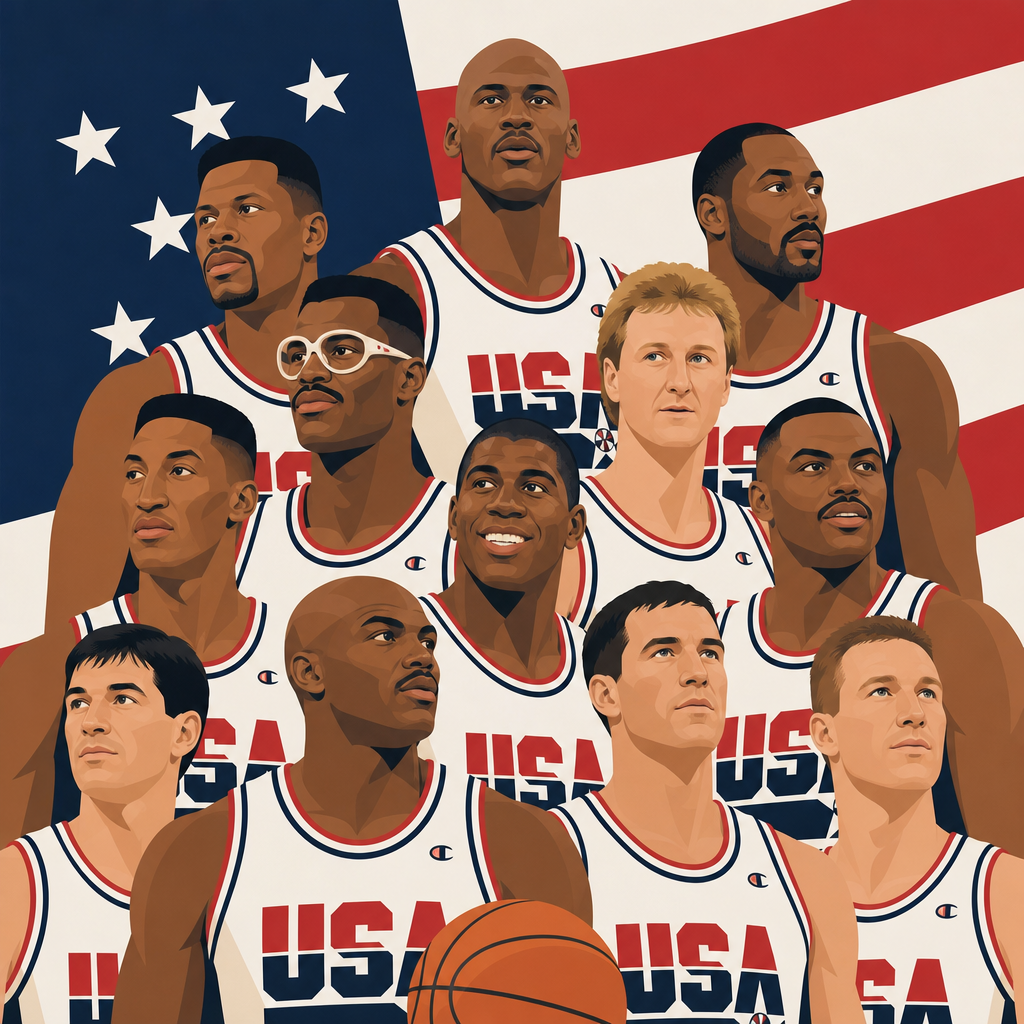
The 1992 Dream Team remains the benchmark for basketball excellence because it united the best NBA talent ever placed on one roster, dominated international competition, and changed the sport’s global trajectory in ways that are still visible today. The term “Dream Team” refers to the United States men’s Olympic basketball squad that competed at the Barcelona Games after FIBA opened Olympic participation to NBA players. Before 1992, Olympic basketball was largely reserved for amateurs, which meant the world had never seen Michael Jordan, Magic Johnson, Larry Bird, Charles Barkley, David Robinson, Karl Malone, John Stockton, Scottie Pippen, Patrick Ewing, Chris Mullin, Clyde Drexler, and Christian Laettner wearing the same uniform in meaningful competition. I have spent years studying NBA history, Olympic archives, game film, and the business side of league expansion, and no team combines pure star power, strategic fit, historical timing, and worldwide impact like this one.
Calling the 1992 Dream Team the greatest basketball team ever assembled is not nostalgia. It is a conclusion supported by roster quality, résumé strength, margin of victory, and cultural consequence. Eleven Hall of Famers plus Laettner, the reigning NCAA star, created a roster with elite scoring, playmaking, defense, rebounding, and leadership at every position. The team won all eight Olympic games by an average of 43.8 points, never called a timeout because no situation demanded one, and often had opponents asking for autographs and photographs. Yet the Dream Team matters for more than blowouts. It became the central catalyst for basketball’s global growth, accelerating youth participation, international media demand, merchandising, and eventually the arrival of more elite international players in the NBA. To understand why this team still stands alone, you have to examine both what happened on the court in Barcelona and what changed across the sport afterward.
The roster was unmatched in talent, accolades, and complementary skills
The simplest argument for the Dream Team starts with the names. Michael Jordan was the reigning NBA champion and the best player in the world. Magic Johnson, though retired from the NBA after announcing he was HIV-positive in 1991, remained one of the greatest playmakers ever and returned as an emotional and tactical centerpiece. Larry Bird was physically limited by back problems, but his shooting, passing, and basketball IQ still shaped games. Charles Barkley led the team in scoring at 18.0 points per game and attacked international defenders with a combination of power and speed they had not seen. Karl Malone and David Robinson brought MVP-level force in the frontcourt. John Stockton organized the offense with surgical precision. Scottie Pippen supplied perimeter defense and transition play. Patrick Ewing added rim protection and interior scoring. Clyde Drexler and Chris Mullin gave the team more elite wing play and shooting than any opponent could absorb.
What made this roster truly historic was not just star count but fit. Coaches often struggle when multiple superstars need the ball, but Chuck Daly had a group whose skills overlapped in productive ways. Jordan and Pippen could pressure the perimeter, create steals, and convert defense into fast-break points. Magic and Stockton could initiate offense without forcing low-efficiency possessions. Bird and Mullin stretched the floor with world-class shooting. Robinson, Ewing, and Malone controlled the paint defensively and offensively. Barkley was the matchup nightmare who punished smaller lineups and outran bigger ones. The result was a team with no obvious weakness. It could play half-court basketball, run in transition, switch defensive assignments, and maintain elite performance even when rotating entire units. Most all-time teams, even hypothetical ones, have at least one tradeoff. The 1992 Dream Team effectively eliminated them.
Barcelona 1992 showed the gap between American NBA excellence and the rest of the world
The Dream Team’s Olympic performance was as overwhelming as its roster suggested. The United States opened by defeating Angola 116-48, then beat Croatia 103-70, Germany 111-68, Brazil 127-83, Spain 122-81, Puerto Rico 115-77, Lithuania 127-76, and Croatia again in the gold medal game, 117-85. Those scores were not inflated by one extraordinary night. They reflected sustained superiority in every phase of play. The team averaged 117.3 points while allowing 73.5, and even those defensive numbers understate its control because many games were effectively decided in the first quarter.
Watching the film now, what stands out is pace married to discipline. The Dream Team pushed after misses and makes, attacked early seals in the post, reversed the ball quickly against zone looks, and defended with athletic pressure that international teams could not consistently solve. Barkley’s scoring led the headlines, but the real engine was collective decision-making. Magic advanced the ball instantly. Jordan turned passing lanes into layups. Robinson and Malone sprinted for deep post position. Bird punished rotations with skip passes. Daly also managed egos expertly. Minutes were spread, combinations changed, and no player needed to dominate possessions for the system to function. The final against Croatia was the clearest test because Toni Kukoc and Drazen Petrovic represented a high-level European challenge, yet the United States still controlled the game with superior depth, defense, and shot creation.
| Olympic Category | 1992 Dream Team | Why It Matters |
|---|---|---|
| Record | 8-0 | Perfect run with no close elimination game pressure |
| Average Margin | +43.8 points | Shows dominance beyond simple wins |
| Leading Scorer | Charles Barkley, 18.0 PPG | Proof that scoring burden was shared across stars |
| Gold Medal Opponent | Croatia | Featured future NBA talent like Toni Kukoc |
| Timeouts Called | 0 | Illustrates control, chemistry, and game management |
Its greatness also comes from context: the team arrived at a pivotal moment in basketball history
Timing matters in sports history, and the Dream Team emerged at exactly the right moment. In 1988, the United States won only bronze in Seoul, losing to the Soviet Union in a result that exposed the growing strength of international basketball and the limitations of sending amateur players against experienced professionals playing under different labels. FIBA’s 1989 rule change allowing NBA players into international competition transformed the Olympic tournament from a symbolic contest into a true best-on-best stage. That rule change alone did not guarantee a cultural event. The event required a roster and a historical setting powerful enough to capture global imagination, and Barcelona in 1992 delivered both.
The NBA was already rising in visibility during the 1980s through the Magic-Bird rivalry and Jordan’s ascent, but its international reach was still developing. Satellite television, expanded sponsorship, and improved merchandising created a window for basketball to become a worldwide entertainment product. The Dream Team turned that possibility into reality. Broadcasters promoted the squad as a once-in-history collection of stars. Fans in Europe, Latin America, Africa, and Asia did not just watch a tournament; they watched the NBA’s top figures perform together under the Olympic banner. In practical terms, that gave many young viewers their first sustained exposure to NBA style, branding, and individual players. For a global audience, the Dream Team was not merely an American team. It was the sport’s highest level made visible all at once.
The Dream Team accelerated basketball’s global growth more than any single event before or since
If this article is a hub for basketball’s global growth, this is the central fact: the Dream Team became the sport’s most powerful international marketing and participation engine. After Barcelona, youth registrations, television interest, apparel sales, and grassroots ambition all rose in multiple regions. FIBA and national federations benefited from greater attention. The NBA expanded its international broadcasts during the 1990s, staged more preseason and exhibition events abroad, and discovered that stars now had meaningful recognition in markets previously considered secondary. This was not an abstract trend. It changed who played basketball, where facilities were built, what leagues invested in coaching, and which young prospects began dreaming about the NBA.
You can trace a line from the Dream Team to the generation of international players who later reshaped the NBA. Pau Gasol in Spain, Dirk Nowitzki in Germany, Tony Parker in France, Manu Ginobili in Argentina, and Yao Ming in China all developed in a world where NBA basketball had become aspirational and culturally familiar. So did later stars such as Giannis Antetokounmpo, Luka Doncic, Nikola Jokic, and Joel Embiid. No single team “created” these players, and local coaching ecosystems deserve real credit, but the Dream Team altered the scale of possibility. It made basketball look global, glamorous, and attainable. In my experience reviewing league growth patterns, that combination matters more than any slogan. When children see excellence embodied by visible stars, participation follows.
The commercial evidence supports the cultural argument. NBA international media rights grew significantly in the 1990s. Merchandise featuring Jordan, Magic, Bird, and USA Basketball became globally recognizable. Shoe companies used Olympic visibility to deepen market penetration. Basketball courts appeared in more schools and urban developments outside the United States. Coaching clinics spread American concepts like spacing, transition offense, and help-side defense more widely. The league’s later success in opening offices abroad and investing in initiatives such as Basketball Without Borders was easier because the Dream Team had already built demand. In historical terms, Barcelona was a launch platform, not a peak.
Critics raise fair counterpoints, but they do not overturn the case
Some argue that later U.S. teams had more athleticism, better spacing for the modern game, or deeper three-point shooting. Others say the 1992 field was weaker than today’s international competition, which is true. Modern global basketball is far stronger because the Dream Team helped inspire and accelerate it. But that criticism actually supports the team’s historical significance. Greatness is not only about defeating today’s opponents in a hypothetical simulation; it is also about dominating one’s era and transforming what comes next. By that standard, the Dream Team has no rival.
Another criticism centers on Christian Laettner, the lone college player, as evidence that the roster was not literally the best twelve NBA players alive. Isiah Thomas supporters still debate his omission, and Shaquille O’Neal had a credible case. Those are legitimate selection controversies. However, they do not materially weaken the larger point. Replace Laettner with another star and the team is still historically loaded; keep Laettner and it still contains perhaps the greatest concentration of accomplished players ever assembled. Seven members were among the NBA’s 50 Greatest Players in 1996, and that count later increased through expanded anniversary lists. The debate over the twelfth spot persists because the standard was impossibly high, not because the team was ordinary in any dimension.
Why the 1992 Dream Team still defines basketball excellence
The Dream Team endures because it solved every test historians usually apply when ranking all-time teams. Talent? Unmatched. Results? Overwhelming. Star power? Unrivaled. Cultural impact? Transformational. Global growth? Foundational. It was the rare sports project that exceeded the hype. Instead of struggling under the weight of celebrity, the team played with clarity, competitiveness, and joy. Opponents respected it, audiences embraced it, and the sport itself expanded because of it. Even now, when international basketball is deeper than ever and NBA talent spans the globe, the Barcelona roster remains the reference point for what a truly definitive team looks like.
For fans exploring NBA history, the Dream Team is not just a memorable chapter; it is the hinge between basketball as a popular American league sport and basketball as a fully global game. If you want to understand why the NBA became an international institution, start here. Study the roster construction, watch the Olympic film, and trace the careers of the international stars who followed. The answer remains clear: the 1992 Dream Team is still considered the greatest basketball team ever assembled because it did more than win. It changed basketball everywhere.
Frequently Asked Questions
What made the 1992 Dream Team so different from every Olympic basketball team that came before it?
The 1992 Dream Team was different because it represented a complete turning point in Olympic basketball. For the first time, the United States sent a roster built around established NBA superstars after international rules changed to allow professional players to compete. Before that, Olympic basketball was mostly limited to amateurs, college players, or athletes who were not yet part of the NBA’s top tier. That meant previous U.S. teams were talented, but they were not the absolute best American players available. In 1992, that changed overnight.
What made the Dream Team especially remarkable was not just that it included NBA players, but that it included many of the greatest players in basketball history all at once. Michael Jordan, Magic Johnson, Larry Bird, Charles Barkley, Karl Malone, John Stockton, Scottie Pippen, David Robinson, Patrick Ewing, Clyde Drexler, Chris Mullin, and Christian Laettner formed a roster with an unmatched combination of skill, experience, IQ, versatility, and star power. Several of those players were already champions, MVPs, or future Hall of Famers, and many were still in or near their prime.
The team also carried enormous symbolic value. It announced to the world that Olympic basketball had entered a new era, one where the sport’s biggest stars would now appear on the international stage. That changed how fans, media, and other national programs viewed the tournament. Instead of simply being a competition the United States was expected to win, the 1992 Olympics became a global showcase for basketball excellence. The Dream Team was not just another great team; it was the moment international basketball truly became part of the modern global sports conversation.
Why is the 1992 Dream Team still considered the greatest basketball team ever assembled?
The Dream Team is still considered the greatest basketball team ever assembled because no other roster has matched its depth of elite talent, historical significance, and overwhelming dominance all at once. This was not a team with one or two superstars supported by role players. It was a team loaded from top to bottom with players who were already among the most accomplished and feared competitors in the world. Nearly every player on the roster had a case as the best at his position during that era, and several belong in any serious discussion of the greatest players of all time.
Just as important, the team performed exactly the way people imagined a collection of legends should perform. The United States steamrolled the competition in Barcelona, winning games by huge margins and never facing real danger. Their offense was explosive, their defense was suffocating, and their overall chemistry was far better than many expected from a group of players used to being franchise centerpieces. Instead of struggling with egos or style clashes, they turned superior talent into seamless execution.
The Dream Team also stands apart because its greatness was bigger than the box scores. It became a cultural and global event. Opposing players wanted autographs and photos because they knew they were sharing the court with icons. Fans around the world were not just watching a basketball team; they were witnessing a once-in-history gathering of legends. That combination of talent, results, aura, and lasting influence is why the 1992 Dream Team remains the standard. Other teams may have been younger, faster, or more modern, but none have equaled the Dream Team’s total package.
How dominant was the Dream Team during the 1992 Olympics?
The Dream Team’s dominance in the 1992 Olympics was absolute. They did not merely win games; they controlled them from start to finish in a way that made the competition look completely overmatched. The United States won every game comfortably and captured the gold medal without ever being seriously threatened. Their average margin of victory was enormous, and in many contests the result felt settled almost immediately because of how quickly they could overwhelm opponents with pressure defense, transition scoring, shooting, rebounding, and half-court execution.
What made that dominance even more striking was the quality of the players on the other side. International basketball already had skilled professionals and strong national programs, but the gap between those teams and the Dream Team was still staggering. The U.S. could rotate Hall of Fame-level talent in waves, meaning there was no letup at any point in the game. Opponents might survive one stretch against Michael Jordan and Scottie Pippen, only to face Magic Johnson orchestrating the offense, Charles Barkley attacking in transition, or David Robinson and Patrick Ewing controlling the interior.
The visual impression of those games is part of the Dream Team legend. They looked faster, stronger, smarter, and more polished than everyone they faced. Yet their dominance did not come across as random hot shooting or one-time momentum; it reflected a level of basketball mastery that no team in that tournament could match. Their run in Barcelona remains one of the clearest examples in sports of a team entering a competition as the favorite and then exceeding even those massive expectations.
How did the Dream Team change basketball around the world?
The Dream Team changed basketball globally by turning the sport into a truly international aspiration. Their games in Barcelona were watched by massive audiences, and for many viewers outside the United States, this was the first time they saw so many NBA superstars sharing the court in one place. The combination of skill, charisma, and entertainment value helped ignite worldwide interest in basketball at a new level. Kids in Europe, Latin America, Africa, and Asia did not just become fans of the Olympics; they became fans of the NBA and of basketball itself.
That influence showed up over the next decade in several ways. International federations invested more heavily in player development. Young athletes modeled their games after Dream Team stars. The NBA’s global reach expanded dramatically through broadcasts, merchandise, grassroots camps, and international scouting. Over time, more elite players from outside the United States entered the NBA and became stars, MVPs, and champions. While international basketball was already growing before 1992, the Dream Team accelerated that growth in a way few sports moments ever have.
The team also changed perceptions. It helped establish basketball as a shared global language rather than a predominantly American game. Countries began to believe they could build programs capable of competing at a much higher level, even if the 1992 roster itself seemed untouchable. In that sense, the Dream Team’s legacy is not just that it dominated its era, but that it inspired future eras. The modern global NBA, with elite talent arriving from all over the world, owes a meaningful part of its momentum to the spectacle and influence of the 1992 team.
Could any modern basketball team realistically surpass the legacy of the 1992 Dream Team?
A modern team could potentially match the Dream Team in raw ability or even surpass it in certain tactical areas, but surpassing its overall legacy would be extremely difficult. Basketball has evolved, training has improved, and today’s players benefit from advances in spacing, conditioning, sports science, and international competition. So if the question is purely about how a modern all-star roster would perform on the court under current rules, there is room for debate. However, the Dream Team’s status is not based only on talent comparison.
Its legacy comes from timing, symbolism, and impact in addition to performance. The 1992 team arrived at the exact moment the Olympics opened to NBA players, and it delivered a spectacle the world had never seen before. It combined iconic personalities, all-time greatness, and perfect execution in a way that felt transformational. Later U.S. teams have included outstanding players and won gold medals, but they were following the path the Dream Team created rather than inventing it themselves.
That is why the Dream Team remains so hard to displace in historical conversations. To surpass it, a future team would likely need more than just superior on-court results. It would need to redefine basketball globally, capture the imagination of fans across generations, and represent a true turning point in the sport’s history. That is an incredibly high bar. The 1992 Dream Team was not simply a great roster; it was a basketball event that permanently changed how the game was seen, marketed, and remembered.