
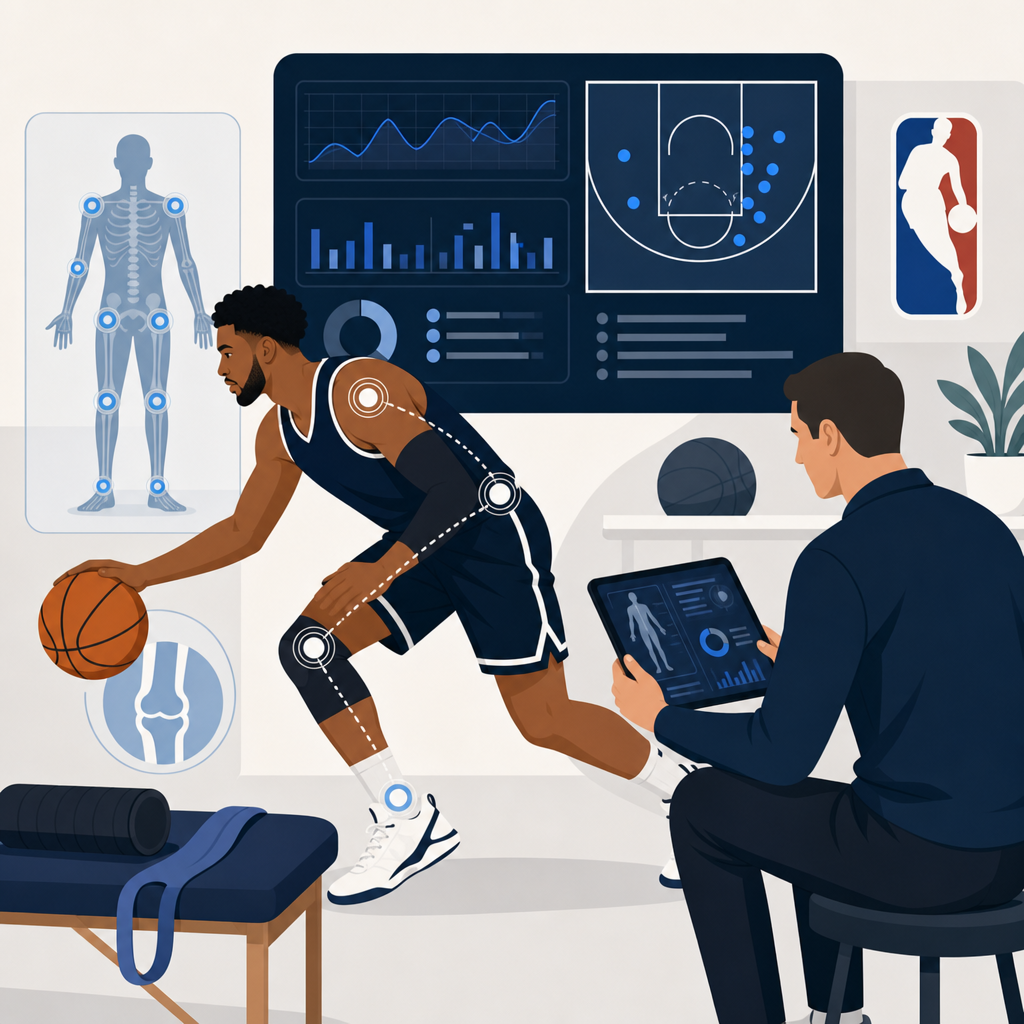
Sports science in the NBA has moved from the training room to the center of roster strategy, shaping how teams practice, travel, recover, and decide who plays on any given night. In this context, sports science means the applied use of biomechanics, physiology, data analysis, nutrition, sleep research, and medical screening to improve performance while reducing injury risk. NBA teams now collect information from force plates, motion-capture systems, wearable sensors, blood markers, video breakdowns, and game-tracking data, then combine it with medical history and coaching observations. The goal is not to predict injuries with absolute certainty, because no model can do that, but to identify elevated risk early enough to change workloads before tissue stress becomes a strain, sprain, or longer-term absence.
This matters because the NBA places unusual demands on the human body. Players jump, decelerate, rotate, absorb contact, and change direction repeatedly in a dense schedule that includes travel across time zones and short recovery windows. Even a minor ankle sprain can affect shooting mechanics, defensive movement, and lineup continuity for weeks. A hamstring issue can linger if return-to-play timing is too aggressive. A star missing twenty games can reshape playoff seeding, ticket demand, and even long-term franchise planning. I have seen teams learn that injury prevention is not one decision but a system: monitor the athlete, understand the game demands, compare those demands to the player’s current capacity, and adjust training or minutes before problems escalate.
At the team level, sports science also changes communication. Performance directors, athletic trainers, strength coaches, physicians, data analysts, and coaching staffs need a shared language. Terms such as acute workload, chronic workload, neuromuscular fatigue, readiness, asymmetry, tissue tolerance, and return-to-play progression are now part of daily operations. Used well, this language creates better decisions. Used poorly, it becomes noise. The best organizations do not chase every new gadget. They build repeatable processes, validate what each metric means for their own roster, and connect the numbers to clear action. That is why sports science has become a major competitive edge in modern NBA analysis, especially for teams trying to keep valuable players available over an eighty-two-game season and through the playoffs.
What NBA teams actually measure
Most injury-prevention programs start with workload monitoring. Teams track external load, which covers the mechanical demands placed on the player, and internal load, which reflects how the body responds. External load includes total distance, high-speed running, acceleration and deceleration counts, jumps, landing forces, and change-of-direction volume. Internal load often includes heart-rate response, session rating of perceived exertion, sleep quality, soreness reports, and recovery questionnaires. In practice, the most useful systems blend both. A player may cover a normal distance in a game, but if his heart-rate response and postgame neuromuscular tests show abnormal fatigue, the staff treats that game differently than the same box-score output on a fresh body.
Force plates are one of the most common tools because they provide fast, repeatable assessments. Players perform countermovement jumps, and the system measures force production, braking forces, asymmetry between legs, impulse, and jump strategy. Staff can detect when an athlete is producing less force, taking longer to generate it, or offloading one leg after a prior ankle or knee issue. Markerless motion-capture systems and high-speed video help identify movement patterns during sprinting, landing, and cutting. GPS is limited indoors, so NBA teams often rely on local positioning systems, camera-based tracking, and practice wearables approved within league rules. Blood testing may be used selectively for vitamin D, iron status, hydration markers, and inflammation trends, though teams balance usefulness with player convenience and privacy.
Medical history remains crucial. A player with previous hamstring strains, patellar tendinopathy, or chronic ankle instability does not need the same monitoring profile as a teammate with a clean record. Screening can include joint range of motion, isometric strength testing, groin squeeze tests, calf capacity, tendon pain scales, and trunk control assessments. Teams also review contextual factors that raw numbers miss: did the player switch shoes, alter lifting volume, return from overseas play, or absorb a high number of collisions defending centers? Good sports science is not just a dashboard. It is a decision process that combines objective data with athlete-specific context and clinical judgment.
From raw numbers to injury-risk decisions
Collecting data is easy compared with turning it into useful decisions. NBA teams usually begin by establishing a baseline for each player during preseason and then updating it throughout the year. Baselines matter because league averages can hide meaningful individual variation. One veteran may always show a slight left-right force difference without pain or performance loss, while another player’s smaller asymmetry could signal a brewing issue because it deviates from his normal profile. Staff therefore look for changes from the individual’s own trend line, not just whether a metric crosses a generic red flag.
Decision-making often centers on the relationship between load and capacity. Load is the stress from games, practices, travel, and training. Capacity is the athlete’s present ability to tolerate that stress. Injury risk rises when load outpaces capacity, especially after sudden spikes. That is why teams are careful when a player returns from an absence, ramps up after the All-Star break, or moves into a larger role because of another injury. Minutes restrictions are only one lever. Coaches may reduce high-intensity practice reps, modify drill design, avoid back-to-back contact sessions, or shorten a player’s defensive assignments that require repeated full-court efforts.
Teams also use simple models because overly complex systems can fail in the real world. A practical daily workflow might combine wellness questionnaires, sleep duration, force-plate output, soreness by body region, and previous seven-day load. If two or three indicators trend negatively, the performance staff flags the player for conversation and possible intervention. Those interventions range from hydration and soft-tissue work to altered lifting, treatment, or reduced on-court volume. No reputable group claims they can predict the exact day of an injury. What they can do is improve odds by reducing avoidable mismatches between demand and readiness, which is often enough to preserve availability across a long season.
Common technologies and what they are good for
The current NBA toolkit is broader than many fans realize. Some technologies are excellent for daily readiness, others for rehabilitation, and others for postgame review. The strongest departments know the limits of each system and avoid using one metric as a universal truth.
| Tool | What it measures | How teams use it for injury prevention |
|---|---|---|
| Force plates | Jump force, asymmetry, braking, impulse | Detect fatigue, monitor lower-body deficits, guide return-to-play progression |
| Camera tracking | Speed, distance, accelerations, movement patterns | Quantify game and practice load without relying on subjective estimates |
| Wearables | Heart rate, sleep, recovery trends | Flag poor recovery after travel, illness, or high-stress stretches |
| Isometric testing | Strength in specific positions | Check hamstring, groin, calf, and quad capacity with low fatigue cost |
| Motion analysis | Joint angles, landing mechanics, gait | Spot compensations after ankle, knee, or hip injuries |
| EMR databases | Medical history, treatment response, timelines | Compare current issues with prior patterns and improve case management |
Force plates are valuable because they are fast and sensitive, but they do not explain everything. Camera tracking captures real game demands, yet it may miss contact load and emotional stress. Wearables can reveal sleep disruption after west-to-east travel, but athlete compliance matters, and consumer-grade devices vary in accuracy. Isometric testing is especially useful during congested schedules because it provides reliable strength data with less soreness than maximal dynamic lifts. Motion analysis helps identify compensations, but interpretation requires trained staff. Teams that get the most value are rarely the ones with the most devices. They are the ones that connect each tool to specific questions and clear interventions.
Load management, schedule density, and the travel problem
No discussion of sports science in the NBA is complete without load management, although the term is often oversimplified. True load management is not just sitting healthy players. It includes adjusting practice intensity, reducing exposure to back-to-backs, modifying travel routines, and using individualized recovery plans. The NBA has tried to reduce extreme schedule congestion compared with earlier eras, but teams still face four-games-in-six-nights stretches, long road trips, and repeated time-zone changes. Circadian disruption affects reaction time, mood, sleep quality, and hormonal rhythms, all of which influence readiness and recovery.
Travel planning is therefore part of injury prevention. Teams often coordinate flight timing, meal composition, hydration, compression strategies, and light exposure to help players adapt. Staff may encourage earlier caffeine cutoffs after late games, specific postflight mobility sessions, and morning sunlight exposure after eastward travel. Sleep specialists have become more common because poor sleep is linked to slower recovery, increased perceived exertion, and reduced motor performance. For very tall athletes, cramped seating and fluid shifts can increase stiffness after flights, so movement breaks and individualized mobility work matter more than they do in many other sports.
There are tradeoffs. Rest can protect tissue, but too much inactivity can reduce conditioning and game rhythm. A player who sits frequently may return less prepared for playoff intensity if his training doses are not carefully maintained. That is why smart teams think in terms of total stress, not only games played. Sometimes the best choice is not a full night off but lower practice volume, shorter stints, or altered substitution patterns that keep the athlete under a target load while preserving competitive sharpness.
How rehab and return-to-play have changed
Rehabilitation in the NBA is now far more objective than it was a decade ago. Instead of relying mostly on pain tolerance and visual observation, teams build criteria-based progressions. After an ankle sprain, for example, the player may need swelling control, restored dorsiflexion, balance symmetry, single-leg force targets, full-speed deceleration tolerance, and successful basketball-specific movement before clearance. For hamstring strains, staff look at sprint exposure, eccentric strength, lumbopelvic control, and recurrence history. For tendinopathy, they monitor pain response over twenty-four hours, tendon loading capacity, and how the player handles repeated jumping, not just whether he can complete one practice.
Return-to-play is typically staged. First comes medical healing, then physical reconditioning, then basketball reintegration, then competition exposure. The final stage is often the hardest because game chaos introduces contact, emotional stress, and unpredictable movement. Teams use controlled scrimmages, targeted minute caps, and postgame testing to make sure the athlete is not simply surviving the first game back but trending toward full resilience. I have seen the biggest mistakes occur when the process ends at clearance instead of continuing for two to three weeks after return, when compensations and hidden fatigue can still create secondary injuries.
Case studies across the league show why patience matters. Kevin Durant’s 2019 Achilles rupture intensified league-wide scrutiny of calf and lower-leg management, although every case is unique and public reporting never captures the full medical picture. Kawhi Leonard’s recurrent knee management has highlighted the difficulty of balancing elite performance with chronic conditions. Zion Williamson’s early-career availability issues showed how force production, body composition, movement strategy, and workload all interact. The lesson is consistent: rehab is not only about healing the injured structure. It is about restoring the whole athlete’s capacity to meet NBA game demands.
Building a culture that players and coaches trust
Even the best data fails if the human side is weak. Players need to believe the process helps them stay on the floor, not just protects the organization’s investment. Coaches need recommendations that are practical and timely, not long technical reports delivered after lineup decisions are already made. The most effective performance departments present information in simple tiers: green for normal, yellow for monitor, red for intervene. Then they explain why. If a player’s landing forces are down, sleep is poor, and he reports calf tightness after two flights in three nights, the recommendation is easy to understand and easier for the coach to act on.
Trust also depends on consistency. If one star is treated differently without explanation, the locker room notices. If data is used only when a player is struggling, athletes may see monitoring as surveillance instead of support. Good departments create routines from training camp onward so testing and recovery work feel normal. They share enough information to educate players while respecting medical privacy. They also admit uncertainty. Not every red flag becomes an injury, and not every injury arrives with warning signs. Credibility grows when staff are honest about that reality while still making decisive, evidence-based recommendations.
For a sub-pillar hub within NBA Analysis, the core takeaway is simple: sports science is not a magic shield, but it is one of the clearest ways teams can improve availability, preserve player value, and support winning over time. The best NBA organizations use data to answer practical questions. How much stress did the player absorb? How well did he recover? Is his movement changing? What can be modified today to reduce risk tomorrow? Those questions drive smarter practice design, better travel planning, stronger rehab, and more durable lineups. If you want to understand modern basketball beyond the box score, follow how teams manage bodies as closely as you follow how they manage possessions. Explore the rest of our NBA Analysis coverage to go deeper into player workload, biomechanics, recovery methods, and the strategic choices behind every availability report.
Frequently Asked Questions
What does sports science actually mean in the NBA, and how is it used to prevent injuries?
In the NBA, sports science refers to the practical use of performance and health data to help players stay available, recover efficiently, and lower the risk of injury over the course of a long season. It combines several disciplines, including biomechanics, exercise physiology, nutrition, sleep science, medical screening, and data analysis. Rather than relying only on what coaches or trainers can observe with the eye test, teams now use measurable information to understand how a player is moving, how much physical stress he is carrying, and whether his body is adapting well to that workload.
Injury prevention is one of the clearest examples of how this works. Teams monitor movement quality with tools such as force plates, motion-capture systems, and high-speed video to detect asymmetries, poor landing mechanics, or unusual changes in explosiveness. They also track workload through practice data, game minutes, acceleration and deceleration counts, and in some cases wearable technology. When that information is combined with medical history, strength testing, soreness reports, and recovery markers, teams can identify trends that may suggest elevated injury risk before a major problem appears.
The key idea is not that data can predict every injury with certainty. Basketball remains unpredictable, and contact injuries can happen to anyone. But sports science helps teams make smarter day-to-day decisions about practice intensity, travel routines, recovery plans, and return-to-play timing. It shifts injury prevention from a reactive model, where staff respond after something goes wrong, to a proactive model, where small warning signs can be addressed early.
What kinds of data do NBA teams collect to monitor player health and workload?
NBA teams collect a wide range of information because injury risk rarely comes from one single factor. Instead, it usually reflects the interaction between workload, recovery, movement quality, past injuries, and the physical demands of schedule density. To understand that full picture, teams gather both internal and external load data. External load includes what a player actually does, such as minutes played, total distance covered, sprint efforts, jump counts, and the number of hard accelerations and decelerations. Internal load focuses on how the body responds, including heart rate trends, fatigue levels, perceived exertion, muscle soreness, hydration status, and various recovery indicators.
Many organizations also use force plates to measure how players produce and absorb force during jumps, landings, and other explosive actions. These systems can reveal differences between the right and left leg, changes in power output, or signs of neuromuscular fatigue. Motion-capture technology and video breakdown help staff analyze movement mechanics in detail, which can be especially useful when monitoring a player after an ankle, knee, hamstring, or back issue. Blood markers and other medical screening tools may be used to evaluate inflammation, nutrient status, or general recovery readiness, depending on team protocols.
Just as important, teams combine objective numbers with subjective input. Daily wellness questionnaires, conversations with players, and trainer evaluations often provide context that raw data alone cannot. A player may test well physically but report poor sleep, tightness, or unusual fatigue after travel. In practice, the most effective systems are not built on one machine or one metric. They rely on integrating multiple sources of information so the performance staff, coaches, and medical team can make balanced decisions grounded in both science and experience.
How do NBA teams use sports science to decide when players should rest or have their minutes managed?
When teams manage minutes or schedule rest, the goal is usually to control cumulative stress rather than simply reduce playing time at random. The NBA season is physically demanding because it includes frequent games, heavy travel, limited recovery windows, and repeated high-intensity movements such as jumping, cutting, and sprinting. Sports science helps teams understand when that stress is building faster than a player can recover from it. If the data suggests rising fatigue, decreased explosiveness, movement changes, or poor recovery patterns, staff may recommend adjustments before performance drops or injury risk increases.
Those adjustments can take several forms. A team may shorten practice reps, reduce a player’s workload on back-to-backs, limit certain high-impact drills, or cap minutes in specific game situations. Rest decisions are often influenced by more than just one night’s fatigue. Teams also look at recent game load, travel burden, sleep disruption, previous injuries, and how quickly the player has recovered from similar stretches in the past. For a veteran with a history of soft-tissue issues or knee problems, the threshold for intervention may be different than it is for a younger player with a lighter injury history.
Importantly, minute management is not only about missing games. Often it is about preserving availability over months, not maximizing output on a single night. Teams want players healthy for the full season and, ideally, for the playoffs, where each possession matters more. Sports science gives organizations a framework for making those choices in a more individualized way. Instead of treating the roster the same, teams can tailor workloads based on each player’s age, position, injury profile, conditioning level, and current readiness.
Can sports science really predict injuries, or does it just improve the odds of prevention?
Sports science is best understood as a risk-management tool, not a crystal ball. No team can predict injuries with perfect accuracy because basketball includes chaotic, high-speed, and contact-heavy situations. A player can land on another player’s foot, take an awkward fall, or experience a sudden collision that no model could foresee. What sports science can do is identify patterns and warning signs that are associated with increased risk, especially for non-contact and overuse injuries.
For example, if a player’s force-plate data shows declining power or a growing imbalance between legs, and that trend appears alongside increased soreness, poor sleep, and a heavy recent workload, the training staff may view that as a meaningful signal. On its own, any single metric might not say much. But when multiple indicators point in the same direction, it becomes easier to justify modifying the player’s routine. That could mean treatment, extra recovery work, reduced practice intensity, or closer medical evaluation. The value lies in improving decision-making before pain becomes a full injury or before a manageable issue turns into a multi-week absence.
So the answer is that sports science improves the odds of prevention rather than guaranteeing it. The strongest programs help teams reduce avoidable risk, catch subtle declines earlier, and make better return-to-play decisions. Over time, that can lead to fewer soft-tissue injuries, smarter workload distribution, and better player availability. But even the most advanced system works in probabilities, not certainties. Successful NBA teams understand that data informs judgment; it does not replace it.
How has sports science changed the way NBA teams handle recovery, travel, and return-to-play decisions?
Sports science has expanded the role of recovery far beyond ice baths and postgame stretching. NBA teams now treat recovery as a full performance system tied directly to injury prevention and long-term durability. That includes sleep planning, nutrition timing, hydration strategies, soft-tissue treatment, strength maintenance, mobility work, and schedule design around games and flights. Because NBA travel can be relentless, teams pay close attention to circadian disruption, time-zone changes, and late-night arrivals, all of which can affect reaction time, tissue recovery, and overall readiness.
To manage those demands, organizations often build individualized recovery plans. One player may need more emphasis on sleep extension and hydration after travel, while another may need reduced on-court volume and additional tissue treatment after a high-minute game. Recovery is also monitored with objective tools such as force-plate testing, movement assessments, and wellness tracking, allowing staff to compare how a player is responding relative to his normal baseline. This helps teams avoid a one-size-fits-all model and instead support each athlete according to his specific needs and injury history.
Return-to-play decisions have also become more structured and data-driven. Rather than clearing a player only when pain decreases, teams now look for evidence that he can tolerate basketball-specific demands safely. That may include restoring strength symmetry, passing movement tests, handling progressive on-court workloads, and showing stable performance markers across multiple days. The process is typically collaborative, involving doctors, athletic trainers, strength staff, performance analysts, coaches, and the player himself. The end result is a more cautious and evidence-based approach designed not just to get players back quickly, but to help them stay back once they return.