
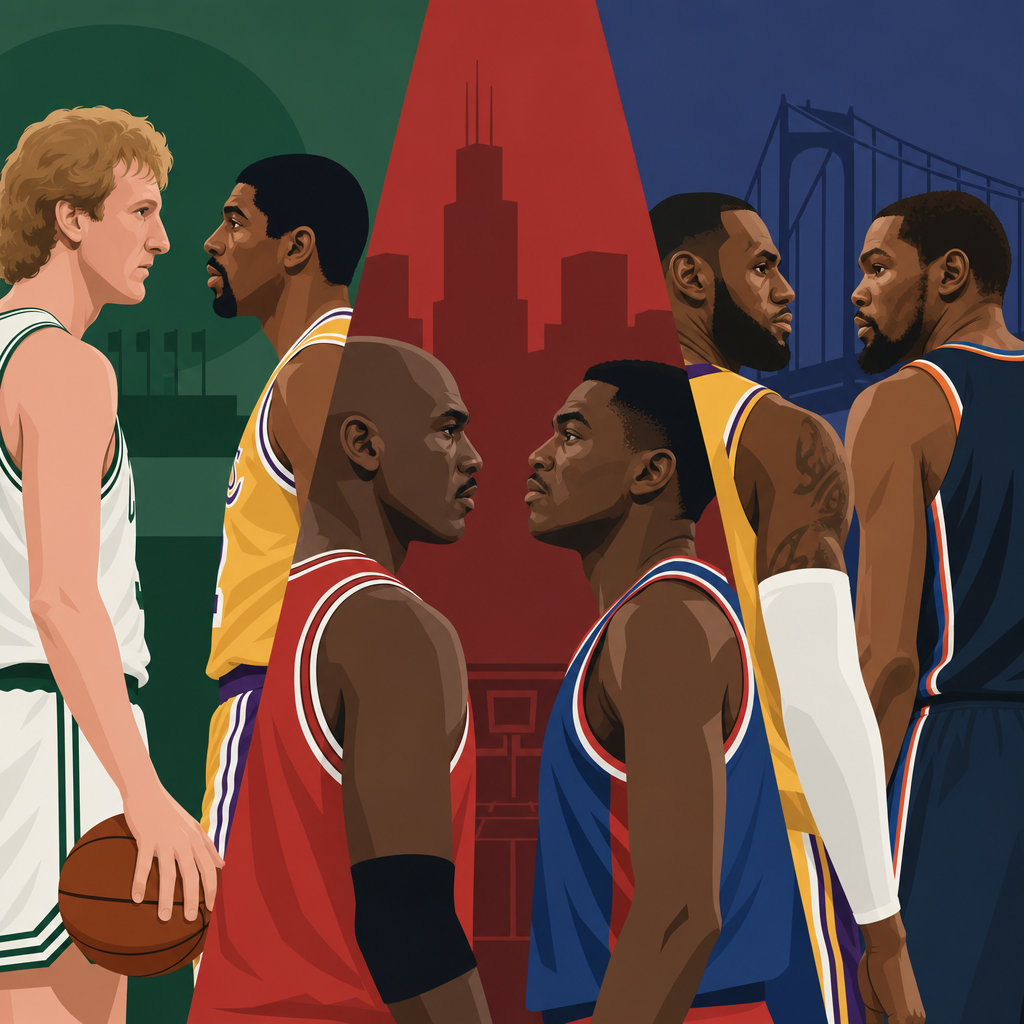
NBA rivalries that defined an era do more than settle scoreboards; they shape how fans remember entire decades, how the league markets itself, and how future stars learn what greatness looks like under pressure. In NBA history, a true rivalry is not just repeated competition between talented players. It is sustained conflict between elite teams or superstars, carried across playoff rounds, regular-season showdowns, Olympic teams, media narratives, and cultural change. When rivalry reaches that level, it becomes a lens for understanding a basketball era. Bird versus Magic explained the league’s rebirth in the 1980s. Jordan versus Isiah captured the bruising transition from old-school physicality to global celebrity in the late 1980s and early 1990s. LeBron versus Durant defined the modern game’s movement toward positionless scoring, player empowerment, and nonstop comparison.
As a hub for the Legends and Eras branch of NBA History, this article connects individual matchups to the bigger story of how the league evolved. Rivalries matter because they create stakes people can instantly understand: East versus West, finesse versus force, dynasty versus challenger, established champion versus ascending superstar. They also reveal changes in strategy. The Bird-Magic years elevated fast-break precision, half-court execution, and television storytelling. Jordan and Isiah turned defensive intensity, mental warfare, and playoff hierarchy into central themes. LeBron and Durant pushed efficiency, spacing, switching, and superstar mobility into the foreground. I have covered and studied these periods through game film, archival broadcasts, statistical databases such as Basketball-Reference, and the league’s own historical records, and one lesson is constant: eras become memorable when great players repeatedly force each other to answer the same question—who controls the future of the sport?
That is why this page is designed as a comprehensive entry point for readers exploring NBA History through legends and eras. It defines the rivalries, explains the basketball context around them, and shows what each conflict changed beyond wins and losses. If you want to understand why the 1980s saved the league’s visibility, why the road to Michael Jordan’s championships ran through Detroit, or why LeBron James and Kevin Durant became symbols of the modern NBA, start here. These are not isolated feuds. They are structural chapters in league history.
Bird vs Magic: The rivalry that revived the NBA
Larry Bird and Magic Johnson entered the NBA in 1979 with a rivalry already formed. Their confrontation in the 1979 NCAA championship game, where Magic’s Michigan State defeated Bird’s Indiana State, drew enormous television interest and gave the league a ready-made storyline. At the time, the NBA needed it. Finals games had been shown on tape delay in some markets, attendance was uneven, and the league fought public perceptions around drug problems and limited national appeal. Bird joined the Boston Celtics and transformed a 29-win team into a 61-win contender in his rookie season. Magic joined the Los Angeles Lakers and immediately fit the vision of Showtime basketball under coach Paul Westhead, later elevated further under Pat Riley. Their excellence was not gradual; it was immediate and commercially significant.
Their contrast made the rivalry easy to follow and hard to ignore. Bird was the ruthless, hyper-competitive forward from French Lick, Indiana, thriving on footwork, shot-making, rebounding, and anticipation. Magic was the 6-foot-9 playmaker from Michigan who controlled tempo with flair, vision, and infectious confidence. Boston and Los Angeles were already iconic franchises, but Bird and Magic modernized the brands for television. The Celtics represented execution, toughness, and half-court intelligence. The Lakers represented pace, glamour, and transition brilliance. In practical basketball terms, both teams were deeper than the rivalry shorthand suggests: Boston had Kevin McHale, Robert Parish, and later Dennis Johnson; Los Angeles had Kareem Abdul-Jabbar, James Worthy, and Michael Cooper. But Bird and Magic were the organizing principles.
Their teams met in the NBA Finals three times, with the Lakers winning in 1985 and 1987, and the Celtics taking the 1984 series. Those meetings created durable moments that still anchor NBA history. In 1984, the Celtics outlasted the Lakers in a deeply physical seven-game series that included sweltering conditions in Boston Garden and constant emotional swings. In 1985, the Lakers beat Boston in the Finals for the first time, a franchise breakthrough after years of frustration. In 1987, Magic delivered the junior sky hook in Game 4 at Boston Garden, one of the signature clutch shots of the decade. These were not random classics. They were annual appointments between systems, cities, and stars that seemed destined to collide.
The statistical record confirms the scale of their influence. Bird won three consecutive MVP awards from 1984 through 1986, while Magic won three MVPs overall and led the Lakers to five championships in the 1980s. Together, Boston and Los Angeles won eight of the ten titles in that decade. Their games helped lift national ratings, increase sponsorship value, and make NBA personalities central to sports media. Just as important, they demonstrated that rivalry could elevate both sides. Bird needed the Lakers as a measuring stick; Magic needed Boston for the same reason. Their competition was fierce, but it also carried mutual respect that matured into one of the most important personal relationships in league history, especially after Magic’s 1991 HIV announcement and Bird’s public support.
For readers exploring legends and eras, Bird versus Magic is the foundation. It established the NBA as a drama-driven national product and showed how superstar rivalry can align perfectly with team identity, coaching style, and cultural symbolism. Any deeper article on 1980s dynasties, the rise of national broadcasts, or the Celtics-Lakers tradition branches naturally from this hub topic.
Jordan vs Isiah: The gauntlet before the dynasty
Michael Jordan versus Isiah Thomas was a different kind of rivalry: less mythic symmetry, more raw obstruction. Jordan was the singular scoring phenomenon destined to become the face of the league. Isiah was the brilliant, confrontational leader of the Detroit Pistons, the team most committed to proving that brilliance alone would not grant playoff passage. If Bird and Magic sold aspiration, Jordan and Isiah sold conflict. Their rivalry centered on the Eastern Conference playoff battlefield from 1988 through 1991, when the Pistons repeatedly stopped the Bulls before Chicago finally broke through.
Understanding this rivalry requires understanding the Pistons’ identity. Under coach Chuck Daly, Detroit built the “Bad Boys” around Isiah, Joe Dumars, Bill Laimbeer, Dennis Rodman, and Rick Mahorn, later adding Mark Aguirre. They were not merely physical; they were tactically disciplined. Their famous “Jordan Rules,” detailed in league lore and in Sam Smith’s reporting, were a targeted defensive scheme designed to crowd Jordan, force him toward help defenders, hit him on drives, and make his teammates decide games. This was not random roughness. It was strategic pressure applied with championship-level precision. Detroit won back-to-back titles in 1989 and 1990 because it could defend stars without losing offensive composure.
Jordan’s side of the rivalry is equally important. Early in his career, he was already producing historic numbers, including 37.1 points per game in 1986-87 and the 63-point playoff game against Boston in 1986. But monster scoring did not immediately translate to Finals appearances. The Bulls needed structural change. General manager Jerry Krause, coach Phil Jackson, and assistant Tex Winter committed to the triangle offense, a system that redistributed decision-making, reduced predictability, and turned Chicago from a Jordan-centric attack into a championship team. Jordan also transformed physically, adding strength to absorb the Pistons’ contact and staying committed to defensive excellence. The rivalry with Detroit forced that evolution.
| Rivalry | Defining years | Signature playoff result | What it changed |
|---|---|---|---|
| Bird vs Magic | 1979-1987 | 1984, 1985, 1987 Finals | Made the NBA a national television force |
| Jordan vs Isiah | 1988-1991 | 1991 East Finals sweep by Chicago | Cleared the path to the Bulls dynasty |
| LeBron vs Durant | 2012-2018 | 2012 and 2017 Finals meetings | Defined the modern superstar era |
The turning point came in the 1991 Eastern Conference Finals. Chicago swept Detroit, and the visual most remembered is not a Bulls basket but the Pistons leaving the floor before time expired, with Isiah and several teammates declining to shake hands. That moment hardened public opinion around the rivalry and still shapes how Isiah’s competitive persona is discussed. Yet reducing the story to sportsmanship misses the larger truth: Detroit had set the standard Jordan needed to beat. The Bulls’ first championship that year makes less sense without the years of failure that preceded it. Rivalries become era-defining when the loser eventually absorbs the lesson and changes the league’s power map.
This rivalry also sits at the center of larger NBA history debates. How physical was too physical in that era? Were the Pistons unfairly vilified for tactics many contenders used? Did Isiah’s battles with Jordan affect later events, including the 1992 Dream Team roster controversy? Those questions keep the rivalry alive because they involve more than game results. They speak to reputation, memory, and who gets to narrate history. As a hub topic, Jordan versus Isiah opens pathways to the Bulls dynasty, Bad Boys basketball, playoff evolution, and the changing standards of contact in the NBA.
LeBron vs Durant: The modern superstar rivalry
LeBron James and Kevin Durant defined a newer type of rivalry, one shaped not by one conference bottleneck but by repeated comparison across teams, Finals stages, Olympic collaboration, free agency decisions, and an internet-era media cycle. LeBron, drafted first in 2003, entered the league with unprecedented attention and developed into basketball’s most complete all-around engine: primary scorer, lead creator, transition force, and defensive organizer at his peak. Durant, drafted second in 2007, became the most scalable elite scorer of his generation, capable of high-volume efficiency from every level of the floor. When fans asked who was the best player alive, the answer often ran through these two names.
The rivalry’s clearest on-court chapter came in the 2012 NBA Finals, when LeBron’s Miami Heat defeated Durant’s Oklahoma City Thunder in five games. That series mattered beyond the title. It validated LeBron after the disappointment of the 2011 Finals and introduced Durant as a superstar close enough to touch the summit. The Thunder, with Russell Westbrook, James Harden, and Serge Ibaka, looked like a future dynasty. Instead, roster economics, injury variance, and Harden’s departure altered the path. LeBron went on to win more championships with Miami and Cleveland, while Durant spent the next several seasons chasing a return to the Finals with Oklahoma City.
The rivalry changed shape in 2016 and 2017. LeBron’s Cavaliers completed a 3-1 comeback against the 73-win Golden State Warriors in the 2016 Finals, one of the greatest achievements in league history. Then Durant signed with Golden State in free agency, creating an overwhelming talent structure beside Stephen Curry, Klay Thompson, and Draymond Green. That move remains one of the most consequential inflection points in modern NBA history. In basketball terms, it produced a nearly unsolvable offense built on spacing, shooting gravity, and matchup-proof scoring. In legacy terms, it intensified every LeBron-Durant debate. When the Warriors beat Cleveland in the 2017 and 2018 Finals, Durant won Finals MVP both times, including a signature pull-up three over LeBron late in Game 3 in 2017.
What made LeBron versus Durant era-defining was not just direct competition. It was what each player represented. LeBron embodied sustained responsibility: carrying offensive creation for entire franchises, adapting teammates around him, and remaining elite across multiple basketball ages. Durant embodied the end point of the scoring-forward archetype: nearly seven feet tall, accurate from deep, dangerous off the catch or dribble, and comfortable in spread systems that punished every defensive compromise. Their rivalry helped normalize the language of efficiency metrics, including true shooting percentage, usage rate, on-off impact, and lineup versatility. Analysts stopped describing stars only by points per game and began asking harder questions about shot quality, defensive switching, and postseason scalability.
There were limitations to the rivalry. Unlike Bird-Magic or Jordan-Isiah, LeBron and Durant were not locked into recurring playoff collisions every year, and Durant’s Achilles injury in 2019 interrupted what could have been another phase. Even so, their shared era influenced roster building across the league. Teams searched for long wings who could switch defensively and shoot. Front offices prized secondary playmaking and floor spacing to survive against LeBron-led drive-and-kick attacks or Durant-led isolation efficiency. The rivalry also reflected player empowerment: stars could shape championship environments through contract strategy, trade leverage, and partnership choices. Any serious exploration of the 2010s NBA, superteams, modern offense, or all-time player rankings runs through LeBron and Durant.
How these rivalries connect the legends and eras of NBA history
Taken together, these rivalries form a practical map of NBA history. Bird and Magic explain how the league became compelling national television. Jordan and Isiah explain how championship standards harden through resistance. LeBron and Durant explain how the modern game prizes versatility, efficiency, and superstar agency. Each rivalry also links individual greatness to institutional change: broadcast growth, coaching innovation, defensive rules, sneaker culture, free agency strategy, and the globalization of player brands.
For readers using this page as a hub, the next logical step is to branch into focused topics: Celtics versus Lakers in the 1980s, the Bad Boys Pistons, the Bulls’ six-title run, the Heat and Thunder in 2012, the Warriors-Cavaliers Finals cycle, and debates over the greatest player of each era. The key takeaway is simple. Rivalries are the clearest way to study NBA legends because they force context into the story. Greatness is never created in isolation; it is sharpened by opposition. Explore those connected chapters, and the full history of the league becomes easier to understand, compare, and appreciate.
Frequently Asked Questions
What makes an NBA rivalry important enough to define an era?
An era-defining NBA rivalry goes far beyond a few exciting games or a temporary clash between talented players. It becomes historically important when it repeatedly influences championships, player legacies, media attention, fan identity, and even the business direction of the league itself. The most memorable rivalries are sustained over time, usually involving elite stars or powerhouse teams that keep meeting on the biggest stages. Those battles create a larger story that fans can follow for years, with every regular-season matchup, playoff series, and press conference adding another chapter.
What separates a true rivalry from a simple competition is emotional and cultural weight. Fans begin to associate entire decades with the conflict. Broadcasters frame seasons around the next meeting. Young players study the stars involved as examples of leadership, toughness, and performance under pressure. Rivalries also sharpen contrast: one player may represent finesse while the other stands for force, one team may symbolize tradition while the other reflects change. That contrast gives the rivalry narrative power.
In the case of Bird vs. Magic, Jordan vs. Isiah, and LeBron vs. Durant, each rivalry helped define how basketball was discussed in its own time. These were not isolated head-to-head matchups. They reflected shifts in style, marketability, competitiveness, and the expectations placed on superstars. That is why these rivalries remain central to NBA history long after the games themselves ended.
Why is Bird vs. Magic often considered the rivalry that helped transform the modern NBA?
Larry Bird and Magic Johnson are widely seen as the rivalry that rescued and elevated the NBA because their competition arrived at a critical moment for the league. In the late 1970s and early 1980s, the NBA was talented but lacked the level of national momentum and mainstream visibility it would later enjoy. Bird and Magic changed that by bringing a deeply compelling contrast that audiences could instantly understand. Their rivalry began before the NBA, most famously in the 1979 NCAA championship game between Indiana State and Michigan State, and it carried directly into the professional ranks. That gave fans a ready-made storyline from the moment both stars entered the league.
On the court, they represented two iconic franchises and two distinct basketball identities. Bird led the Boston Celtics with precision, toughness, shooting brilliance, and quiet swagger. Magic led the Los Angeles Lakers with charisma, creativity, pace, and showmanship. The Celtics-Lakers rivalry already had historic importance, but Bird and Magic gave it fresh life for a new generation. Their NBA Finals meetings in 1984, 1985, and 1987 were not just championship series; they were cultural events that drew national attention and elevated the league’s profile.
Just as important, Bird and Magic made each other better. Rivalries become legendary when both sides force excellence out of one another, and that is exactly what happened here. Their battle raised standards for team basketball, superstar leadership, and postseason intensity. Off the court, their relationship also evolved from fierce competition to mutual respect, which added another layer to their legacy. In many ways, they helped establish the model for how the NBA would market star-driven competition for decades to come.
How did Jordan vs. Isiah Thomas shape the toughness and intensity of late-1980s and early-1990s basketball?
Michael Jordan versus Isiah Thomas captured a brutally competitive period in NBA history when championships often required surviving repeated physical and psychological tests. This rivalry was not simply about two great guards trying to outscore each other. It was about the Chicago Bulls attempting to rise while the Detroit Pistons defended their place as the league’s hardest and most intimidating power. Thomas, as the leader of the “Bad Boys” Pistons, represented a team identity built on depth, discipline, defense, and unapologetic physicality. Jordan represented the spectacular individual force trying to break through that wall.
The rivalry became especially significant in the playoffs, where Detroit repeatedly blocked Chicago’s ascent before Jordan and the Bulls finally broke through. The Pistons’ defensive approach to Jordan, often summarized by the famous “Jordan Rules,” reflected a broader truth about that era: superstar brilliance alone was not enough. To reach the top, Jordan had to become stronger, more patient, and more trusting of a complete team structure. That developmental arc became one of the defining stories of his career.
There was also real personal tension, which intensified public interest. Unlike some rivalries that remain mostly respectful in public, Jordan and Isiah carried visible friction that fans and media closely followed. That edge made every meeting feel bigger. Historically, the rivalry marks a transfer of power. Thomas and the Pistons stood for the last line of resistance before the Bulls dynasty emerged. Without that obstacle, Jordan’s eventual triumph would not carry the same meaning. The rivalry helped define what “earning” a championship looked like in that era.
Was LeBron vs. Durant a true rivalry even though they did not always meet repeatedly in the playoffs?
Yes, LeBron James versus Kevin Durant absolutely qualifies as a true rivalry, even if it unfolded differently from older rivalries rooted in the same conference or annual playoff collisions. Modern NBA rivalries do not always depend on repeated postseason meetings alone. They are also shaped by Finals matchups, Olympic experiences, MVP conversations, social media discussion, changing team structures, and debates about who best represents the league at a given moment. LeBron and Durant checked all of those boxes.
The rivalry centered on greatness at the highest level. LeBron was the complete force of his generation: physically dominant, elite as a scorer and passer, and capable of controlling every dimension of a game. Durant brought a different kind of dominance, combining rare size with historic shot-making efficiency and one of the most unguardable offensive skill sets the league has ever seen. That contrast fueled endless discussion. Fans debated who was the better scorer, who had the bigger impact, and whose style translated more effectively in the biggest moments.
The 2012 NBA Finals gave the rivalry one of its clearest stages, with LeBron’s Miami Heat defeating Durant’s Oklahoma City Thunder. Later, the Warriors-Cavaliers years expanded the rivalry further, especially as Durant joined Golden State and became a central obstacle in LeBron’s pursuit of more championships. Their battles came to symbolize the complexity of the modern NBA: player movement, superteams, evolving offensive strategy, and the global spotlight placed on superstar comparisons. So while their rivalry may not look exactly like Bird vs. Magic or Jordan vs. Isiah, it undeniably defined a major chapter of basketball history.
Why do these rivalries still matter to fans, analysts, and future NBA players today?
These rivalries still matter because they provide the clearest lens for understanding how the NBA evolves. Every era can be explained through its biggest conflicts. Bird vs. Magic helps explain the league’s rise into mainstream prominence. Jordan vs. Isiah helps explain the physicality, hierarchy, and playoff mentality of the late 1980s and early 1990s. LeBron vs. Durant helps explain the modern superstar era, where individual brilliance, branding, player empowerment, and stylistic versatility all intersect. When fans revisit these rivalries, they are not just remembering famous games; they are revisiting the forces that shaped the league’s identity.
For analysts, these rivalries offer a framework for comparing eras without reducing the conversation to simple statistics. They highlight context: team construction, coaching philosophy, media pressure, rules, pacing, and the emotional demands of winning. Rivalries also help explain legacy in a more human way. Greatness is often defined by the opponents a player had to overcome, not just the trophies collected at the end.
For younger players, these matchups remain valuable examples of how elite competitors respond to pressure, adapt to challenges, and build championship habits over time. Rivalries teach resilience. They show that even all-time greats face roadblocks, criticism, and failure before breaking through. That is part of why these stories endure. They are not just basketball history; they are case studies in ambition, adjustment, and sustained excellence under the brightest spotlight.