
NBA basketball IQ is the difference between seeing the game and merely reacting to it, and that difference often separates long careers from short highlight reels. In practical terms, basketball IQ means reading space, timing, personnel, score, and game context quickly enough to make the right play before the defense or offense fully declares itself. Athleticism still matters in the NBA, but intelligence turns speed, strength, and leaping ability into efficient possessions, reliable rotations, and winning habits. Across scouting rooms, film sessions, and player development programs, coaches repeatedly value the same traits: anticipation, decision-making, discipline, and technical fundamentals under pressure.
When people ask what separates smart players from athletic ones, they are really asking why certain players control games without dominating a vertical leap test. I have sat in enough film rooms and skill workouts to see the pattern clearly. The smartest players know where the next pass is going before the catch, understand which matchup to attack without stalling the offense, and recognize when a simple swing pass is more damaging than a forced isolation. They also master fundamentals that hold up in the playoffs: footwork, passing angles, closeout technique, box-outs, tag responsibilities, and shot selection. This article is a complete hub for IQ and fundamentals, connecting how players process the game to how they execute basic skills at NBA speed.
Basketball IQ matters because the league is too fast and too spaced for late decisions. Modern offenses use spread pick-and-roll, Spain actions, empty-corner attacks, ghost screens, and quick-hitting transition threes designed to punish hesitation. Defenses counter with nail help, low-man rotations, scram switches, top-locking shooters, peel switching, and pre-rotations. The players who thrive are not always the most explosive; they are the ones who identify the coverage first and choose the correct answer with balance and precision. That is why a player like Nikola Jokic can dominate without elite burst, why Jrue Holiday remains valuable in any scheme, and why role players with dependable reads often close playoff games over more gifted athletes.
What basketball IQ means in the NBA
Basketball IQ in the NBA is the ability to process information early, choose the highest-value action, and execute it on time. That definition includes offensive reads, defensive recognition, communication, emotional control, and an understanding of clock and score. A smart player does not just know the playbook. He knows why the play exists, what counters the defense is likely to use, and where the advantage moves if the first option is taken away. This is why veterans often look “slower” physically yet create cleaner possessions than younger athletes. They are operating one beat ahead.
Offensively, high-IQ players manipulate defenders rather than simply trying to outrun them. Luka Doncic changes pace to force the big defender into a choice, then punishes whichever foot turns first. Chris Paul spent years getting to his elbow spots because he understood screening angles, drop coverage depth, and the low man’s priorities. Defensively, smart players win with positioning, early help, and clean communication. Draymond Green’s value has never been just switching ability; it is his timing as a back-line quarterback, his calls before the action develops, and his awareness of where the next pass wants to go. Basketball IQ is decision quality under speed, not trivia about sets.
How smart players create offensive advantages
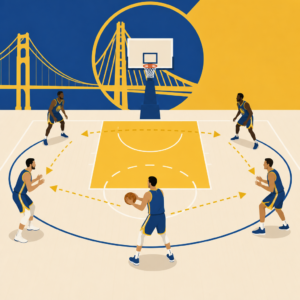
Smart offensive players consistently generate advantages without wasting dribbles. They understand spacing rules, keep the paint open, and know where teammates should be so passes arrive on time and on target. In a spread pick-and-roll, for example, the ball handler is reading at least four things at once: the screen defender’s coverage, the on-ball defender’s recovery angle, the low man tagging the roller, and the weak-side shooter’s defender zoning up two players. The best readers do not simply react after the tag comes. They anticipate it and throw the pass as the helper commits.
That anticipation is what separates a good passer from an advanced offensive engine. Jokic is the obvious example because he punishes every layer of help, but the principle applies across positions. Tyrese Haliburton manipulates weak-side defenders with eyes and tempo. Jalen Brunson creates paint touches not through elite vertical explosion, but through footwork, shoulder placement, and a precise understanding of how defenders open their hips. Even off the ball, smart players create value by cutting behind ball watching defenders, setting legal screens at useful angles, and relocating after passes instead of standing still. NBA offense rewards players who understand geometry as much as those who win sprint tests.
Shot selection is another core marker of IQ. A player can score 20 points and still hurt an offense if those points come from low-efficiency pull-ups early in the clock while teammates are ignored. Smart scorers know the hierarchy: layups, free throws, corner threes, open catch-and-shoot threes, then selective midrange shots created against coverage concessions. They also know personnel. If the roll man is a vertical lob threat, the tag must be respected. If the weak-side shooter is at 43 percent from three, help is more expensive. The smartest offensive players memorize those probabilities through film and repetition, then make simple choices that look effortless on television.
Defensive IQ: rotations, communication, and anticipation
Defensive IQ is often harder for casual fans to see because the best plays prevent obvious action. A high-IQ defender recognizes alignment, calls out coverage early, takes away first options, and rotates on the pass rather than after the catch. In NBA terminology, this means tagging the roller from the correct spot, zoning up on the weak side without losing the corner, bumping cutters through the lane, and executing stunt-and-recover actions without overhelping. Teams chart these details because one late rotation can undo twenty seconds of strong defense.
Consider the low man, one of the most important roles in modern defense. When a pick-and-roll gets downhill, the low man must protect the rim until the big recovers, then peel back to his shooter or exchange responsibilities through a scram or X-out rotation. Players like Holiday and Green excel because they process this instantly and communicate it loudly. Athletic defenders can still fail here if they chase blocks, jump at every fake, or lose sight of the strong-side corner. Smart defenders rarely need spectacular recoveries because they arrive on balance and in the right place first.
Defensive rebounding is another IQ area disguised as effort. Coaches value “hit-find-get” technique: make contact, locate the ball, then secure it with two hands. Russell Westbrook at his best was explosive, but strong rebounding guards across eras have also been excellent anticipators who read shot trajectory and understand where misses come from. Long jumpers create long rebounds; baseline drives often produce weak-side misses. Smart defenders know those patterns. They close possessions, avoid cheap fouls, and understand game context, such as when to switch everything late, when to foul up three, and when to deny the inbound rather than sag.
Fundamentals are the visible part of basketball IQ
Fundamentals are how intelligence shows up possession after possession. Footwork, balance, passing technique, screening, closeouts, pivoting, and finishing angles are not beginner topics; they are the tools smart NBA players trust when pressure rises. In player development settings, I have seen the same truth repeatedly: once game speed increases, players default to their habits. If the footwork is clean and the reads are trained, good decisions hold. If the base is loose, athleticism tries to compensate and efficiency drops.
Footwork is the foundation. Brunson, Shai Gilgeous-Alexander, and DeMar DeRozan create scoring windows because their feet stay connected to their eyes and shoulders. They stop under control, pivot without drifting, and maintain leverage. Passing fundamentals matter just as much. Smart players throw on-time passes to the shooting pocket, away from defenders’ hands, with the correct speed and spin. Defensively, closeout mechanics decide whether a shooter gets a clean look or a driving lane. Great closeouts are short, choppy, and balanced with high hands and a controlled chest angle. That is not glamorous, but it wins minutes in the NBA.
| Skill area | Low-IQ habit | High-IQ fundamental | NBA example |
|---|---|---|---|
| Pick-and-roll | Predetermined drive | Read tag and hit weak-side shooter | Haliburton skips to corner |
| Finishing | Jumping without a plan | Use stride stop, pivot, and angle | Brunson changes feet in traffic |
| Defense | Ball watching | See man and ball, tag early | Green rotates as low man |
| Shooting | Rushed off-balance attempts | Shot prep and one-two alignment | Klay Thompson ready on catch |
| Rebounding | Watching the shot | Hit-find-get box-out sequence | Josh Hart tracks long rebounds |
How coaches, scouts, and front offices evaluate IQ and fundamentals
NBA teams do not rely on vague impressions when evaluating smart players. They use synergy clips, lineup data, turnover types, foul rates, shot quality metrics, and detailed film coding to determine whether a player’s decisions scale against better competition. In scouting meetings, language becomes specific: Can he make the pocket pass against drop? Does he recognize top-locks and back cut automatically? Is he early as the nail helper? Does he understand peel switching? Can he play out of advantages without freezing the ball? Those questions reveal whether a prospect’s production came from superior athletic traits alone or from translatable processing and skill.
Interviews and workouts matter too, but the strongest evidence is always on film. Smart players tend to be consistent across possessions, opponents, and roles. They may not post the highest usage, yet coaches trust them because they preserve structure. Alex Caruso is a textbook example. His value shows in screen navigation, timely digs, extra passes, and early rotations more than in basic box score totals. Teams also examine mistake patterns. A turnover from trying the right read late is different from a turnover caused by never seeing the weak-side help. A missed rotation while learning a new scheme is different from repeated ball watching. Context matters, but intelligent habits are visible over time.
Can basketball IQ be developed, or is it mostly natural?
Basketball IQ can absolutely be developed, though some players process patterns faster than others from the start. The teachable part comes from film study, guided repetition, and constraints that force correct reads. In practice, that means small-sided games, advantage-disadvantage drills, scripted defensive rotation work, and shot selection standards connected to player roles. The key is not memorizing plays in isolation. It is learning cues. When the low man tags from the corner, where is the next pass? When the big is in a deep drop, which pull-up or pocket window opens? When a shooter is top-locked, what cut punishes it?
The best development programs blend film with on-court transfer. A player watches ten clips of Spain pick-and-roll coverages, then walks through the reads, then plays live reps with scoring rules that reward the right decision. Over time, decisions speed up because the player recognizes the picture earlier. Veterans often improve dramatically this way. Aaron Gordon became more effective as he simplified reads, cut harder, screened better, and understood how to play off Jokic. Young guards reduce turnovers not only by tightening handles, but by learning when not to force the pocket pass. IQ grows when players connect concepts to repeatable habits.
Why smart players win in the playoffs
The playoffs expose players who rely only on athletic superiority because every action is scouted, every tendency is tracked, and every weak read is targeted over a seven-game series. Smart players survive because they adjust. If a team top-locks a shooter, he back cuts. If a defense switches late clock actions, the offense attacks the mismatch quickly before help is set. If a star sees two at the ball, he trusts the early release pass and relocates for the return. Playoff basketball compresses space and time, so fundamentals and IQ become even more valuable than they are in January.
This is why experienced role players often swing postseason games. They know the personnel report, avoid gambling, move the ball on schedule, and make disciplined defensive choices under stress. Think about the importance of one clean tag, one extra pass, or one box-out in a game decided by three points. Athleticism can steal possessions, but smart execution stacks reliable edges over forty-eight minutes. If you want to study basketball skills deeply, start here: learn how players read the floor, then connect those reads to footwork, spacing, and technique. Basketball IQ is not separate from fundamentals. It is fundamentals applied at the right moment. Watch games through that lens, and smart players become impossible to miss.
Frequently Asked Questions
What does basketball IQ actually mean in the NBA?
NBA basketball IQ is the ability to process the game faster and more accurately than everyone else on the floor. It goes far beyond knowing plays or understanding basic rules. A high-IQ player reads spacing, anticipates rotations, recognizes personnel tendencies, understands time and score, and makes the correct decision before the action is fully obvious to others. In the NBA, where every player is elite athletically, that mental edge often becomes the real separator.
In practical terms, basketball IQ shows up in small but winning details. It is the guard who knows when to push tempo and when to settle the offense. It is the wing who cuts at the exact moment a defender turns his head. It is the big man who shades one step earlier to take away a drive without giving up the lob. Smart players are not just reacting to what happened. They are identifying what is about to happen and positioning themselves accordingly.
This is why basketball IQ is so valuable over the course of a long NBA career. Athletic tools can get a player into the league, but anticipation, discipline, and decision-making help him stay there. Coaches trust players who consistently make the right reads, avoid preventable mistakes, and elevate teammates through timing and awareness. That trust leads to minutes, responsibility, and longevity.
How is a smart NBA player different from a player who is simply more athletic?
An athletic player can overwhelm a possession with speed, explosiveness, strength, or vertical pop. A smart player controls the possession before raw physical talent even has to take over. That is the key difference. Athleticism can create an advantage, but basketball IQ determines whether that advantage turns into an efficient shot, a clean rotation, a foul drawn, or a turnover avoided.
For example, an athletic guard may beat his defender off the dribble, but a smart guard knows where the low man is rotating from, whether the corner shooter is lifting, and how the weak-side defender is tagging the roller. The athletic player sees an opening. The high-IQ player sees the entire chain reaction. That broader vision allows him to make better choices consistently rather than relying on difficult plays or highlight-level recoveries.
On defense, the contrast is just as clear. A great athlete may recover after a mistake with speed or leaping ability. A smart defender avoids the mistake in the first place by reading the action early, taking the correct angle, understanding scouting tendencies, and communicating with teammates. Over time, that difference matters. The NBA rewards players who can repeatedly make the right read under pressure, not just players who can occasionally erase errors with elite physical gifts.
The best players, of course, combine both traits. But when comparing two players with similar athletic profiles, the smarter one usually has the greater impact because he wastes fewer possessions and creates more stable winning basketball.
Why does basketball IQ matter so much if NBA players are already elite athletes?
Because at the NBA level, everyone is athletic. The margins are so thin that mental processing, pattern recognition, and situational awareness become enormous competitive advantages. A fraction of a second matters in pick-and-roll coverage, closeouts, help rotations, transition defense, and late-game execution. Basketball IQ helps players operate inside those tiny windows more effectively than opponents.
It also improves efficiency. The league is not just about making spectacular plays. It is about making the right play over and over again. Smart players know when to take the quick three, when to swing the ball one more time, when to cut behind ball watching defenders, and when to pull the ball out to avoid a bad shot. That discipline increases offensive quality and reduces wasted possessions, which is often the difference in close games.
Defensively, basketball IQ helps teams stay connected. Smart players understand schemes, know how to disguise coverages, recognize opponent actions early, and rotate on time. They understand personnel, too. Guarding an elite shooter requires different positioning than guarding a reluctant one, and high-IQ defenders make those adjustments naturally. They are constantly filtering information: who is hot, who wants to drive left, who slips screens, who rejects picks, who thrives in the midrange, and what the score demands in that moment.
That is why basketball IQ remains one of the most scalable traits in the league. It helps a player fit with stars, adapt to different systems, and contribute even when his shot is not falling or his athleticism declines. Intelligence travels from lineup to lineup and from season to season.
Can basketball IQ be developed, or is it mostly something players are born with?
Basketball IQ can absolutely be developed, even though some players naturally process the game faster than others. Like many advanced skills in sports, it is a blend of instinct, repetition, film study, experience, coaching, and deliberate attention to detail. Some players arrive with a natural feel for timing and space, but nearly every smart NBA player has spent years sharpening that feel through study and reps.
Film work is one of the biggest tools. Watching possessions repeatedly teaches players to recognize patterns that are hard to fully absorb in real time. They learn where help defenders come from, how certain teams defend actions, what common counters look like, and how small shifts in spacing create openings. Film turns the game into a series of familiar scenarios, which makes in-game decisions faster and cleaner.
Experience matters, too. Players improve their basketball IQ by making mistakes, seeing the same actions from different opponents, and learning how game context changes decision-making. Understanding when to foul, when to hold for the last shot, when to attack a mismatch quickly, or when to avoid overhelping often comes from repeated exposure to those situations. Great coaching accelerates that process by teaching players what to look for and why it matters.
Just as importantly, communication develops basketball IQ. Talking through coverages, asking questions, understanding teammate tendencies, and learning the logic behind a scheme all deepen a player’s feel for the game. So while not every player reaches the same level as the league’s best thinkers, basketball IQ is very much trainable. Players who commit to studying the game usually improve their decision-making in visible ways.
What are the clearest signs that a player has high basketball IQ?
The clearest sign is consistency in making winning plays that do not always show up in a box score. High-IQ players rarely look rushed, even in chaotic moments. They know where to be, when to move, and what the possession needs. Offensively, they relocate to create passing angles, make quick reads against help, understand clock management, and avoid forcing low-value shots. Defensively, they rotate on time, tag rollers correctly, communicate coverages, and anticipate actions before they fully form.
Another strong indicator is adaptability. Smart players can change their approach based on matchup, lineup, score, and momentum. If a defense is top-locking a shooter, they know how to counter with a back cut. If a big is playing in a deep drop, they know whether to pull up, snake the dribble, or hit the pocket pass. If a teammate is struggling in a matchup, they subtly offer help without compromising the team structure. They are constantly solving problems in real time.
Turnover quality is another clue. Every player turns the ball over, but low-IQ mistakes tend to be careless and predictable: forcing passes into loaded help, losing track of clock, gambling out of scheme, or rotating late because of poor awareness. High-IQ players may still make aggressive mistakes, but their process is usually sound. Over time, that difference shows up in trust from coaches and teammates.
Finally, high basketball IQ is visible in how a player raises the level of everyone around him. He creates easier shots, stabilizes defensive possessions, keeps lineups organized, and helps a team execute under pressure. That is the real value of basketball intelligence in the NBA. It is not just about looking smart. It is about making the game easier, cleaner, and more effective for the entire group.