
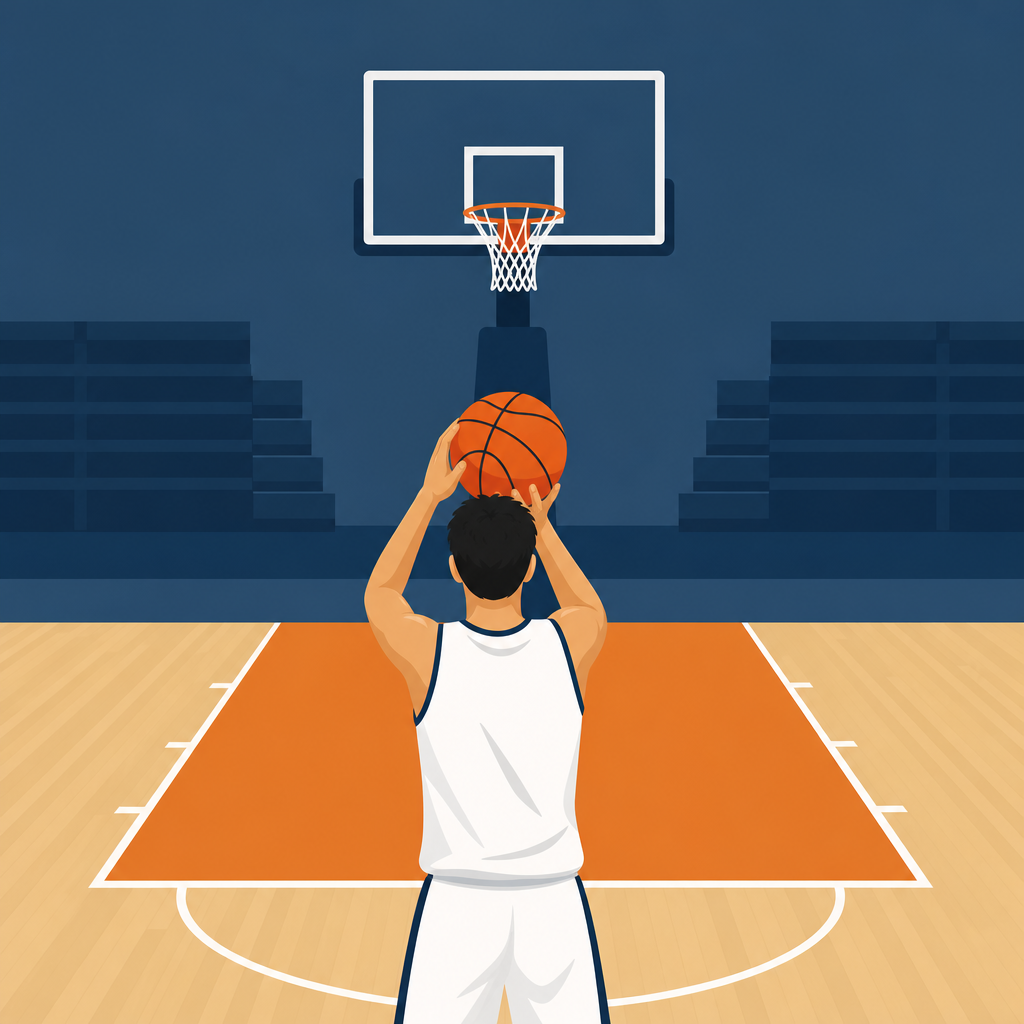
A free throw looks simple: one player, one ball, fifteen feet, no defender. In practice, it exposes every weakness in shooting mechanics, breathing, focus, and confidence. If you want to learn how to shoot a free throw without missing, you need more than a lucky touch. You need a repeatable routine, technically sound form, and a mental process that holds up when your legs are tired and the gym is loud.
In basketball, shooting is the broad skill category that includes set shots, jump shots, catch-and-shoot attempts, pull-ups, layups, floaters, and free throws. The free throw is the purest shooting test because outside variables are reduced. That makes it the ideal hub topic for improving your entire shooting package. When I work with players on overall shooting development, I almost always start at the line. Free throws reveal balance problems, off-hand interference, inconsistent arc, rushed tempo, and poor concentration faster than any drill on the floor.
This matters because free throws directly change games and indirectly improve every other shot. Strong free throw shooters usually have better touch, cleaner mechanics, and more reliable pre-shot habits. At every level, from youth leagues to the NBA, coaches trust players who can convert uncontested points. A player who shoots 85 percent from the line forces smarter defense, closes games, and builds offensive value without needing extra possessions. Just as important, free throw work gives you a controlled environment to practice shooting under measurable pressure.
To make free throws consistently, focus on three pillars: mechanics, routine, and mentality. Mechanics determine whether the ball starts on line with proper arc and backspin. Routine creates consistency by making every rep feel familiar. Mental habits keep you from speeding up, overthinking, or carrying the last miss into the next shot. Put together, those pillars form a system. The goal is not to hope you get hot. The goal is to make each free throw a repeatable action your body and mind can trust.
Build a repeatable free throw shooting form
The first answer to how to shoot a free throw without missing is simple: remove unnecessary motion. Great shooters do not chase perfection with ten moving parts. They organize the body so the shot can travel straight, high, and soft. Start with your stance. Most players shoot best with feet about shoulder width apart, shooting-side foot slightly ahead, knees unlocked, and weight balanced through the middle of the feet. If your heels lift early or your toes grip the floor, your base is unstable before the ball even moves.
Next, align the upper body. Your shooting hip, shoulder, elbow, wrist, and index-middle finger line should work toward the center of the rim. The elbow does not need to be pinned unnaturally tight, but it cannot flare wide at release. Keep the guide hand on the side of the ball, not behind it. A guide hand that pushes creates sidespin and left-right misses. Hold the ball high enough to see the rim clearly, with the wrist loaded and forearm ready to extend through the shot.
The release should be smooth, not forceful. Extend from the legs through the arm in one connected motion, finishing with a relaxed wrist snap and fingers down. The cue many shooters use is reach into the cookie jar, but the deeper point is complete extension without tension. The ball should leave your hand with clean backspin and enough arc to enlarge the effective entry area. Research commonly cited in coaching circles shows that higher arc improves the margin for error because the ball approaches the rim more vertically. In practical terms, line drives reduce your chance of getting a soft make.
Your eyes matter too. Pick one precise target and keep it. Some players lock on the front rim, others the back rim, and many elite instructors teach aiming at the center or a specific hook on the rim. The important thing is consistency. I have seen players improve ten percentage points simply by stopping the habit of looking at the ball during the dip or shifting their focus between shots. Stable eyes support stable mechanics.
Create a pre-shot routine you can trust under pressure
A free throw routine is not superstition. It is a sequence that regulates timing, breathing, and attention. The best routines are short enough to hold up late in games and specific enough to trigger your best mechanics. Most successful players use the same order every time: receive the ball, set the feet, take one or two dribbles, center the seams, breathe, lock on the target, and shoot. If your routine changes based on score or emotion, it is not doing its job.
Keep the routine between roughly four and seven seconds once the ball is in your hands. Too short, and players rush. Too long, and tension builds. During workouts, rehearse the routine exactly as you want to use it in competition. That means same number of dribbles, same breath, same visual target, same cue word. A cue such as smooth, up, or through can be useful if it points your mind toward one action instead of ten technical thoughts.
One mistake I see often is players practicing free throws casually, then expecting automatic execution in games. Practice must match pressure. If your game routine uses one deep breath before the shot, use that breath on every training rep. If you wipe your shooting hand on your shorts and center the valve before starting, do it every time. Consistency is what turns a routine into a performance tool rather than a habit with no purpose.
| Routine Element | Purpose | Common Mistake | Better Option |
|---|---|---|---|
| Foot placement | Creates balance and alignment | Feet too narrow or uneven | Set shoulder width with shooting foot slightly forward |
| Dribbles | Controls tempo | Random number each shot | Use the same one or two dribbles every time |
| Breath | Reduces tension | Holding breath before release | Take one calm inhale and relaxed exhale |
| Visual target | Improves aim consistency | Eyes moving between ball and rim | Lock on one exact spot on the rim |
| Cue word | Keeps mind simple | Thinking about five mechanics at once | Use one clear cue like smooth or through |
Use mental tips that prevent misses from multiplying
Players usually do not miss several free throws in a row because they suddenly forgot how to shoot. They miss because one miss changes their thoughts, body tension, and tempo. The key mental skill is resetting between attempts. After a miss, do not search for a complete rebuild in five seconds. Return to your routine, trust one cue, and let the next shot be independent. The best free throw shooters have short memory and stable behavior.
Breathing is the fastest way to control nerves. A slow inhale through the nose and relaxed exhale through the mouth lowers physical tension in the shoulders and hands. That matters because anxious players often release the ball flat, push with the guide hand, or speed up the shot. Before big late-game free throws, I tell players to feel their feet on the floor and exhale fully before lifting the ball. It is simple, but it works because it reconnects the body to the present rep.
Self-talk should be instructional, not emotional. Telling yourself do not miss is useless because the brain hears miss and tightens up. Better phrases are straight up, soft touch, or same shot. Visualizing the ball dropping cleanly can help, but keep imagery brief. Long internal speeches make players mechanical. Your goal is a clear mind with one purposeful cue, not a motivational monologue at the line.
Pressure also changes perception. In loud moments, the rim can look small because attention narrows around the consequence of the shot. Experienced shooters train against this by adding consequences in practice: make ten in a row before leaving, shoot two while teammates distract, or run after every miss. Those constraints are not punishment. They teach you to execute your routine while feeling elevated heart rate and emotional stakes. Confidence comes less from positive thinking than from repeated proof.
Practice free throws in ways that improve all shooting
If this article serves as a hub for shooting, free throw practice has to connect to broader scoring skill. The line teaches rhythm, touch, arc control, and follow-through, but those qualities must transfer to jump shots and game movement. I recommend dividing shooting sessions into three blocks: form shooting close to the basket, free throws, and game-speed shots from spots you actually use. That progression links pure mechanics to pressure-free repetition and then to realistic play.
Form shooting should come first because it calibrates the release. Start three to eight feet from the basket with one hand emphasis, guide hand light, and full follow-through. Then step to the line and apply the same wrist action and arc. After every set of jump shots, return to the free throw line for a small quality check. Many college programs use this approach because the line quickly shows whether fatigue or speed has pulled the mechanics apart.
Track your percentages honestly. For developing players, 50 made free throws after a workout is useful, but percentage matters more than raw makes. If you go 50 for 80, you learned something different than if you go 50 for 56. Record attempts, makes, streaks, and misses by type, such as short, long, left, or right. Patterns tell the truth. Short misses often indicate tired legs or deceleration. Left-right misses usually point to alignment or guide-hand issues. Data turns vague frustration into fixable problems.
To build transfer, pair free throws with game actions. Shoot five catch-and-shoot threes, then two free throws. Attack off a ball screen into a pull-up, then shoot two free throws. Finish through contact at the rim, then shoot two free throws while breathing hard. This matters because real free throws rarely come when you are rested and calm. They come after sprints, collisions, and emotional swings. Training that context improves not only free throw percentage but overall shooting reliability.
Fix the most common reasons players miss at the line
Most misses fit clear categories. If the ball is short, check leg drive, follow-through, and whether you are pausing at the top of the motion. Young players often try to aim the ball instead of shooting through it, which kills rhythm and leaves the shot short. If the ball is long, the release may be too forceful, the arc too flat, or the player may be jumping forward. A straight shot that hits back rim is usually a power or touch issue, not an aiming issue.
Left and right misses are usually alignment problems. Start by checking feet, hips, and shooting elbow. Many right-handed players miss left because the guide hand adds force at release or the wrist turns inward. Many miss right because the elbow starts outside the frame of the ball and the shot never gets back on line. Video helps here. A phone on a tripod from the front and side can reveal problems that players cannot feel in real time.
Another common issue is inconsistency caused by changing mechanics after every miss. Make adjustments only when a pattern appears over multiple attempts. One miss proves very little. Ten misses with the same shape tell you where to look. I trust simple diagnostic questions: Was the ball on line? Did it have enough arc? Did it come off with clean backspin? Did my tempo match my routine? Those answers are more useful than emotional reactions.
Equipment and environment matter too, though less than players think. Different basketballs, bright backdrops, dead rims, and crowd noise can affect comfort. Good shooters adapt by locking onto familiar cues: target, breath, balance, release. If you rely on a perfect gym, your percentage will travel poorly. If your routine is portable, your shooting will hold up in unfamiliar spaces.
Shooting a free throw without missing is not about magic and it is not about copying one star exactly. It is about building a repeatable system that gives you the same chance on every attempt. Start with efficient mechanics: balanced stance, aligned elbow, quiet guide hand, full extension, and soft arc. Add a routine that controls timing and attention. Then strengthen the mental side with breathing, reset habits, and practice conditions that create real pressure. Those pieces work together, and none should be ignored if you want dependable results.
As the hub for shooting development, the free throw line teaches principles that carry into every shot in basketball. Touch, rhythm, balance, alignment, follow-through, and confidence all show up there first. When your free throws improve, your jump shot usually becomes more stable because the same foundations are cleaner. Use the line as both a scoring weapon and a diagnostic tool. It is one of the fastest ways to evaluate whether your overall shooting mechanics are holding together.
Your next step is simple: choose one routine, film your form, track your percentage for two weeks, and make small adjustments based on patterns instead of emotion. If you do that consistently, your free throw percentage will rise and your entire shooting skill set will become more reliable. Commit to the process the next time you step to the line.
Frequently Asked Questions
What is the most important part of learning how to shoot a free throw without missing?
The most important part is building a repeatable routine that connects solid shooting mechanics with calm mental focus. Players often assume free-throw shooting is only about touch, but consistency at the line comes from doing the same things in the same order every time. That means your feet go to the same spots, your grip is set the same way, your eyes lock onto the same target, your breathing follows the same pattern, and your release finishes with the same follow-through. A free throw is one of the few moments in basketball where you can control nearly every variable, so the goal is to remove guesswork.
Mechanically, start with balance. Your feet should be comfortably set, your knees relaxed, and your weight centered. Your shooting hand should be under the ball, your guide hand should support the side without pushing, and your elbow should stay aligned so the ball travels on a straight path. From there, use a smooth upward motion with your legs and arm working together, then finish high with a relaxed wrist and full extension. Mentally, the key is to focus on your process rather than the outcome. Thinking “don’t miss” creates tension. Thinking “breathe, target, smooth release” reinforces the actions that produce makes.
If you want to become automatic at the line, treat each free throw like a skill sequence, not a hope shot. The best shooters trust a routine so much that crowd noise, fatigue, and pressure stop feeling disruptive. They rely on habits. That is what gives you the best chance of making free throws consistently, even in game situations.
What should a good free-throw routine include?
A good free-throw routine should be simple, repeatable, and short enough to hold up under pressure. The purpose of a routine is to create familiarity and rhythm, not to add extra thinking. Most effective routines include a few controlled dribbles, a breath, a target lock, and one clear shooting cue. For example, a player might step to the line, place the feet, take two dribbles, inhale and exhale slowly, look at the back of the rim, and think “up and through” before shooting. That type of sequence helps settle the body and organize the mind.
The routine should also help regulate tempo. Many misses happen because players rush after receiving the ball or freeze and overthink. A reliable routine keeps you in the middle ground: composed but not stiff. It tells your body, “This is the same shot I have taken thousands of times.” That predictability matters when your heart rate is elevated or the game situation is stressful. The line becomes a place of structure rather than pressure.
Keep the routine consistent across practice and games. If you only use it in competition, it will not feel natural. If you rehearse it every day, it becomes automatic. Avoid making the routine too long or superstitious. You do not need a complicated ritual. You need a sequence that supports focus, balance, breathing, and release. The best routine is the one you can trust when you are tired, distracted, or standing at the line with the game on the line.
How do you improve free-throw form and shooting mechanics?
Improving free-throw form starts with simplifying the shot and making sure every part of your mechanics works together. Begin from the ground up. Your stance should be balanced and comfortable, usually about shoulder width or slightly narrower depending on what feels natural. Your shooting-side foot may be very slightly ahead, but the main goal is alignment and stability. Your knees should be flexed enough to generate smooth upward energy, not so bent that the shot becomes forced or inconsistent.
Next, focus on hand placement and ball path. Your shooting hand should sit under the center of the ball so you can guide it upward cleanly. Your guide hand should rest on the side, helping with balance without adding sideways force. As you start the shot, bring the ball up in a controlled line. Keep your elbow under or close to under the ball, and avoid letting the ball swing across your body. A straight, efficient path gives you better direction and touch. Your legs should start the motion, your arm should continue it, and your wrist should finish it. That sequencing creates fluid power instead of a push.
The release is where many players either gain consistency or lose it. Aim for a smooth extension with a relaxed wrist snap and a high follow-through. Hold your finish briefly so you can feel whether the shot was balanced and complete. The ball should leave your hand with backspin and arc, not on a flat line. Good arc increases the margin for error because the ball has a better angle of entry into the rim. If you are missing short often, you may be losing leg involvement or decelerating on the release. If you are missing left or right, check your guide hand, elbow alignment, and follow-through.
The best way to improve mechanics is through deliberate repetition. Do not just shoot large numbers of free throws mindlessly. Shoot in sets while paying attention to one or two key details, such as balance, elbow position, or follow-through. Video can help, and so can feedback from a coach. Over time, the goal is to make sound mechanics feel natural enough that they hold up under fatigue and pressure.
How do you stay mentally locked in at the free-throw line during pressure situations?
Staying mentally locked in during pressure free throws is about narrowing your attention to things you can control. Pressure usually causes players to think ahead to the result: the score, the crowd, the consequences of a miss, or how tired they feel. That kind of thinking pulls you away from the shot itself. The solution is to use a mental routine built around present-moment cues. Focus on your breath, your target, and one simple action phrase such as “smooth,” “through,” or “hold the finish.” Those cues keep your mind anchored in execution.
Breathing is especially important because it directly affects tension. A quick, shallow breath often leads to tight shoulders and rushed movement. A controlled inhale and exhale can calm your nervous system and improve touch. Once you receive the ball, use your routine to slow the moment down. You do not need to force confidence. You need to create clarity. Confidence often follows when your mind recognizes a familiar process. That is why elite free-throw shooters look composed even in loud gyms: they are not trying to block everything out perfectly, they are returning to the same internal sequence they always use.
It also helps to reframe pressure. Instead of viewing free throws as a test of whether you are clutch, view them as a chance to execute a trained skill. That mindset reduces emotional weight. If negative thoughts appear, do not fight them dramatically. Replace them with action-based cues. “Don’t miss” becomes “eyes on target.” “My legs are dead” becomes “use my legs, soft release.” Mental toughness at the line is not about having no nerves. It is about staying committed to your routine and mechanics even when nerves show up.
What are the best ways to practice free throws so they translate into games?
The best free-throw practice combines repetition, routine work, and game-like pressure. Shooting a high volume of free throws has value, but only if each rep is intentional. Every practice shot should begin with the same routine you want to use in a game. That includes your foot placement, dribbles, breath, target focus, and follow-through. When players casually toss up practice free throws without structure, they miss the chance to train consistency. Practice should teach your body and mind exactly what to do every time you step to the line.
It is also important to practice under fatigue. In games, many free throws happen after hard sprints, contact, and high heart rate. That means your practice should sometimes include conditioning before stepping to the line. Run, cut, or complete a drill, then shoot free throws while tired. This helps you learn how to settle your breathing, regain balance, and trust your mechanics when your legs are heavy. That is a major part of learning how to shoot a free throw without missing in real basketball conditions rather than ideal ones.
Add consequences and pressure to your training as well. For example, require yourself to make a certain number in a row before finishing, or create score-based situations where two free throws decide the outcome of a drill. You can also track percentages over time and set measurable goals. Pressure practice is useful because it reveals whether your routine and mental cues stay stable when the make feels important. Finally, review your misses honestly. Patterns tell you what to fix. If you miss short late in workouts, your legs may be dropping out. If you miss to one side repeatedly, alignment or guide-hand interference may be the issue. Smart practice is not just about taking shots. It is about building a dependable process that survives game speed, noise, fatigue, and pressure.