
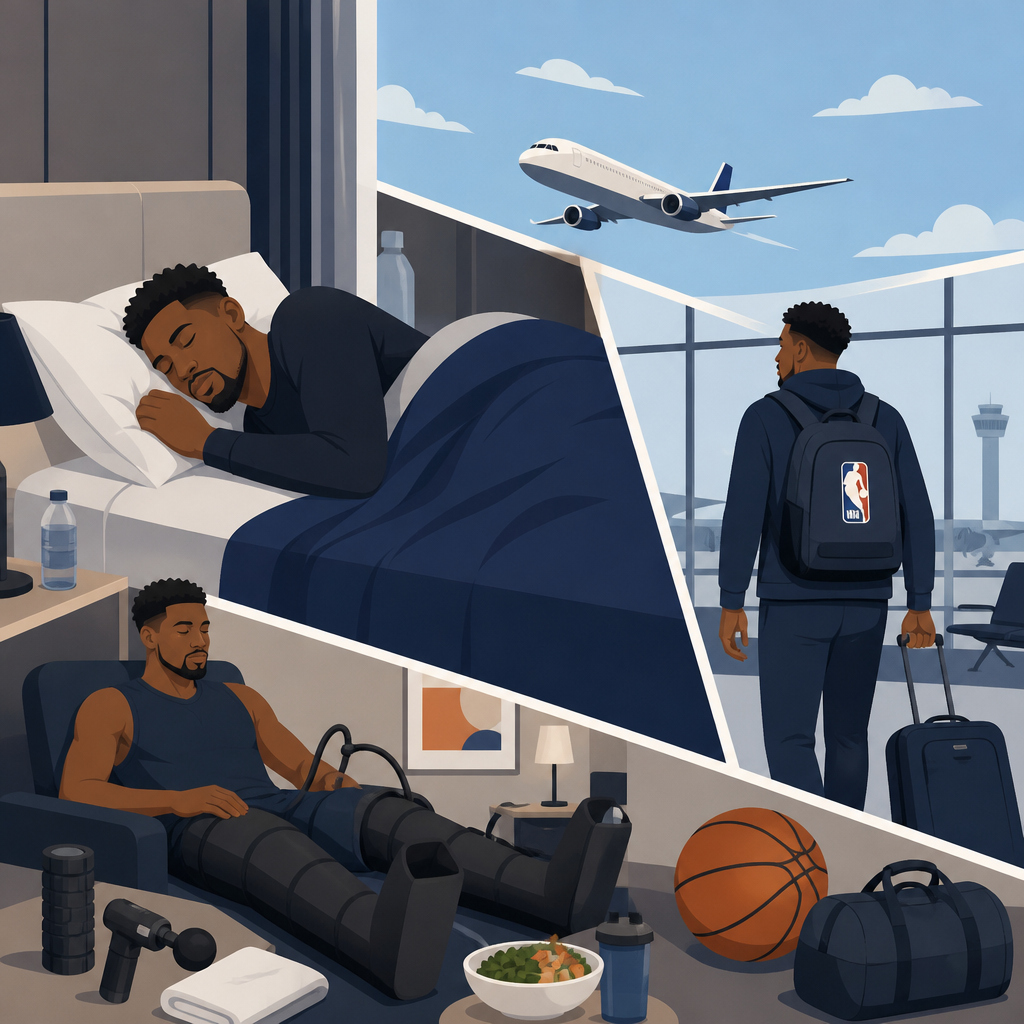
NBA players spend nearly half their season away from home, and the way they sleep, travel, and recover on the road shapes both performance and player culture. In practical terms, road life in the league is a controlled routine built around charter flights, luxury hotels, circadian management, nutrition timing, and treatment windows squeezed between games. Sleep is the foundation, travel is the stressor, and recovery is the process that keeps the schedule from wearing players down. Teams that manage those three factors well usually look fresher late in back-to-backs, more focused in film sessions, and more resilient over an 82-game season.
When people talk about NBA culture, they often focus on style, locker room chemistry, or social media, but player culture is also operational. It is about what happens after the arena empties: when players board a plane at 11:30 p.m., when training staff text wake-up times, when room service replaces a missed dinner, and when a veteran decides whether to chase extra shots or prioritize sleep. I have worked around high-performance travel planning long enough to know that elite teams treat sleep as a competitive variable, not a lifestyle accessory. The players who last deepest into May rarely ignore that reality.
Key terms matter here. Jet lag is a circadian rhythm disruption caused by crossing time zones, especially eastward travel, which usually feels harder because the body must fall asleep earlier than its internal clock prefers. Recovery includes sleep quantity, sleep quality, hydration, nutrition, soft-tissue treatment, mobility work, and nervous system downregulation after competition. Sleep hygiene means the habits and environment that support rest, including room temperature, light exposure, caffeine timing, and screen management. On the NBA road, these concepts are not abstract wellness ideas. They determine whether a player wakes up restored or foggy.
This topic matters because the NBA schedule is uniquely punishing. Teams can play four games in six nights, land after midnight, practice in unfamiliar facilities, and immediately prepare for opponents with different defensive schemes. According to sports science research, sleep restriction impairs reaction time, mood, decision-making, and sprint output, all of which matter in basketball. Recovery is therefore not separate from skill. It supports shot selection, closeout effort, communication, and injury risk management. To understand modern player culture, you have to understand hotels, flights, time zones, and the habits players build to survive them.
Why NBA travel is harder than it looks
NBA teams fly private charters, stay in premium hotels, and travel with dedicated staff, so from the outside the road can look comfortable. It is comfortable compared with commercial travel, but it is still physically disruptive. Players leave arenas with adrenaline elevated, core temperature high, and legs heavy from repeated accelerations and jumps. Then they sit on a plane, often eat late, and try to sleep at an hour when their nervous system is still in competition mode. Even a short flight can delay sleep onset. A longer cross-country flight can shift the entire next day.
The schedule compounds the issue. A team might play a nationally televised game in Los Angeles, land in Denver in the early morning, then face altitude the next night. Or it might finish in Portland and head east, losing hours and asking players to perform before their body clocks catch up. Eastward travel generally produces more measurable fatigue because circadian phase advance is difficult. In plain language, it is easier to stay up later than to fall asleep earlier. That is why smart teams front-load recovery protocols as soon as the plane takes off.
There is also the cultural side of travel. Younger players often see the road as freedom at first: new cities, room service, friends visiting, and less structure than home. Veterans usually learn that bad road habits cost them later. The league has gradually shifted toward a culture in which sleep is not considered soft. It is part of professionalism. The best locker rooms reinforce that standard informally, with veterans telling younger teammates when to eat, when to get treatment, and when to stop scrolling and go to bed.
Where players stay and how hotel routines are managed
Most NBA teams stay in high-end business or luxury hotels selected for security, logistics, and sleep quality. Proximity to the arena matters, but so do blackout curtains, quiet floors, reliable room service, meeting space, and enough control over guest access. Teams often use the same hotel brands repeatedly because consistency reduces friction. Familiar rooms, predictable bedding, and established kitchen relationships make the road feel less random. In my experience, that predictability matters more than people realize. Recovery starts faster when players do not have to solve basic comfort problems at midnight.
Room assignments can be strategic. Veterans may prefer specific floor locations, mattress toppers, or pillow types. Some teams travel with sleep kits that include eye masks, earplugs, blue-light blocking glasses, and magnesium-based recovery products. Others work with hotel staff in advance to secure cold tubs, late healthy meals, or meeting rooms converted into treatment areas. The details are small, but together they reduce what performance staffs call transition cost: the physical and mental load of moving from one environment to another.
Hotels also shape routine. On game day, players may have breakfast windows, treatment appointments, a shootaround bus, film review, pregame meals, and curfew guidance. Few teams impose old-school bed checks anymore, but standards still exist. The best-run travel groups create freedom inside a strong framework. Players know where to be, when to eat, and how to recover, while still managing their own evenings. That balance is central to player culture because adults perform better when trusted, but elite teams still protect habits that support winning.
How NBA players actually sleep on the road
Road sleep is less about a perfect eight-hour block and more about managing fragments effectively. After night games, many players do not fall asleep quickly. Postgame media, treatment, showers, travel to the airport, and the flight itself can push bedtime into the early morning. Add caffeine from pregame routines and emotional carryover from competition, and it is easy to see why sleep latency becomes a problem. For some players, the answer is a split model: shorter overnight sleep followed by a planned nap the next afternoon.
Teams increasingly individualize sleep plans. One player may respond well to melatonin under medical guidance, another may avoid it because of grogginess. Some need colder rooms, others need white noise. Sleep specialists often emphasize two non-negotiables: light management and schedule consistency. Bright morning light helps reset the clock after travel, while limiting bright screens late at night supports melatonin release. Consistency matters because wildly changing sleep and wake times increases circadian strain. The best players often become experts in their own patterns.
Napping is common, but the timing matters. A well-timed nap of 20 to 40 minutes can improve alertness without causing sleep inertia. Longer naps can help repay debt but may also leave a player groggy if taken too close to evening. Teams usually build nap windows into hotel schedules, especially on back-to-backs. This is not laziness. It is energy management. In elite environments, recovery time is programmed just as intentionally as a walkthrough or lifting session.
Jet lag, time zones, and circadian strategy
Jet lag affects NBA players because basketball performance depends on timing, not just effort. Shooting touch, reaction speed, emotional regulation, and decision quality all fluctuate with circadian rhythm. Research in chronobiology and sports performance consistently shows that internal timing influences output. For a player crossing multiple time zones, the challenge is not merely tiredness. It is misalignment between local clock time and biological time. That is why a 7 p.m. tip can feel like 10 p.m. to one team and 4 p.m. to another.
Teams address this with circadian strategy rather than guesswork. Staff may shift meal timing, encourage sunlight exposure upon arrival, moderate caffeine based on the destination time zone, and recommend earlier or later naps depending on direction of travel. Eastbound trips often require earlier light exposure and stricter nighttime habits. Westbound trips can feel easier initially, but they still disrupt next-day sharpness if players stay up even later because local time feels early. Adaptation is never automatic.
| Travel challenge | Common effect on players | Typical team response |
|---|---|---|
| Late-night postgame flight | Delayed sleep onset and shorter overnight sleep | Postflight meal planning, hydration, compression, next-day nap window |
| Eastward time-zone change | Harder bedtime, earlier wake demand, circadian misalignment | Morning light exposure, earlier meals, reduced late caffeine |
| Back-to-back games | Accumulated fatigue and lower neuromuscular freshness | Minutes monitoring, mobility work, shorter shootaround, extra treatment |
| Altitude destination | Breathing discomfort, dehydration risk, heavier legs | Aggressive fluids, oxygen strategies where permitted, reduced optional workload |
One practical example is the difference between a West Coast swing and a Northeast road trip. On the West Coast, Eastern teams often play later by their body clocks, which can help initial alertness but complicate postgame wind-down. On an East Coast return, sleep timing becomes harder. That is why veteran players often say the trip home can feel worse than the trip out. The body is not reading the schedule release. It is reading light, food, movement, and sleep timing.
Recovery tools players use between games
Recovery on the road combines old fundamentals and newer technology. The fundamentals still matter most: sleep, hydration, adequate calories, protein intake, and movement. Teams usually provide postgame shakes, anti-inflammatory food options, and electrolyte plans immediately after games because late travel can compress normal eating. If a player misses the best refueling window, recovery quality drops the next day. Performance staffs know this, so they remove friction by making good decisions easy and fast.
Treatment work varies by player and injury history. Common modalities include massage, soft-tissue work, NormaTec compression boots, mobility circuits, contrast therapy, and individualized strength maintenance sessions. Some teams use wearable data to track workload trends, sleep duration, and readiness markers, though the best staffs avoid treating one metric as truth. Subjective feedback still matters. A player who says his legs feel dead after 34 minutes and a cross-country flight is giving useful information, even if a dashboard looks normal.
Cold tubs and cryotherapy get attention, but they are tools, not magic. Their value depends on timing, the player’s training phase, and the desired adaptation. For acute soreness during dense travel, they can help players feel better. For long-term strength adaptation, overuse may be counterproductive. Experienced performance teams match the tool to the context. That measured approach reflects the modern NBA culture around recovery: less superstition, more individualized decision-making.
Nutrition, hydration, and the hidden cost of road life
Travel makes nutrition harder than fans assume. Hotel breakfasts are convenient, but game schedules can turn lunch into the most important meal of the day, and postgame hunger often hits when quality options are limited. Teams now travel with chefs more often, coordinate with hotel kitchens, or pre-order meals that fit player preferences and body-composition goals. Carbohydrate timing matters for glycogen restoration, and protein distribution matters for muscle repair. This is especially important during stretches with little practice and many games.
Hydration is another quiet differentiator. Flights are dehydrating, arenas are dry, and altitude amplifies fluid loss. Even mild dehydration can affect focus, perceived exertion, and repeated sprint ability. Teams monitor urine color, body weight changes, and cramping history, then individualize fluid and sodium intake. Some players need simple reminders. Others maintain disciplined routines on their own, carrying marked bottles and starting hydration before they feel thirsty. Those habits rarely make headlines, but they show up in fourth-quarter legs.
Road life also tempts inconsistency. Late room service, celebratory eating after big wins, and long gaps between meals can turn a travel week into a recovery deficit. Veteran professionals learn to normalize boring good choices. They know that one poor meal does not ruin a season, but six days of poor timing can. In the NBA, discipline is often less about dramatic sacrifice and more about repeating ordinary habits in unfamiliar places.
How travel shapes player culture, leadership, and team identity
Travel reveals a team’s culture quickly. You see who gets treatment without being chased, who arrives on time for buses, who helps rookies understand the routine, and who protects sleep before a back-to-back. On strong teams, veterans model professional road behavior. They may organize dinners, keep social plans controlled, or remind younger teammates that a 2 a.m. wakeful stretch can snowball into a flat game. Those are not glamorous leadership acts, but they are often more valuable than speeches.
The road also creates relationship time. Flights, hotel lobbies, card games, and shared meals help build trust across the roster. Player culture is strengthened there, not only in the locker room. At the same time, modern players need privacy more than outsiders realize. Some decompress alone with family calls, gaming, or quiet treatment sessions. Good team environments respect both bonding and personal reset. The goal is not forced togetherness. It is enough connection to sustain accountability over a long season.
For fans trying to understand why some teams outperform their talent level, this is part of the answer. The NBA road tests maturity every week. Teams with stable habits recover faster, communicate better, and handle schedule adversity with less drama. If you want a deeper view of player culture, follow the road routine. It explains effort, focus, durability, and why professionalism often separates good teams from serious contenders. Explore the rest of our NBA Culture hub to see how daily habits shape everything fans notice on game night.
Frequently Asked Questions
How do NBA players manage sleep during long road trips?
NBA players manage sleep on the road through structure, timing, and constant adjustment. Because teams spend so much of the season traveling, sleep is not treated as an afterthought; it is one of the main performance tools available between games. Most teams build road routines around predictable sleep windows, late check-ins, controlled wake times, and environments designed to reduce disruption. Players often arrive in a new city late at night after a game or flight, so the goal is not simply to get more hours in bed, but to protect sleep quality whenever possible.
Team staff often help by coordinating hotel room assignments, limiting unnecessary interruptions, and creating schedules that allow players to wind down after competition. That matters because athletes do not fall asleep instantly after games. Adrenaline, bright arena lights, media obligations, treatment sessions, and postgame meals can all delay sleep. To counter that, players may use individualized routines such as stretching, hydration, quiet time, blue-light reduction, breathing work, or sleep-friendly room settings like cooler temperatures and blackout curtains.
Some players also rely on strategic naps, especially when game schedules compress recovery time. A nap is not a replacement for a full night of sleep, but it can help offset travel fatigue and improve alertness. In practical terms, the best teams treat road sleep as part of the game plan: travel staff, performance coaches, and medical personnel all work to reduce the sleep cost of an 82-game season. Over time, that consistency can influence reaction time, mood, energy, decision-making, and physical recovery.
What kind of hotels do NBA teams stay in, and why does that matter for recovery?
NBA teams typically stay in high-end hotels that can support privacy, security, convenience, and recovery needs. These are usually luxury or premium business properties in central locations, chosen not just for comfort but for control. Teams need efficient access to arenas, meeting rooms, dining spaces, treatment areas, and elevators that can move players and staff quickly. A well-run hotel becomes part of the recovery system because it reduces logistical stress and helps preserve routine.
The room itself matters more than many fans realize. Sleep quality can be affected by noise, room temperature, mattress comfort, blackout capability, and how easily a player can avoid disturbance. Teams often request quiet floors, late checkout options, and customized food service. In some cases, players may also bring personal sleep items or ask for specific room setups to make an unfamiliar place feel more consistent with home. That familiarity can help the body settle faster, especially after late arrivals or time-zone changes.
Hotels also matter because they create a controlled environment for everything around sleep. Players may receive postgame meals, hydration support, mobility work, massage, or medical treatment either in the hotel or immediately upon arrival. Meeting spaces can be converted into recovery areas, and nutrition timing can be coordinated around team schedules. In other words, the hotel is not just where players sleep. On the road, it often functions as a temporary performance hub where rest, treatment, food, and routine all connect.
How does jet lag affect NBA players, and what do teams do about it?
Jet lag can affect NBA players in ways that go far beyond feeling tired. When teams cross time zones, especially on back-to-back travel or long road swings, the body’s internal clock can fall out of sync with local time. That can influence sleep onset, wakefulness, appetite, digestion, energy levels, concentration, and even coordination. For athletes competing at a high level, small changes in timing can have real consequences, particularly when games are decided by fast reactions and repeated physical effort.
Teams address jet lag by managing circadian rhythm as carefully as they can. That often includes planning flight times, meal timing, light exposure, and sleep opportunities based on destination and game schedule. For example, a team traveling east may encourage earlier sleep and morning light exposure to help advance the body clock, while westbound travel may call for a different strategy. Players may also be advised on when to nap, how long to nap, and when to avoid over-sleeping during the day so nighttime sleep is not disrupted further.
Recovery staff may support these efforts with hydration protocols, individualized scheduling, and education on maintaining routine despite changing cities. The goal is not to eliminate jet lag entirely, because that is rarely realistic during the season. The goal is to minimize the performance drop that comes with travel. The better teams are at stacking small advantages such as sleep timing, food timing, and treatment timing, the better players can stay physically and mentally ready through a demanding schedule.
Why are charter flights such an important part of NBA travel?
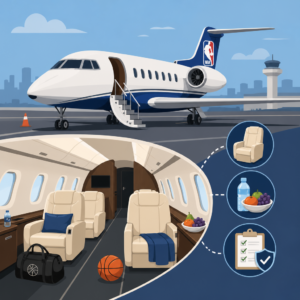
Charter flights are one of the biggest reasons NBA teams can function through such a compressed travel schedule. Commercial travel would introduce long delays, public terminals, tighter seating, inconsistent departure times, and far less control over recovery logistics. Charter flights allow teams to leave soon after games, reduce total transit time, carry medical and performance equipment, and create an environment better suited to very tall athletes whose bodies already take a beating over the course of a season.
That flexibility has major recovery benefits. Teams can coordinate departure times to align with game endings, airport access, hotel arrival, and next-day practice or shootaround plans. Players can begin postgame nutrition and hydration immediately, get treatment while traveling or shortly before boarding, and settle into a more predictable routine. Even though sleeping on planes is not always ideal, charter travel reduces many of the stressors that make recovery harder, especially after late-night games in another city.
Charters also support privacy and continuity. Coaches can hold meetings, staff can monitor players, and the team can move as a unit without the unpredictability of public travel. In a league where small recovery edges matter, that level of control is valuable. It does not make road life easy, but it helps turn a chaotic travel calendar into something that can be managed with precision. For NBA players, charter travel is not just a luxury. It is a practical tool for preserving energy, sleep opportunity, and readiness for the next game.
What does recovery on the road actually look like for NBA players between games?
Recovery on the road is usually a tightly scheduled mix of sleep, food, hydration, treatment, movement, and timing. After a game, players often begin recovery immediately with cooldown work, fluids, and a postgame meal designed to replace energy and support muscle repair. From there, depending on the city and schedule, they may head to the airport, board a charter, and arrive at the hotel late at night. What looks simple from the outside is actually a carefully managed sequence designed to limit how much the body falls behind.
The next day often includes some combination of treatment, mobility work, lifting, light court activity, film, and additional nutrition support. Not every player follows the exact same plan. Veterans, stars, younger players, and players returning from injury may all have different recovery needs. Some may prioritize extra sleep. Others may need soft-tissue work, cold or contrast therapy, physical therapy exercises, or activation work to prepare for the next game. Team performance staffs use these windows to keep players functional when there is not enough time for full recovery in the traditional sense.
The most important point is that road recovery is continuous, not something saved for the training room. Sleep is the base, but everything around it matters: when players eat, when they hydrate, when they receive treatment, when they move, and when they rest. Over a long season, teams that manage these details well can help players maintain performance, reduce wear and tear, and handle the unique culture of NBA road life more effectively. On the road, recovery is not a luxury or a bonus. It is the system that keeps the season moving.