

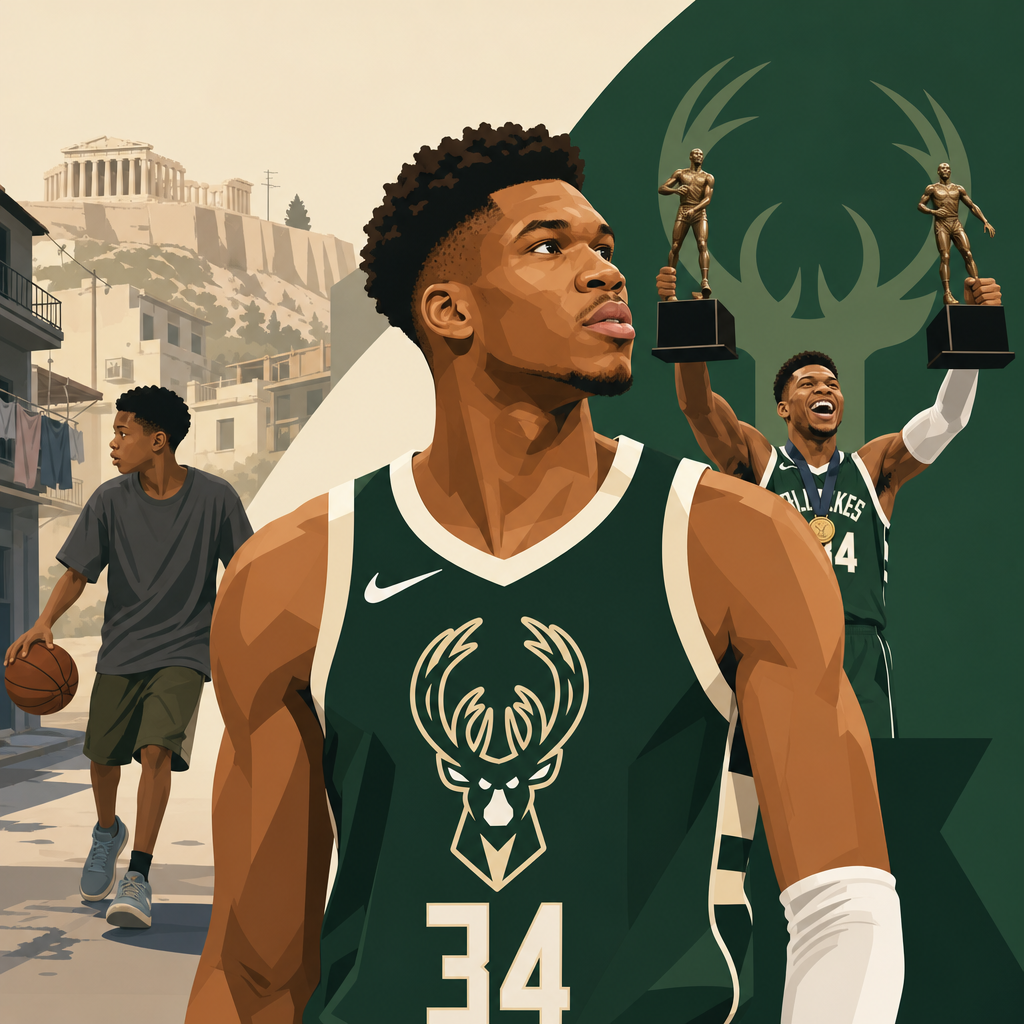
Giannis Antetokounmpo’s story is one of the most remarkable player profiles in modern basketball, tracing a path from poverty and exclusion in Athens to global superstardom with the Milwaukee Bucks. For readers exploring NBA players, his career works as a model case because it combines raw talent, late physical development, relentless skill growth, and unusual personal resilience. Any complete look at player profiles should include not just awards and statistics, but also family background, developmental context, playing style, leadership arc, and historical impact. Giannis checks every one of those boxes, which is why his journey has become essential to understanding the league itself.
Born on December 6, 1994, in Athens, Greece, to Nigerian parents Charles and Veronica Antetokounmpo, Giannis grew up in circumstances far removed from the polished youth pipelines that produce many elite prospects. His family sold items on the street to survive, and because of Greece’s citizenship laws at the time, he and his brothers spent years effectively stateless despite being born in the country. That detail matters. It shaped how he viewed opportunity, work, and belonging. When people ask what makes Giannis different from many MVP winners, the answer begins there: he entered basketball not as a guaranteed prodigy, but as a teenager trying to help his family eat.
In practical terms, the Giannis Antetokounmpo story matters because it explains how environment influences development. He was not a polished American high school phenom with private trainers from age ten. He was a thin, largely unknown forward discovered through the Greek club system while still learning the game’s finer points. Scouts saw unusual length, coordination, and motor, but they also saw a project. Since entering the NBA in 2013, he has transformed that project label into one of the strongest two-way resumes of his generation: multiple Most Valuable Player awards, a Defensive Player of the Year trophy, an NBA championship, a Finals MVP, perennial All-NBA status, and statistical production few players in league history have matched.
For a hub article under NBA player profiles, Giannis also offers a useful framework for evaluating greatness. His story includes origin, draft evaluation, physical tools, skill progression, signature strengths, weaknesses opponents target, playoff turning points, cultural significance, and long-term legacy. Those are the categories serious fans use when comparing stars across eras. Looking at Giannis through that lens shows why he is more than a highlight machine who dunks in transition. He is a case study in player development, role expansion, and how an organization can build around a singular talent without forcing him into a traditional positional mold.
Early life in Athens and the family struggle that shaped him
Before Giannis became an NBA MVP, he was one of five brothers growing up in Sepolia, a working-class neighborhood of Athens. His parents had moved from Nigeria, and the family faced constant financial strain. Giannis and his brothers, including Thanasis and Kostas, helped by selling watches, bags, and sunglasses on the streets. In interviews over the years, Giannis has described sharing shoes and worrying about basic necessities. I have covered enough player backgrounds to know that these details are often smoothed over into motivational slogans, but in this case they are central facts. Hardship did not simply inspire him; it structured his daily life, his schedule, and his access to sport.
Basketball entered his life through local youth programs and the encouragement of coaches who recognized uncommon physical upside. Compared with players raised in elite academies, his development was late and uneven. He played for Filathlitikos in Greece’s lower divisions, where scouts first saw flashes of a ballhandler trapped inside a lanky forward’s body. At that stage he was nowhere near the finished product. His jumper was inconsistent, his strength was limited, and his understanding of high-level team concepts was still developing. What stood out was the combination of stride length, fluidity, competitiveness, and openness to coaching. He could cover space in a way few teenagers could.
The citizenship issue remained a major factor in his early life. Giannis did not receive Greek citizenship until 2013, just before the NBA draft. Without proper documentation, travel and participation opportunities were more complicated than they should have been. That experience helps explain why he later embraced representing Greece while also speaking openly about identity and belonging. For readers interested in player profiles, this is an important reminder that biography shapes performance. The discipline, gratitude, and public humility often associated with Giannis are not branding inventions. They come from a youth defined by uncertainty, responsibility, and an understanding that career opportunities can disappear quickly if not seized.
From raw prospect to first-round NBA draft pick
By the time NBA teams seriously evaluated Giannis in 2013, he was one of the draft’s most fascinating mystery cases. He had played limited top-tier competition, his frame was undeveloped, and there was less video available than teams usually want for a first-round investment. Yet international scouts and decision-makers saw something difficult to teach: functional mobility at extreme length. At around 6-foot-9 entering the draft, with a wingspan reported near seven feet three inches, he offered the outline of a modern positionless player before the term became standard front-office language.
The Milwaukee Bucks selected him 15th overall, a range where teams often balance upside against risk. It was a smart bet. In his rookie season, Giannis averaged 6.8 points, 4.4 rebounds, and 1.9 assists per game, numbers that look modest until you remember he was 18, adapting to a new country, learning NBA defensive schemes, and physically years away from his prime. What I remember from those early Milwaukee games was not polished dominance but repeated moments of possibility: a grab-and-go rebound, an impossible recovery block, a transition finish from half court in two dribbles. The outline of the future star was already visible.
His body changed dramatically over the next several years. Through strength training, nutrition, and repetition, he added muscle without losing mobility. That development was crucial. Plenty of prospects have length; very few become overwhelming downhill forces who can absorb contact, finish through elite rim protectors, and still defend every frontcourt matchup. Milwaukee’s coaching staffs, from Larry Drew to Jason Kidd and later Mike Budenholzer, used Giannis in different ways, but the consistent priority was expanding his on-ball responsibility. Once he became a full-time initiator rather than a complementary wing, his trajectory accelerated toward superstardom.
How Giannis built an MVP game
Giannis became a true MVP-level player by mastering the areas where his physical gifts created impossible decisions for defenses. His most important offensive skill is rim pressure. He attacks from the top of the floor with unusually long strides, gathers from distances most defenders do not expect, and finishes with either hand. Synergy-style possession tracking and shot-location data have consistently shown his value in transition and at the rim. In his peak seasons, he has ranked among the league leaders in paint points, free throw attempts, and fast-break production. That is not accidental. It is the core of his offensive identity.
As a passer, he is better than casual observers often assume. When teams wall off the lane with multiple defenders, he can hit corner shooters, find cutters, or pass to screeners on short rolls. Milwaukee’s offense under Budenholzer leaned heavily on spacing principles, placing shooters around Giannis to maximize driving lanes. Khris Middleton, Brook Lopez, and a range of role players benefited from the attention Giannis drew. He is not Nikola Jokic as a manipulative half-court passer, but he does enough to punish predictable help. That balance is why loading up on him works only if rotations behind the initial wall are disciplined and quick.
Defensively, Giannis has been just as valuable. He won Defensive Player of the Year in 2020 because he can protect the rim as a weak-side helper, switch onto perimeter players, and erase mistakes with recovery speed. Coaches value defenders who can execute a scheme; Giannis can also solve problems when the scheme breaks. His timing as a help defender often changes possessions before a shot even occurs. In practical scouting terms, he is one of basketball’s rare force multipliers: a player whose presence makes teammates more effective because he covers so much space and deters so many actions.
| Area | What defines Giannis | Why it matters |
|---|---|---|
| Transition offense | Long-stride ballhandling and power finishing | Creates easy points before defenses are set |
| Half-court scoring | Rim attacks, spins, seals, and post touches | Forces fouls and collapses defensive structure |
| Playmaking | Kick-outs to shooters and reads against help | Punishes double teams and wall coverage |
| Defense | Help-side rim protection and switchability | Raises team versatility in playoff matchups |
| Rebounding | Secure boards and instant push tempo | Turns defense into offense immediately |
His weaknesses are real, and serious player profiles should state them clearly. The jump shot has remained inconsistent, especially above-the-break threes and pull-ups. Free throw rhythm has fluctuated. In tightly spaced playoff settings, opponents still try to build a wall, force him into crowds, and make him score over set defenders. Yet the durability of his production despite those flaws is part of what makes him great. He does not need a perfectly rounded skill package to dominate; he needs enough spacing, enough decision-making support, and his usual level of force.
Back-to-back MVP seasons and the championship breakthrough
Giannis won NBA MVP in 2019 and 2020, becoming the first player since Stephen Curry to win the award in back-to-back seasons. The 2018-19 campaign established him as the league’s central force. He averaged 27.7 points, 12.5 rebounds, and 5.9 assists while leading Milwaukee to the NBA’s best record. The Bucks built a spread system around him, and he responded by overwhelming defenses both in transition and in the half court. In 2019-20 he was even more efficient, averaging 29.5 points, 13.6 rebounds, and 5.6 assists in just over 30 minutes per game, while also winning Defensive Player of the Year.
Those awards, however, came with a complication: postseason disappointment. Milwaukee lost to Toronto in the 2019 Eastern Conference finals and then to Miami in the 2020 bubble playoffs. In both series, opponents packed the paint, sent extra bodies early, and challenged the Bucks to create counters. Critics questioned whether Giannis could be the best player on a title team if he lacked a dependable perimeter jumper. That was always too simplistic. The real issue was broader playoff adaptability: lineup flexibility, late-game shot creation diversity, and offensive variation when the first action stalled.
The answer arrived in 2021. Giannis led Milwaukee to its first championship since 1971 and produced one of the greatest Finals closeout performances ever: 50 points, 14 rebounds, and 5 blocks in Game 6 against the Phoenix Suns. Just as important, he shot 17-for-19 from the free throw line in that game, crushing a weakness narrative on the biggest stage possible. Throughout that playoff run he combined force, discipline, and defensive range. His block on Deandre Ayton in the Finals and his alley-oop finish from Jrue Holiday’s steal became defining images because they captured his two-way impact in single plays.
That championship changed the way his career is discussed. Before 2021, Giannis was often framed as a brilliant regular-season engine still seeking playoff validation. After 2021, he entered the inner circle of superstars who have carried a franchise to the top as the unquestioned centerpiece. For Milwaukee, keeping him and building patiently around him was vindication. For the wider NBA, it was proof that loyalty and long-term development can still produce a title in an era dominated by player movement and superteam speculation.
Legacy, leadership, and why Giannis matters in NBA player profiles
Giannis Antetokounmpo’s legacy reaches beyond trophies. He represents a modern superstar who fused international development, elite athleticism, and constant self-reinvention into a Hall of Fame trajectory. His leadership style is direct but grounded. Teammates and coaches consistently describe his work habits, emotional honesty, and competitive standards. He is not a detached celebrity archetype. He is visible in community work, vocal about family, and candid about failure, including his widely shared comments that setbacks are part of growth rather than proof of collapse. That mindset has helped define his public image as much as any dunk or stat line.
Within the larger NBA players landscape, Giannis is also central to how player profiles should be built. A useful profile does not stop at biography or box-score averages. It should connect personal history to development, identify signature skills, explain tactical strengths and weaknesses, and place career milestones in historical context. Giannis makes that approach easy because every stage of his career reveals something instructive: underdog beginnings, draft uncertainty, dramatic physical growth, MVP dominance, playoff criticism, championship response, and sustained excellence. He is both a singular star and a blueprint for how to analyze other players with depth.
The simplest takeaway is this: Giannis Antetokounmpo became great not because his path was easy, but because every stage of difficulty sharpened his game and perspective. From the streets of Athens to back-to-back MVP honors and an NBA title, he built a career defined by force, discipline, and adaptability. If you are exploring player profiles under the NBA players category, use Giannis as a reference point for what a complete profile should capture. Then continue through the rest of this hub with the same lens: background, development, playing style, turning points, and legacy. That is how you understand not just who a player is, but why he matters.
Frequently Asked Questions
What makes Giannis Antetokounmpo’s journey from Athens to NBA superstardom so unique?
Giannis Antetokounmpo’s story stands out because it is not simply a tale of athletic success; it is a rare example of a player overcoming severe social, economic, and developmental barriers on the way to becoming one of basketball’s defining stars. Born in Athens to Nigerian parents, Giannis grew up in a household dealing with poverty, instability, and exclusion. His family often struggled to meet basic needs, and because of their immigration status, life was filled with uncertainty. He helped support the family by selling items on the streets, which gives important context to the discipline and seriousness that later became central to his professional identity.
What makes his rise even more unusual is that he did not emerge as a polished teenage prodigy in the traditional American basketball pipeline. He was largely unknown internationally until relatively late, and his game was still raw when NBA scouts began to notice him. At that point, what intrigued evaluators was not a finished product, but a combination of extraordinary physical tools, coordination, work ethic, and room for growth. That projection proved historically accurate. He went from an under-the-radar prospect in Greece to an NBA draft pick, then developed year by year into an MVP, Defensive Player of the Year, NBA champion, and Finals MVP.
For readers interested in player profiles, Giannis is a model case because his career blends talent with delayed development, adversity with opportunity, and personal humility with elite competitiveness. His path reminds people that greatness does not always begin with privilege, structure, or early fame. In Giannis’s case, it began with resilience, family responsibility, and a relentless willingness to improve.
How did Giannis Antetokounmpo develop from a raw prospect into a back-to-back MVP?
Giannis became a back-to-back MVP because his development was both physical and technical, and because he improved with unusual consistency over time. When he entered the NBA, he was fascinating but unfinished. He had length, mobility, ball-handling flashes, and open-court creativity, but he lacked the strength, polish, and tactical refinement needed to dominate established professionals. Instead of plateauing, he treated every season as a major growth phase.
Physically, he transformed his body without losing the mobility that made him special. He became stronger, more explosive through contact, and better equipped to finish at the rim against elite defenders. That physical evolution changed the geometry of the court. Once Giannis gained the strength to absorb contact and still complete plays, he became nearly impossible to stop in transition and increasingly punishing in half-court offense.
Skill-wise, he expanded from being a promising slasher into a primary offensive engine. He improved as a ball-handler, passer, rebounder, screener, and interior scorer. He learned how to read help defense, attack gaps, and create pressure on defenses even when his jump shot was inconsistent. Just as important, he became one of the league’s most versatile defenders, capable of protecting the rim, switching onto perimeter players, and covering huge areas of the floor with his reach and timing.
The MVP seasons reflected more than raw numbers. They showed total impact. Giannis could score efficiently, generate offense for teammates, dominate the glass, and anchor a defense, all while playing with remarkable energy. His back-to-back MVP awards symbolized the moment when potential had fully become production. He was no longer just a fascinating athlete; he was the most forceful two-way player in basketball.
Why is Giannis Antetokounmpo considered such an important example of resilience and personal growth?
Giannis is widely seen as a powerful example of resilience because his achievements were built on hardship that could easily have limited or derailed his future. His early life was shaped by financial struggle, insecurity, and the emotional burden of helping his family survive. That background matters because it influenced the way he approached success later. He did not come into basketball from comfort. He came into it carrying responsibility.
His resilience also shows in the way he handled transition. Moving from Greece to the NBA meant adapting to a different country, language, culture, style of play, and public spotlight. Many talented players struggle with one or two of those changes. Giannis faced all of them while still physically maturing and learning the professional game in real time. Rather than resisting that process, he embraced it. Coaches, teammates, and observers consistently pointed to his willingness to learn, accept criticism, and work through weaknesses.
Personal growth is a major part of his profile because he did not allow early limitations to define his ceiling. He entered the league as an intriguing project, not a guaranteed superstar. Over time, he became more skilled, more disciplined, and more composed as a leader. He learned how to carry expectations, respond to playoff disappointment, and keep improving instead of becoming discouraged. That emotional durability is a major reason his story resonates far beyond basketball. It speaks to the value of patience, humility, and sustained effort under pressure.
What role did family background play in shaping Giannis Antetokounmpo’s career and mindset?
Family is central to understanding Giannis Antetokounmpo, both as a player and as a person. His identity was formed in a close-knit family environment where sacrifice, loyalty, and collective survival were everyday realities. Growing up with parents who had emigrated from Nigeria and worked to keep the family together under difficult conditions gave Giannis a strong sense of perspective. Success was never only about personal recognition. It was tied to responsibility, gratitude, and creating security for the people around him.
That background helps explain many of the qualities that fans and analysts associate with him today. His humility, emotional openness, and fierce competitiveness are often rooted in family experience. He has repeatedly spoken and acted in ways that show how deeply his journey is connected to his parents and brothers. The hardships they faced together created a mentality built on endurance and unity, not entitlement.
His brothers also played a meaningful role in his development, reinforcing the idea that basketball was part of a larger family story rather than an isolated individual pursuit. In many player profiles, family is treated as side context. With Giannis, it is foundational. It shaped his work habits, his emotional drive, and his long-term motivation. Understanding his family background makes his career more than a sequence of achievements; it turns it into a story about shared struggle, mutual support, and the transformation of opportunity into generational change.
Beyond awards and statistics, what should readers understand about Giannis Antetokounmpo’s legacy?
Readers should understand that Giannis’s legacy is about far more than MVP trophies, scoring averages, or highlight plays. Those accomplishments matter, of course, but they do not fully capture why he is such an important figure in modern basketball. His career represents the power of development. He is proof that a player can enter the league unrefined, improve dramatically through work and adaptability, and still reach the very top of the sport.
His legacy also includes redefining what a franchise superstar can look like. In an era often dominated by quick movement and constant speculation, Giannis became deeply identified with the Milwaukee Bucks and helped elevate the franchise to championship status. That matters historically. He did not just accumulate personal honors; he changed the trajectory of an organization and delivered one of the most meaningful titles in team history.
On the court, his influence is tied to versatility. He helped popularize the modern value of positionless impact: initiating offense, finishing inside, defending multiple positions, rebounding, and dictating tempo in transition. Off the court, his story carries cultural and human significance because it reflects immigration, belonging, hardship, ambition, and dignity. For anyone studying NBA player profiles, Giannis offers one of the clearest examples of how biography, growth, mentality, and performance can combine to create a truly lasting legacy.