
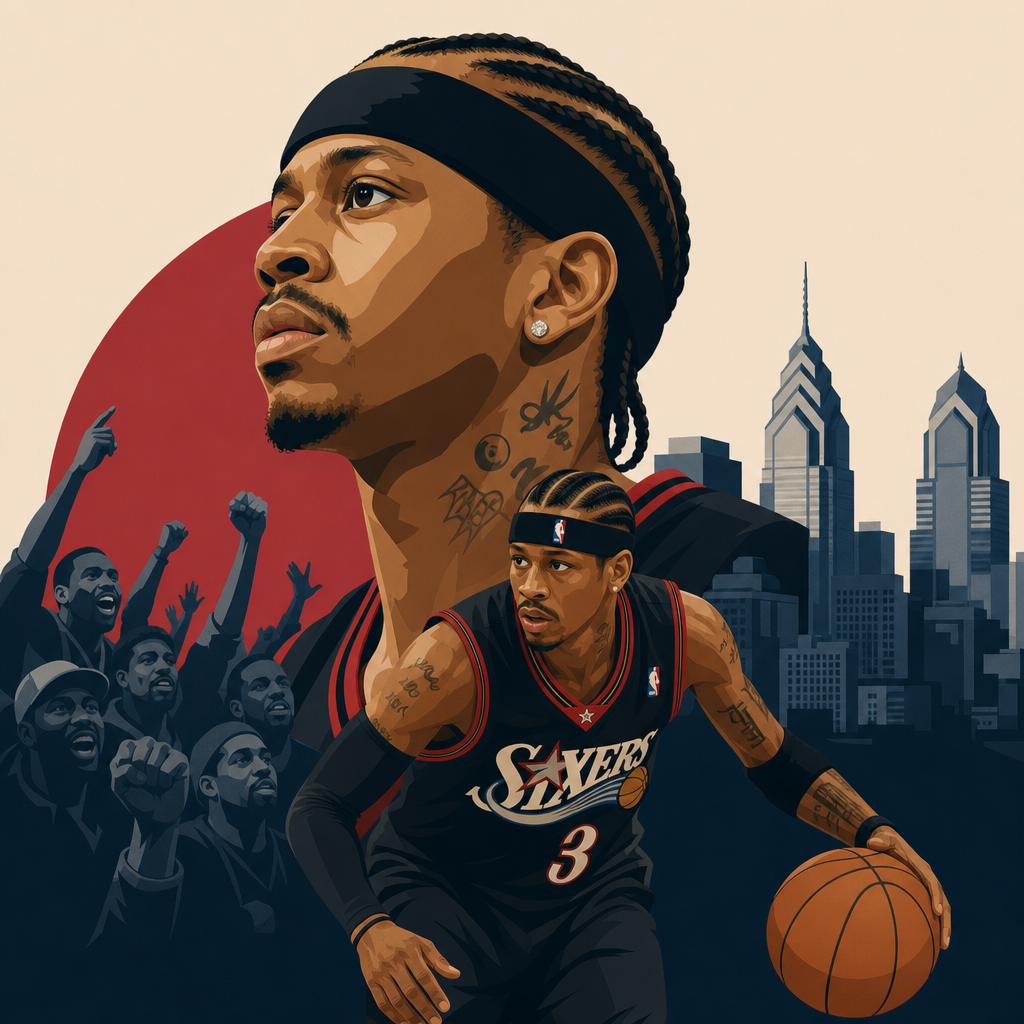
Allen Iverson’s legacy reaches far beyond points per game, crossover highlights, and Hall of Fame speeches. He changed the definition of an NBA star by combining elite production, relentless competitiveness, and unapologetic personal style at a moment when the league, its sponsors, and its fans were renegotiating what basketball culture looked like in public. Any serious player profile of Iverson has to cover the whole package: the athlete, the scorer, the symbol, the controversy, and the enduring influence that still shapes how modern guards play, dress, speak, and build their identities.
In NBA history, few nicknames have fit a player better than “The Answer.” Iverson was an answer to several questions at once. Could a smaller guard dominate among giants? Could a franchise centerpiece reject polished corporate expectations and still become one of the most recognizable athletes in the world? Could a player from a difficult background carry both the burden of scrutiny and the hopes of fans who saw themselves in him? Iverson answered yes, often at full speed, usually through contact, and almost always on his own terms.
That is why Allen Iverson remains central to any NBA Players hub focused on player profiles. His career is not just a biography; it is a case study in how talent, culture, media, race, fashion, and league business intersect. Drafted first overall by the Philadelphia 76ers in 1996, listed at six feet and around 165 pounds, he won Rookie of the Year, captured four scoring titles, earned the 2001 MVP award, made eleven All-Star teams, and led Philadelphia to the NBA Finals. Those are elite credentials by any standard. Yet statistics alone do not explain why Iverson still feels alive in basketball conversations decades later.
When I look at Iverson’s place in league history, the defining point is simple: he expanded the template for superstardom. Before him, the model NBA star was often framed as conventionally polished, media-safe, and physically imposing. Iverson did not fit that mold. He brought cornrows, tattoos, shooting sleeves, hip-hop affiliations, and a hard-edged honesty into the center of the sport’s commercial stage. He also brought breathtaking shot creation, fearless rim attacks, and a workload that would break many bigger players. Understanding his legacy means understanding both what he accomplished and what he forced the league to confront.
Why Allen Iverson’s player profile still matters
Allen Iverson matters because he sits at the crossroads of basketball excellence and cultural transformation. In player-profile terms, he is not merely a great scorer from a past era. He is a benchmark for evaluating undersized stars, usage-heavy offensive engines, and athletes whose off-court identity becomes inseparable from their on-court value. When people discuss modern guards like Kyrie Irving, Ja Morant, Damian Lillard, or even the stylistic freedom embraced by younger players across the league, Iverson’s influence is part of the conversation whether named directly or not.
His profile also matters because it shows how perception can lag behind reality. Critics often remembered inefficient shot volume, tension with coaches, and the infamous “practice” press conference. Those elements were real, but they can obscure how extraordinary his burden was. Iverson played in one of the slowest, most physical defensive eras in modern basketball. Hand-checking was legal for most of his prime. Spacing was cramped. Philadelphia’s offense often depended on him to create late-clock shots against loaded defenses. He absorbed punishment nightly and still produced like a superstar.
For a sub-pillar hub on NBA player profiles, Iverson is useful because every angle opens into deeper coverage. There is the Georgetown chapter under John Thompson, the 1996 draft class context, the Larry Brown years in Philadelphia, the 2001 Finals run, the Denver period with Carmelo Anthony, and the broader debate about how media framed Black athletes at the turn of the century. A complete profile needs all of that. Iverson’s career rewards close reading because every phase reveals something about the league around him.
The player: skill set, production, and competitive identity
At his core, Iverson was an offensive force built on speed, balance, and nerve. His first step was devastating, but what separated him from other quick guards was how he turned that burst into repeatable offense against set defenses. He attacked high, attacked low, changed tempo, and used a low dribble to keep bigger defenders off balance. His crossover against Michael Jordan as a rookie became iconic, but the deeper truth is that Iverson’s handle was not about tricks alone. It was functional shot creation designed to generate just enough separation to survive constant pressure.
His résumé supports the eye test. Iverson averaged 26.7 points per game for his career, won scoring titles in 1999, 2001, 2002, and 2005, and led the league in steals three times. In 2000-01, his MVP season, he averaged 31.1 points, 4.6 assists, and 2.5 steals while carrying an offense that leaned heavily on isolation and transition opportunities. He was not a tall playmaker seeing over defenses like Magic Johnson or Luka Dončić. He created by collapsing the paint, forcing help, and generating chaotic rotations before modern spacing made that easier.
His toughness was as important as his talent. I have watched many stars play through contact, but Iverson accepted contact as part of the job in a way few guards ever have. He regularly hit the floor, got up, and attacked again. That relentless style won teammates’ respect and gave coaches a predictable source of effort even when his shot selection was volatile. It also took a physical toll. Injuries, bruises, and accumulated wear were constant features of his career, and they help explain both his brilliance and his shorter prime.
| Category | Allen Iverson | Why It Mattered |
|---|---|---|
| Size | Listed at 6’0″, about 165 lbs | Redefined how much offense a small guard could shoulder |
| Scoring | 26.7 career points per game | Placed him among the most prolific perimeter scorers ever |
| Awards | 2001 MVP, 11 All-Stars, 4 scoring titles | Confirmed that his impact was elite, not just popular |
| Style of play | Explosive drives, pull-ups, heavy usage | Made self-created offense central to his stardom |
| Cultural influence | Cornrows, tattoos, sleeve, hip-hop image | Changed how an NBA star could present himself publicly |
There were limitations. Iverson could dominate the ball, and his career field-goal percentage, 42.5, reflects difficult shot diets as well as inefficiency. He was not a pure floor general in the Jason Kidd mold, and he gambled defensively. But player profiles are strongest when they identify tradeoffs honestly. Iverson’s weaknesses were inseparable from the responsibilities that made him great. The same confidence that produced a contested jumper also made him willing to take over games no one else on his roster could rescue.
The 2001 season and the Finals run that defined his peak
If one season explains Allen Iverson to a new fan, it is 2000-01. Philadelphia finished 56-26, Iverson won MVP, and the 76ers reached the Finals despite entering the postseason without the offensive depth typical of a contender. Coach Larry Brown built that team around defense, rebounding, and Iverson’s ability to manufacture points. Dikembe Mutombo anchored the middle after arriving midseason, while players like Eric Snow, Aaron McKie, George Lynch, and Tyrone Hill filled specialized roles. Everyone understood the structure: defend hard, limit mistakes, and let Iverson bend the game.
The playoff path was grueling. The 76ers survived a five-game series against Indiana, then needed seven games against Vince Carter’s Raptors in one of the best duels of the era. Iverson scored 54 in Game 2 and 52 in Game 5, while Carter answered with 50 in Game 3. Philadelphia then beat Milwaukee in seven hard, physical games in the Eastern Conference Finals. By the time the Sixers reached the Finals, Iverson had already spent weeks facing traps, body blows, and relentless attention. His offensive burden was enormous by any historical measure.
Game 1 of the 2001 Finals sealed the image. The Los Angeles Lakers entered 11-0 in the postseason, with Shaquille O’Neal and Kobe Bryant looking unstoppable. Iverson scored 48 points in an overtime road win, including the famous step-over of Tyronn Lue after drilling a jumper. Philadelphia lost the series in five, but that game became one of the defining single-night performances in NBA history. It captured everything essential about him: defiance, stamina, shot-making, and the refusal to be overwhelmed by a superior roster.
That Finals run matters in legacy terms because it gave Iverson a clear peak that stands up under scrutiny. Some stars have gaudy regular seasons without a signature postseason chapter. Iverson has one. He did not win the championship, and that matters when ranking all-time greats, but his 2001 postseason provided evidence that his style could lead a team deep into June. In profile work, that distinction is important. He was not just a cultural icon who happened to score a lot. He was the best player on a Finals team in a brutally physical conference.
How Allen Iverson changed NBA culture, fashion, and the image of stardom
Iverson’s cultural impact is impossible to separate from his basketball legacy. By the late 1990s and early 2000s, the NBA was a global entertainment business trying to balance corporate appeal with player individuality. Iverson entered that environment carrying visible signs of a world the league could market but not fully control: hip-hop aesthetics, neighborhood authenticity, jewelry, tattoos, and a refusal to sanitize his identity for comfort. For many fans, especially younger Black fans, that visibility felt honest and overdue. For some executives and commentators, it felt threatening.
The league’s 2005 dress code, introduced during David Stern’s tenure, was widely understood as a response to the image associated with players like Iverson, even though it applied broadly. Business-casual requirements were framed as professionalism, but the cultural subtext was obvious. Iverson said as much at the time, noting that the policy targeted the style of dress common in hip-hop communities. Whether one agrees with every aspect of his critique, the historical record is clear: his presence forced the NBA to reveal where it drew the line between individuality and acceptable branding.
Just as important, he won that argument over time. The modern NBA is a player-expression league. Tunnel fashion is covered like a runway. Tattoos are normal. Hairstyles once treated as controversial are routine. Players build personal brands rooted in music, community, activism, and regional identity. Iverson did not create every part of that shift, but he accelerated it and paid a price for doing so publicly. He made it harder to insist that greatness had to look polished in one narrow, approved way.
His influence on fan connection was equally strong. Many stars inspire admiration; Iverson inspired identification. People saw the sleeve, the braids, the swagger, the scars, and the undersized frame and believed there was room in the sport for someone who did not resemble the classic corporate superstar. That is why his jersey remained everywhere, why younger players still cite him, and why his image endures in music videos, sneaker culture, and highlight packages. He changed what an NBA star could look like, sound like, and represent.
The debates: efficiency, leadership, and the cost of carrying the brand
No honest Allen Iverson player profile avoids the debates. He remains a polarizing figure because his greatness came wrapped in tension. Analysts point to efficiency concerns, limited off-ball value, and friction with authority figures. Supporters counter with era context, roster limitations, and the extraordinary load he carried. Both sides are touching part of the truth. Iverson was not a perfect superstar, and the imperfections matter. They also should not be used to minimize how difficult his job was in Philadelphia and how rare his gifts were.
The “practice” press conference from 2002 is the best example of how a moment can flatten a person. The clip became a punchline, but the full setting involved grief, stress, and frustration after a disappointing playoff exit. Reduced to a meme, it fed a simplistic image of irresponsibility. In reality, teammates often vouched for Iverson’s willingness to play hurt and compete. Coaches did not always love his habits, but they rarely questioned his courage. Leadership can take different forms, and Iverson’s version was example through sacrifice more than boardroom polish.
His later career also complicates the legacy. After productive seasons in Denver, where he formed a high-scoring partnership with Carmelo Anthony, Iverson struggled to adapt to reduced status in Detroit and later short stints elsewhere. This is common for stars built around dominance with the ball. The league changes, athletic edges shrink, and reinvention becomes essential. He never fully made that transition. That should be acknowledged. It should also be paired with the fact that many transformational players age imperfectly because the qualities that made them singular are hard to downshift.
Ultimately, the debate around Iverson says as much about basketball values as it does about the player himself. If one values control, efficiency, and tidy narratives, he can seem messy. If one values burden, resilience, and the ability to bend a game through force of will, he looks monumental. The strongest evaluation holds both views together. Allen Iverson was not conventional, and that is precisely why his legacy remains so important inside any serious NBA Players hub.
Allen Iverson changed the meaning of NBA stardom by proving that greatness could arrive in a smaller body, speak in a different voice, and wear its identity without apology. His legacy rests on elite production, a historic 2001 peak, unmatched toughness for his size, and a cultural footprint that permanently widened the league’s idea of marketable excellence. He was a scoring champion, an MVP, a Finals leader, and a symbol of self-definition in a sport that often preferred conformity.
For readers exploring player profiles, Iverson is essential because his career connects performance to context better than almost any other star’s. Study his numbers, and you see a relentless offensive engine. Study his era, and you see the challenge of creating under hand-checking and cramped spacing. Study his image, and you see the NBA learning, resisting, and eventually embracing a broader understanding of who its stars could be. Few players have influenced both the game and its presentation so deeply.
The simplest takeaway is this: Allen Iverson did not just play like a star; he redefined the category. If you are building out your understanding of NBA players, start here, then follow the threads his career opens into team building, guard evolution, league marketing, and basketball culture. Revisit the games, compare the eras, and use Iverson as a lens for understanding how one player can change a sport far beyond the box score.
Frequently Asked Questions
Why is Allen Iverson considered more than just a great scorer?
Allen Iverson is remembered as far more than a player who piled up points because his impact touched nearly every part of basketball culture. On the court, he was an MVP, an elite shot creator, a fearless finisher despite his size, and a relentless competitor who carried enormous offensive responsibility against bigger, stronger defenders. Off the court, he became a symbol of individuality at a time when the NBA was becoming a global entertainment product and trying to define what its stars should look and sound like in public. Iverson did not separate his game from his identity. His tattoos, cornrows, sleeve, direct way of speaking, and connection to hip-hop culture made him instantly recognizable and deeply influential. That combination of elite production and cultural visibility changed how people thought about stardom in the league. He showed that an NBA superstar did not have to fit a polished, corporate mold to command attention, loyalty, and respect. That is a huge part of why his legacy remains so powerful.
How did Allen Iverson change the image of an NBA star?
Iverson changed the image of an NBA star by making authenticity central to superstardom. Before and during his rise, there was strong pressure on top athletes to present themselves in ways that were considered broadly marketable, controlled, and non-threatening to league partners and sponsors. Iverson reached the highest levels of fame without sanding down the parts of himself that reflected his background, personality, and generation. He helped normalize a version of basketball celebrity that was inseparable from streetball energy, hip-hop aesthetics, and personal expression. For many fans, especially younger ones, he felt real in a way that traditional sports icons often did not. His influence could be seen in how players dressed, spoke, celebrated, and carried themselves. Even the league’s reaction to him, including the dress code era, revealed how much pressure his presence put on old expectations. In that sense, Iverson did not just become a star within the NBA’s system. He forced the system to respond to a new kind of star power.
What made Allen Iverson so influential to players who came after him?
Allen Iverson’s influence on later generations comes from both his playing style and his example as a public figure. As a player, he inspired guards of all sizes with his speed, handle, fearlessness, and ability to create offense under constant defensive pressure. He attacked the paint without hesitation, embraced difficult shots late in games, and played with a level of toughness that earned admiration across the league. Smaller guards in particular saw in Iverson proof that size did not have to limit ambition. But his influence extended well beyond basketball technique. He gave future players permission to be themselves more openly, to see style, music, fashion, and self-presentation as part of athlete identity rather than distractions from it. Many stars who came after him benefited from a league and media environment that had already been forced to confront and eventually absorb a more expressive player culture. That is why Iverson’s legacy shows up not only in crossovers and scoring explosions, but in the broader confidence modern NBA players have in defining themselves on their own terms.
Why was Allen Iverson such a controversial figure during his career?
Iverson was controversial because he sat at the intersection of sports, race, class, media framing, and generational change. Some of the controversy came from basketball questions, such as his high-usage style, shot selection, and whether a team built around him could win a championship. But much of the attention around him had little to do with box scores. He was scrutinized for his appearance, his language, his social circle, and the way he represented himself in public. Critics often treated those elements as evidence of instability or irresponsibility, while supporters saw them as expressions of honesty and cultural reality. The intensity of the reaction to Iverson revealed how uncomfortable many institutions were with a superstar who did not fit older expectations of acceptability. In hindsight, a lot of that controversy says as much about the era as it does about Iverson himself. He became a lightning rod because he embodied changes that the NBA, advertisers, commentators, and fans were still learning how to process. That tension is essential to understanding his legacy. He was not merely debated as a player; he was debated as a symbol.
What is Allen Iverson’s lasting legacy in NBA history?
Allen Iverson’s lasting legacy is that he expanded the definition of greatness and the definition of marketable stardom at the same time. Historically, he belongs among the most important guards ever because of his scoring titles, MVP season, playoff heroics, and unforgettable role in leading the 2001 Philadelphia 76ers to the NBA Finals. Culturally, his footprint may be even larger. He helped bridge the distance between professional basketball and the cultural language of the communities that shaped so much of the sport’s style and energy. He made individuality impossible to dismiss. He influenced how players looked, how they expressed themselves, and how fans connected to them. He also remains a reminder that legacy is not always neat. Iverson’s story includes brilliance, friction, vulnerability, and contradiction, which is exactly why it continues to matter. His career forces people to think about what an NBA star is supposed to be, who gets to define professionalism, and why authenticity can be just as transformative as championships. That is what makes Allen Iverson’s legacy enduring: he did not simply succeed within basketball culture, he helped permanently reshape it.