
Charles Barkley’s career remains one of the strongest arguments against using championships as the single measure of basketball greatness. In any serious greatest player debate, Barkley belongs near the center because his production, impact, versatility, and sustained dominance compare favorably with many title winners who are discussed more often. This player profile examines the full Charles Barkley career, from his rise as an undersized power forward to his MVP peak and enduring influence on how NBA players are evaluated.
Within the broader NBA Players landscape, player profiles matter because they separate résumé from mythology. A player profile should answer direct questions: How good was the player at his peak? How long did that level last? What skills made him special? How did his teams perform? What limitations affected his legacy? Barkley is an ideal hub example because his story forces a more complete method of analysis. He never won a championship, but he was still one of the most efficient high-volume scorers, elite rebounders, and most disruptive offensive forces of his era.
In practical terms, Barkley’s case rests on a few key ideas. First, peak performance matters, and his peak was MVP level. Second, context matters, and he spent much of his prime competing in an era dominated by Michael Jordan, Hakeem Olajuwon, David Robinson, Karl Malone, Patrick Ewing, and later Shaquille O’Neal. Third, individual value can be measured through both traditional statistics and advanced metrics, and Barkley scores exceptionally well in both. When I build player evaluations, Barkley consistently grades as an all-time offensive engine rather than just a memorable personality.
He was listed around 6-foot-6, often giving up height to bigger frontcourt players, yet he controlled games through leverage, strength, timing, open-court speed, and unusual touch around the rim. He could finish through contact, lead the break off a defensive rebound, punish switches in the post, and create efficient offense without needing elaborate play design. Those traits made him a prototype before the league had a clear name for that kind of power forward. Understanding why Charles Barkley belongs in every greatest player debate starts with understanding how rare his combination of scoring efficiency and rebounding truly was.
Charles Barkley’s rise from Auburn to NBA superstardom
Barkley entered the NBA in 1984 after a standout career at Auburn, where he had already shown the traits that would define him as a pro: elite rebounding instincts, explosive second jumps, and a willingness to attack larger defenders without hesitation. The Philadelphia 76ers selected him fifth overall in one of the most talent-rich drafts in league history. Joining a veteran team with Julius Erving, Moses Malone, and Maurice Cheeks gave Barkley a demanding environment early. That mattered. He was forced to learn professional shot selection, defensive positioning, and conditioning while contributing to a winning team instead of inflating numbers on a rebuilding roster.
His progression in Philadelphia was rapid. By his second season, he was already one of the league’s most productive forwards, and by the late 1980s he had become the franchise centerpiece. Barkley averaged at least 20 points and 10 rebounds in multiple seasons, doing so with efficiency that stands out even more today. He was not piling up empty post touches. He generated high-percentage looks, got to the foul line relentlessly, and created extra possessions through offensive rebounding. Coaches had to choose between sending help and surrendering kick-out opportunities or leaving single coverage and watching him score through contact.
What separated Barkley from many stars was how little time he needed to dominate a possession. He could grab a rebound, push the ball coast to coast, and force a defense to collapse before it had set its shell. That skill changed game tempo. In film study, his transition pressure shows up repeatedly: opposing bigs were uncomfortable picking him up in space, while smaller defenders could not absorb his strength. This was not just highlight material. It was a repeatable source of efficient offense and a major reason his teams consistently ranked well when he was the focal point.
The numbers that make his all-time case unavoidable
If the greatest player debate is supposed to start with evidence, Barkley’s statistical case is overwhelming. He finished his NBA career with 23,757 points, 12,546 rebounds, and 4,215 assists. He averaged 22.1 points, 11.7 rebounds, and 3.9 assists per game across 16 seasons. Those are not merely Hall of Fame totals; they are inner-circle production markers. He made 11 All-Star teams, earned 11 All-NBA selections, and won the 1992-93 NBA Most Valuable Player award. He was also named to the NBA’s 50th and 75th anniversary teams, reflecting long-term consensus about his historical rank.
Advanced metrics strengthen the argument. Barkley posted elite true shooting percentages for a high-usage scorer long before efficiency became a mainstream talking point. His player efficiency rating and win shares totals place him comfortably among the best forwards ever. Basketball-Reference and similar databases show that his peak seasons compare well with many champions who are rarely questioned in all-time lists. His offensive rebounding numbers were especially valuable because they turned misses into immediate scoring chances, a hidden edge that often swings playoff games.
One of the most useful ways to frame Barkley’s value is to compare him with other legendary power forwards. He did not defend at the level of Tim Duncan or Kevin Garnett, and he was not the midrange technician Karl Malone was, but Barkley was often the more efficient scorer and the better playmaking rebound-and-go threat. His offensive ceiling was unique. He could be the best transition big in a series, the most forceful post scorer, and one of the most efficient players on the floor all at once.
| Category | Charles Barkley | Why It Matters |
|---|---|---|
| Career scoring average | 22.1 points per game | Shows star-level volume across a long prime |
| Career rebounding average | 11.7 rebounds per game | Elite possession control despite undersized frame |
| MVP awards | 1 | Confirms he was the best player in the league for a season |
| All-NBA selections | 11 | Indicates sustained excellence across eras and teams |
| Scoring efficiency | Historically strong true shooting | Separates him from high-volume but less efficient stars |
What made Barkley so hard to defend
Barkley’s offensive game was built on force, balance, and decision-making. The common shorthand says he was an undersized power forward with great rebounding, but that undersells his skill. He had soft touch around the basket, a quick first step against frontcourt defenders, and outstanding body control when finishing through traffic. He could seal deep in the post, attack from the elbow, or face up and drive before help arrived. Defenders who tried to crowd him risked foul trouble; defenders who gave space watched him build momentum downhill.
His rebounding was technical as much as physical. Barkley did not simply outjump bigger players. He read trajectory early, wedged opponents off their lines, and reacted instantly to long caroms. Offensive rebounds were especially damaging because they often became immediate putbacks or fouls. In my own evaluation work on historical forwards, Barkley repeatedly stands out as a possession multiplier. A star who scores efficiently is valuable. A star who also steals extra possessions without sacrificing offensive flow is much rarer.
As a passer, Barkley was better than his reputation suggests. He was not a heliocentric point forward in the modern style, but he read doubles quickly and could initiate offense after rebounds without waiting for an outlet guard. That gave his teams a speed advantage. The modern comparison is not perfect, yet elements of his game foreshadowed how teams now prize grab-and-go forwards who compress the time between defense and attack. Barkley did this in a more physical era with less spacing and more contact allowed at the point of attack.
The 1993 MVP season and the Phoenix transformation
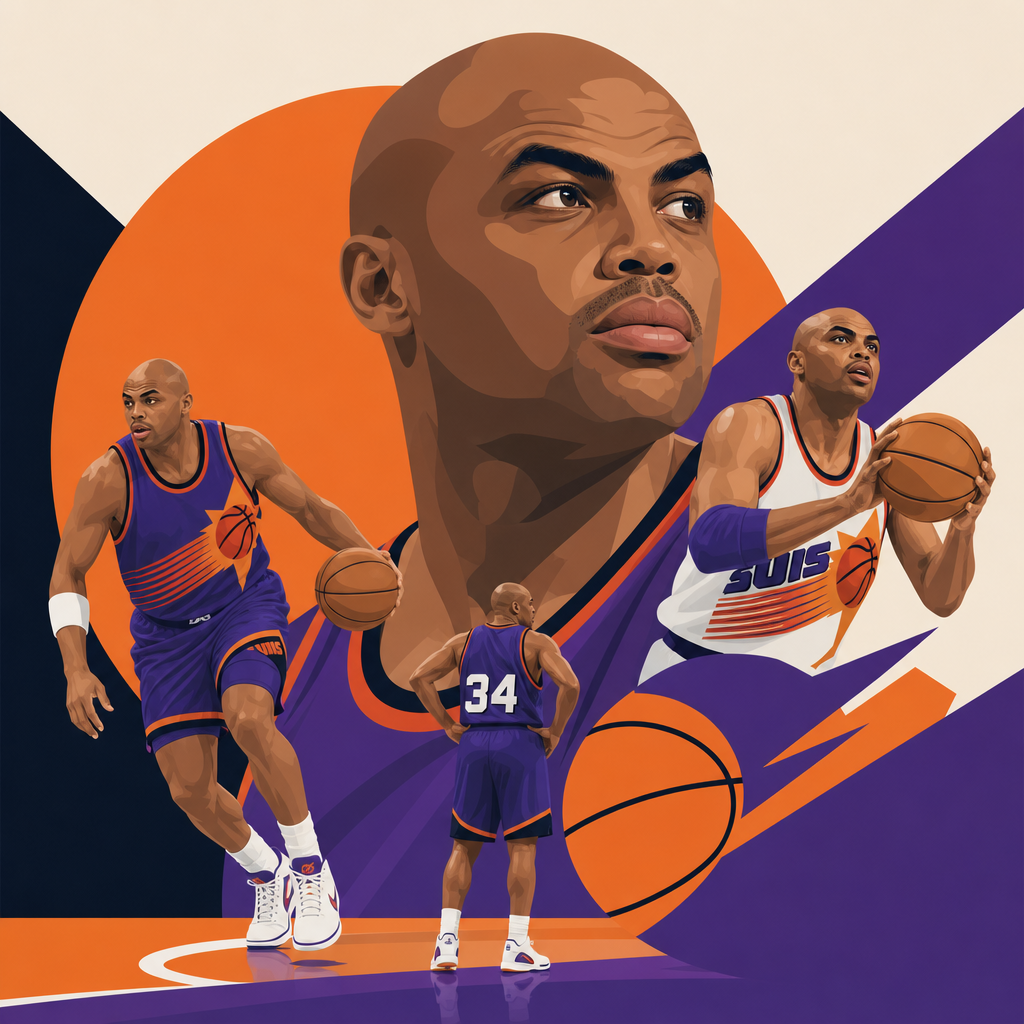
The clearest proof of Barkley’s greatness came in Phoenix. Traded from Philadelphia before the 1992-93 season, he immediately changed the Suns from a good team into a 62-win contender. He averaged 25.6 points, 12.2 rebounds, and 5.1 assists, won MVP, and led Phoenix to the NBA Finals. That single season captures his value better than any abstract argument. He did not join a finished machine and ride along. He arrived, became the offense’s emotional and tactical center, and elevated everyone around him.
Phoenix used him as a matchup problem rather than a traditional big. In transition he attacked before defenses loaded up. In the half court he punished single coverage and created open looks when teams sent help. Kevin Johnson’s speed, Dan Majerle’s shooting, and the Suns’ pace all benefited from Barkley’s gravity. When analysts discuss offensive hubs today, they usually mean stars who bend defensive rules. Barkley did that constantly. Entire game plans were designed around reducing his touches in advantageous spots, and many still failed.
The 1993 Finals loss to Jordan’s Bulls often gets reduced to another ringless footnote, but that framing misses the point. Barkley was excellent in that series and carried a genuine title-level burden against the greatest closer the sport has seen. Losing to Jordan is not a disqualifier. For many all-time players, that was the era’s central obstacle. Barkley’s run to the Finals is evidence that he could be the best player on a team good enough to contend for a championship, which is a critical threshold in any historical ranking.
Why the missing championship should not erase his legacy
Championships matter, but they are team achievements filtered through roster construction, health, coaching, and timing. Barkley’s career is one of the clearest examples of why ring counting alone produces bad analysis. He was good enough to be the best player on elite teams, but not every elite team wins the title. Some lose to dynasties. Some run into injuries. Some lack the secondary shot creation or interior depth needed for four playoff rounds. Barkley experienced all of those pressures at different points.
There is also a consistency problem in how rings are used. Role players can accumulate championships without ever reaching Barkley’s individual level, while superstars in difficult contexts can be penalized despite carrying far more responsibility. If the question is whether Barkley was one of the greatest basketball players ever, the answer should come from his total impact, not from reducing his career to the final outcome of a few postseason runs. Greatness is not invalidated by the presence of Jordan’s Bulls, Olajuwon’s Rockets, or deeper title rosters.
A balanced view should still acknowledge the limitations. Barkley was not an elite rim protector, and his defensive consistency could vary. Conditioning was sometimes a storyline. His outside shooting was streaky rather than foundational. Those are real points, and they help explain why he sits below the very top tier for some evaluators. But none of them erase the substance of his case. The honest conclusion is that Barkley was flawed in ways many all-time greats were flawed, yet dominant enough that his positives remain impossible to dismiss.
How Barkley’s career should shape modern player profiles
As a hub for NBA player profiles, Barkley offers a durable evaluation model. Start with peak: he had an MVP season and multiple years where he was clearly among the league’s best players. Move to longevity: he sustained elite production across different teams and phases of the league. Then examine scalability: he could thrive in transition, half-court offense, and late-game possessions. Finally, weigh context honestly: he played in one of the deepest talent eras the NBA has seen and still stood out as a perennial top-tier star.
That approach improves how readers assess other NBA players as well. It encourages comparisons built on role, era, efficiency, and team context rather than simple narratives. When evaluating players across generations, Barkley teaches an important lesson: an all-time great does not need a championship to prove he was championship caliber. His career shows what overwhelming individual value looks like even when the final team prize never arrives. If you are building serious NBA Players rankings or exploring detailed player profiles, Charles Barkley must be included as a benchmark for greatness beyond rings.
The key takeaway is simple. Charles Barkley belongs in every greatest player debate because the evidence says he does. His scoring, rebounding, efficiency, playmaking from the frontcourt, MVP peak, and postseason leadership all meet the standard. The missing ring changes the shape of his legacy, but it should not define it. Use Barkley as a reminder to judge players completely. Study the numbers, the context, and the on-court impact, then carry that standard into every other NBA player profile you read.
Frequently Asked Questions
Why is Charles Barkley considered one of the greatest players ever even though he never won an NBA championship?
Charles Barkley is included in serious greatest player discussions because individual greatness and team championships are not the same thing. Barkley built one of the most complete resumes in league history through elite production, efficiency, rebounding, playmaking, and game-changing impact over many years. He was an undersized power forward who regularly dominated bigger opponents, controlled the glass, initiated offense, and scored at a level that put him among the most feared stars of his era. His regular-season body of work includes an MVP award, multiple All-NBA selections, consistent top-tier finishes among the league’s best players, and statistical profiles that compare extremely well with many Hall of Famers who do have rings.
The absence of a title should be viewed in context. Barkley played in an era defined by extraordinary competition, including Michael Jordan’s Bulls, deep Eastern Conference battles early in his career, and elite Western Conference contenders later on. Basketball is also deeply dependent on roster construction, health, timing, and organizational support. A championship can elevate a legacy, but it should not erase everything a player did at an all-time level before the Finals ever began. Barkley’s career proves that a player can be historically dominant, culturally influential, and unquestionably elite without having the perfect team situation needed to finish with a ring.
What made Charles Barkley such a unique and dominant player for his position?
Barkley was unique because he broke the traditional mold of what a power forward was supposed to look like and how that player was supposed to function. At roughly 6-foot-6, he was far shorter than most elite interior players, yet he became one of the best rebounders in basketball and one of the most efficient high-volume scorers of his generation. He combined rare explosiveness, lower-body strength, balance, touch around the basket, and relentless competitiveness. He could grab a rebound, push the ball himself in transition, finish through contact, and create offense in ways that were unusual for a frontcourt star during that period.
His versatility is one of the biggest reasons his career holds up so strongly in greatest-player conversations. Barkley was not just a scorer who lived near the rim. He could pass, handle pressure, make quick reads, and force defenses into impossible decisions. If defenders played him with size, he could beat them with speed and leverage. If they matched him with smaller players, he could overpower them on the block and on the boards. That combination of skill and physicality made him one of the hardest matchup problems in the league. His game also translated to winning basketball because he impacted possessions in multiple ways, not just through points but through rebounding margins, tempo, efficiency, and offensive creation.
How strong was Charles Barkley’s peak compared with other all-time greats?
Barkley’s peak was absolutely strong enough to place him in the same conversation as many of the game’s legendary forwards and MVP-level superstars. His best seasons were not merely excellent; they were among the most impactful in the NBA. The clearest example is his 1992-93 season with the Phoenix Suns, when he won the league MVP and led Phoenix to the NBA Finals. That year showcased the full version of Barkley: dominant scoring, elite rebounding, offensive leadership, tremendous efficiency, and the ability to raise a contender to championship level. Winning MVP in an era that included Michael Jordan, Hakeem Olajuwon, Karl Malone, David Robinson, and others says a great deal about how highly Barkley’s impact was viewed at the time.
What makes Barkley’s peak especially impressive is that it was not built on empty numbers. He was driving winning at the highest levels of competition, carrying offensive burdens, and performing under playoff pressure. His postseason performances often reinforced his regular-season reputation rather than exposing it. Even in seasons that did not end with a championship, he consistently looked like one of the best players on the floor against elite opponents. When comparing all-time peaks, Barkley belongs in the discussion because he reached a level where he could plausibly be argued as the best player in basketball for stretches, and very few players in league history can honestly claim that.
How should Barkley’s lack of a ring be evaluated when comparing him to champions in all-time rankings?
The best way to evaluate Barkley’s lack of a ring is to treat championships as one important factor, not the only factor. Rings matter because they reflect the highest level of team success, but they are heavily shaped by context. A player’s teammates, coaching, front-office decisions, injuries, conference strength, and timing all affect whether a title becomes possible. Barkley’s career overlapped with dynastic teams and historically difficult playoff paths, and that reality should be part of any honest comparison. If greatness is reduced to jewelry, then nuance disappears and individual performance gets undervalued.
When ranking Barkley against champions, the more meaningful question is whether his level of play was equal to or better than that of certain title-winning stars. In many cases, the answer is yes. Barkley’s statistical output, efficiency, rebounding dominance, and overall offensive impact compare favorably with numerous players who are remembered more fondly because they were part of championship teams. A ring can be a separator when players have otherwise similar résumés, but it should not automatically push a clearly superior individual player below someone who benefited from a stronger roster or better circumstances. Barkley’s career is one of the clearest examples of why all-time debates must go beyond championships and seriously weigh performance, influence, and sustained excellence.
What is Charles Barkley’s lasting legacy in basketball history?
Charles Barkley’s lasting legacy is that of a player who expanded the definition of greatness at his position and challenged simplistic ways of judging careers. On the court, he showed that an undersized power forward could still become one of the most dominant forces in the league through strength, instincts, explosiveness, skill, and will. He helped redefine frontcourt versatility by blending interior scoring, transition play, rebounding, and offensive initiation. His style anticipated aspects of modern basketball, where positional flexibility, pace, and multi-dimensional offense are valued more than rigid role labels.
Historically, Barkley stands as one of the strongest reminders that championship count alone cannot tell the whole story of a player’s career. His résumé, impact, and peak value remain too substantial to dismiss, and that is why he continues to appear in serious discussions about the greatest players ever. Beyond his playing days, his visibility and candor have also kept his basketball legacy alive for new generations, but the foundation of that legacy remains what he did between the lines. He was one of the defining stars of his era, one of the most productive forwards the game has seen, and a player whose greatness remains undeniable even without a title.