
Chris Paul’s career is one of the clearest case studies in how a point guard can control winning without always controlling the headlines. For nearly two decades, Paul has set the standard for pace, decision-making, midrange efficiency, ball security, and late-game orchestration, building a résumé that places him among the greatest floor generals in NBA history. Any serious player profile within the NBA Players landscape has to treat Paul as a central figure, because his story connects almost every important basketball question: how elite guards age, how leadership changes teams, how regular-season brilliance is judged against playoff outcomes, and how legacy is shaped when a championship remains elusive.
The basics are well known, but they matter. Chris Paul entered the NBA in 2005 after starring at Wake Forest, and he immediately became one of the league’s most advanced lead guards. A point guard is the primary organizer of an offense, responsible for initiating sets, creating advantages, reading help defenders, and managing tempo. Paul mastered each of those tasks early. The nickname “Point God” did not emerge from hype alone; it came from repeated evidence that when Paul was on the floor, offenses became cleaner, teammates got easier shots, turnovers dropped, and end-of-game possessions had structure.
What makes the Chris Paul career especially important in a player profile hub is its range. He has been an All-NBA star, an elite defender at his position, a transformative teammate for rebuilding and contending teams, a union leader, and one of the most statistically efficient small guards the sport has seen. He has also become the reference point for discussions about playoff pressure, durability, and whether all-time greatness requires a ring. Those debates are not side notes; they are central to understanding both his records and his reputation.
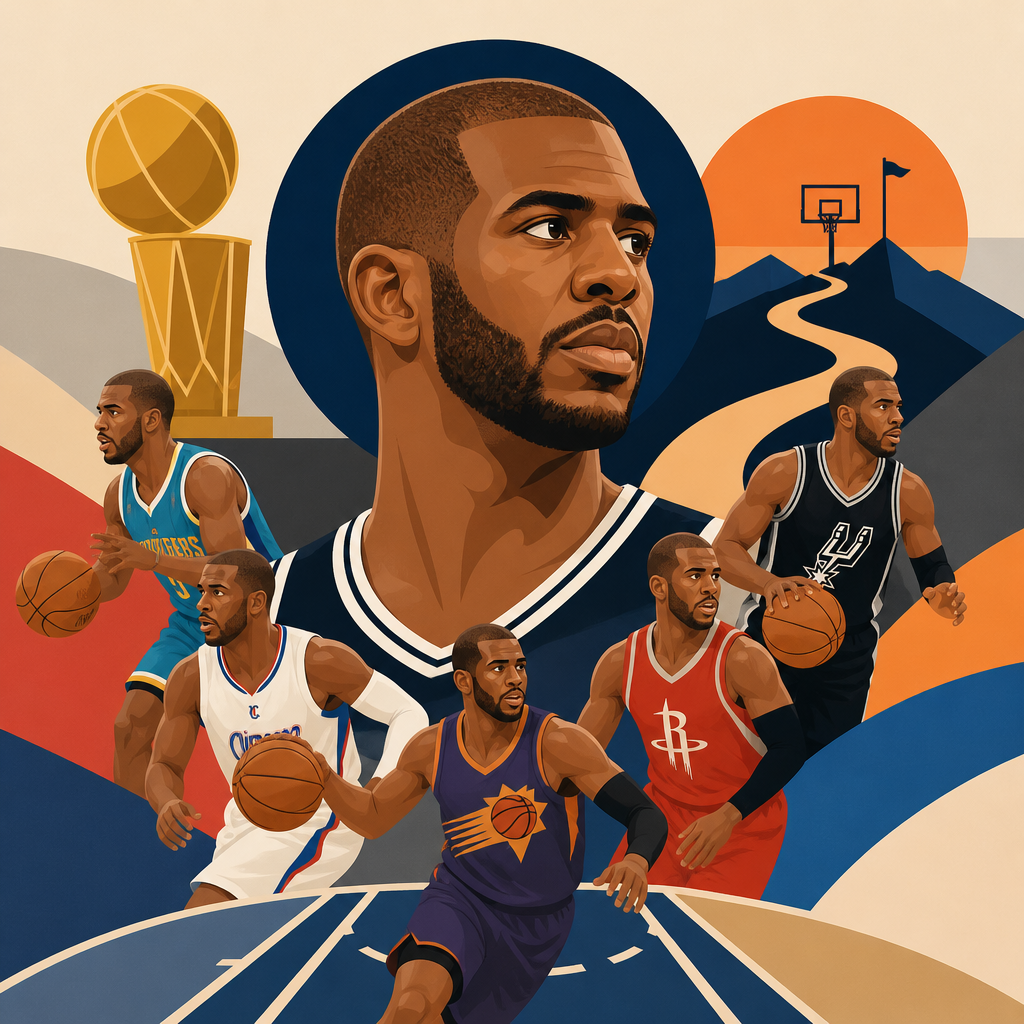
From New Orleans to Los Angeles, Houston, Oklahoma City, Phoenix, Golden State, and San Antonio, Paul has consistently altered team identity. I have watched his teams over multiple eras, and the pattern never really changed. Possessions became more deliberate, big men became more productive in screen actions, weak-side shooters saw better timing windows, and close games felt manageable because Paul almost always knew where the best shot would come from. That repeatable effect is why his career deserves a full, comprehensive look, not just a highlight reel summary.
Early rise in New Orleans and the making of an elite point guard
Paul was selected fourth overall in the 2005 NBA draft by the New Orleans Hornets and won Rookie of the Year in 2005-06. He averaged 16.1 points, 7.8 assists, and 2.2 steals as a rookie, numbers that already hinted at his profile: high control, pressure on the paint, and disruptive hands on defense. By his third season, he was not just promising; he was an MVP-level engine. In 2007-08, Paul averaged 21.1 points, 11.6 assists, and 2.7 steals, finishing second in MVP voting while leading the Hornets to 56 wins.
That season remains one of the best point guard campaigns of the modern era. Paul combined heavy on-ball usage with outstanding efficiency and low turnover rates relative to his creation burden. He manipulated defenders with hesitations, snake dribbles in pick-and-roll, and pocket passes delivered at perfect angles. His chemistry with David West became a model for guard-forward two-man play, especially from the elbows and in short midrange areas. Defensively, he was just as sharp. Paul’s anticipation in passing lanes and ability to bother ball handlers at the point of attack gave New Orleans extra possessions.
The New Orleans period established the template that followed him everywhere: immediate competence, then rapid elevation. Teams with Paul did not simply improve because he posted good box-score totals. They improved because he created offensive order. Coaches trust point guards who can call a set, reject a screen if the coverage shifts, hit the rolling big, skip to the opposite corner, or pull up from 15 feet when drop coverage opens that space. Paul did all of it. That is why his early career still matters when evaluating his entire arc.
Lob City, star power, and the Los Angeles transformation
When Paul arrived in Los Angeles before the 2011-12 season, the Clippers changed from a historically unstable franchise into a relevant contender. Alongside Blake Griffin and DeAndre Jordan, he helped build the “Lob City” era, but the branding sometimes obscured the precision underneath. Those teams were not successful just because they were athletic. They were successful because Paul turned vertical spacing into a system. Griffin became more dangerous as a short-roll passer and face-up threat, while Jordan benefited from one of the league’s most accurate lob passers.
Paul led the NBA in assists four times and steals six times across his career, and much of his mainstream visibility came during the Clippers years. He was the late-game organizer on teams that often needed structure after loose or transition-heavy stretches. In close contests, Paul slowed tempo, hunted weaker defenders in switches, and got to his right-elbow jumper, one of the most reliable shots of his generation. He was not a volume three-point bomber in the Stephen Curry mold, but he was devastating from the midrange, especially when bigs retreated too far in pick-and-roll coverage.
Yet the Clippers years also intensified the central criticism of the Chris Paul career: no conference finals appearances during that run despite high talent levels. Some of that was self-inflicted, and some was circumstantial. Injuries hit key moments. Depth failed in certain series. Opponents like San Antonio, Oklahoma City, and Houston were legitimate championship-caliber teams. Still, fair player evaluation requires acknowledging that the Lob City Clippers often fell short of their ceiling. Paul’s individual control was real, but control in basketball has limits when the roster around a star cannot defend consistently across positions or survive health setbacks in May.
Houston, Oklahoma City, Phoenix, Golden State, and San Antonio
Paul’s post-Clippers journey strengthened his reputation as a franchise stabilizer. In Houston, he partnered with James Harden in a backcourt that looked awkward on paper but was devastating in practice. The 2017-18 Rockets won 65 games and pushed the Kevin Durant-era Warriors to seven games in the Western Conference finals. That team may have been Paul’s best championship chance. Houston switched aggressively on defense, spread the floor with shooting, and used isolation plus high pick-and-roll to force constant decision stress. Paul’s hamstring injury late in that series remains one of the defining what-ifs of modern NBA history.
After being traded to Oklahoma City in 2019, Paul produced one of the clearest examples of veteran value in recent memory. Many expected the Thunder to rebuild aggressively and miss the playoffs. Instead, Paul guided a roster built around Shai Gilgeous-Alexander, Danilo Gallinari, and Dennis Schröder to a surprising postseason berth. He was masterful in clutch situations, using pace changes and pull-up jumpers to punish defenders who thought age had reduced his burst beyond relevance. What stood out most was command. Young teams often lose close games because they do not know what shot they want. With Paul, Oklahoma City usually did.
Phoenix then became the strongest proof of his transformative impact. The Suns had talented pieces in Devin Booker, Deandre Ayton, and Mikal Bridges, but they lacked a veteran conductor. Paul gave them one immediately. In 2020-21, Phoenix reached the NBA Finals, and Paul delivered several signature playoff performances, including his 41-point closeout game against the Clippers in the Western Conference finals. His two-man actions with Ayton were particularly effective because he could score from the elbow, hit the pocket pass, or string out the dribble until the weak-side tag defender committed.
The 2021 Finals loss to Milwaukee complicated the legacy conversation. Paul was brilliant at times, but the Suns surrendered a 2-0 lead. Giannis Antetokounmpo’s dominance, Milwaukee’s defensive adjustments, and Phoenix’s half-court stagnation shifted the series. That disappointment did not erase the achievement of leading the Suns there, but it reinforced the same question that has followed Paul for years: how should the sport judge an all-time great who gets close but not all the way?
His later moves to Golden State and then San Antonio reflected a different stage. Paul was no longer expected to carry an offense for 38 minutes nightly, but his value as an organizer, second-unit stabilizer, and mentor remained obvious. Even with reduced athleticism, his processing speed, handle, and shot discipline still translated.
| Team | Years | Career significance |
|---|---|---|
| New Orleans Hornets | 2005-2011 | Won Rookie of the Year, became an MVP candidate, established himself as an elite two-way point guard |
| Los Angeles Clippers | 2011-2017 | Led Lob City era, turned franchise into a perennial playoff team, expanded national profile |
| Houston Rockets | 2017-2019 | Formed title contender with James Harden, reached 65 wins, came within one game of the Finals |
| Oklahoma City Thunder | 2019-2020 | Revived perceived decline narrative, led overachieving playoff team, excelled in clutch minutes |
| Phoenix Suns | 2020-2023 | Helped end playoff drought, reached NBA Finals, elevated Devin Booker and team structure |
| Golden State Warriors | 2023-2024 | Added ball security, bench leadership, and veteran control to a complex motion offense |
| San Antonio Spurs | 2024-present | Brought experience, playmaking, and developmental guidance in the late-career phase |
Records, advanced metrics, and what the numbers actually say
Paul’s counting stats are strong enough on their own, but advanced metrics explain why coaches and analysts rate him so highly. He ranks among the NBA’s career leaders in assists and steals, two categories that capture both his playmaking and anticipation. More important, he reached those totals while maintaining unusually low turnover rates for a high-usage primary creator. Assist-to-turnover efficiency is one of the clearest signatures of Paul’s game. He did not just make passes; he made the right pass, on time, without wasting possessions.
Metrics such as Player Efficiency Rating, Box Plus/Minus, Win Shares, and Value Over Replacement Player consistently place Paul in historic company for point guards. No single metric should decide legacy, but when every major model keeps identifying the same player as massively impactful, that consistency matters. Paul’s on-off influence has long reflected improved offensive coherence, better shot quality, and fewer empty possessions. His teams often generated efficient offense without relying on chaos because he could manufacture good looks in the half court.
His defensive résumé also deserves more respect than it usually gets in broad legacy debates. At six feet tall, Paul was never going to function like a switch-everything wing, yet he was elite within the actual demands of guard defense. He pressured handlers, blew up entry passes, navigated screens intelligently, and used strong hands to strip bigger players. Multiple All-Defensive selections were not reputation gifts. They were earned through film and results. In player profile terms, that matters because it separates him from offensive specialists who surrender points on the other end.
Why Chris Paul has never won a title and what that means for his legacy
The simplest answer is that championships depend on timing, health, matchup luck, and roster completeness as much as individual brilliance. Paul has had title-caliber stretches, but not many seasons where everything aligned at once. In 2008, his Hornets were excellent but not yet complete enough. In Los Angeles, injuries and roster flaws repeatedly interrupted momentum. In Houston, the path was real until the hamstring injury against Golden State. In Phoenix, the Finals run was historic, but Milwaukee ended it with size, force, and defensive adaptability.
That does not mean Paul is above criticism. There were playoff games where his teams stagnated, where his own scoring aggression dipped, or where physical wear clearly reduced his ability to create separation. Older guards face that problem first because the postseason punishes every lost step. Paul’s game aged better than most because of skill, but skill cannot fully replace health. His championship chase is therefore both a basketball story and a durability story.
Legacy-wise, the absence of a ring lowers his standing only if the standard is absolute. If the question is whether he belongs with the greatest point guards ever, the answer is yes. Magic Johnson and Stephen Curry occupy unique territory because of rings and offensive revolution. Isiah Thomas has championship credibility. John Stockton owns remarkable longevity and record totals. Paul belongs in that tiered conversation because few guards have combined playmaking, efficiency, defense, and portability across so many team contexts. A title would simplify the argument. The lack of one does not erase the evidence already on the floor.
What Chris Paul teaches about player profiles in the modern NBA
Paul’s career is a strong template for evaluating NBA players beyond scoring averages. A complete player profile should ask five questions: Can the player create efficient shots for teammates? Can he protect possessions? Can he execute in the half court when defenses are set? Can he defend his position? Can he raise the floor of multiple roster types? Paul checks every box at a high level, which is why his teams kept trusting him as the organizer even as he moved from franchise to franchise.
His story also shows why context matters. Basketball careers are not linear. A player can peak statistically in one city, gain fame in another, come closest to a title somewhere else, and still add value deep into his late thirties. Paul has done all of that. For readers exploring NBA player profiles, he is a hub figure because his path intersects draft evaluation, leadership analysis, playoff variance, advanced stats, and aging curves. He is not just a famous point guard. He is one of the best examples of how basketball intelligence shapes winning over time.
Chris Paul’s career ultimately stands as a record of sustained excellence, tactical brilliance, and relentless competitive relevance. He has led teams, changed franchises, produced elite numbers, and set a benchmark for point guard play that younger stars still chase. The championship question will always follow him, and it should be part of any honest assessment, but it should not overwhelm everything else. Few players in league history have controlled games so precisely for so long. If you are building out your understanding of NBA player profiles, start with Chris Paul, then use his career as the measuring stick for what true point guard mastery looks like.
Frequently Asked Questions
Why is Chris Paul called “The Point God,” and what makes his playing style so influential?
Chris Paul earned the nickname “The Point God” because few players in NBA history have controlled a game from the point guard position with the same level of precision, consistency, and intelligence. His influence goes far beyond traditional box-score production. Paul has long been regarded as a master of pace, meaning he dictates when a game speeds up, when it slows down, and where each possession unfolds. That ability allows him to organize an offense in a way that maximizes teammates, limits mistakes, and creates efficient scoring opportunities over and over again.
What separates Paul from many other elite guards is the total package. He combines elite ball handling, passing vision, midrange shooting, defensive instincts, and decision-making with remarkable ball security. He has consistently posted high assist totals while keeping turnovers unusually low for a player who handles the ball so often. That is one of the strongest indicators of true point guard mastery. He does not simply create action; he creates the right action at the right time. Whether it is a pocket pass in the pick-and-roll, a skip pass to the weak side, a pull-up jumper from the elbow, or a late-clock isolation, Paul has built his reputation on making the smartest possible read.
His style has also been influential because it proves that dominance does not have to look explosive or chaotic. Paul’s game has often been subtle, technical, and surgical. He punishes defensive mistakes, manipulates big men in the pick-and-roll, hunts mismatches, and keeps offenses organized in high-pressure situations. For younger guards, he became a model for how basketball IQ, footwork, patience, and shot selection can be just as powerful as sheer athleticism. That combination of control, efficiency, and leadership is why the nickname has stuck and why it carries so much weight in NBA conversations.
What are the most important records, milestones, and achievements in Chris Paul’s NBA career?
Chris Paul’s career résumé is one of the strongest ever assembled by a point guard. He has been selected to multiple All-Star teams, earned numerous All-NBA honors, and received repeated All-Defensive recognition, which is especially important because it highlights his two-way impact. Many great offensive guards never matched Paul’s consistent defensive value. He has regularly ranked among league leaders in assists and steals, and he has spent much of his career near the top of the NBA’s all-time lists in both categories.
One of Paul’s defining statistical traits is the relationship between his assists and turnovers. Throughout his prime and even into the later stages of his career, he has maintained elite playmaking output without the carelessness that often comes with high usage. That balance is historically rare. He has also been one of the most efficient midrange guards of his era, turning a shot many teams de-emphasized into a dependable weapon late in games and in the playoffs. His scoring totals, assist milestones, steal numbers, and longevity all strengthen his standing as one of the most complete point guards the league has ever seen.
Beyond the numbers, some of his biggest achievements are tied to team transformation. Paul repeatedly joined teams and immediately improved their structure, execution, and win totals. He helped redefine the New Orleans franchise during his early years, elevated the Los Angeles Clippers into a true contender during the “Lob City” era, guided Houston to one of the most serious challenges to the Kevin Durant-era Warriors, helped revive Oklahoma City when many expected a rebuild, and played a central role in Phoenix’s rise to the NBA Finals. Those stops matter because they show that his impact was not empty production; it translated directly into organization, competitiveness, and wins.
Which teams did Chris Paul play for, and how did he impact each stage of his career?
Chris Paul’s NBA journey spans several franchises, and each chapter added something important to his legacy. He began with the New Orleans Hornets, where he quickly established himself as one of the league’s brightest young guards. In New Orleans, Paul showcased the skills that would define his career: elite passing, command of tempo, relentless competitiveness, and advanced defensive instincts. He was not just putting up numbers there; he was turning a smaller-market team into a serious playoff threat and announcing himself as a franchise-level talent.
His move to the Los Angeles Clippers marked the beginning of perhaps the most publicly visible stretch of his career. With the Clippers, Paul became the engine behind the “Lob City” era, helping transform the franchise from a long-struggling organization into a perennial playoff team. While the team was often known for its athletic highlights, Paul was the strategic force that made everything function. He organized the offense, created structure in high-leverage moments, and gave the Clippers a level of credibility and consistency they had rarely enjoyed before his arrival.
In Houston, Paul joined James Harden in a partnership built around championship ambition. This phase of his career was especially significant because it showed how well his cerebral style could blend with another ball-dominant superstar. When healthy, that Rockets team looked capable of winning the title, and many observers still view the 2017-18 season as one of the best chances Paul ever had to reach the top. After Houston, he was traded to Oklahoma City in what many interpreted as a transitional stop, but Paul once again changed the narrative by leading a surprisingly competitive Thunder team and reinforcing his reputation as one of basketball’s great floor leaders.
He then joined the Phoenix Suns and played a major role in elevating a promising young roster into a Finals team. His leadership, calm in late-game situations, and ability to organize an offense were invaluable to Phoenix’s rise. Later stops, including Golden State and beyond, have further emphasized his longevity and adaptability. Across every franchise, the pattern has remained remarkably consistent: Chris Paul arrives, the offense becomes cleaner, the team becomes more disciplined, and expectations rise immediately.
Why has the championship chase defined so much of Chris Paul’s legacy?
For a player as accomplished as Chris Paul, the championship question naturally becomes central because his individual credentials are already secure. He has the statistics, awards, longevity, and respect of peers needed to rank among the greatest point guards ever. When a player reaches that level, the conversation often shifts from “Was he elite?” to “Did he finish the journey with a title?” That is why the championship chase has followed Paul through so many phases of his career.
Part of the reason this discussion remains so persistent is that Paul has been close multiple times. He led strong playoff teams in different eras, played on rosters capable of contending, and consistently performed as a high-level organizer in pressure environments. At the same time, injuries, difficult postseason matchups, roster limitations, and plain bad timing repeatedly complicated his path. The Western Conference during much of his career was especially unforgiving, and many of Paul’s best chances came against historically strong opponents.
Still, the absence of a championship does not erase the significance of his career. If anything, it sharpens the conversation around how basketball greatness is measured. Paul’s career is a reminder that team titles matter, but they are not the only lens through which all-time ability should be judged. He has repeatedly demonstrated that he can raise a team’s floor, stabilize chaotic possessions, and make contenders more functional. That is real championship-level value, even if the final step proved elusive. The chase remains a defining storyline because it is the one major item not fully settled in an otherwise extraordinary basketball résumé.
Where does Chris Paul rank among the greatest point guards in NBA history?
Chris Paul belongs firmly in the all-time point guard conversation, and for many analysts he sits comfortably among the top tier of the position. The exact ranking varies depending on how someone weighs championships, peak performance, longevity, statistical dominance, and era context, but Paul’s case is extremely strong. He has been one of the most complete floor generals the league has ever seen, combining elite offensive orchestration with uncommon defensive value for a lead guard. That two-way balance gives him an argument against almost anyone outside the very top names in basketball history.
His standing is strengthened by both style and substance. Statistically, Paul checks nearly every major box associated with elite point guard play: assists, steals, efficiency, durability across eras, and sustained impact on winning. Stylistically, he represents many of the classic traits associated with the pure point guard role while also thriving in modern offensive environments. He can run a half-court offense, control end-of-game possessions, create his own shot from the midrange, and exploit defensive coverages with precision. Few guards have ever blended old-school orchestration and modern efficiency so seamlessly.
When people debate Paul’s historical place, the comparison group is usually made up of legends such as Magic Johnson, Stephen Curry, Isiah Thomas, John Stockton, Oscar Robertson, and Steve Nash. That alone tells you how highly he is regarded. Even those who place him slightly lower because of the missing championship still typically acknowledge that his command of the game, consistency, and technical excellence make him one of the defining point guards of his generation. In practical terms, Chris Paul is not just part of the conversation; he is one of the benchmarks by which great point guard play is measured.