
Basketball fouls are the rules that govern illegal contact, unsafe behavior, and unsportsmanlike actions, and understanding them is one of the fastest ways for a beginner to start enjoying the game. New players often know that “a foul is bad,” but they do not always know the differences between personal fouls, technical fouls, and flagrant fouls, or why referees call them. This matters because fouls affect possession, free throws, player eligibility, strategy, and player safety. If you are learning basketball basics, this is a core building block. In youth leagues, school games, pickup runs, and professional play, fouls shape how defenders guard, how offensive players attack, and how coaches manage minutes. I have found that beginners improve much faster once they can identify what legal defense looks like, what illegal contact looks like, and what behavior crosses the line from physical play into penalty territory.
A basketball foul is any action that violates the rules and results in a penalty. The three categories beginners should know first are personal fouls, technical fouls, and flagrant fouls. Personal fouls usually involve illegal physical contact between players, such as holding, blocking, pushing, or reaching across an opponent’s body. Technical fouls generally involve unsportsmanlike conduct or procedural violations that are not normal live-ball contact plays, such as arguing excessively, taunting, delay of game, or too many players on the court. Flagrant fouls are serious personal fouls involving unnecessary contact or unnecessary and excessive contact. Different rule sets, including NBA, NCAA, and NFHS high school rules, define and penalize these categories with some differences, but the basic ideas remain consistent. Learning the common standards now makes every future game easier to follow.
Fouls also matter because they change decision-making. A player in foul trouble must defend more carefully. A team in the penalty sends opponents to the free-throw line more often. A technical foul can swing momentum without a live-ball play even happening. A flagrant foul can lead to ejection and suspension review. For a beginner, the smartest way to study this topic is to start with the purpose behind the rules: basketball allows contact, but only within legal boundaries that protect fairness and safety. The sections below explain those boundaries in plain terms, with examples you can recognize immediately while watching or playing.
Getting Started: What Counts as a Foul in Basketball
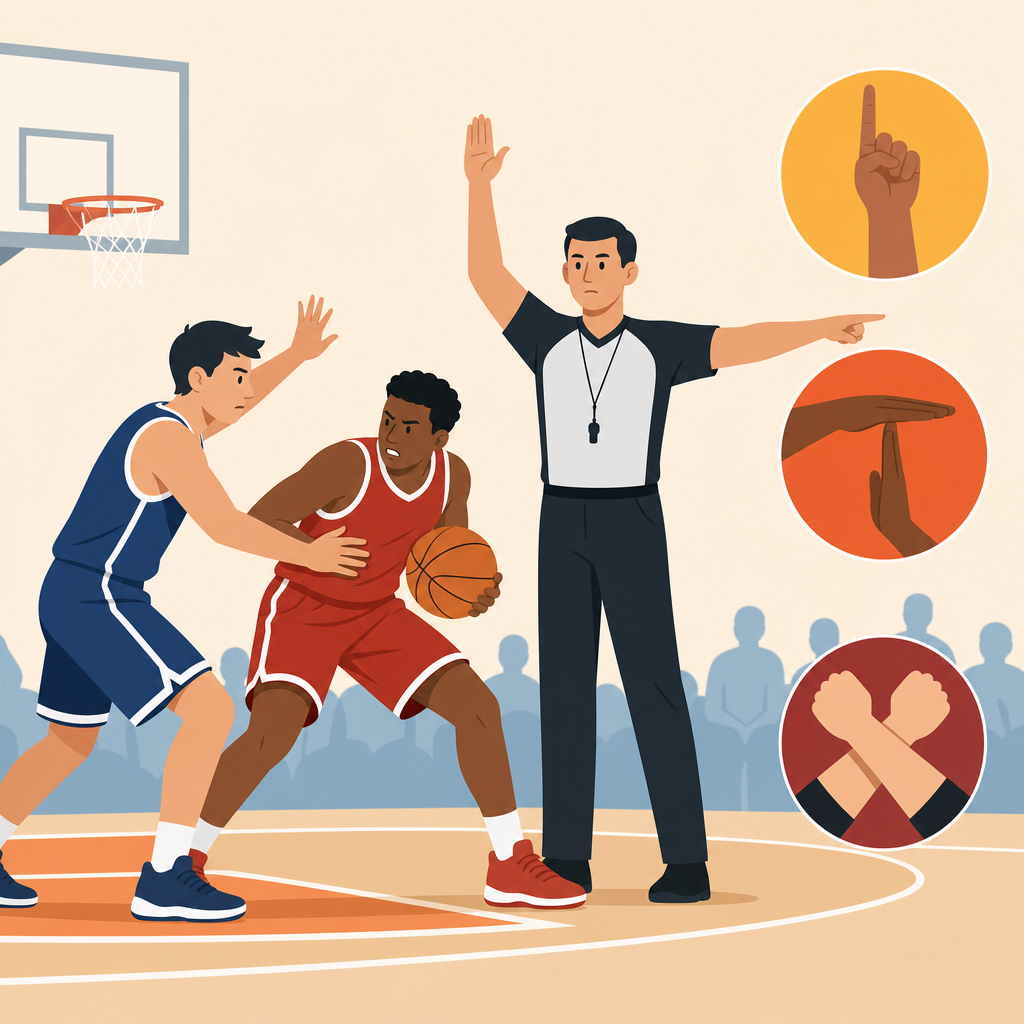
The simplest definition is this: a foul is called when contact or conduct gives one side an unfair advantage or creates an unacceptable risk. Not all contact is a foul. Basketball is a contact sport, especially in the lane, on drives, and during rebounding. Referees judge whether contact is incidental or illegal. For example, two players may brush shoulders while chasing a loose ball, and no foul is called because neither gained a real advantage. But if a defender bumps a dribbler off their path without legal guarding position, that is a foul. When I teach beginners, I stress one phrase used across levels of the sport: legal guarding position. A defender must establish position with both feet on the floor and torso facing the opponent before contact occurs. Once that standard is met, many charge or block decisions become easier to understand.
Officials also evaluate rhythm, speed, balance, and quickness, often shortened in officiating education to advantage-disadvantage principles. If contact knocks a shooter off balance, reroutes a cutter, or prevents a rebounder from jumping naturally, referees are likely to call it. If the contact is minor and does not change the play, they may pass on it. This is why beginners sometimes think officiating is inconsistent. In reality, the same action can be legal in one context and illegal in another depending on impact. Learning this principle helps you read games more accurately than simply watching whether bodies touched.
Personal Fouls: The Most Common Calls Beginners See
Personal fouls are the everyday contact fouls of basketball. They happen during defense, rebounding, screening, and even on offense. Common defensive personal fouls include blocking, hand-checking, reaching in, holding, and pushing. Blocking occurs when a defender impedes an opponent’s progress without establishing legal position in time. Hand-checking happens when a defender uses a hand or forearm to impede movement, especially on the perimeter. Holding and pushing are straightforward: grabbing an opponent or displacing them with force. Offensive personal fouls also exist. The most common is a charge, where an offensive player runs into a defender who has established legal guarding position. Another common offensive foul is an illegal screen, where a screener moves into a defender instead of remaining stationary long enough to allow avoidance.
Personal foul penalties depend on the game situation. If the fouled player is shooting and the shot misses, they usually get free throws: two for a standard two-point attempt, three for a three-point attempt. If the shot goes in, the basket counts and the shooter typically gets one additional free throw, called an and-one. Non-shooting fouls usually result in the ball being inbounded unless the team foul limit has been reached. Team foul limits differ by ruleset. In the NBA, a team enters the penalty after the fifth team foul in a quarter. In NCAA men’s basketball, team foul accumulation leads to bonus free throws by half. High school rules often use a one-and-one bonus before double bonus. Beginners do not need to memorize every league difference immediately, but they should understand the universal idea: repeated team fouls eventually produce free throws.
The table below summarizes the most common foul categories a beginner will encounter first.
| Foul type | What it usually involves | Typical penalty | Beginner example |
|---|---|---|---|
| Personal foul | Illegal physical contact during a play | Inbound, free throws on shooting foul, or free throws in penalty | Defender bumps a driver off the lane line |
| Technical foul | Unsportsmanlike conduct or administrative violation | Free throw(s) plus possession depending on ruleset | Player taunts, hangs on rim unnecessarily, or coach argues excessively |
| Flagrant foul | Unnecessary or excessive contact | Free throws, possession, and possible ejection | Hard hit to stop a fast break with dangerous contact |
One of the best ways to avoid personal fouls is to defend with your feet first and hands second. Young players often reach because they are beaten. That leads to slaps, body bumps, and recoveries from bad angles. Better defenders slide, absorb contact legally with the chest, show open hands, and contest vertically. Verticality is another key concept: when a defender jumps straight up with arms extended within their vertical cylinder, contact initiated by the offensive player may be legal. Big players especially need this skill around the rim. Coaches at every level teach wall-up technique because it reduces fouls without giving up layups automatically.
Technical Fouls: Behavior, Bench Violations, and Game Management
Technical fouls cover actions that damage sportsmanship or disrupt game administration. They are not primarily about ordinary basketball contact. A technical foul can be called on a player, coach, bench personnel, or in some cases a team. Common examples include disrespectfully arguing with officials, using abusive language, taunting an opponent, faking being fouled in certain leagues, delaying the game, calling timeout when none remain, or having too many players on the court. In youth and school settings, bench decorum matters more than many beginners realize. A coach stepping too far onto the court repeatedly or a bench player leaving the bench area during an altercation can trigger significant penalties.
Technical foul penalties vary. In the NBA, a technical generally results in one free throw for the opposing team, and team possession resumes according to the point of interruption. In college and high school rules, technical fouls often include free throws and possession. Those differences matter when you watch multiple levels of the sport, but the practical lesson is simple: technical fouls give away points and momentum without forcing the opponent to earn them through normal offense. I have seen youth teams lose control of close games because one emotional outburst led to free throws, possession, and a complete momentum swing.
Beginners should also know that not every emotional reaction is automatically a technical foul. Officials usually allow brief frustration if it is not directed aggressively at someone. The line is crossed when conduct becomes prolonged, demonstrative, profane, threatening, or clearly unsportsmanlike. Celebrating a good play may be allowed; taunting a defender is not. Hanging on the rim after a dunk may be legal for safety reasons if a player needs to avoid landing on someone, but unnecessary hanging can draw a technical. These distinctions show that context matters. Referees are managing both the rules and the temperature of the game.
Flagrant Fouls: Safety, Severity, and Ejection Risk
Flagrant fouls are the most serious common foul category beginners need to understand. They involve contact that is unnecessary, or both unnecessary and excessive, and they exist to protect players from dangerous plays. A routine hard foul is not automatically flagrant. Officials look at the wind-up, impact, follow-through, point of contact, the player’s opportunity to make a legitimate basketball play, and the vulnerability of the opponent. Contact to the head or neck, undercutting an airborne player, or wrapping up a fast-break player in a dangerous way are all red flags. The NBA distinguishes between Flagrant 1 and Flagrant 2. A Flagrant 1 is unnecessary contact; a Flagrant 2 is unnecessary and excessive contact and results in ejection. NCAA and NFHS use different labels and review standards, but the safety principle is the same.
Replay review has made flagrant foul enforcement more precise. Officials can slow down a play and assess whether the defender made a genuine play on the ball or simply delivered a dangerous blow. This is especially important on closeout plays against jump shooters and at the rim when players are airborne. In recent years, leagues have emphasized landing-space protection for shooters because undercutting can cause ankle and knee injuries. That emphasis has helped beginners understand a larger truth: foul rules are not only about fairness; they are injury-prevention tools. The more dangerous the action, the more severe the penalty should be.
For players, the lesson is clear. If you are beaten, do not make a reckless recovery. On a fast break, turn and sprint instead of grabbing from behind. Around the basket, contest high without swinging downward. Coaches often say “make them earn it at the line,” but that only applies to controlled, legal attempts to defend. Reckless contact is not smart toughness. It is poor technique, and at advanced levels it can cost games, suspensions, and reputations.
How Fouls Affect Strategy, Minutes, and Player Development
Fouls influence almost every strategic choice in basketball. Individually, players must manage foul trouble. In the NBA, six personal fouls disqualify a player; in college and high school, the limit is usually five. A star player with two early fouls may sit longer in the first half. That changes rotations, defensive matchups, and offensive usage. Teamwide, foul accumulation changes how aggressively defenders can pressure the ball. Once a team reaches the penalty, every non-shooting defensive foul becomes more expensive. Smart offenses know this and attack the paint, force closeouts, and use ball screens to draw contact. Smart defenses adjust by showing help earlier and keeping hands off drivers.
For beginners, foul awareness is also a development tool. Players who constantly foul usually have one of four problems: poor stance, late positioning, overactive hands, or lack of anticipation. Fixing those habits improves defense more than simply telling someone to “play harder.” One practical drill I use is no-reach shell defense, where defenders keep palms visible and must cut off drives with slides and chest angles. Another is verticality finishing defense with pads, teaching bigs to jump straight up under controlled contact. These drills reduce fouls because they teach legal movement patterns instead of desperate recovery habits.
If you are building your basketball basics foundation, treat foul knowledge as part rules study and part skill study. Watch games with one question in mind: why was that contact legal or illegal? Then connect the answer to footwork, balance, timing, and body control. That habit will make you better whether your next step is youth league play, high school basketball, or simply understanding the sport more clearly as a fan.
Basketball fouls become much easier to understand once you group them by purpose. Personal fouls regulate ordinary illegal contact during live play. Technical fouls punish unsportsmanlike behavior and administrative violations. Flagrant fouls address dangerous contact and protect player safety. From there, the game opens up: you can see why a defender was called for a block, why a coach was assessed a technical, or why officials stopped to review a hard collision. You also begin to understand strategy, because fouls affect free throws, possession, rotations, and late-game decisions.
The main benefit of learning fouls early is that it speeds up everything else in basketball. You defend better because you know legal positioning. You attack better because you know what contact draws whistles. You watch better because you can separate normal physical play from illegal advantage. As your Basketball Basics hub for getting started, this page gives you the framework you need before moving deeper into topics like blocking versus charging, shooting fouls, bonus situations, referee signals, and player disqualification rules. Keep this foundation simple: play with control, defend with your feet, respect officials, and avoid reckless contact. If you want to improve faster, use this guide while watching your next game and identify every personal, technical, and flagrant foul in real time.
Frequently Asked Questions
What is the difference between a personal foul, a technical foul, and a flagrant foul in basketball?
A personal foul usually involves illegal physical contact between players during live play. This is the type of foul beginners see most often. Examples include hitting an opponent’s arm while they are shooting, bumping a ball handler off their driving path, holding a cutter, or blocking a player without establishing legal guarding position. Personal fouls are mainly about contact that creates an unfair advantage or disrupts normal play.
A technical foul is different because it does not have to involve live-ball contact. Technical fouls are often called for unsportsmanlike behavior, disrespect toward officials, taunting, excessive arguing, delay of game, or other rule violations that hurt game control. In some levels of basketball, a technical foul can also be called for administrative issues, such as too many players on the court or dunking during warmups when that is not allowed by the rules being used.
A flagrant foul is the most serious of the three because it involves excessive or unnecessary contact, or contact that puts another player’s safety at risk. A flagrant foul goes beyond normal basketball contact. It may happen when a defender violently hits a player in the air, delivers a dangerous body check, or makes a play that is reckless rather than a legitimate attempt to play the ball. Depending on the rules of the league, flagrant fouls may be divided into levels, with the more severe version leading to ejection.
For beginners, the easiest way to remember the difference is this: personal fouls are illegal contact during regular play, technical fouls are behavior or non-contact violations that damage sportsmanship or game administration, and flagrant fouls are dangerous or excessive acts that receive stronger penalties because player safety comes first.
What happens after each type of foul is called?
The penalty depends on the type of foul, whether the player was shooting, the team foul count, and the rule set being used. After a personal foul, the most common outcomes are either free throws or the ball being awarded to the other team out of bounds. If the fouled player was in the act of shooting and the shot misses, they usually get free throws. If the shot goes in, the basket counts and the shooter often gets one additional free throw. If the foul happens on a non-shooting play, the penalty may be side-out possession unless the defensive team has reached the team foul limit, in which case free throws may be awarded.
Technical fouls usually bring a more direct penalty. In many levels of basketball, the opposing team is awarded free throws and then keeps or receives possession according to that rule set. Because technical fouls are tied to conduct and control, they are meant to punish unsportsmanlike behavior and discourage players, coaches, or benches from disrupting the game. Even though they may not look as dramatic as a hard collision, technical fouls can be very costly because they can give away easy points and momentum.
Flagrant fouls carry the heaviest penalties among common foul types. The offended team usually gets free throws plus possession of the ball. In more serious cases, the player who committed the foul may also be ejected from the game. This stronger penalty exists to protect players from dangerous contact and to send a clear message that reckless or violent actions will not be treated like ordinary physical mistakes.
One important point for beginners is that basketball rules vary by league, such as youth basketball, high school, college, FIBA, or the NBA. The basic ideas stay consistent, but the number of free throws, possession rules, and disqualification standards can differ. That is why learning the principles behind fouls is more helpful than memorizing only one rulebook version.
How do referees decide whether contact is a normal basketball play or a foul?
Referees are not calling every bit of contact they see. Basketball is a physical sport, so officials are trained to judge whether contact is illegal, whether it causes a disadvantage, and whether a player had legal position. This is one of the most important concepts for beginners to understand. Not all contact is a foul. Clean defense, incidental contact, and legal box-outs can all happen without a whistle.
Officials look at several things. They ask who established legal position first, whether the defender moved into the opponent’s path legally, whether the offensive player initiated the contact, whether there was a clear push, hold, trip, or hit, and whether the contact affected speed, balance, rhythm, or freedom of movement. For example, if a defender jumps straight up with arms vertical and the offensive player crashes into them, that may be legal defense. On the other hand, if the defender slides under the shooter late or hacks across the arms, that is more likely to be a foul.
Referees also consider intent less than many beginners expect. A player can commit a foul even if they were “just trying to get the ball.” If the result is illegal contact, the whistle can still come. That is why reaching in carelessly, swiping down across the arm, or bodying a driver without position often leads to fouls even when the defender did not mean to play dirty.
When judging possible flagrant fouls, officials pay even closer attention to the severity of the contact and the risk to the player. A hard foul is not automatically flagrant, but if it is unnecessary, excessive, or dangerous, the ruling becomes more serious. In short, referees are trying to protect fairness and safety, not eliminate all physical play. The best way for a beginner to read a whistle is to ask: was the contact legal, did it create an unfair advantage, and did it put anyone at risk?
Why are technical fouls considered so serious if they are not always about physical contact?
Technical fouls matter because basketball is not only governed by physical rules but also by standards of sportsmanship, respect, and game control. A game can become chaotic very quickly if players, coaches, or benches are allowed to argue endlessly, taunt opponents, delay play, or ignore officials. Technical fouls exist to stop that behavior before it damages the competition.
For beginners, this can seem confusing because a technical foul may look less dramatic than a hard personal foul. But the effect on the game can be huge. A technical foul can give the other team free points, shift momentum, energize the crowd, frustrate teammates, and put a player or coach closer to ejection. In close games, one emotional outburst can change the result just as much as a missed shot or turnover.
Technical fouls also protect the environment of the game. Youth players need structure and examples of good conduct. Officials need authority to manage the contest. Opponents deserve to play without being baited, insulted, or threatened. When the rules punish unsportsmanlike actions, they help keep the focus on skill, teamwork, and fair competition rather than emotion spilling out of control.
It is also important to know that technical fouls are not always for arguing. They can be called for hanging on the rim when not allowed, entering the court improperly, delay tactics, or bench misconduct. So while technical fouls may not be about contact, they are still serious because they protect the integrity, pace, and respectfulness of the game.
How can a beginner avoid committing fouls while still playing effective defense and staying competitive?
The best starting point is to focus on positioning before contact happens. Most beginner fouls come from being out of position and then trying to recover with hands, arms, or body contact. If you move your feet early, stay balanced, and keep your chest in front of the ball handler, you are much less likely to reach, grab, or bump. Good defense begins with anticipation, not desperation.
Use your feet more than your hands. Reaching is one of the fastest ways to commit a personal foul because it often leads to slaps on the wrist, forearm contact, or body imbalance. Instead of lunging for steals, slide laterally, keep your hands active but controlled, and contest shots by going straight up. Learning the principle of verticality is especially helpful. If you jump vertically with your arms raised and do not move into the shooter, you have a much better chance of defending legally.
Avoid using your forearms, hips, or hands to redirect opponents. Holding cutters, pushing rebounders, and bumping drivers may feel minor in the moment, but referees notice repeated illegal contact. On rebounds, box out with your body and lower base, not with extended arms. On drives, beat the offensive player to the spot rather than trying to stop them with a late collision.
To avoid technical fouls, control your reactions. Do not clap sarcastically at officials, argue every whistle, taunt opponents, or make emotional plays that hurt your team. Competing hard is encouraged, but losing composure is costly. To avoid flagrant fouls, never make a dangerous frustration play, especially against a player who is airborne or defenseless. If you cannot make a clean play on the ball, it is better to give up the basket than commit reckless contact.
For beginners, the smartest mindset is simple: defend early, stay balanced, keep your hands disciplined, respect the officials, and prioritize safety. Players who