

Basketball court dimensions shape every pass, cut, screen, and shot, so understanding the lines and zones is one of the fastest ways to get comfortable with the game. If you are new to basketball, court markings can look like a maze of arcs, rectangles, and short hash marks, but each line has a specific purpose tied to rules, spacing, and strategy. In practical terms, knowing where the sideline ends, where the free-throw line begins, and what the lane is used for helps players avoid turnovers, set up better offense, and defend legally.
When coaches talk about full court lines, they mean every regulation marking from baseline to baseline: boundaries, center line, center circle, three-point line, free-throw line, lane markings, restricted area arc, and inbound spots. Zones, in this context, are the functional areas those lines create. The backcourt is where a team starts possession. The frontcourt is where it attacks. The paint is where rebounding and interior defense happen. The perimeter is where spacing and outside shooting matter most. I have taught beginners on everything from taped community gym floors to polished high school courts, and the same issue comes up every time: players improve faster once the court stops feeling abstract.
This matters beyond basic orientation. Court dimensions affect how the game is officiated, how drills are designed, and how players at different levels develop habits. A youth player shooting from a shorter three-point distance learns different shot selection than a college guard. A coach planning shell defense uses the lane width, help-side positioning, and corner spacing as nonnegotiable reference points. Even recreational players benefit from understanding dimensions, because pickup games still rely on shared expectations about out-of-bounds, check ball areas, and what counts as a long two versus a three. If you are building your Basketball Basics foundation, court dimensions are not trivia. They are the map that makes every other skill easier to learn.
Standard basketball court dimensions at a glance
A standard full basketball court is measured from baseline to baseline and sideline to sideline, but the exact dimensions depend on the level of play. Under NBA rules, the court is 94 feet long and 50 feet wide. NCAA men’s and women’s courts are also 94 by 50 feet. Most high school courts in the United States use the same 84-foot or 94-foot formats depending on the facility, though NFHS competition commonly uses 84 feet long by 50 feet wide. FIBA courts, used internationally, are slightly smaller at 28 meters by 15 meters, which converts to about 91.9 by 49.2 feet. Those small differences matter because they change driving angles, transition spacing, and weak-side help distances.
The basket height is one of the few constants across most organized levels: 10 feet from the floor to the rim. Backboards are typically 6 feet wide, and the rim has an 18-inch diameter. The free-throw line sits 15 feet from the plane of the backboard in most major rule sets. The lane, often called the key or paint, varies by level. In the NBA, the lane is 16 feet wide. In FIBA and NCAA women’s play, modern lane measurements align more closely with international standards. High school and older court designs may differ, which is why players sometimes feel cramped or unusually open when changing gyms.
For beginners, the smartest way to read a court is from the outside in. Start with the four boundary lines, then identify half court, then the three-point arc, then the free-throw line and lane. Once those anchors are clear, the rest of the markings make sense quickly.
Boundary lines, baselines, sidelines, and half court
The outer rectangle defines where the ball is live. The two longer lines are the sidelines, and the two shorter lines under each basket are the baselines, also called end lines in many rule books. If a player dribbles on or over these boundaries, or if the ball touches out-of-bounds first, possession changes. This is one of the earliest rules new players internalize, but it is also one of the most important because spacing starts with staying in play. On offense, wide spacing near the sidelines stretches the defense. On defense, forcing a ball handler toward the sideline uses the boundary as an extra defender.
The division line, commonly called half court, splits the floor into backcourt and frontcourt. Once the offense establishes the ball in the frontcourt, it cannot legally return the ball to the backcourt without penalty under standard competitive rules. That is the over-and-back violation. The center circle is used for the opening jump ball in some levels and as a spatial reference point in transition and set plays. In practice, I tell new guards to think of half court as a timing line as much as a location line. You need to cross it under pressure, avoid traps near it, and understand that late-clock offense often begins from just over the division line.
Backcourt and frontcourt are not just labels. They define pressure schemes, press breaks, and transition defense. A full-court press uses the entire length of the court to force rushed decisions. A half-court defense waits until the offense enters the frontcourt before engaging fully.
The three-point line and perimeter zones
The three-point line marks the area beyond which a made field goal is worth three points instead of two. In the NBA, the arc is 23 feet 9 inches at the top and 22 feet in the corners. NCAA and high school distances are shorter, and FIBA uses 6.75 meters, or about 22.15 feet, with shorter corner distances. Because the line is not a perfect circle, the corner three is shorter than the shot above the break. That is why offenses value corner spacing so heavily. It creates one of the most efficient shots in basketball when paired with drive-and-kick action.
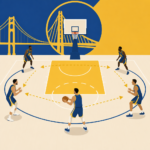
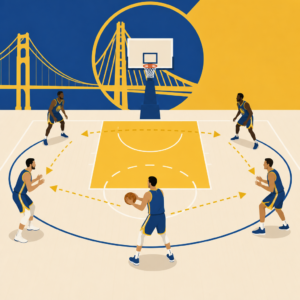
The perimeter zone includes the top of the key, the wings, and the corners. These spots are not always marked explicitly by lines, but every coach and player uses them as shared landmarks. The top of the key is centered above the free-throw circle. The wings are to the left and right, usually outside the lane line extended. The corners sit near the baseline and sideline intersections. Beginners should know these areas because almost all offensive concepts are taught through them: pass from the top to the wing, cut from the corner, lift from the dunker spot, or rotate from the weak-side wing.
A common source of confusion is the long two. If a shooter’s foot is touching the three-point line, the shot counts for two, not three. Learning to spot that distinction helps players with shot selection and helps spectators understand scoring disputes.
The key, lane, free-throw line, and restricted area
The painted rectangle below the basket is the lane, often called the key or the paint. This is where post play, rebounding, shot contests, and many fouls occur. The free-throw line forms the top of the lane, 15 feet from the backboard. Players shoot foul shots from this line after certain defensive fouls and technical fouls. On free throws, the lane spaces on each side are assigned to rebounders and defenders under rule-specific alignment rules. That is why the lane has marked blocks and hash marks: they tell players where to stand until the ball hits the rim or the shot ends.
The key is central to several rule concepts. The offensive three-second rule, used in the NBA and many other levels, prevents an offensive player from standing in the lane too long while the team controls the ball in the frontcourt. Defensive three seconds exist in the NBA as well, discouraging a defender from camping in the paint without actively guarding an opponent. Even where that exact rule does not apply, officials still monitor illegal positioning, displacement, and post contact closely in this area.
The restricted area arc under the basket limits where a defender can establish legal help position for a charge on drives to the rim. In the NBA the restricted area radius is 4 feet from the center of the basket. NCAA and FIBA use similar but not identical measurements. For beginners, the practical meaning is simple: if a defender is standing inside that arc, taking a charge is harder to earn legally against an airborne attacker. This protects players and reduces dangerous collisions directly under the rim.
What each court zone means in real play
Every zone on a basketball court carries a tactical meaning. The backcourt is about ball security, press resistance, and initiating offense. The frontcourt is where scoring actions unfold. The paint is the highest-contact area and usually the highest-percentage scoring area. The mid-range zone sits inside the three-point line but outside the lane, often used for pull-up jumpers, floaters, and short corner shots. The perimeter stretches the defense and creates driving lanes. The corners force defenders to cover the widest possible distance when helping inside.
When I teach first-time players, I frame court zones by decision-making. In the backcourt, your first job is advance safely. At the wings, read help defenders and passing angles. In the corners, be ready to shoot or baseline drive. At the elbows, look for handoffs, high-post passes, and face-up opportunities. In the dunker spot, just outside the lane along the baseline, be available for drop-off passes when the defense rotates. None of these areas are random basketball jargon. They are practical references that let five players organize movement instantly without explaining the whole floor every possession.
| Zone | Location | Main purpose | Typical actions |
|---|---|---|---|
| Backcourt | From baseline to half court | Start possession and beat pressure | Inbounding, press break, primary dribble advance |
| Top of key | Center above free-throw circle | Organize offense | Ball screens, swing passes, pull-up threes |
| Wing | Left or right side outside lane area | Create driving and passing angles | Catch-and-shoot, pick-and-roll, entry passes |
| Corner | Near sideline and baseline intersection | Maximize spacing | Corner threes, baseline drives, skip-pass catches |
| Paint | Inside the lane | High-value scoring and rebounding | Post-ups, layups, shot contests, box outs |
Differences by league, age, and facility
Not every court you step onto will match the same rule book. Youth basketball often shortens free-throw distances, lowers rim heights for younger age groups, and uses modified three-point lines or no three-point line at all. Middle school gyms sometimes have overlapping markings for volleyball and multiple basketball levels, which can confuse beginners. High school athletes moving into college quickly notice wider lanes in some facilities, deeper three-point lines, and more floor to cover in transition. International players adapting to NBA spacing talk often about corner positioning, stronger-side help rotations, and how much extra room elite shooters exploit.
Facility design also changes how a court feels even when dimensions are technically compliant. Adequate run-off space beyond baselines and sidelines improves safety. Clear backboard padding, visible line paint, and consistent lighting matter more than casual players realize. In older gyms, faded lines can create officiating problems and hesitancy on closeout footwork because players are unsure of their landmarks. Good court design supports better habits. That is why serious training environments maintain crisp markings and use standard dimensions whenever possible.
If you are just getting started, always ask which rule set applies before a game or practice. That one question prevents confusion about three-point scoring, lane violations, backcourt rules, and charge circles.
How beginners should use court knowledge to improve faster
The quickest way to turn court dimensions into skill is to connect each line with a habit. Use the sideline to practice controlled dribbling without stepping out. Use half court to rehearse advancing the ball with your head up in eight seconds or less. Use the three-point line to learn shot discipline: know whether you are spacing for a three or stepping in for a two. Use the free-throw line and elbows for passing drills, handoffs, and one-dribble pull-ups. Use the lane lines to practice defensive slides, closeouts, rebounding position, and legal verticality near the rim.
A strong beginner routine can be built entirely around court landmarks. Start with form shooting from both blocks and the middle of the lane. Move to free throws. Add layups from each side using the lane as your angle guide. Practice cuts from wing to basket and corner to wing so you understand spacing. Finish with defensive shell movement: ball, help, recover, and box out. The court itself becomes your teacher because every line gives you immediate feedback about spacing and balance.
As your Basketball Basics hub page, this topic connects naturally to ball handling, shooting form, defensive stance, rebounding, and common rule violations. Learn the map first, then every other fundamental starts to click. The main takeaway is simple: basketball court dimensions are not decorative markings. They define legal play, shape strategy, and give beginners a framework for understanding where to stand, move, and attack. Study the full court once, and the game becomes easier to read forever. The next time you step into a gym, walk the lines, name each zone, and use that awareness to play with more confidence.
Frequently Asked Questions
What are the standard dimensions of a full basketball court?
A full basketball court measures different sizes depending on the level of play, but the basic layout stays very similar. In the NBA and NCAA, a regulation full court is 94 feet long by 50 feet wide. High school courts are commonly 84 feet long by 50 feet wide, while many youth and recreational courts may vary slightly based on available space. The court is divided in half by the midcourt line, creating two equal backcourts and frontcourts. Around the perimeter, the baselines run behind each basket and the sidelines run the length of the court. These outer boundaries define where the ball is in or out of play. Inside that main rectangle, you will also see the center circle, free-throw lanes, three-point arcs, free-throw lines, and restricted areas near the basket. Learning these measurements matters because the size of the floor affects spacing, transition play, defensive positioning, and shooting range. Even if you are just beginning, understanding the standard court dimensions makes it much easier to follow rules and recognize why players move to certain spots during a game.
What do the sidelines, baselines, and half-court line mean in basketball?
The sidelines and baselines are the court’s boundary lines, and they are some of the most important markings for understanding where play happens. The sidelines run along the longer sides of the court, and the baselines, sometimes called end lines, run behind each basket. If a player steps on or beyond any of these lines while holding the ball, that player is out of bounds. If the ball touches outside the boundary, possession stops and the other team usually gets the ball. The half-court line, also called the division line or midcourt line, splits the court into two equal halves. This line matters because it separates the backcourt from the frontcourt. Once an offensive team advances the ball across half court, it generally cannot bring the ball back into the backcourt without risking a backcourt violation. That rule is designed to keep the game moving forward. These lines are not just simple borders; they help define possession, pace, pressure defense, and how teams organize their offense. For new players, understanding these markings is one of the quickest ways to avoid turnovers and make smarter decisions with the ball.
What is the lane, and why is it sometimes called the key or the paint?
The lane is the rectangular area that extends from the baseline to the free-throw line under each basket. It is often called the key because older court designs made this area look like an old-fashioned keyhole, and it is also commonly called the paint because it is frequently shaded a different color from the rest of the floor. This zone plays a major role in both rules and strategy. Offensively, players attack the lane for close-range shots, post moves, layups, and rebounds. Defensively, teams protect this space because it is the highest-percentage scoring area on the court. The lane is also where several important violations are enforced. For example, offensive players cannot remain in the lane too long under certain rule sets, which leads to the three-second violation. During free throws, players line up along the sides of the lane in designated spaces to compete for a rebound if the shot is missed. Because the lane sits directly in front of the basket, it is one of the most physically contested areas in basketball. Understanding the lane helps players learn spacing, timing, interior defense, and why controlling the middle of the floor is so important.
What is the purpose of the free-throw line and the free-throw circle?
The free-throw line is the line from which players shoot foul shots after certain defensive fouls or technical fouls. On most standard courts, it is 15 feet from the backboard, making it a fixed and important scoring spot. The free-throw circle surrounds this line and helps organize player positioning during free throws and live-ball action. When a player is awarded free throws, teammates and opponents line up in marked lane spaces along both sides of the paint, while the shooter stands behind the free-throw line. Players cannot cross into the lane too early, and the shooter must release the ball according to the rules before stepping over the line. Beyond foul shooting, the free-throw area is a major part of offensive strategy. It often serves as a decision-making zone for passes, short jumpers, and dribble penetration. Coaches frequently talk about getting to the “elbow” areas, which are the corners where the free-throw line meets the lane, because those spots are useful for screening actions and mid-range offense. For beginners, knowing the free-throw line’s purpose helps connect rules, scoring opportunities, and court positioning in a very practical way.
What does the three-point line and the area under the basket tell players?
The three-point line marks the boundary for long-range shots worth three points instead of two. If a player shoots from behind this arc and makes the basket, the team earns three points. If any part of the player’s foot is on the line, the shot counts as only two points. The exact distance of the three-point line depends on the level of play, but its purpose is always the same: to reward shooting from greater range and stretch the defense across more of the court. This line has a huge effect on spacing because defenders must cover players farther from the basket, which opens driving lanes and passing opportunities inside. Under the basket, another important marking is the restricted area arc, used in many higher levels of basketball. This arc helps determine certain charging and blocking calls near the rim. Defenders standing inside the restricted area often cannot draw a charge against an attacking player driving to the hoop. Together, the three-point line and the area near the basket define two of the game’s most valuable scoring zones: the perimeter and the rim. Understanding how those zones work helps players see why teams balance outside shooting with inside finishing and why court markings shape nearly every offensive and defensive decision.