
An ACL injury in basketball is one of the most consequential diagnoses a player can receive because it affects stability, explosiveness, confidence, and long term career planning all at once. The anterior cruciate ligament, usually called the ACL, is a major stabilizing ligament in the knee that helps control forward movement of the tibia and rotational forces during cutting, landing, and sudden deceleration. Those actions define modern basketball, from a guard planting for a crossover to a forward contesting a shot and landing in traffic. When the ACL tears, the problem is not just pain or missed games. The injury disrupts movement mechanics that sit at the center of basketball performance.
In team settings, I have seen ACL injuries change everything from roster construction to how a player approaches simple drills months after surgery. A clean jumper can become hesitant when the athlete no longer trusts the plant leg. A defender who once slid laterally with ease may overcompensate and lose half a step. Because basketball careers are short and margins are thin, the significance of an ACL tear extends far beyond the operating room. It affects development curves, contract value, minute restrictions, and the athlete’s identity.
This topic matters especially within NBA analysis because the league asks players to generate force repeatedly over an eighty two game season plus travel, playoffs, and off season workload. Sports science has made ACL rehabilitation far more sophisticated than it was twenty years ago, yet recovery remains highly individual. Some players return to All Star form. Others come back technically healthy but never fully regain prior burst or availability. Understanding the anatomy, recovery process, performance impact, and prevention strategies helps fans, coaches, and analysts evaluate what an ACL injury in basketball really means rather than relying on generic timelines.
At its core, an ACL injury in basketball is both a tissue injury and a systems problem. The ligament tears in a body that may be fatigued, imbalanced, poorly landed, collided into, or simply caught in an unlucky position. Recovery therefore requires more than reconstruction. It demands strength restoration, neuromuscular retraining, load monitoring, psychological readiness, and a realistic return to play plan. For a hub article on sports science, that broad view is essential, because the best analysis connects medical facts to on court outcomes and career trajectories.
How ACL Tears Happen in Basketball
Most ACL tears in basketball happen without direct contact. The classic mechanism is a player decelerating, planting, and changing direction while the knee falls into a vulnerable position involving valgus collapse, internal rotation, and insufficient hip control. Another frequent pattern appears on single leg landings after rebounds, blocks, or layup attempts, especially when the torso is off balance. Contact can still contribute, but even then the dangerous moment often comes from how the leg absorbs force rather than from the collision itself.
Basketball creates repeated high risk scenarios because the sport combines sprinting, abrupt stops, vertical jumping, and chaotic landing environments. Guards face danger during hard cuts and step back moves. Wings are exposed on closeouts and transition finishes. Bigs are vulnerable when they land in crowded paint areas. Fatigue matters because mechanics often degrade late in games or during dense schedule periods. Researchers studying injury mechanisms consistently note that poor trunk control, knee valgus, and asymmetrical force absorption increase stress on the ACL.
There are also athlete specific risk factors. Previous lower extremity injury can alter movement patterns. Deficits in hamstring strength relative to quadriceps strength may reduce dynamic knee protection. Limited ankle mobility can force compensations up the chain. Female athletes, particularly at younger levels, have higher ACL injury rates due to a combination of anatomical, hormonal, and neuromuscular factors, which has driven extensive prevention research across basketball and other court sports. In the NBA and high level men’s basketball, workload history, prior surgeries, and cumulative tendon or cartilage wear often shape risk as much as isolated bad luck.
Diagnosis, Surgery, and the First Phase of Recovery
When an ACL tear is suspected, clinicians typically use a combination of physical examination, injury history, and MRI confirmation. Players often report a popping sensation, immediate instability, swelling within hours, and inability to trust the knee during pivoting. MRI is critical because ACL tears rarely occur in isolation. Meniscus damage, bone bruising, cartilage injury, and associated ligament sprains can complicate the prognosis. Those accompanying injuries often influence recovery more than casual observers realize.
Not every torn ACL is managed identically, but in elite basketball surgery is common because the sport places extreme rotational demands on the knee. Reconstruction usually uses either a patellar tendon autograft, hamstring tendon autograft, or quadriceps tendon autograft. Each has advantages and tradeoffs. Patellar tendon grafts have long been favored for high demand athletes because of strong fixation, though anterior knee pain can be an issue. Hamstring grafts may reduce front of knee discomfort but can affect hamstring strength recovery. Quadriceps grafts have become increasingly popular because they offer a robust tissue option with favorable outcomes in many cases.
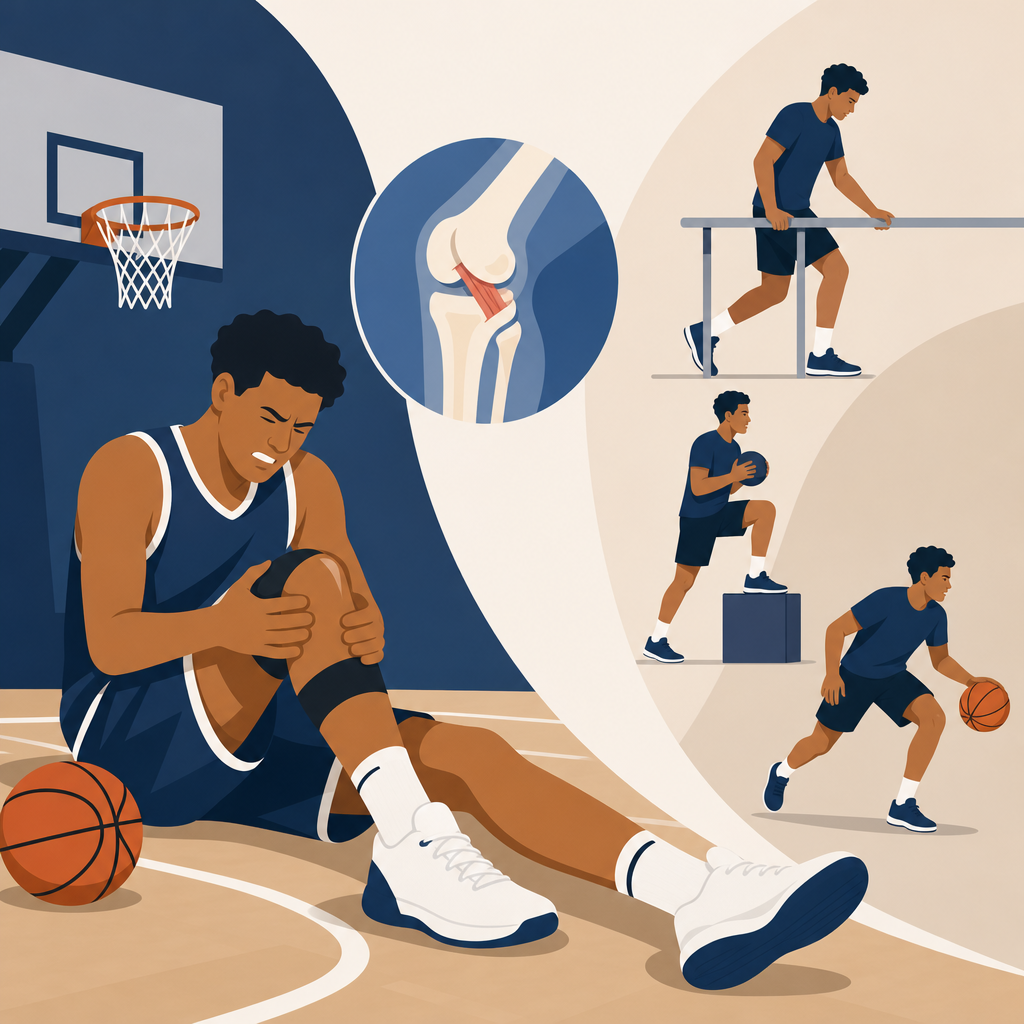
The early rehabilitation phase focuses on controlling swelling, restoring knee extension, reactivating the quadriceps, and rebuilding normal gait. In practice, this stage is less glamorous than fans expect, but it is foundational. A player who does not regain full extension early can fight stiffness for months. Quad inhibition is also a major barrier; the knee can look structurally repaired while the athlete still struggles to produce force. Sports medicine staffs use cryotherapy, neuromuscular electrical stimulation, blood flow restriction training, and progressive loading to address these deficits. The first milestone is not running or dunking. It is a quiet, symmetrical, well functioning knee.
Rehabilitation Benchmarks and Return to Play Standards
Modern ACL rehabilitation in basketball is criterion based, not purely calendar based. While public discussion often cites nine to twelve months as the expected timeline, responsible return to play decisions depend on measurable benchmarks. Strength symmetry, hop testing, force plate analysis, movement quality, swelling response, pain levels, and practice tolerance all matter. A player can be ten months post surgery and still not be ready. Another may look sharp at nine months but still need additional exposure to contact and reactive game demands.
One reason return timelines are misunderstood is that clearance is layered. Medical clearance means the graft is stable and the athlete can advance. Performance clearance means the body can tolerate basketball movements under increasing intensity. Competition clearance means the player can handle full game demands, travel, back to backs, and emotional stress. Teams that blur these distinctions often create preventable setbacks. I have consistently found that the cleanest returns happen when staffs treat reentry as a staged ramp rather than a final green light.
| Recovery Stage | Primary Goal | Typical Benchmarks | Basketball Relevance |
|---|---|---|---|
| Early rehab | Reduce swelling and restore motion | Full extension, improving flexion, normal walking | Builds the base for later running and landing mechanics |
| Strength phase | Rebuild muscle capacity | Quadriceps and hamstring strength approaching symmetry | Supports deceleration, takeoff, and knee protection |
| Running and plyometrics | Reintroduce force absorption and production | Tolerates jogging, jumping, controlled cutting | Prepares for transition speed and vertical contests |
| Basketball integration | Add reactive sport specific movement | Passing, shooting, defensive slides, live change of direction | Tests whether rehab gains transfer to actual play |
| Return to competition | Handle full game exposure | Practice tolerance, contact confidence, monitored minutes | Determines whether the player can sustain NBA demands |
Leading practitioners also emphasize psychological readiness. Tools such as the ACL Return to Sport after Injury scale help assess confidence, fear of reinjury, and emotional preparedness. This matters in basketball because hesitation changes biomechanics. An athlete who subconsciously avoids loading one leg may pass medical tests yet still move inefficiently in games. That is why high quality rehab includes live decision making, unplanned cuts, contested finishes, and progressive exposure to the exact situations that previously felt threatening.
What an ACL Injury Means for Performance and Career Trajectory
The biggest question fans ask is simple: will the player be the same? The honest answer is that some are, some are not, and the details matter. Return to play rates after ACL reconstruction in professional basketball are generally high, but return to previous performance is less predictable. Guards and wings who rely on elite acceleration, sharp deceleration, and change of direction may show temporary or lasting declines in rim pressure, isolation efficiency, or defensive recovery. Bigs may lose vertical pop, rebounding range, or lateral coverage mobility. Even when box score numbers recover, minute loads and availability can remain different.
Age is a major variable. Younger players often recover physical qualities more completely, but they still face development disruption because one lost season can interrupt skill progression and role growth. Veterans may benefit from experience and smarter pacing, yet they have less margin for diminished athleticism. Style of play also matters. A movement shooter can remain highly effective with modest athletic decline, while a slashing creator may need substantial technical adaptation. This is why surface level comparisons between players after ACL tears are often misleading.
There are notable examples across basketball of successful returns, but context always explains the outcome. Some players regained scoring form because their jump shooting and size insulated them from reduced burst. Others reinvented themselves with stronger pacing, improved footwork, and lower usage. On the other side, some athletes technically returned but never recovered preinjury availability, largely because secondary issues emerged: tendinopathy, cartilage irritation, contralateral injuries, or chronic compensations. An ACL reconstruction can solve instability while still leaving an athlete in a long conversation with load management.
From a front office perspective, the injury affects contract structure, insurance decisions, and roster depth planning. Teams now use richer biomechanical and workload data when evaluating post ACL value. They monitor sprint exposure, jump counts, asymmetry trends, and recovery markers to avoid asking for too much too soon. For analysts, that means a player returning from an ACL injury should be judged with more than points per game. Watch first step quality, deceleration control, frequency of paint touches, defensive assignments, and game to game availability. Those indicators often reveal more than headline numbers.
Prevention, Load Management, and the Future of Sports Science
No prevention program can eliminate ACL injuries, but basketball sports science can reduce risk meaningfully. The best programs target landing mechanics, single leg strength, posterior chain development, trunk control, and fatigue resistant movement quality. Proven concepts from neuromuscular warm up systems, including structured jump landing drills and cutting technique work, are now standard across many elite organizations. Force plates, markerless motion capture, and GPS style indoor tracking provide additional data, although technology only helps when staff translate it into coaching decisions.
Load management is often misunderstood as simple rest, when the better concept is load governance. A player needs enough high intensity exposure to stay robust, but not so much poorly timed stress that tissue capacity is exceeded. Teams monitor acute and chronic workload patterns, sleep quality, travel stress, and subjective wellness to guide practice volumes. This is especially important after ACL reconstruction because the athlete may tolerate straight line conditioning before being ready for dense multidirectional game loads. The knee does not read the calendar; it responds to stress dosage.
Screening also has limits. It is useful to identify deficits in strength, balance, or force asymmetry, but no single test predicts who will tear an ACL. That is why strong organizations combine screening with ongoing training and clear communication among surgeons, physical therapists, strength coaches, skill coaches, and performance directors. The future will likely bring more individualized models that connect imaging, biomechanics, and workload history. Even then, the core principle will stay the same: healthier movement and smarter progression protect careers.
For anyone following NBA analysis, the key takeaway is that an ACL injury in basketball should be evaluated as a multidimensional event, not a simple absence projection. The ligament heals on one timeline, neuromuscular performance on another, and competitive confidence on yet another. Players can return, thrive, and even evolve, but successful recovery demands patience, rigorous standards, and honest expectations. If you cover the league, coach athletes, or simply want sharper insight into injuries, use this framework as your baseline and keep tracking the sports science behind every comeback story.
Frequently Asked Questions
What exactly is an ACL injury, and why is it such a major issue in basketball?
An ACL injury involves damage to the anterior cruciate ligament, one of the key stabilizing ligaments inside the knee. The ACL helps control forward movement of the shinbone relative to the thighbone and provides rotational stability when an athlete cuts, pivots, lands, or stops suddenly. In basketball, those movements are constant. Every hard plant on a drive, every change of direction on defense, every awkward landing after a rebound, and every deceleration into a jump shot places stress on the structures that keep the knee stable. That is why an ACL tear is not just a knee injury in a general sense. It directly affects the exact mechanics that basketball players rely on most.
What makes the diagnosis so consequential is that it impacts several layers of performance at once. Physically, a torn ACL can lead to instability, weakness, loss of explosiveness, and reduced confidence in planting or changing direction. Functionally, it disrupts timing, footwork, and the ability to react instinctively at game speed. Mentally, it can create hesitation even after the knee has healed, especially when a player is asked to return to chaotic, high intensity situations. From a career standpoint, it can alter a player’s development arc, contract value, role on a team, and long term durability outlook. For elite basketball players, the ACL is tied not only to movement but also to identity, because so much of their game depends on trusting that the knee will respond instantly and reliably.
How does an ACL tear typically happen in basketball players?
Most ACL injuries in basketball are noncontact injuries, meaning they happen without a direct blow to the knee. A player may plant the foot to change direction, land from a jump with the knee in a vulnerable position, or decelerate suddenly while the body is slightly off balance. In those moments, the forces traveling through the knee can exceed what the ligament can handle. The classic basketball scenarios include a guard trying to explode into a crossover, a wing landing awkwardly after contesting a shot, or a forward pivoting in traffic while the foot stays planted and the upper body rotates. Contact can contribute, of course, but many ACL tears occur in movements that look routine until the knee gives way.
There are usually multiple factors involved rather than one single cause. Biomechanics, muscle strength, fatigue, movement patterns, previous injury history, and even game conditions can all influence risk. If an athlete lands with poor knee control, has weak hip and hamstring support, or is fatigued late in a game, the stabilizing systems around the knee may not protect the ACL effectively. In some cases, players describe hearing or feeling a pop, followed by immediate pain, swelling, and a sense that the knee is unstable. In others, the pain is less dramatic at first, but swelling and instability develop quickly. Either way, the mechanism matters because understanding how the injury happened helps trainers, physicians, and rehab specialists build a recovery plan that addresses not just healing, but also the movement flaws or stress patterns that may have contributed to the tear.
Does an ACL injury always require surgery, and what does treatment usually involve?
Not every ACL injury is identical, so treatment depends on the severity of the tear, the athlete’s age, competitive level, knee stability, associated damage, and future goals. For basketball players who want to return to high level cutting, pivoting, and jumping sports, surgery is often recommended, especially in cases of a complete tear. That is because basketball places repeated rotational and deceleration demands on the knee, and an unstable ACL-deficient knee may not tolerate those loads safely or consistently. Surgery typically involves reconstructing the ligament using a graft, often taken from the patellar tendon, hamstring tendon, or quadriceps tendon, though graft choice depends on the player and surgeon’s approach.
That said, surgery is only one part of the process. Before surgery, many athletes go through “prehab,” which focuses on reducing swelling, restoring range of motion, improving muscle activation, and preparing the knee for a better postoperative recovery. After surgery, rehabilitation becomes the centerpiece. Early phases emphasize pain control, motion, walking mechanics, and rebuilding quadriceps strength. Later phases progress into balance work, force absorption, jumping mechanics, cutting drills, sprint development, and sport specific movement patterns. Return to play is no longer judged only by time from surgery. The best programs use objective testing, including strength symmetry, hop tests, movement quality, conditioning benchmarks, and psychological readiness. In other words, the goal is not simply for the knee to heal, but for the player to regain the strength, stability, movement efficiency, and confidence needed for real basketball demands.
How long does recovery take, and can a basketball player return to the same level as before?
Recovery from an ACL injury is measured in months, not weeks, and a full return to competitive basketball often takes around 9 to 12 months, sometimes longer. Some athletes may be medically cleared earlier, but that does not always mean they are fully ready for the intensity and unpredictability of live basketball. Healing timelines vary based on the extent of the injury, whether there was associated meniscus or cartilage damage, the type of surgery performed, the quality of rehabilitation, and the player’s baseline athletic profile. Younger athletes and professionals may have access to elite rehab resources, but even with excellent care, the process is demanding and rarely linear.
As for returning to the same level, the answer is yes, many players do, but it is never automatic. Some return with little visible decline, while others need a full season or more before they regain their prior explosiveness, rhythm, and trust in the knee. Performance after ACL reconstruction can be influenced by the player’s style of play. Athletes who depend heavily on sudden burst, lateral agility, and vertical pop may feel the effects more acutely at first than players whose game is built more on size, shooting, timing, or positional intelligence. The mental side also matters. A player may be physically cleared yet still hesitate when planting, absorbing contact, or attacking in traffic. The most successful returns usually happen when physical recovery, basketball conditioning, movement retraining, and psychological confidence all progress together. So while an ACL injury can be career-altering, it does not automatically mean career-defining decline. Many players return and continue to perform at a high level, but the path requires patience, precision, and complete buy-in.
What are the long term career implications of an ACL injury for basketball players?
The long term effects of an ACL injury can range from minimal to significant, depending on how the injury is managed and how the player adapts afterward. In the best cases, an athlete returns, stays healthy, and continues on a strong career trajectory. In more difficult cases, the injury can lead to lingering strength deficits, subtle loss of explosiveness, recurring knee irritation, or compensatory issues elsewhere in the body. There is also an increased focus on reinjury risk, including the possibility of injuring the reconstructed ACL or the opposite knee. That is one reason teams monitor workload, minute restrictions, movement quality, and recovery carefully after a player returns.
Another major consideration is long term joint health. Even after successful reconstruction, an ACL injury can increase the risk of future knee degeneration and osteoarthritis, especially if there was also meniscus or cartilage damage at the time of injury. For a professional or high level player, that affects more than just availability. It can influence training design, off-season planning, contract decisions, and how a player’s role evolves over time. Some players become more selective with their movement patterns, rely more on skill and anticipation, or adjust their style to reduce unnecessary stress on the knee. Importantly, an ACL injury does not have to end a career, but it often changes the conversation around career management. Teams, coaches, trainers, and players all have to think more strategically about durability, recovery, and performance preservation. In that sense, the injury is not just about missing games in the short term. It can reshape the entire long term plan for how a player trains, competes, and sustains success.