
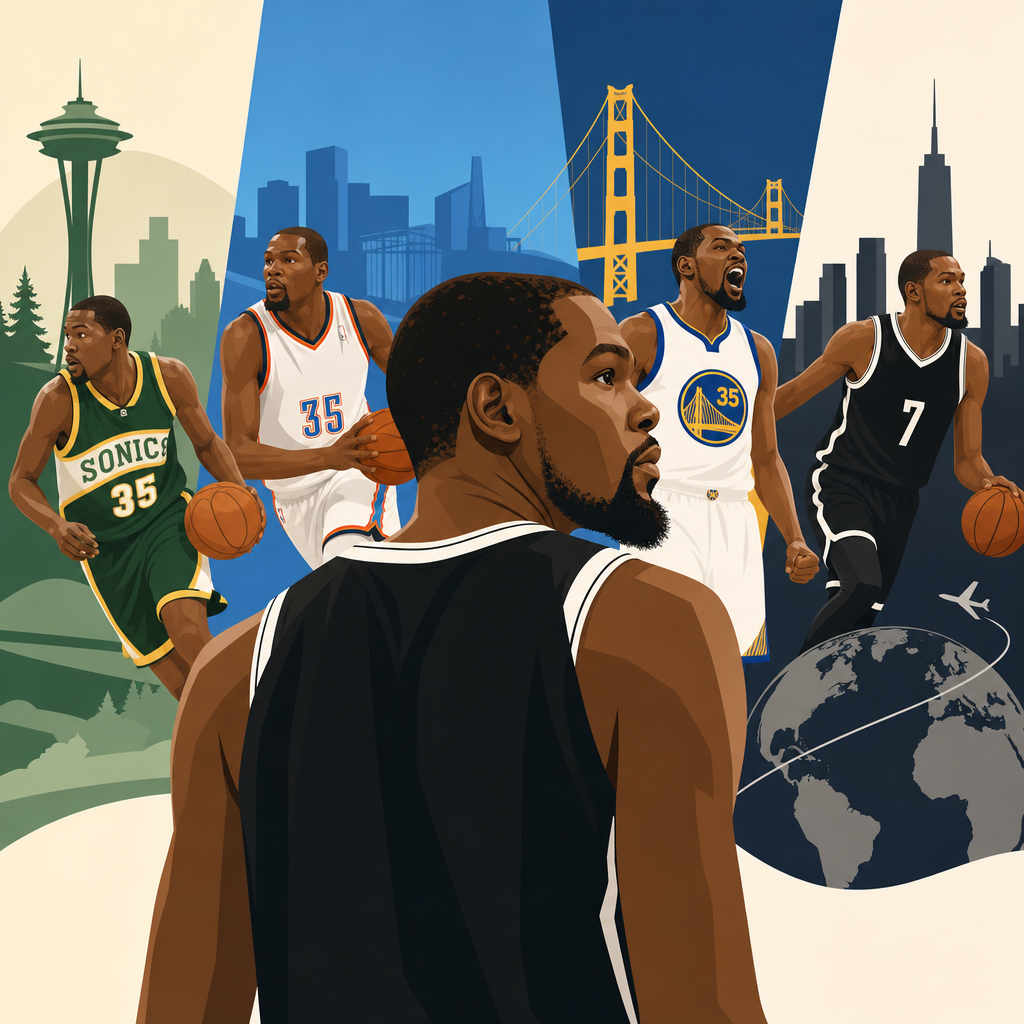
Kevin Durant’s career story traces one of the most consequential paths in modern basketball, moving from the Seattle SuperSonics to the Oklahoma City Thunder, then to the Golden State Warriors, Brooklyn Nets, and Phoenix Suns while reshaping how fans discuss scoring, loyalty, team-building, and greatness. As a player profile hub within the broader NBA Players topic, this article explains Durant’s development, playing style, milestones, controversies, and long-term significance in plain terms. Durant is not simply a prolific scorer; he is a seven-foot wing creator whose combination of shot-making, ball handling, rim protection, and efficiency changed roster construction across the league. I have followed Durant’s career since his Texas season and have seen firsthand how coaches, scouts, and analysts talk about his uncommon release point, his off-ball gravity, and his ability to function as both a first option and a system enhancer.
Understanding Durant matters because his journey mirrors larger NBA shifts. His move from a small-market contender to a superteam fueled debates about player empowerment. His Achilles injury and elite return informed discussions about sports medicine and longevity. His later moves to Brooklyn and Phoenix showed both the promise and instability of star-driven roster building. Any complete Kevin Durant career story must cover the Seattle draft context, the Thunder’s rise, the Warriors championships, the Nets experiment, and the Suns chapter, while also addressing his Olympic success, awards, and where he ranks among the greatest scorers ever. For readers exploring NBA player profiles, Durant is a central case study in how talent, timing, health, and decision-making shape a Hall of Fame career.
Early life, Texas breakout, and the Seattle beginning
Kevin Wayne Durant was born on September 29, 1988, in Washington, D.C. He developed through the area’s highly competitive basketball pipeline, playing for schools including National Christian Academy, Oak Hill Academy, and Montrose Christian. Even before the NBA, he stood out for a rare skill package: guard instincts in a near-center frame. At the University of Texas in 2006-07, Durant averaged 25.8 points and 11.1 rebounds, won the Naismith College Player of the Year award as a freshman, and established himself as a top prospect despite concerns from some evaluators about his lean build. Those concerns now look outdated. What mattered was his functional scoring versatility: transition pull-ups, weak-side shot blocking, jab-step jumpers, and advanced touch from all levels.
The Seattle SuperSonics selected Durant second overall in the 2007 NBA draft, behind Greg Oden. In Seattle, Durant’s rookie season was more than a preview. He averaged 20.3 points per game, won Rookie of the Year, and immediately proved he could carry volume on a rebuilding team. The Sonics finished 20-62, but the environment forced Durant to learn difficult offensive reps early. He saw traps, late-clock isolations, and top-defender assignments every night. That accelerated his growth. Seattle’s final season also positioned Durant at the center of a historic franchise transition. When the team relocated in 2008, Durant became the foundational star for a new identity in Oklahoma City, even though the roots of his NBA story began in the Pacific Northwest.
Oklahoma City Thunder rise and the making of a superstar
When the franchise became the Oklahoma City Thunder in 2008-09, Durant’s development aligned with one of the strongest young cores the league had seen. General manager Sam Presti added Russell Westbrook, James Harden, Serge Ibaka, and key role players, while coach Scott Brooks fostered a high-energy culture built on pace, length, and relentless pressure. Durant averaged 25.3 points in the first Thunder season, then jumped to 30.1 in 2009-10 and won the first of four scoring titles. By age 21, he had become an elite offensive engine. What separated him was not just shot volume, but economy. He scored efficiently from the midrange, the foul line, and the arc without needing a traditional post-heavy diet.
From 2010 through 2014, Durant was a fixture in the MVP conversation. He made repeated deep playoff runs and reached the 2012 NBA Finals, where Oklahoma City defeated Dallas, the Lakers, and San Antonio before losing to Miami. That postseason highlighted both Durant’s brilliance and the thin margins of title contention. He averaged 28.5 points per game in the Finals and looked capable of dominating any defense, yet Miami’s experience and defensive connectivity won out. In 2013-14, with Westbrook missing stretches, Durant delivered the best regular season of his Thunder tenure. He averaged 32.0 points, 7.4 rebounds, and 5.5 assists, won league MVP, and gave a memorable speech that emphasized gratitude and accountability. At that point, Durant had fully evolved from gifted scorer to complete offensive leader.
| Team | Years | Why the stop mattered |
|---|---|---|
| Seattle SuperSonics | 2007-08 | Rookie season, Rookie of the Year, first proof he could score at NBA volume |
| Oklahoma City Thunder | 2008-2016 | MVP, four scoring titles, 2012 Finals run, rise into the league’s elite tier |
| Golden State Warriors | 2016-2019 | Two championships, two Finals MVPs, peak efficiency in a historic system |
| Brooklyn Nets | 2019-2023 | Achilles comeback, MVP-level play, unstable superteam experiment |
| Phoenix Suns | 2023-present | Late-career contention push, continued elite scoring and lineup versatility |
The Thunder years also carried the defining “what if” questions of Durant’s legacy. Oklahoma City traded James Harden in 2012, then dealt with injuries that repeatedly disrupted championship windows. In 2013, Westbrook’s knee injury changed the playoff path. In 2015, Durant’s foot issues limited him to 27 games. In 2016, the Thunder led the 73-win Warriors 3-1 in the Western Conference finals before losing the series. I remember that run as the point when Durant’s strengths and limits were both amplified. He was devastating in space and capable as a defender, but the team’s half-court creation often tightened under pressure. That collapse set up the most controversial decision of his career.
Golden State move, championships, and the superteam debate
Durant signed with the Golden State Warriors in July 2016, joining Stephen Curry, Klay Thompson, and Draymond Green on a team that had just won 73 games. The move triggered immediate backlash because it felt less like a transfer and more like a competitive shortcut to many fans. That criticism has never fully disappeared, but the basketball fit was undeniable. Golden State’s motion offense reduced the burden of creating every possession from scratch, and Durant’s presence solved the one issue the Warriors occasionally faced in high-leverage playoff moments: a half-court scorer who could rise over any defender and get a clean look. In practical terms, Durant made an already elite attack nearly unsolvable.
On the floor, his Warriors tenure was brilliant. In 2016-17, Golden State went 16-1 in the playoffs and won the title over Cleveland. Durant averaged 35.2 points in the Finals and won Finals MVP, punctuated by his pull-up three over LeBron James in Game 3, one of the signature shots of the era. The Warriors repeated in 2017-18, again beating Cleveland, with Durant winning a second Finals MVP after averaging 28.8 points, 10.8 rebounds, and 7.5 assists in the series. Beyond the trophies, Durant’s all-around game matured. He defended the rim as a weak-side helper, passed more decisively from the elbows, and accepted off-ball movement within Steve Kerr’s structure. The tradeoff was narrative: his skill was unquestioned, but many observers weighed those championships differently because of the roster context.
The final Warriors season in 2018-19 showed both the power and fragility of the arrangement. Internal tension surfaced publicly, most memorably in Draymond Green’s on-court outburst toward Durant. Then injuries changed everything. Durant strained his calf in the playoffs, returned in the Finals against Toronto, and ruptured his Achilles tendon in Game 5. That injury was devastating not only because it ended Golden State’s title chase, but because Achilles ruptures historically altered careers. Before leaving, however, Durant had already cemented his place in Warriors history. He did not merely join a champion; he raised the team’s offensive ceiling and gave it a level of shot creation almost no defense could survive.
Brooklyn comeback, Phoenix chapter, and how Durant actually plays
Durant signed with the Brooklyn Nets in 2019, even while rehabbing the Achilles injury, a major vote of confidence from the franchise. He missed the entire 2019-20 season, then returned in 2020-21 looking shockingly close to his peak. That comeback remains one of the most impressive recoveries in NBA history. Durant averaged 26.9 points in the regular season and nearly carried Brooklyn past Milwaukee in the 2021 playoffs, including a 49-point triple-double in Game 5 and the famous Game 7 shot that was a two-pointer because his foot touched the line. If that shoe is half an inch back, the entire Nets era might be remembered differently. Instead, Brooklyn became a lesson in volatility. Injuries, Kyrie Irving’s part-time availability, and James Harden’s eventual exit prevented continuity.
Even so, Durant’s individual level in Brooklyn was elite. He remained a three-level scorer, averaging over 29 points per game in both 2021-22 and 2022-23 before the trade. His game at this stage relied less on explosive burst and more on surgical timing. He used high release jumpers from the nail, patient pick-and-roll reads, and selective drives to create efficient offense. Defensively, he still offered value as a weak-side shot blocker and switchable helper, though heavy offensive loads affected consistency. When Brooklyn’s experiment unraveled, Durant was traded to the Phoenix Suns in 2023. In Phoenix, he joined Devin Booker and later Bradley Beal, giving the Suns enormous shot-making but also raising familiar questions about depth, health, and roster balance.
To understand Durant across every stop, start with his style. He is one of the best pure scorers the NBA has produced because he has no obvious defensive answer. Smaller defenders cannot contest his release. Bigger defenders struggle with his handle and face-up speed. He scores from isolations, pindowns, transition, post mismatches, and pick-and-rolls. His career free-throw percentage has stayed around 88 percent, which reflects touch and late-game reliability. He has also exceeded 50 percent from the field multiple times despite taking difficult jumpers. The best shorthand is simple: Durant combines the efficiency profile of a big with the shot diet of an elite perimeter star. That is why he has remained dominant across systems, teammates, and injury setbacks.
Legacy, records, Olympic dominance, and where Durant ranks
Durant’s legacy rests on production, adaptability, and historical standing. He has won an NBA MVP, multiple scoring titles, two championships, two Finals MVPs, and numerous All-NBA selections. He entered the league in 2007 and quickly built one of the most efficient high-volume scoring resumes ever recorded. By the mid-2020s, he had climbed into the top tier of the NBA’s all-time scoring list, a remarkable feat given the missed season after his Achilles tear and several other injury interruptions. Advanced metrics consistently support his impact. His true shooting percentage has remained elite for a player with such difficult shot creation responsibilities, and his playoff scoring volume compares well with nearly any wing in league history.
Internationally, Durant has been even more definitive. He became the United States men’s national team’s all-time leading Olympic scorer and won four Olympic gold medals, including key roles in London 2012, Rio 2016, Tokyo 2020, and Paris 2024. In FIBA settings, where spacing and physicality differ from the NBA, Durant’s skill set travels perfectly. He can score without needing many dribbles, punish switching, and close games from midrange when defenses take away the rim. That international record strengthens his historical case because it shows his game is not system-dependent. When discussions turn to where Durant ranks among all-time small forwards and scorers, the consensus is clear on one point: he belongs in the inner circle. The exact slot depends on how heavily someone weighs championships, context, and longevity.
For readers using this page as an NBA player profiles hub, Durant offers a complete framework for studying modern stardom. He shows how a prospect becomes a franchise anchor, how roster context influences public judgment, and how elite skills age when athleticism changes. He also demonstrates that legacy is never built on talent alone. Team fit, injuries, front office choices, and timing matter. The simplest takeaway is this: Kevin Durant is one of basketball’s greatest scorers, one of its most adaptable superstars, and one of the defining players of his era. If you are exploring NBA players in depth, use Durant’s career as a reference point, then continue to related player profiles to compare how different stars reached greatness through very different paths.
Frequently Asked Questions
How did Kevin Durant’s NBA journey begin with the Seattle SuperSonics and continue into Oklahoma City?
Kevin Durant entered the NBA in 2007 as the second overall pick in the draft, selected by the Seattle SuperSonics after a brilliant one-year college season at Texas. Even at that early stage, he stood out as an unusually advanced scorer for his age. He had the height of a big man, the ball skills of a guard, and a natural ability to create shots from almost anywhere on the floor. His rookie season in Seattle immediately showed why he was viewed as a franchise-changing talent, and he won Rookie of the Year despite playing for a team in transition.
That transition became historic when the franchise relocated and became the Oklahoma City Thunder in 2008. Durant’s story is therefore tied to two eras of the same organization: the final chapter in Seattle and the formative rise of a new team in Oklahoma City. With the Thunder, he developed from a promising young star into one of the best players in the league. Alongside players like Russell Westbrook and James Harden, Durant helped transform Oklahoma City into a contender. The Thunder reached the NBA Finals in 2012, and Durant established himself not just as a prolific scorer, but as the face of a small-market team capable of competing with the league’s biggest brands. That stretch is essential to understanding his legacy because it shaped the image of Durant as a homegrown superstar who could lead a franchise from rebuilding to relevance.
What made Kevin Durant such a unique and dominant scorer throughout his career?
Durant’s scoring ability has always been the foundation of his greatness, and what makes him special is how difficult he is to defend within the normal rules of basketball. At nearly seven feet tall with a long wingspan, he can shoot over smaller defenders with ease. At the same time, he moves with the fluidity of a wing player, which allows him to handle the ball, change direction, and attack off the dribble in ways that taller players typically cannot. That combination creates matchup problems that few players in league history have presented so consistently.
He is not just a volume scorer, either. Durant has built his reputation on efficient scoring from all three levels. He can hit pull-up jumpers in the mid-range, finish at the rim with length and touch, and stretch defenses with three-point shooting. He is also highly effective at the free-throw line, which adds to his efficiency and punishes overly aggressive defenders. Over the years, Durant has won multiple scoring titles because he can adapt to almost any defensive scheme. If a team switches smaller defenders onto him, he shoots over them. If bigger defenders try to crowd him, he uses his quickness and ball handling to get by them. If help defense arrives, he has become a capable passer who can punish double teams.
Another reason Durant’s scoring has aged so well is that it does not depend only on explosive athleticism. His game is built on skill, balance, timing, and shot-making touch. That is why he has remained elite across multiple teams and different stages of his career. Whether in Oklahoma City, Golden State, Brooklyn, or Phoenix, his offensive style has translated because it is fundamentally scalable and difficult to scheme against. In the broader conversation about all-time scorers, Durant is regularly included because he combines production, versatility, and efficiency at a level very few players have matched.
Why was Kevin Durant’s move to the Golden State Warriors so controversial?
Durant’s 2016 decision to leave the Oklahoma City Thunder and sign with the Golden State Warriors remains one of the most debated moves in modern sports. The controversy came from both the timing and the destination. Durant had just been part of a Thunder team that led the Warriors 3-1 in the Western Conference Finals before losing the series. Golden State had also just completed a 73-win regular season, the best in NBA history at the time. So when Durant joined that team, many fans saw it as a superstar leaving a legitimate contender to join the very team that had beaten him.
Critics argued that the move disrupted competitive balance and made an already dominant team nearly unbeatable. For many observers, it also changed the way people discussed loyalty, rivalry, and championship pursuit. Durant had spent years building his image as the centerpiece of Oklahoma City, and his exit felt to some fans like the end of a traditional star-franchise bond. The backlash was intense because people were not just reacting to a basketball fit; they were reacting to what the decision symbolized in the larger culture of the NBA.
At the same time, there is another side to the story. Durant made a basketball decision that clearly worked on the court. In Golden State, he won two NBA championships and two Finals MVP awards, proving he could thrive under the biggest pressure and on the biggest stage. He was not simply riding along with a great team; he was central to its highest achievements. His time with the Warriors also demonstrated his adaptability. He fit into a motion-heavy offense, defended at a high level, and delivered elite shot creation in playoff moments. The controversy endures because both realities are true: the move changed how fans viewed him, but it also strengthened his résumé as one of the defining players of his era.
What happened during Kevin Durant’s later years with the Brooklyn Nets and Phoenix Suns?
After leaving Golden State, Durant joined the Brooklyn Nets in a sign-and-trade move that represented another major career pivot. Brooklyn was supposed to be the next stage of Durant’s superstar story, one in which he could build a contender on new terms. However, that period became complicated by injuries, roster instability, and constant change. Durant missed significant time recovering from the Achilles injury he suffered during the 2019 Finals, one of the most serious setbacks any elite player can face. His eventual return was impressive because he still looked like an elite scorer and impact player, but the Nets as a team never achieved the stability many expected.
The Brooklyn era featured enormous talent but limited continuity. Injuries, lineup disruptions, and off-court drama often overshadowed the team’s potential. Durant still produced at an extremely high level and had stretches where he looked every bit like one of the best players in the world. One of the most memorable examples came during the 2021 playoffs, when he delivered a remarkable series against the Milwaukee Bucks and nearly carried Brooklyn forward by himself. Even so, the Nets never reached the Finals, and the project ultimately fell short of its championship expectations.
Durant’s move to the Phoenix Suns marked yet another chapter in a career defined by major transitions. In Phoenix, he joined another win-now situation built around elite scoring and postseason ambition. The Suns viewed Durant as the kind of player who could elevate a strong team into a true title threat because of his half-court scoring, playoff experience, and ability to perform under pressure. His time in Phoenix has continued to reinforce the central theme of his career: wherever he goes, the discussion immediately shifts to championship possibility. Even as teams and circumstances change, Durant remains one of the league’s clearest examples of a superstar whose presence alone alters expectations.
What is Kevin Durant’s long-term legacy in NBA history?
Durant’s long-term legacy is likely to be one of the most layered and fascinating of any modern NBA star. On pure basketball ability, he is already firmly established as one of the greatest scorers the league has ever seen. His combination of size, shooting touch, off-the-dribble skill, and efficiency has influenced how teams evaluate and develop tall perimeter players. In many ways, Durant helped normalize the idea that a near-seven-footer could function like a complete offensive creator rather than just a traditional forward or center.
His legacy also includes major milestones and accolades that place him among the game’s elite. He has won MVP honors, multiple scoring titles, NBA championships, Finals MVP awards, and Olympic gold medals, all while maintaining extraordinary statistical production over a long period. Those accomplishments alone would make him a defining player of his generation. But Durant’s significance goes beyond awards. He has been central to major debates about player movement, superteams, competitive balance, and how fans judge greatness in an era where stars have more control over their careers.
That is why Durant’s story continues to matter so much in the broader NBA conversation. Some fans focus on his scoring genius and his ability to succeed in multiple environments. Others focus on the decisions that shaped public opinion about him, especially his departure from Oklahoma City and his role in the Warriors dynasty. Both perspectives are part of the full picture. Ultimately, Durant’s career is important because it captures the complexity of modern superstardom: elite talent, historic production, intense scrutiny, and constant debate about what greatness should look like. Whether someone views him primarily as a basketball artist, a transformational scorer, or a controversial symbol of the player-empowerment era, his place in NBA history is secure.