
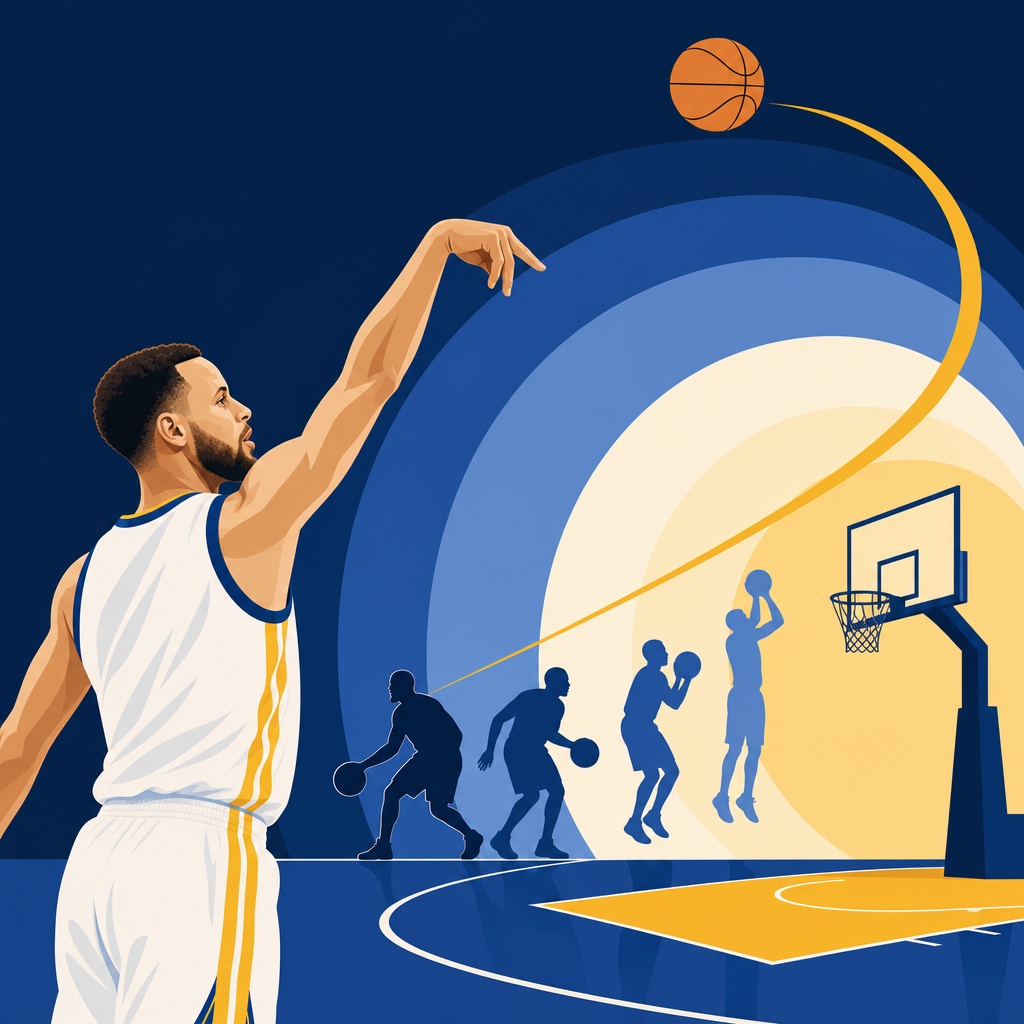
Stephen Curry changed professional basketball more profoundly than any perimeter player since Michael Jordan. His career is the clearest explanation for the NBA’s three-point revolution, a league-wide transformation in shot selection, spacing, skill development, and roster construction. A player profile of Curry cannot stop at awards and statistics, because his importance lies in how one shooter altered the geometry of the court and the logic of offense. When coaches, scouts, and front offices now talk about gravity, efficiency, volume shooting, relocation, and deep range, they are usually describing concepts Curry pushed from novelty to standard practice.
For an NBA Players hub focused on player profiles, Curry is the ideal central case study because his story connects biography, technique, strategy, and historical impact. He is a two-time MVP, four-time champion, and the all-time leader in made three-pointers, but those facts only frame the larger point. The three-point revolution refers to the shift toward generating more shots from beyond the arc because they produce more expected value than long two-pointers. That change had been building for years through analytics departments and coaches like Mike D’Antoni, yet Curry turned the argument into a spectacle the entire sport could understand instantly.
What makes this topic matter is that Curry did not simply benefit from a changing league; he accelerated and personalized it. Youth players now practice pull-up threes off movement. Defenders pick up ball handlers near half court. Big men are expected to survive in space. Teams design offenses around spacing five players to the perimeter and forcing impossible help decisions. I have covered player development conversations where trainers mention “Curry range” as if it were a standard benchmark, even though it still represents an outlier skill. Understanding Curry means understanding how a single player can reshape habits from grassroots basketball to championship-level strategy.
This hub article covers Curry as both an individual star and a model for evaluating modern player profiles. It explains his rise, the technical traits behind his shooting, the Warriors system that amplified him, the statistical evidence of league change, the copycat effects across roster building, and the limits of trying to reproduce his style. If you want one player profile that also explains the modern NBA, Stephen Curry is the starting point.
From Davidson phenom to franchise cornerstone
Curry’s revolution began before he entered the NBA, but not in the way superstar origin stories usually unfold. He was lightly recruited, played at Davidson, and became a national star during the Wildcats’ 2008 tournament run. What stood out then was not only accuracy but degree of difficulty. Curry thrived on movement, fast releases, and shots taken under real pressure. NBA teams still had doubts about his size, defensive ceiling, and position. That hesitation now looks outdated, yet it reflected the league’s older assumptions: primary creators were expected to fit traditional physical molds, and extreme perimeter volume was still treated cautiously.
Selected seventh overall by Golden State in 2009, Curry entered a franchise without the infrastructure or prestige associated with dynastic beginnings. Early ankle injuries threatened his trajectory. The turning point came when the Warriors invested in his long-term health, paired him with Klay Thompson, and gradually built a roster that maximized passing, shooting, and defensive versatility. By the time Steve Kerr replaced Mark Jackson in 2014, Golden State had the personnel to unlock a more fluid version of offense. Curry’s profile shifted from gifted scorer to the central organizing force of the sport’s most influential team.
His 2014-15 MVP season made him the face of a contender; his 2015-16 unanimous MVP campaign changed the language of what was considered a good shot. Curry averaged 30.1 points, made 402 threes, and often pulled up from distances that previously belonged to end-of-clock desperation. Defenses knew what was coming and still failed to contain it. That season became a blueprint and a warning. It showed that elite shooting could function not as a complement to star play, but as the engine of a championship-level offense.
The shooting mechanics that made the revolution believable
Curry’s influence rests on skill, not myth. His shooting mechanics are unusually efficient and repeatable. He generates power from his lower body without a dramatic dip, which allows an exceptionally fast release. His footwork is elite whether he is stepping into a catch-and-shoot attempt, drifting to the corner after a pass, or flowing from a handoff into a pull-up three. He keeps the ball tight to his frame, limiting the time defenders have to contest. The result is a shot that scales from stationary attempts to high-speed movement better than almost any jumper the league has seen.
Range matters, but range alone is not the whole profile. Many players can shoot from thirty feet in workouts. Curry does it in games, against traps, with changing angles, while reading second and third defenders. That is where technique meets decision-making. He knows when a defender is top-locking him off screens, when a big is dropping too deep, and when transition confusion offers a one-second opening. His shot preparation is as advanced as his touch. In player development terms, he merges balance, compact release mechanics, proprioception, and processing speed at an historic level.
Equally important is stamina. Curry’s shooting is inseparable from conditioning because his offense depends on nonstop relocation. He gives up the ball, sprints through traffic, changes direction, then catches ready to fire. Tracking data and film both show how exhausting it is to guard him over an entire possession, let alone a playoff series. Coaches often describe this as “cardio pressure.” Even possessions that end with another Warrior scoring can begin with Curry forcing two defenders to chase him through multiple actions. That invisible workload is part of the revolution.
Gravity: the word Curry made essential
If one concept defines Curry’s player profile, it is gravity. Offensive gravity means a scorer bends defenders toward him even when he does not touch the ball. Curry’s gravity is the strongest perimeter version the NBA has documented. Defenders deny him at thirty feet, switch preemptively, and send help earlier than schemes normally require. Those reactions create layups, slips, open corners, and short-roll passing opportunities for teammates. Draymond Green became one of the league’s most dangerous playmaking bigs partly because Curry’s gravity turned four-on-three situations into a routine feature of Golden State’s attack.
This matters because box-score scoring alone understates Curry’s effect. Traditional player profiles might list points, assists, and percentages, but those numbers miss the defensive panic he creates. Watch Golden State’s split actions or high pick-and-rolls and the pattern is clear: two defenders commit to Curry, the back line shifts, and the offense finds the next advantage. In coaching clinics, this is often discussed as advantage basketball. Curry reliably creates the first advantage before the official play even develops fully.
The gravity concept also explains why Curry fit so seamlessly next to other stars, including Kevin Durant. Some high-usage superstars reduce teammates to spot-up roles. Curry’s movement has the opposite effect. Because he can score without monopolizing the ball, others can operate while still benefiting from his presence. That trait is central to modern player evaluation. The best offensive stars are not only efficient creators; they are ecosystem creators. Curry set the standard.
How the Warriors system magnified his strengths
Golden State’s dynasty was not created by one player alone, but the system was built around Curry’s unusual properties. Kerr’s offense drew from the triangle, motion principles, and Gregg Popovich-style ball movement, then adapted them for a roster loaded with passing and shooting. Instead of static isolations, the Warriors used split cuts, flare screens, pistol actions, and dribble handoffs to keep defenses occupied. Curry’s willingness to move after passing turned every action into a chain reaction. Opponents could survive one screening action; they usually could not survive three.
Klay Thompson’s shooting prevented defenses from overloading one side. Green’s processing as a short-roll passer punished traps. Andre Iguodala connected possessions with quick reads. Later lineups with Durant made the choices even uglier for defenses. I have always thought the most important detail of the Warriors era was not just talent concentration, but fit concentration. Every core player amplified Curry’s strengths while Curry amplified theirs. That is why the system endured across different supporting casts.
| Element | How it helped Curry | How Curry helped it |
|---|---|---|
| Spacing | Opened driving and pull-up lanes | Forced defenders to extend far beyond the arc |
| Draymond short roll | Turned traps into four-on-three advantages | Drew the second defender automatically |
| Off-ball screening | Created catch-and-shoot windows | Made every screen more urgent to defend |
| Small-ball lineups | Increased pace and playmaking space | Punished centers who could not guard in space |
The broader lesson for player profiles is that context matters. Curry could have been great anywhere, but his full revolutionary force required organizational alignment. Golden State drafted well, embraced modern spacing, trusted skill over convention, and committed to a style that matched its best player’s strengths. That is how talent becomes era-defining influence.
The statistical proof behind the three-point revolution
The NBA was already moving toward more threes before Curry’s peak, but his rise corresponded with a dramatic acceleration. In 2011-12, teams averaged about 18.4 three-point attempts per game. By 2015-16, during Curry’s unanimous MVP season, that figure was roughly 24.1. By the early 2020s, it climbed past 34 per game. League strategy shifted because the math was undeniable: a 36 percent three-pointer yields the same expected value as a 54 percent two-pointer. Curry turned that arithmetic into nightly evidence on the biggest stage.
His personal numbers shattered old assumptions. Before Curry, making 300 threes in a season sounded extreme. He made 286 in 2014-15, then 402 in 2015-16. Defenses were not giving him clean specialist looks; they were built entirely around stopping him. That volume and efficiency combination changed scouting priorities. Pull-up three-point percentage, deep range, off-movement shooting, and release versatility became premium traits. Teams also downgraded the midrange attempts that once defined star shot profiles unless those looks came from truly elite specialists.
The revolution also appeared in youth and international basketball. High school players began extending range earlier. Big men trained corner threes and pick-and-pop footwork. NBA Draft evaluations increasingly rewarded shooting indicators across positions. Not every trend was healthy; plenty of young players copied Curry’s audacity without copying his discipline or technique. Still, the strategic center of gravity had moved. The league now treats spacing as infrastructure, not luxury.
What rivals copied, and what they could not
Every team wanted “the next Stephen Curry,” but most discovered that copying the surface is easier than reproducing the substance. The easy part was increasing three-point volume. The hard part was finding a guard who combines all-time shooting with elite handle, constant movement, rapid decision-making, and enough endurance to weaponize those traits for forty minutes. Damian Lillard matched the deep pull-up threat in many stretches. Trae Young imported long-range shooting into high pick-and-roll orchestration. Luka Doncic, while stylistically different, benefited from the league-wide acceptance of step-back threes as a primary weapon. Yet none are replicas.
The limits of imitation are important for any serious player profile. Curry did not prove that every offense should become a freelance shooting contest. He proved that spacing, pace, and perimeter skill create superior scoring environments when paired with judgment. Teams that chased threes without building passing, screening, and defensive versatility often stalled. Houston under D’Antoni came closest to a parallel model, using James Harden’s isolation brilliance and extreme shot-value discipline to push Golden State repeatedly. Even that version looked very different from Curry’s movement-based ecosystem.
Curry also changed defense. Opponents now prioritize point-of-attack containment, switchable wings, and bigs who can survive higher on the floor. The search for rangy defenders who can both navigate screens and recover to shooters intensified because of matchups like Golden State. In that sense, Curry rewired not only offenses, but the job descriptions of players asked to stop them.
Legacy, nuance, and what this player profile teaches
Curry’s legacy is secure because it combines individual greatness with structural impact. He is not just one of the best guards ever; he is one of the players who changed what basketball asks from everyone else. That said, nuance matters. The three-point revolution did not begin with him alone, and the modern NBA still requires balance. Championships still depend on defense, rim pressure, rebounding, health, and adaptable shot creation when playoff opponents remove first options. Curry’s career supports analytics, but it also supports craft. The numbers worked because his skills were extraordinary and his team context was smart.
For an NBA Players hub built around player profiles, this is the key takeaway: the best profiles explain influence, not just résumé lines. Curry’s biography, mechanics, tactics, and ripple effects belong in one conversation because each part clarifies the others. He made the three-pointer the league’s most powerful symbol, but more importantly, he showed how one player can change spacing, training, and team building across an entire sport. Explore the rest of this player profiles hub with that lens. The most revealing stars are the ones who alter the game after them.
Frequently Asked Questions
Why is Stephen Curry considered the face of the NBA’s three-point revolution?
Stephen Curry is widely seen as the face of the NBA’s three-point revolution because he did more than make a lot of threes—he changed what teams believed was possible, efficient, and repeatable on offense. Before Curry, the three-point shot was often treated as a useful supplement, something teams used to space the floor or generate extra value in specific situations. Curry helped turn it into the organizing principle of modern offense. His combination of deep range, lightning-quick release, off-ball movement, ball-handling, and shot-making under pressure forced defenses to guard far beyond the traditional perimeter, which stretched the court in ways the league had never fully experienced.
What made Curry revolutionary was not just volume, but context. He could hit threes off the dribble, in transition, from several feet behind the arc, coming off screens, relocating after giving up the ball, or under heavy defensive attention. That versatility made the shot itself more dangerous and more scalable. Coaches and executives across the league saw that if one player could bend an entire defense with shooting gravity, then spacing, pace, and perimeter skill could become the foundation of winning basketball. In that sense, Curry was not just a great shooter. He was the proof of concept for a new basketball economy, one in which shot value, floor spacing, and offensive geometry became central to roster construction and game planning.
How did Curry’s playing style change the geometry of the court?
Curry changed the geometry of the court by expanding the area defenses had to treat as dangerous. Traditionally, defenses were most concerned with the paint, the mid-post, and the standard three-point line. Curry pushed that threat zone several feet farther out, which may sound subtle but had enormous tactical consequences. When defenders had to pick him up near half court or navigate multiple screens just to prevent a pull-up three, the floor effectively became wider and longer. That created more driving lanes, cleaner passing angles, and more room for cutters, rollers, and secondary shooters.
His impact was especially powerful because of his off-ball movement. Curry does not simply stand still after passing. He relocates, sprints through traffic, uses screens, and forces defenders into split-second decisions. If they trail him, he can catch and shoot. If they switch, he may create a mismatch elsewhere. If two defenders commit to him, someone else is left open. This is why his influence went beyond his own scoring totals. He altered the shape of every possession. Big men were pulled away from the rim, help defenders were delayed, and weak-side defenders were pinned in place by the fear of a kick-out three. In practical terms, Curry turned shooting into a spatial weapon, not just a scoring skill.
Did Stephen Curry alone cause the NBA to prioritize three-point shooting?
No, the NBA’s shift toward three-point shooting was already being supported by analytics, rule changes, and broader offensive innovation, but Curry became the player who accelerated and embodied that shift more clearly than anyone else. Front offices had increasingly recognized that three-pointers and shots at the rim were generally more efficient than long midrange attempts. Coaches were also beginning to emphasize pace, spacing, and ball movement. However, theories and spreadsheets do not transform a league by themselves. Players do. Curry supplied the most compelling on-court demonstration that a perimeter-centered, high-volume three-point attack could power an elite offense and win championships.
That distinction matters. He was not the only cause of the revolution, but he became its most visible and influential catalyst. Teams watching Curry and the Warriors saw a style that was not merely analytically sound but aesthetically devastating and competitively dominant. Young players began training deeper range earlier. Coaches at every level gave shooters more freedom. Scouts started valuing skill, shooting versatility, and decision-making in ways that would have seemed less urgent in earlier eras. So while the revolution had multiple parents—analytics departments, innovative coaches, changing player development systems—Curry was the player who made the revolution undeniable.
How did Curry’s success influence roster construction and player development across the league?
Curry’s success reshaped roster construction by increasing the premium on shooting, ball-handling, versatility, and basketball intelligence at nearly every position. Once teams saw how devastating elite spacing could be, they began seeking lineups filled with players who could pass, dribble, and shoot rather than relying heavily on traditional specialists with limited offensive range. Big men were increasingly expected to defend in space, set screens, make quick reads, and in many cases stretch the floor themselves. Wings who once might have survived without a reliable jumper suddenly became harder to build around. Guards were expected not only to initiate offense, but also to threaten defenses from deep.
Player development changed just as dramatically. Younger players began practicing off-the-dribble threes, movement shooting, and deep-range shot creation much earlier in their development. Trainers and coaches became more open to shots that had once been labeled reckless, provided the player had the skill to make them efficiently. Curry’s game also reinforced the importance of conditioning, footwork, and decision-making. His shooting brilliance is inseparable from his stamina and movement. That lesson filtered down through basketball culture: modern skill is not just about having range, but about being able to weaponize it within the flow of the game. As a result, the league increasingly invested in multi-skilled players who could keep an offense spaced, fast, and unpredictable.
What is Stephen Curry’s long-term legacy in NBA history beyond records and championships?
Stephen Curry’s long-term legacy goes far beyond MVP awards, championships, or three-point records because his true significance lies in how he changed the logic of professional basketball. Many all-time great players dominate within the existing structure of the sport. Curry altered that structure. He helped redefine what a superstar could look like, how an offense could be built, and which skills became most valuable in the modern era. That is a rare kind of influence. His career shifted assumptions about acceptable shot selection, ideal spacing, and even the kinds of prospects teams prioritize in the draft.
Historically, that places him in a very small category of players whose impact extends beyond their own teams and generations. Curry did not just succeed in the NBA; he changed the sport’s direction. Future eras will still be measuring the aftereffects of his influence in youth coaching, international basketball, player archetypes, and team-building philosophy. When people say he “rewired” the NBA, they mean that he changed not only how the game is played, but how the game is imagined. That is the deepest form of basketball legacy: not just excellence, but transformation.