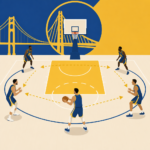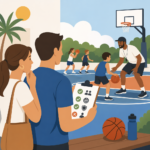

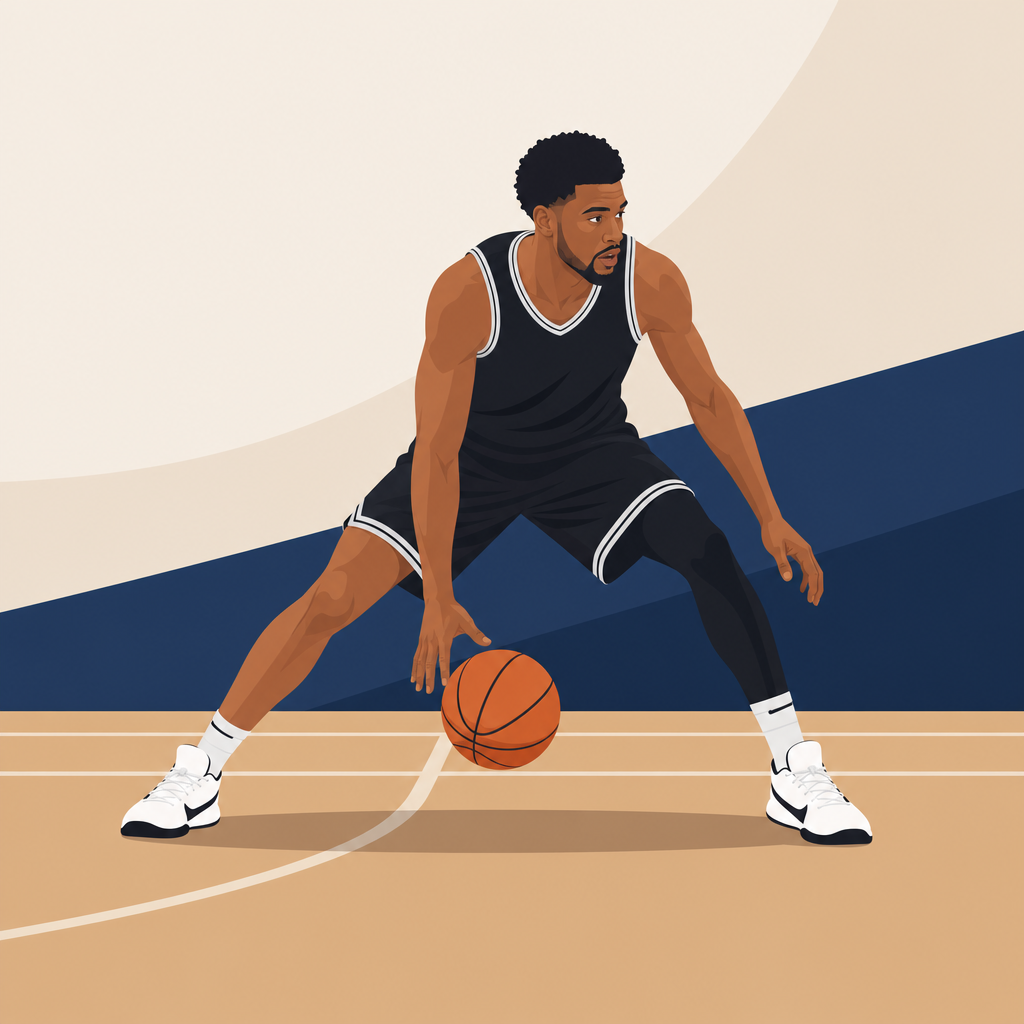
The between-the-legs dribble is one of basketball’s most useful ball handling skills because it changes direction while protecting the ball from a defender’s reach. In practical terms, the move sends the ball from one hand to the other through the space between the legs, usually while the dribbler shifts stance, hips, and angle. NBA guards rely on it not because it looks flashy, but because it creates cleaner driving lanes, tighter change-of-pace attacks, and safer transitions into pull-ups, hesitations, and step-backs. As a hub within Basketball Skills, this guide explains how the move works, why elite guards trust it, and how it connects to the full ball handling toolkit, including crossover mechanics, pacing, footwork, live dribble reads, and pressure control.
When I teach ball handling, I define control as the ability to move the ball where you want, on time, without losing posture or vision. That standard matters more than pure dribble creativity. A between-the-legs dribble only helps if it preserves balance, keeps the off hand legal and active, and moves the ball outside the defender’s line of attack. For younger players, the move often breaks down because they slap the ball, stand too tall, or swing the leg too late. For advanced players, the issue is different: the dribble becomes predictable, especially if they repeat the same rhythm every possession. The best guards solve both problems by pairing tight mechanics with read-based decision making.
Ball handling is the broader category that makes the between-the-legs dribble valuable. It includes stance, fingertip control, wrist snap, pound dribbles, in-and-out moves, split dribbles, retreat dribbles, and the ability to manipulate a defender’s hips. If you are building a complete ball handling foundation, treat this move as a connector rather than an isolated trick. It links one hand to the other under pressure, lets you attack from different angles, and opens counters when a defender cuts off the first action. That is why so many lead guards, from Chris Paul to Kyrie Irving to Shai Gilgeous-Alexander, use it at different tempos and from different starting positions.
Understanding the move also matters because defensive pressure has changed. Guards now face longer, more switchable defenders, more nail help, and more aggressive point-of-attack schemes. A basic open crossover can expose the ball for an extra beat; a well-timed between-the-legs dribble keeps it shielded by the lead leg and the body’s center line. Used correctly, it is a practical answer to modern defense. Used poorly, it stalls an offense and burns clock. The goal of this tutorial is to show exactly how NBA guards master the move, then place it inside a complete ball handling development plan so players, parents, and coaches know what to train next.
What the Between-the-Legs Dribble Does in Real Game Situations
The between-the-legs dribble is a protected transfer dribble. Its primary jobs are to change hands, shift the defender, and preserve attack position. Unlike a wide crossover, which can leave the ball exposed in front of the body, this move uses the front leg as a barrier. The ball travels low and diagonally, allowing the dribbler to keep shoulders over toes and chest over knees. In game terms, that means the player can reject pressure without giving up momentum.
One common use is against a defender who shades the strong hand. Imagine a right-handed guard bringing the ball up while the on-ball defender sits on the right hip to force the action left. A simple right-to-left crossover might drift too high, especially near the top of the key. A right-to-left between-the-legs dribble lets the guard step the left foot forward, punch the ball through low, and immediately attack downhill with the left hand. The same action works in tight spaces, such as when a guard turns the corner off a ball screen and a recovering defender reaches from behind.
It is also a timing move. Players often assume dribble moves are about speed alone, but NBA guards use pace changes more than raw quickness. Luka Doncic, for example, frequently slows the defender first, then uses a between-the-legs dribble to shift the angle before accelerating into contact or backing into space. The move becomes even more effective when paired with a hesitation, because the defender has to respect both the shot and the drive. In that sense, the dribble is not the finish of the possession; it is the bridge to the next advantage.
Technique Breakdown: Stance, Hand Position, Footwork, and Ball Path
Proper technique starts before the ball moves. The base should be wider than hip width, knees bent, hips loaded, and heels light. I cue players to keep their nose over their toes because standing upright raises the dribble and slows the transfer. Eyes should stay up, not fixed on the ball. At the hand level, the dribble is guided by the pads of the fingers, not the palm. The wrist snaps down, and the elbow stays compact so the ball is driven into the floor rather than pushed sideways.
Footwork decides whether the move is efficient or sloppy. On a basic stationary right-to-left between-the-legs dribble, the left foot steps slightly forward and outward. That creates a window for the ball and positions the body to attack left after the catch. The ball should hit the floor just inside the lead heel line, not out in front. If it lands too far ahead, the player reaches and loses posture. If it lands too close to the back foot, the ball clips the shoe or rises into the thigh. The receiving hand must meet the ball early, outside the knee, ready for the next dribble.
The ball path should be low, hard, and direct. Coaches sometimes tell players to “swing” the ball through the legs, but that often creates a looping motion. A better cue is punch and receive. The dribbling hand punches the ball down and across; the opposite hand receives it immediately into another live dribble or into a shot pocket. Ball handling improves fastest when players understand this path physically. Use a hardwood line, tape line, or painted seam as a target and keep every transfer crossing that same lane. Repetition with precise placement builds reliability under fatigue and pressure.
Why NBA Guards Use It More Effectively Than Most Players
NBA guards separate themselves through efficiency, not just creativity. Their between-the-legs dribble works because the move is tied to body positioning, defender reads, and next-action intent. Kyrie Irving is an obvious example. His transfers stay compact, his shoulders sell one direction, and his feet are always prepared for the next touch. When he goes between the legs, he is rarely dribbling for show. He is moving the defender’s chest off line, setting up a pull-up, or creating a better angle to finish with touch off either foot.
Chris Paul offers a different model. He uses the move to control pace and maintain his midrange comfort zones. In pick-and-roll, Paul often snakes the screen, keeps the defender on his back, then uses a low between-the-legs dribble to re-center the ball and force the big man to hesitate. That tiny hesitation is enough to unlock a foul-line jumper or pocket pass. The lesson is important: elite ball handling is about placing the ball where the defense cannot disrupt your next decision.
Shai Gilgeous-Alexander uses length and stride variation better than almost anyone. His between-the-legs dribble often comes with a glide step that keeps defenders uncertain about whether he is slowing down or accelerating. Because his shoulders stay relaxed and the ball remains low, defenders struggle to time digs. This is where advanced ball handling meets deception. The move is not faster than a crossover in every case, but it is often harder to read because the body and ball tell different stories for a split second.
| Player | Primary use of the move | What developing guards should copy |
|---|---|---|
| Kyrie Irving | Creating separation into pull-ups and finishes | Compact transfer, low ball path, balanced feet |
| Chris Paul | Repositioning in pick-and-roll and controlling pace | Patience, body shielding, next-read discipline |
| Shai Gilgeous-Alexander | Manipulating stride length and defender timing | Change of pace, long attacks, relaxed shoulders |
| Stephen Curry | Flowing into quick pull-up threes and re-attacks | Immediate shot readiness after the catch |
Common Mistakes That Break the Move
The first mistake is dribbling too high. A high transfer gives defenders more time to react and makes the ball vulnerable to digs from help defenders. If the ball rises above the knee on the transfer, the move is already less secure. The second mistake is poor timing between the leg step and the dribble. Many players move the foot after the ball starts down, which closes the window and causes awkward contact with the calf or shoe. The step must create the lane before the ball is punched through.
Another common issue is overusing the move without reading the defense. Ball handling drills can create false confidence because cones do not reach, bump, or angle their hips. In games, defenders sit on patterns. If you always go between the legs after two rhythm dribbles, smart defenders will load to the receiving hand. Advanced guards avoid this by changing cadence: one dribble, hold; hard pound, transfer; hesitation, transfer, retreat; or transfer into a split. Unpredictability matters as much as technical cleanliness.
Players also forget what their off hand should do. It cannot push off, but it should be active as a legal shield, bent at the elbow and ready to protect space. Meanwhile, the torso must stay over the ball. Leaning backward during the transfer usually means the player is trying to watch the move instead of feeling it. Finally, many athletes train only stationary reps. That helps beginners, but game ball handling requires movement, contact tolerance, and decision making. A move you own while standing still is not yet a move you own in traffic.
How to Train the Between-the-Legs Dribble Within a Complete Ball Handling Plan
The fastest way to improve is to progress from control to pressure. Start with stationary pound dribbles, alternating high and low rhythm, then add stationary between-the-legs reps at game speed. From there, move to walking transfers, then jogging, then full-speed advances and retreats. I prefer short sets with strict standards: ten perfect reps each side, eyes up, no foot contact, immediate next dribble. Sloppy volume teaches sloppy mechanics. Clean repetition builds dependable habits.
Next, connect the move to other core ball handling actions. A strong weekly plan should include crossover-to-between, between-to-hesitation, between-to-retreat, and between-to-pull-up sequences. This is where the move becomes a true hub skill. It links to nearly every important guard action. If your Basketball Skills training library includes separate lessons on crossover dribbles, hesitation moves, change of pace, and pick-and-roll reads, this page should point players there because mastery comes from combinations, not isolated tricks.
Use constraint drills to make the practice transfer to games. Put a chair or cone on the defender’s top foot and attack the outside hip after the transfer. Add a second cone at the nail to represent help defense and require a finish, floater, or kick-out read. Film ten reps from the side. If your shoulders rise during the move, the problem is usually in your base. If the ball loops, the issue is hand path. I have found that simple video review often speeds ball handling improvement more than adding another hundred random dribbles at the end of a workout.
Applying the Move Against Pressure, Screens, and Help Defense
Against full-court pressure, the between-the-legs dribble is valuable because it changes angle without exposing the ball in front of the body. The key is not to spam it. Use it when the defender opens one hip too far or reaches across your frame. Near the sideline, it can help you avoid being pinned, but only if you have room to attack the new lane. Otherwise, a retreat dribble is the better ball handling answer. The rule is simple: protect space first, then shift direction.
In pick-and-roll, the move shines when the guard needs to reject pressure or re-center after using the screen. Suppose a defender chases over the top and the big defender plays at the level. A low between-the-legs dribble can move the ball away from the trailing defender’s swipe while setting up the pocket pass or split. Smaller guards especially benefit because the transfer happens under the body’s shield. Watch how veteran point guards keep the dribble alive until the weak-side tagger commits; the move buys that extra half second.
Help defense changes the read. If the nail defender is sitting early, the transfer should usually lead to a pull-up, retreat, or swing pass rather than a forced drive into traffic. Good ball handling does not mean dribbling into crowds. It means maintaining options. The best guards treat the between-the-legs dribble as a way to stay organized under pressure. They can still pass on time, rise into a balanced jumper, or re-attack after the defense shifts. That versatility is what makes the move worth mastering.
How Players, Coaches, and Parents Can Measure Progress
Progress should be tracked with standards that reflect game usefulness. First, measure clean transfer percentage: out of fifty reps each direction, how many stay below the knee, avoid foot contact, and lead directly into the next action? Second, measure eyes-up consistency using a partner or numbered callout system. Third, test movement quality by adding a live defender or pad bump. A player who can execute the move only in empty space is still early in development.
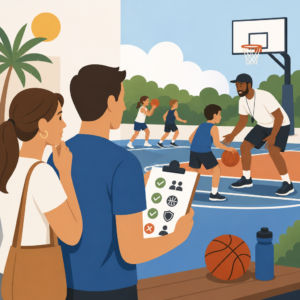
Coaches should also evaluate decision quality. Did the player use the move for a reason, or just because there was space to dribble? In film sessions, tag each between-the-legs dribble as advantage created, neutral, or possession stalled. That language keeps ball handling connected to outcomes. Parents can help by valuing controlled workouts over flashy social clips. Ten minutes of disciplined footwork and low transfers three times a week will usually beat one long session of random combos.
The main takeaway is straightforward: the between-the-legs dribble is a foundational ball handling skill when it is taught as a protected transfer tied to reads, pace, and next actions. Learn the stance, footwork, and low ball path first. Then build combinations, add movement, and test the move against real pressure. Study how NBA guards use it to create angles rather than highlights, and your improvement will be faster and more durable. If you are building your Basketball Skills base, use this guide as your ball handling hub, then train the related moves that make the transfer truly dangerous.
Frequently Asked Questions
Why is the between-the-legs dribble so important for guards instead of just being a flashy move?
The between-the-legs dribble matters because it is a practical control move, not just a highlight-play skill. When used correctly, it lets a guard change direction while keeping the ball protected from a defender’s reach. Instead of exposing the ball on the outside of the body during a basic crossover, the dribbler moves it from one hand to the other underneath the frame, which naturally shields it with the legs, hips, and torso. That extra protection is a major reason NBA guards trust the move in tight spaces and against aggressive on-ball pressure.
It also helps create better offensive angles. A guard can attack one direction, read the defender’s feet and balance, then shift stance and send the ball through the legs to re-angle the drive. That small redirection often creates a cleaner lane, especially when the defender overplays one side. Just as important, the move blends smoothly into other actions such as a burst to the rim, a hesitation, a pull-up jumper, or a step into a pick-and-roll. In other words, it is valuable because it keeps the dribbler compact, protected, and ready to attack immediately after the exchange.
What is the proper technique for doing a between-the-legs dribble correctly?
Good technique starts with posture and balance. The player should stay low with knees bent, chest controlled, and hips loaded so the move comes from an athletic stance rather than an upright reach. The ball should be dribbled hard and low, not floated. A soft, high bounce gives defenders time to react and increases the chance of the ball clipping the leg or getting poked away. Most players execute the move by stepping one foot slightly forward, opening a lane between the legs, and pushing the ball diagonally backward or sideways into the opposite hand, depending on the angle they want to create.
Hand placement is also critical. The dribbler should guide the ball with the fingers and wrist instead of slapping at it with the palm. The receiving hand must be ready early, so the move becomes one clean exchange rather than two separate actions. At the same time, the shoulders, hips, and eyes should sell the initial direction. That body language is what makes the move effective against defenders. If the lower body is lazy and the eyes drop to the floor, the move becomes predictable. The best between-the-legs dribbles are compact, low, and purposeful, with the player immediately prepared to explode, stop into a jumper, or chain into the next dribble.
What are the most common mistakes players make when learning the between-the-legs dribble?
The most common mistake is standing too tall. When players try this move from an upright position, the ball path becomes longer, slower, and easier to steal. A low stance shortens the exchange and helps keep the dribble tight. Another frequent problem is dribbling the ball too softly. The between-the-legs move needs a crisp, controlled bounce so the ball gets through the gap quickly and arrives on time to the opposite hand. If the bounce is weak, the ball may hit the back foot, drift too far out front, or force the player to pause and recover.
Players also often focus only on getting the ball through their legs instead of using the move to shift direction. That turns the skill into a stationary trick instead of a functional game move. In real basketball situations, the feet, hips, and shoulders should work together with the dribble to create an angle change. Another mistake is looking down at the ball, which limits court vision and makes the player easier to defend. Finally, many beginners rush into advanced combinations before they can control a single clean repetition on both sides. The best fix is to slow down, emphasize stance and timing, and practice game-speed repetitions only after the mechanics are reliable.
How do NBA guards use the between-the-legs dribble to create space for drives and pull-up shots?
NBA guards use the move as a setup tool as much as a change-of-hands dribble. They first force the defender to commit by attacking a shoulder, changing pace, or threatening a drive lane. Once the defender shifts weight or widens stance to cut off that angle, the guard goes between the legs to redirect the ball and body into space. Because the move keeps the ball protected, it is especially effective against defenders who like to swipe at exposed crossovers. The result is often just enough separation to turn the corner, get downhill, or enter the paint under control.
It is equally useful for pull-up scoring. After the dribble exchange, a guard can rise into a jumper if the defender retreats too far, or string the move into a hesitation if the defender is still off balance. In pick-and-roll situations, guards often use between-the-legs dribbles to re-center themselves, manipulate the screen angle, or move the defender onto the screener’s hip. That is why the move shows up so often in elite guard play: it keeps options open. Rather than locking the player into a single direction, it allows quick transitions into a drive, stop, step-back, snake dribble, or mid-range pull-up depending on how the defense reacts.
What is the best way to practice the between-the-legs dribble so it actually translates into games?
The best practice progression starts simple and then becomes more realistic. First, build clean mechanics with stationary repetitions on both sides, focusing on low stance, hard bounce, and immediate control with the receiving hand. Then add movement by walking and jogging into the dribble, making sure the ball stays tight and the footwork remains balanced. Once that feels comfortable, progress to cone work or guided lane changes so the move is tied to an actual shift in direction rather than empty repetition. The goal is not just to complete the dribble, but to complete it while staying ready to attack right away.
After the foundation is solid, players should train the move under game-like pressure. That means practicing between-the-legs into a first-step drive, into a pull-up, into a hesitation, and out of pick-and-roll setups. It also helps to work on change-of-pace timing, because the move becomes far more effective when used after a pause, a burst, or a defender-triggering setup. Live defenders, guided one-on-one drills, and small-space ball-handling drills are especially valuable because they teach when to use the move, not just how to perform it. The players who carry this skill into games are the ones who connect technique, timing, reading the defender, and the next offensive action all in one sequence.