
The behind-the-back dribble is one of basketball’s most useful ball-handling moves because it protects the ball while changing direction, but it only works when players understand the timing, footwork, reading of help defenders, and game context that make it effective. In plain terms, a behind-the-back dribble is a change-of-direction dribble where the ball is transferred from one hand to the other by bouncing it behind the hips, usually while moving laterally, driving downhill, or escaping pressure. Players often learn it as a flashy move, yet in real games it is primarily a protection move. I coach ball handlers to think of it less as a trick and more as a shield: your body stays between the defender and the ball, your outside shoulder leads, and your next dribble should immediately create space or an angle. That distinction matters because most turnovers with this move happen when players perform it for style instead of for advantage.
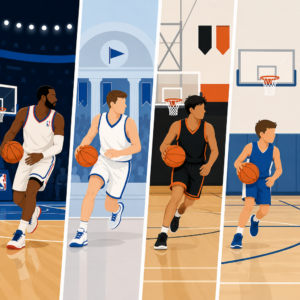
Ball handling is the broader skill set that makes the behind-the-back dribble valuable. It includes stance, hand position, rhythm dribbles, speed changes, retreat dribbles, hesitations, crossovers, in-and-out moves, spin dribbles, live-dribble passing, and decision-making under pressure. Great ball handling is not just about keeping the ball alive. It is about manipulating defenders, staying balanced, seeing the floor, and arriving at the next action on time. At every level, from youth leagues to the NBA, the best handlers combine low center of gravity, strong fingertips, clean ball placement, and anticipation. Kyrie Irving, Chris Paul, and Jamal Murray all use the behind-the-back differently, but each does the same essential thing: they move the ball to a safer line while shifting the defender’s hips. That is why this move belongs in any complete basketball skills hub on ball handling.
The move matters because modern defenses pressure the ball earlier, switch more often, and send help from crowded gaps. Against that environment, players need answers when a defender cuts off the front crossover or reaches at the exposed outside dribble. The behind-the-back dribble gives a direct answer. It reduces the ball’s exposure, lets the handler keep eyes up, and often sets up the next read: pull-up, pocket pass, re-attack, or reset. Still, it is not automatic offense. Use it at the wrong time and you dribble into help, lose momentum, or take yourself away from an advantage. This article explains when to use it, when not to, and how to learn it properly while placing it inside the bigger ball-handling framework every serious player needs.
What the behind-the-back dribble is really for
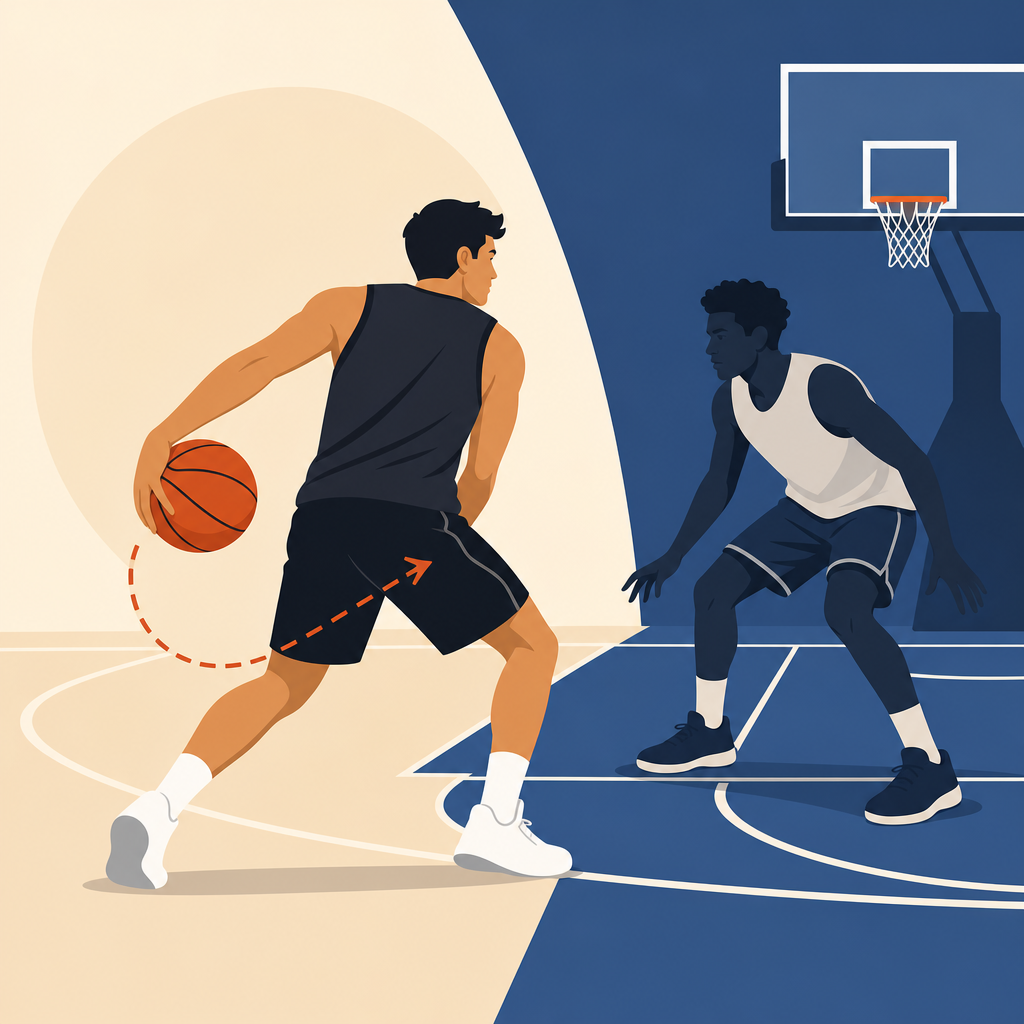
The simplest definition is this: the behind-the-back dribble is a protection change, not a show move. The ball travels behind the body from one hand to the other so the defender cannot poke it from the front. The best use cases are when the defender is on your hip, when a front crossover would be exposed, or when you need to shift your angle without turning your back completely. If a defender lunges with the top hand, the behind-the-back can punish that reach. If a defender shades your strong hand, the move can quickly reverse the lane line and force a recovery step.
Mechanically, the move starts with a low stance, chest slightly forward, knees bent, and hips loaded. Your dribble hand pushes the ball behind the hips rather than wrapping it in a big loop. The receiving hand meets the ball early and outside the frame of the body, ready to explode into the next step. The feet matter as much as the hands. Most players are better when they plant the outside foot, shift weight, then transfer the ball as the lead foot changes direction. On film, the move looks smooth, but the hidden detail is that elite players keep the bounce tight and low, usually below knee level in traffic. High bounces are steals waiting to happen.
I teach three purposes for the move. First, escape pressure. When a defender crowds your handle, a behind-the-back retreat can create a safer dribble line. Second, attack a top foot. If the defender’s hips open too far to one side, the move lets you redirect and drive the opposite seam. Third, maintain downhill momentum. Unlike some spins, which can slow the play and narrow vision, a compact behind-the-back can preserve your eyes and passing angle. Used this way, it becomes part of decision-making, not decoration.
When to use it in real game situations
The best time to use a behind-the-back dribble is when the defender’s positioning makes other changes riskier. One common example is the hard cut-off. You drive right, the on-ball defender beats you to the spot, and the help defender is waiting near the nail or elbow. A front crossover back left would expose the ball to the cut-off defender’s reach. A spin may carry you toward congestion. A compact behind-the-back, however, lets you pull the ball out of danger and angle left while keeping your body between the defender and the ball. This is especially useful in pick-and-roll when the big shows high and the guard trails over the screen.
Another strong use case is against aggressive point-of-attack defense. Pressure defenders often mirror the front shoulder and swipe at rhythm dribbles. If you feel the defender on your hip and sense a reach, the behind-the-back can turn a defensive gamble into an advantage. Guards like Chris Paul have long used this to snake into the middle after the screen defender commits. The move is not always about beating the first defender cleanly. Sometimes it is about getting half a step, re-centering the ball, and forcing the low man to help. Once that happens, the offense has options.
It also works well in transition when a retreat or hesitation has shifted the defender upright. Imagine a two-on-two break with the defender backpedaling and trying to shade the passing lane. If you show a push dribble to one side and then go behind the back to the other, you can force a hip turn and attack the new lane. The key is space. In open floor situations, the bounce can be slightly longer. In traffic, it must stay tight. Good players adjust the same move to the environment instead of using one version everywhere.
Late-clock situations provide another practical use. When the initial action stalls, a handler often needs one secure change of direction to create a pull-up or step into a re-screen. A behind-the-back dribble can buy that half-second if the defender is lunging or sitting on the crossover. Used this way, it is a survival tool. It helps the offense reset without picking up the dribble.
When not to use it and common mistakes
The wrong time to use a behind-the-back dribble is when the defense has not committed, when the lane is crowded, or when a simpler move would work. Young players often force the move against a defender who is balanced and square. That usually creates lateral movement without advantage. If the defender is already giving ground, a direct push dribble may be better. If the help is loaded at the elbows and blocks, dribbling behind the back into traffic often walks you into a trap. Ball handling is about choosing the easiest effective answer, not the hardest impressive one.
Another bad use case is when the ball handler cannot yet execute the move at game speed with low bounce and immediate control. Turning your back too much, standing upright, or swinging the ball in a wide arc invites strips from trailing defenders. So does taking an extra gather dribble after the move. The receiving hand should secure the ball into the next action right away. If you need to look down to find the ball, the move is not ready for games. Your eyes must stay up to read the tag defender, roller, corner shooter, or cut behind the play.
Players also misuse the move near sidelines and traps. Because the ball travels behind the body, your margin for error shrinks when one side of the floor is already closed. In those spots, a retreat dribble, reverse pivot, or simple pass is often smarter. The same applies against long defenders with active rear contests. If they are on your back shoulder and there is a second defender pinching the lane, the behind-the-back can become a turnover because the dribble line is predictable. The lesson is simple: never confuse capability with necessity.
| Situation | Use behind-the-back? | Why | Better alternative if not |
|---|---|---|---|
| Defender reaches across your body on a drive | Yes | Protects the ball and changes angle safely | — |
| Open floor with space and backpedaling defender | Yes | Can force a hip turn and open a lane | — |
| Defender is balanced and giving ground | No | Extra movement without real advantage | Push dribble or hesitation |
| Crowded paint with help defenders loaded | No | Likely dribbles into traffic | Jump stop, pass, or retreat |
| Sideline trap forming | No | Little room for error behind the body | Retreat dribble or advance pass |
How to learn it: technique, drills, and progression
Learning the behind-the-back dribble starts without movement. Begin in an athletic stance with feet just wider than shoulders, hips down, and the ball on your right side. Push the ball behind the hips with the right hand, keeping the wrist firm and fingers over the top-outside quadrant of the ball. Catch it with the left hand outside the left hip. The bounce should land slightly behind your heels but not so far back that you have to reach. Do fifty clean reps each side without looking down. Focus on bounce height, hand timing, and balance. If the ball slaps the back of your legs, the angle is wrong or your stance is too narrow.
Next, add stationary rhythm variations: pound dribble to behind-the-back, two pounds to behind-the-back, and alternating behind-the-back dribbles. Then progress to lateral movement. Slide one step, transfer the ball, and explode out. After that, move into retreats, advancing dribbles, and cone work. A simple game-speed drill I use is cone at the wing, cone at the nail, cone at the slot. Attack the wing cone with two hard dribbles, perform the behind-the-back at the nail, then finish with one more dribble into a pull-up or rim finish. This teaches the move at a point on the floor where defenders often cut off drives.
Film and feedback matter. Players think they are low when they are not. Record ten reps from the side and from behind. Check posture, bounce height, and whether the first step after the move is explosive. If there is a pause, the move is disconnected. Tennis-ball reaction drills can help keep the eyes up, but they should supplement, not replace, real dribble mechanics. For strength and control, fingertip pounds, heavy-ball sequences, and single-leg stance dribbles can improve hand speed and trunk stability. Just remember that overloaded tools do not automatically transfer. The transfer comes from repeating the same angles and footwork you will use in games.
The final progression is live defense. Start with guided defense where the defender shades one side and occasionally reaches. Then move to one-on-one from the wing, top, and slot. Give the ball handler a rule: use the behind-the-back only if the defender cuts off the first line. This builds decision-making. In advanced workouts, add a help defender so the handler must read whether to finish, kick, or pull out. That is when ball handling becomes complete. The move is no longer isolated skill work; it becomes part of a chain that includes pace, advantage creation, and passing under pressure.
Building complete ball handling around the move
No player becomes a reliable ball handler by mastering one move. The behind-the-back dribble is most effective when it sits inside a complete package of foundations. First comes stance and control: low hips, strong core, relaxed shoulders, and fingertips instead of palms. Second comes pace: changing speeds is often more important than changing directions. Third comes directional variety: crossover, in-and-out, hesitation, retreat, spin, and split dribbles all solve different problems. Fourth comes vision: handling the ball while reading tags, stunts, and closeouts is the real standard. If you want this page to serve as a hub for Basketball Skills and Ball Handling, that is the central idea to carry into every related drill and article.
In practice planning, I organize ball-handling work into five categories. Stationary control develops touch and coordination. Movement dribbles train body alignment and stride rhythm. Change-of-direction work teaches creation and recovery. Pressure dribbles prepare players for contact and traps. Advantage reads connect dribbling to shots and passes. The behind-the-back belongs mostly in the third and fourth categories, then graduates into the fifth. That sequence is important because players who skip directly to highlights rarely develop the body positions needed to survive pressure. By contrast, players who spend time on retreat dribbles, stop-start control, and weak-hand repetitions usually learn the move faster and use it more efficiently.
There is also a role-specific layer. Primary ball handlers need behind-the-back counters out of pick-and-roll, isolations, and late-clock scenarios. Wings need it when attacking tilted closeouts or escaping baseline pressure. Bigs need a simpler version mainly for handoff rejects and short-space face-up drives, not endless perimeter dancing. Your training volume should match your role and your offensive responsibilities. That is how smart skill development works: specific enough to be useful, broad enough to improve your whole game.
What separates flashy handles from effective handles
Effective ball handling creates an advantage that leads to a better shot, pass, or reset. Flashy ball handling creates movement without a clear purpose. The difference shows up in efficiency. If a player uses three extra dribbles to get back to the same spot, the defense wins. If one behind-the-back shift opens a driving lane, moves the low man, and creates a corner three, the offense wins even if the box score never credits the move. Coaches trust handlers who value possession, spacing, and timing. Teammates trust handlers who can beat pressure without hijacking the possession.
That is why learning when not to use the behind-the-back is as important as learning how. The move belongs in your game, but only as one answer among many. Build it from sound mechanics, train it through progressive drills, and test it under live reads. Then connect it to the wider ball-handling habits that matter most: staying low, keeping eyes up, changing pace, protecting the ball, and making the next decision quickly. Do that, and the behind-the-back dribble becomes what it should be: a practical tool that helps you control defenders instead of a risky move that controls you. If you are building your Basketball Skills foundation, make this your next step: practice the move with purpose, then link it to the rest of your ball-handling work.
Frequently Asked Questions
What is a behind-the-back dribble, and why is it so effective in basketball?
A behind-the-back dribble is a change-of-direction move where the ball is bounced from one hand to the other behind the player’s hips instead of in front of the body. That detail matters because it keeps the ball farther away from the on-ball defender’s reach while allowing the ballhandler to shift angle, protect possession, and continue moving without exposing the ball. In practical game terms, it is one of the safest ways to redirect the dribble when a defender is crowding the front hip, reaching for a steal, or trying to cut off a drive.
What makes the move effective is not just the dribble itself, but the combination of protection, timing, and body positioning. A good behind-the-back dribble lets the offensive player keep their chest and shoulders between the defender and the ball. It can also help a player turn the corner, avoid a dig from a help defender, or escape pressure near the sideline. Unlike some flashy dribble moves that mainly create visual deception, this one has a strong functional purpose: it changes direction while shielding the basketball. That is why coaches at every level teach it when they want guards and wings to handle pressure more securely.
It is especially useful because it fits real game situations. If a defender is overplaying one side, if a second defender is stepping up, or if the lane angle changes suddenly, the behind-the-back dribble gives the ballhandler a way to adjust without picking up the ball. Used correctly, it is not a trick move. It is a controlled, practical tool for maintaining advantage and protecting the dribble under pressure.
When should a player use a behind-the-back dribble in a game?
The best time to use a behind-the-back dribble is when it solves a specific defensive problem. One common example is when a defender is sliding hard to cut off the original driving lane. If the defender beats you to the spot in front of your body, taking the ball behind your back can shift it away from their hands and move you into a better angle. It is also valuable when attacking downhill and a help defender shows early. Rather than crossing the ball in front where both defenders can reach it, the behind-the-back dribble can move the ball to the safer side while keeping momentum.
Another strong use case is against aggressive pressure. If a defender is crowding your handle, swiping at the ball, or trying to trap near the sideline, a behind-the-back dribble can create space and reverse the angle of the attack. It works well on retreats, hesitations into redrives, and side-to-side shifts when you need to keep your dribble alive without exposing the ball. Players also use it effectively in transition when a defender commits to one side and there is room to shift lanes while staying balanced and under control.
The key is that the move should be used with purpose. It is most effective when the defender’s momentum is taking them one way and you need a protected route the other way. Good players do not decide in advance that they are going to use it. They read the defender’s feet, hips, and hand activity, then choose it because it is the safest and most efficient answer. In other words, the move should come from what the defense gives you, not from a desire to make a highlight play.
When should a player avoid using a behind-the-back dribble?
A player should avoid using a behind-the-back dribble when there is no real need to change direction or protect the ball. If the lane is already open, adding an extra move can slow you down, disrupt rhythm, and give the defense time to recover. It is also a poor choice in tight traffic when there is not enough space behind the hips for a clean transfer. In crowded areas, a mistimed bounce can hit your foot, clip a defender’s leg, or pop loose into help defenders. The move is safest when there is clear room to redirect and continue the play immediately.
It should also be avoided by players who have not yet built dependable control and footwork. A behind-the-back dribble demands coordination between the dribble hand, opposite receiving hand, hips, shoulders, and lead foot. If those pieces are out of sync, the ball often floats too high, lands too far behind the body, or takes the player off balance. That is why forcing the move under pressure before mastering the basics often leads to unnecessary turnovers. Coaches would much rather see a player use a strong pound dribble, retreat dribble, or simple crossover they can control than attempt a behind-the-back move they cannot execute consistently.
Game context matters too. Late-game possessions, heavy help defense in the lane, or situations where a teammate is immediately open may call for a simpler decision. Sometimes the smartest play is to pass, pull out, or keep the same driving line. The behind-the-back dribble is a useful weapon, but it is not the answer to every defensive look. If it does not improve your angle, protect the ball better, or help you beat pressure, it is probably the wrong choice in that moment.
What footwork and body mechanics make a behind-the-back dribble work?
The move works best when the lower body and upper body stay connected. The first major principle is staying low. Players need bent knees, a strong base, and hips loaded so they can change direction without rising up. Standing too tall makes the dribble slower and easier to read, while also increasing the chance that the ball will bounce too high. A low center of gravity lets the player keep balance, absorb contact, and explode out of the move instead of drifting through it.
Footwork is just as important as hand skill. In most game situations, the player plants and shifts weight in a way that matches the new angle of attack. For example, if the ball is moving from the right hand to the left behind the back, the player typically loads the right side, turns the hips slightly, and gets the left foot ready to receive and drive. The exact pattern can vary based on speed and situation, but the principle stays the same: the feet must prepare the body to go somewhere, not just perform a dribble in place. The move should reposition the whole player, not only the ball.
Body protection is another major factor. The shoulders, back, and off-arm all contribute to shielding the dribble. The ball should travel tight behind the hips, not in a wide loop. Wide motion makes the move slow and vulnerable. The receiving hand needs to meet the ball early and cleanly so the player can attack on the next step. Great ballhandlers make the move look smooth because the bounce is compact, the hips rotate efficiently, and the ball is gathered into the next action right away. The behind-the-back dribble is most effective when the mechanics are economical, balanced, and connected to the next move, whether that is a drive, pull-up, retreat, or pass.
How can beginners learn the behind-the-back dribble without turning it into a turnover machine?
Beginners should learn the move in stages instead of rushing straight into full-speed game reps. The first step is control. Start stationary with a low stance and practice bouncing the ball behind the hips from one hand to the other without worrying about speed. The goal is to feel the path of the ball, keep the bounce tight, and receive it cleanly on the opposite side. Once that feels dependable, add small side steps and slow changes of direction. This helps connect the dribble to movement, which is where the move actually lives in games.
After the stationary and slow-moving versions are comfortable, players should progress to more realistic reps. That means practicing out of a drive, a hesitation, a retreat dribble, or a pressure escape. It is important to train both directions, because many players become predictable by only using the move from their dominant hand. Repetition should focus on clean details: staying low, keeping the dribble below the waist when possible, making the bounce direct rather than loopy, and attacking immediately after the catch. The move is not finished when the ball gets to the other hand. It is finished when the player has actually changed angle and gained control of the next action.
To keep it from becoming a turnover machine, players need decision-making reps, not just skill reps. Use guided practice with cones, a coach, or a live defender to learn when the move is truly available. Read the defender’s top foot, hand pressure, and body angle. If the defender is not taking away your path, there may be no reason to use it. Video review can also help because it shows whether the move is solving pressure or just being forced. The fastest way to make the behind-the-back dribble useful is to combine technical repetition with game-like reads. Master the mechanics, then learn the timing, then apply it only when the situation actually calls for it.