
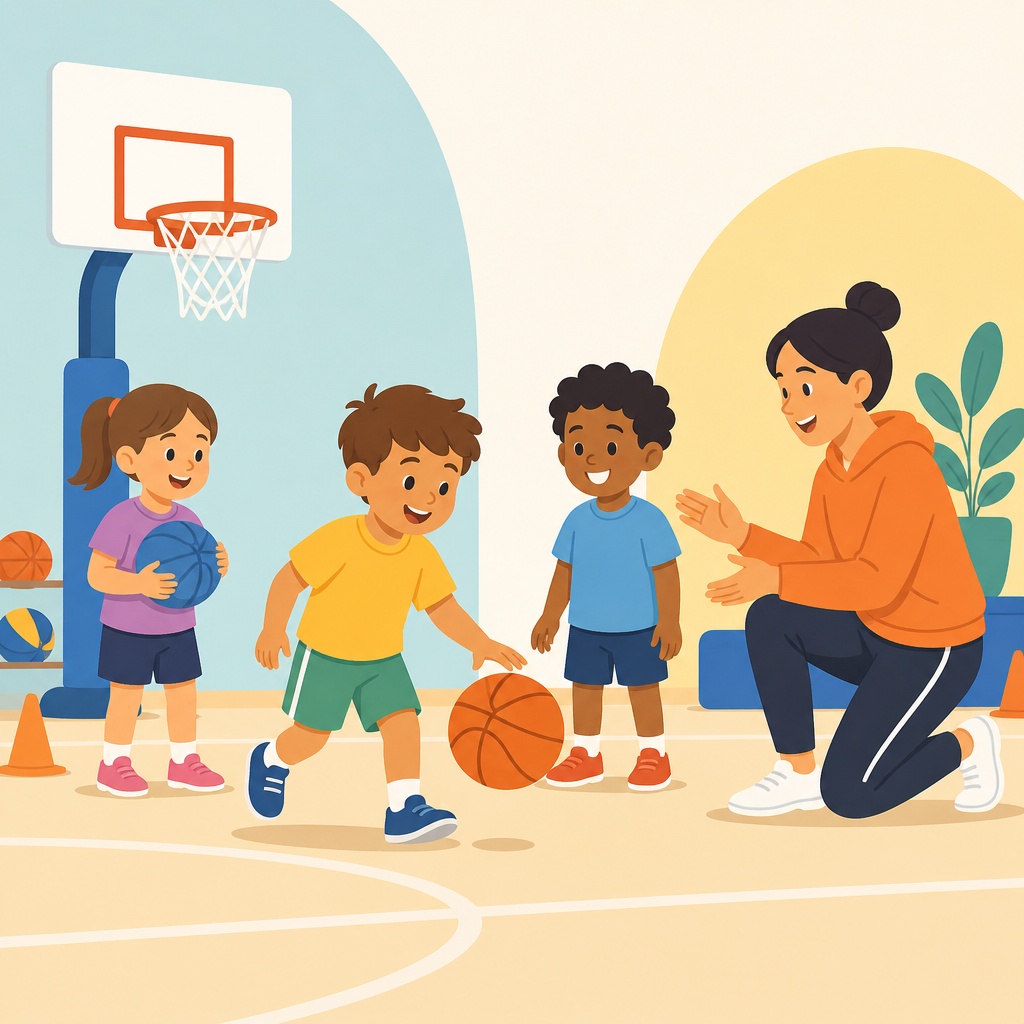
Basketball for 5-year-olds works best when it feels like play, not performance. At this age, the goal is not teaching a child to run an offense, memorize positions, or shoot with textbook form. The real job is introducing the game in a way that builds confidence, coordination, listening skills, and enjoyment. When parents and coaches remove pressure, young children learn faster because they stay curious, active, and willing to try. That is the foundation of effective youth basketball coaching.
In practical terms, coaching 5-year-olds means adapting the game to their stage of development. Most children this age are still learning basic movement patterns such as stopping under control, changing direction, hopping, balancing on one foot, and tracking a moving object. Their attention spans are short, their hands are small, and their understanding of team concepts is limited. That is normal. Basketball for 5-year-olds should therefore focus on simple skills: dribbling with either hand at waist height, catching with two hands, short chest passes, layup footwork through imitation, and shooting at a lowered hoop with a light ball.
It matters because early sports experiences often shape whether a child sees activity as fun or stressful. I have seen children light up after a ten-minute session built around animal walks, red-light green-light dribbling, and one-handed toss-and-catch games. I have also seen children shut down when adults corrected every mistake or kept score like the final minute of a tournament game. The difference was not talent. It was coaching. A strong youth basketball approach for beginners protects joy while still teaching structure, effort, and respect. If you want long-term skill development, the first step is making sure a child wants to come back tomorrow.
What Basketball Coaching for 5-Year-Olds Should Prioritize
The best coaching priorities for this age are movement literacy, ball familiarity, and emotional safety. Movement literacy means helping children become more comfortable with running, stopping, turning, jumping, landing, and reacting to cues. Ball familiarity means they learn that the basketball is something they can carry, bounce, roll, trap, pass, and shoot without fear. Emotional safety means they know mistakes are expected and that adults are there to encourage, not judge.
That is why practice plans should be short, active, and predictable. A useful session for 5-year-olds usually lasts 30 to 45 minutes. Within that time, each activity should change every few minutes. Long lines create boredom and behavior problems. Complex explanations cause children to tune out. The most effective coaches demonstrate quickly, use one teaching point at a time, and get every child moving right away. USA Basketball and the Positive Coaching Alliance both support age-appropriate coaching that emphasizes participation, effort, and simple skill progressions over early specialization.
At this stage, winning is not a coaching priority. Learning how to share space, take turns, follow a whistle, and celebrate a teammate matters more. If a child learns to stop on command, keep eyes up for a second while dribbling, and try again after missing five shots, that practice was successful. Those habits later support game understanding far better than forcing advanced drills too early.
Choosing the Right Equipment and Environment
Equipment shapes success more than many adults realize. A standard men’s basketball is far too large and heavy for most 5-year-olds. For beginners, a size 3 or size 4 ball is usually a better fit because small hands can grip and control it more easily. Lower hoops, often six to eight feet, also matter. When the basket is too high, children heave the ball with both hands from the chest or hip, reinforcing poor movement patterns and frustration. A lower rim allows them to use a smoother upward motion and see the ball go in, which strengthens motivation.
Space should also be scaled down. A full court asks too much physically and cognitively. Small areas with clear boundaries work better. Cones, floor spots, and poly dots help define personal space and reduce collisions. If you coach indoors, make sure the floor is not slippery and baskets are safely padded where possible. If you coach outdoors, avoid cracked surfaces and heavy winds, both of which make ball control much harder for young children.
Noise level and visual clutter can affect learning too. In crowded gyms, some children become overstimulated and stop listening. I have had better sessions using one half court, fewer props, and clear routines: everyone starts on a line, every drill has a home base, and transitions use the same cue each time. Five-year-olds do not need a fancy setup. They need a calm environment where expectations are consistent.
How to Teach Core Skills Without Pressure
Teaching basketball fundamentals to 5-year-olds requires simplification without removing purpose. Start with dribbling, but define success realistically. A child who can bounce the ball three times with control, stop it, and begin again is learning. Keep the ball at belly-button height or lower and encourage finger pads rather than slapping with a flat palm. Instead of repeating “keep your head up” for five minutes, create games where they must dribble to a colored cone you call out. That turns a technical cue into a playful challenge.
Passing should begin with partners standing close together. Teach “push from the chest, thumbs down at the end” for a chest pass, then celebrate catches just as much as passes. Many children this age struggle more with receiving than sending. Rolling the ball first can help them understand direction and timing before moving to air passes. Shooting instruction should focus on balance and touch, not perfect form. Use cues like “feet still, eyes on the square, reach up high.” On a low hoop, children can begin to connect bend-and-extend mechanics without straining.
Defense can be introduced as body control rather than pressure. Teach wide feet, bent knees, and hands out like airplane wings. Then use mirror games where one child slides and the other copies. Rebounding can be framed simply: find the ball, grab it with two hands, and freeze strong. Every skill should come through action, imagination, and repetition in short bursts.
| Skill | Age-Appropriate Teaching Focus | Simple Coaching Cue | Example Activity |
|---|---|---|---|
| Dribbling | Control at low height with either hand | Soft fingers, ball below belly | Red-light green-light dribble race |
| Passing | Short two-hand chest passes | Push and snap thumbs down | Partner pass through gate cones |
| Catching | Two hands ready, eyes on ball | Show your hands early | Toss-and-catch with soft bounce |
| Shooting | Balance and upward reach on low hoop | Eyes up, reach to the sky | Close-range bank shot stations |
| Defense | Stance, balance, and lateral movement | Wide feet, airplane arms | Mirror shuffle game |
Practice Structure, Attention Span, and Behavior Management
A strong youth basketball coaching session for 5-year-olds usually follows a repeatable rhythm. Start with two or three minutes of movement warm-up, then move into ball-handling games, partner work, a simple shooting activity, and a short scrimmage or obstacle course finish. Repetition helps children feel secure, but the activities inside that structure should rotate often enough to keep interest high. In my experience, most drills for this age should last three to six minutes before changing.
Behavior management improves when children stay busy. The fastest way to lose a group is to lecture too long or create lines where one child moves and seven wait. Give every child a ball whenever possible. Use clear, concrete directions: “Put one foot on the line and hold the ball at your knees” works better than “Everybody settle down.” Praise effort publicly and correct quietly when you can. A simple ratio of several positive comments for each correction changes the tone of a practice immediately.
Transitions deserve planning. Use one whistle blast for freeze, two claps for eyes on coach, or a phrase such as “ball on hip.” Children this age respond well to cues they can copy physically. If a player becomes upset, avoid embarrassment. Bring them close, kneel to eye level, and offer one next step: “Take a breath and try one more bounce.” Emotional regulation is a coaching skill at this age just as much as teaching dribbling.
The Role of Parents in Early Youth Basketball
Parents strongly influence whether basketball feels supportive or stressful. Before a season starts, coaches should explain the purpose of the program clearly: fun, fundamentals, and confidence first. That message reduces sideline pressure and aligns expectations. A 5-year-old does not need postgame analysis in the car. They need encouragement, hydration, and the feeling that adults enjoyed watching them try.
The most helpful parents praise specific behaviors they can control. Good examples include “I liked how you listened,” “You kept dribbling even when it got away,” or “You were a great teammate.” Less helpful comments focus only on outcomes, such as how many baskets they made. Children quickly absorb what adults notice. If adults reward hustle, sharing, and bravery, those traits grow.
Parents can also support learning at home without turning the driveway into a second job. Five to ten minutes of playful practice is enough: dribble around chalk circles, toss the ball to a wall and catch, or shoot soft bank shots on a low rim. Stop while the child still wants more. That preserves motivation. Coaches who communicate regularly with families often see steadier progress because the home message matches the gym message.
Common Mistakes Coaches Should Avoid
The biggest mistake in basketball for 5-year-olds is expecting older-player behavior and skill. Young children are not miniature middle school athletes. They will travel, double dribble, forget directions, crowd the ball, and celebrate randomly. That is part of the stage, not a sign of failure. Overcorrecting every error makes children tense and passive. Choose one or two teaching points per activity and let the rest go.
Another mistake is using adult language. Terms like “triple threat,” “help-side denial,” or “read the weak-side tag” have no place in beginner sessions for this age. Plain language works: “show your hands,” “stay between your player and the basket,” or “stop and look.” The same principle applies to practice design. Suicides, long conditioning blocks, and rigid half-court offenses are poor fits. Young children get enough conditioning through games and movement-rich drills.
Coaches also hurt learning when they compare players. Development at age five is uneven. One child may dribble better because they are six months older, have older siblings, or simply mature earlier physically. Another may be shy in week one and fully engaged by week four. Good coaching tracks individual growth. If a player entered the season unable to catch and now catches three clean passes in a row, that is meaningful progress and should be treated as such.
Building a Long-Term Path From Fun to Skill
The best reason to introduce basketball without pressure is that it supports long-term development. Children who enjoy early sessions are more likely to stay involved, and staying involved creates the repetition needed for real skill. Over time, playful dribbling becomes control. Toss-and-catch becomes passing timing. Running games become footwork. Confidence becomes coachability.
This hub approach to youth basketball coaching starts with age-appropriate foundations, then expands into ball-handling progressions, shooting mechanics, defensive habits, practice planning, communication with parents, and season design. Each area matters, but none works well if the first exposure feels tense or evaluative. Five-year-olds need freedom to explore the game while adults provide structure, safety, and simple feedback.
The key takeaway is straightforward: meet the child before you teach the sport. Use smaller balls, lower hoops, short activities, and language they understand. Reward effort, attention, and teamwork. Keep practices organized, fast-moving, and upbeat. When you coach basketball for 5-year-olds this way, you do more than introduce a game. You help a child build positive associations with movement, learning, and belonging. If you coach or parent a beginner, start small, stay patient, and make the next session one they cannot wait to join.
Frequently Asked Questions
What should basketball look like for a 5-year-old who is just getting started?
Basketball for a 5-year-old should look much more like active play than formal instruction. At this age, children are still developing basic coordination, balance, body control, attention span, and confidence. That means the best introduction to the game is simple, upbeat, and flexible. Instead of expecting a child to understand positions, set plays, or proper shooting mechanics, focus on experiences that help them enjoy moving with a ball. Dribbling while walking, tossing and catching, rolling the ball through cones, practicing stop-and-go movement, or aiming at a low hoop are all age-appropriate ways to build comfort with basketball skills.
A good beginner session should be short, positive, and varied. Five-year-olds respond well to games that feel imaginative and easy to understand, such as pretending to dribble around “traffic,” playing red light-green light with a ball, or trying to make a shot after hopping like a frog or tiptoeing like a giant. These playful activities improve motor skills and listening without making the child feel evaluated. The goal is not perfect execution. The goal is participation, repetition, and fun.
Most importantly, success at this age should be measured by enthusiasm. If a child is smiling, moving, listening, trying again after mistakes, and asking to play more, the session is working. That is the real foundation of long-term development in youth basketball.
How can parents and coaches teach basketball without creating pressure?
The most effective way to remove pressure is to shift the focus away from performance and toward exploration. Young children learn best when they feel safe to experiment, make mistakes, and repeat skills at their own pace. Pressure usually shows up when adults over-correct, compare children to others, emphasize outcomes too early, or expect young players to perform skills that are not developmentally realistic. For a 5-year-old, that can quickly turn basketball from something exciting into something stressful.
Parents and coaches can keep the experience low-pressure by using encouraging language and setting simple goals. Instead of saying, “You need to make the basket,” say, “Let’s see if you can get the ball up to the hoop.” Instead of correcting every dribble or shot, celebrate effort: “Great try,” “I like how you kept going,” or “Nice job listening and moving your feet.” This helps children associate basketball with confidence and progress instead of judgment.
It also helps to keep practices short and avoid too much talking. Five-year-olds learn through doing, not through long explanations. Offer one instruction at a time, demonstrate it clearly, and then let them try. If they lose interest, switch activities instead of pushing through. A child who feels in control and emotionally comfortable is much more likely to stay engaged. When the environment stays light, supportive, and playful, skill development happens more naturally and more effectively.
What basketball skills are most important for 5-year-olds to learn first?
The most important early basketball skills are not advanced sport-specific techniques. They are foundational movement and ball-handling abilities that prepare a child to enjoy the game and keep learning. For 5-year-olds, the priorities should include balance, coordination, body awareness, listening, stopping and starting under control, basic catching, simple passing, and becoming comfortable dribbling or bouncing the ball without frustration. These are the building blocks that make future basketball instruction much easier.
Shooting should be introduced in a very relaxed way, but it should not be treated as a technical project. Many young children are not physically strong enough to shoot with ideal form on a standard hoop, so it is better to use lower baskets, lighter balls, and close-range attempts. Let them push, toss, or loft the ball naturally. Forcing “perfect form” too early often creates bad habits, tension, and discouragement. What matters more is learning how to aim, try repeatedly, and enjoy seeing the ball go toward a target.
Dribbling should also be simplified. A child does not need to dribble with speed, control, and both hands right away. Start with bouncing the ball once, then catching it. Then try several bounces while standing still. Later, add slow walking. Passing can be taught through partner games using chest passes, bounce passes, and rolling the ball. If the child is learning to move, react, listen, and stay engaged with the ball, they are developing exactly the right kind of basketball foundation for this age.
How long should basketball practice be for a 5-year-old?
For most 5-year-olds, shorter is better. In many cases, 15 to 30 minutes of focused, active play is enough, especially for beginners. Some children may stay happily involved a bit longer in a group setting, but attention spans at this age are limited, and energy tends to come in bursts. Once a child becomes tired, distracted, or frustrated, the learning value drops quickly. Ending while the child is still having fun is often more productive than stretching the session too long.
A strong practice at this age should include frequent movement, very little standing still, and quick transitions between activities. Instead of repeating one drill for ten minutes, rotate through short games or challenges every few minutes. For example, you might spend a few minutes on dribbling, then passing, then a movement game, then shooting at a low hoop. This variety keeps children engaged and gives them repeated chances to succeed.
It is also wise to watch the child rather than the clock. Some days they will be energetic and eager, and some days they will lose focus quickly. That is normal. Flexibility is a strength in early childhood coaching. A short, happy session where a child feels successful is far better than a long session that ends in tears or frustration. The goal is to build a positive relationship with the game, and that happens best when practice feels manageable and enjoyable.
How do you know if a 5-year-old is ready for organized basketball?
Readiness for organized basketball at age 5 has less to do with talent and more to do with temperament, attention, and interest. A child does not need to dribble well, shoot well, or understand the rules to be ready. More useful signs include being able to follow very simple directions, participate in a group for short periods, take turns, handle small frustrations without shutting down completely, and show curiosity about the game. If a child enjoys running, tossing a ball, copying instructions, and being around other kids, they may be ready for a beginner program.
It is equally important to recognize that “organized basketball” for this age should still be developmentally appropriate. The best programs for 5-year-olds are built around fun, movement, basic skill exposure, and simple group games. They should not look like miniature versions of older children’s practices. If a league or class emphasizes heavy competition, rigid structure, constant correction, or long periods of waiting in line, it may not be the right environment for a young beginner.
If a child seems hesitant, that does not automatically mean they are not ready. Some children need more time to warm up, observe, and gain confidence. A good coach or parent can support that by keeping expectations low and making participation feel welcoming rather than demanding. In the end, readiness is not about whether a 5-year-old can “play real basketball.” It is about whether the experience helps them feel confident, included, active, and excited to come back again.