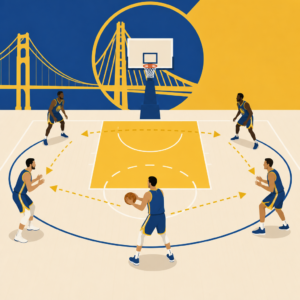

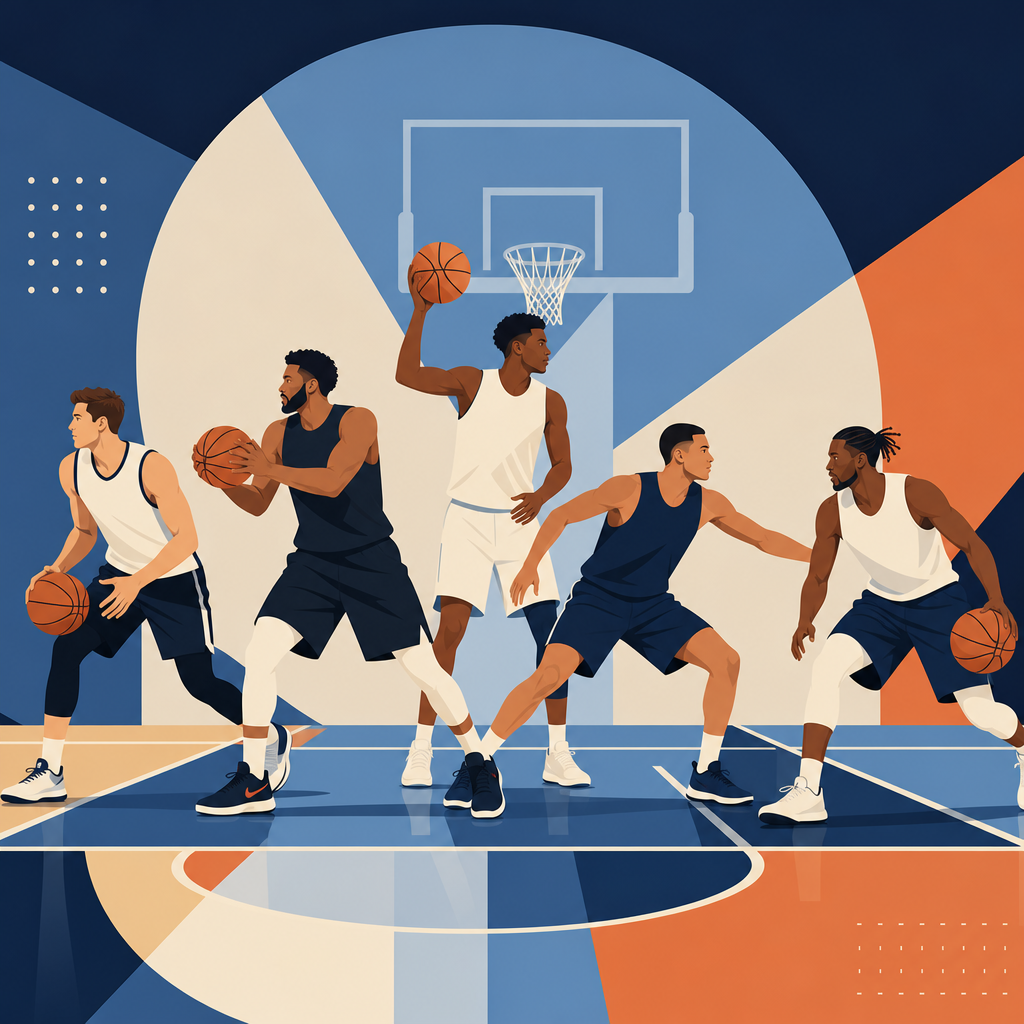
Positionless basketball in the NBA describes a style in which traditional labels like point guard, shooting guard, small forward, power forward, and center matter less than a player’s total skill set. Instead of assigning rigid jobs based on height, coaches now prioritize ball handling, passing, shooting, switching on defense, and decision-making across every lineup spot. In practical terms, that means a 6-foot-8 forward may bring the ball up like a guard, a center may run dribble handoffs and space to the three-point line, and a wing may defend everyone from lead guards to post scorers. The phrase does not mean positions vanished. It means roles became fluid, matchup-driven, and interconnected.
This shift matters because it explains how the modern NBA is played, how rosters are built, and why player development looks very different from past eras. It also serves as the clearest entry point for understanding positions and roles across the league. In my experience breaking down games and roster construction, the biggest mistake new fans make is assuming the five traditional position names still describe what each player actually does. They often describe who starts next to whom, but not how an offense functions or how a defense survives playoff targeting. Modern teams win by creating lineups where multiple players can initiate offense, shoot enough to preserve spacing, rotate quickly, and cover weaknesses in real time.
Historically, NBA positions were tied closely to size. Point guards organized the offense, wings scored from the perimeter, power forwards rebounded and screened, and centers protected the rim and played near the basket. Those categories still provide useful shorthand, especially on depth charts, but they no longer capture the full picture. As three-point volume increased, pace accelerated, and analytics highlighted the value of efficient shots, teams began rewarding players who could do more than one classic job. The result is not chaos. It is a more demanding structure in which everyone must process the game faster, read space better, and adapt from possession to possession.
For readers exploring NBA basics, this article is the hub for understanding positions and roles in the current game. It explains what positionless basketball means, why versatility became so valuable, how each traditional position evolved, which skills matter most, and where the trend has limits. If you want to understand why Nikola Jokic can function as an offensive hub, why Jayson Tatum can defend multiple spots while initiating offense, or why teams hunt weak defenders regardless of listed position, start here. Positionless basketball is the framework that connects modern lineup construction, player archetypes, coaching strategy, and playoff success.
Why the NBA Moved Toward Positionless Basketball
The modern game did not become positionless by accident. Several forces pushed the league in that direction at the same time. First, the three-point revolution changed spacing. When four or five players can threaten from outside, the court opens for drives, cuts, and post entries. That spacing rewards players who can pass on the move and attack closeouts, not just those assigned to a traditional ball-handler role. Second, rule interpretations and offensive innovation increased the value of quick decisions. Spread pick-and-roll, five-out alignments, empty-side actions, and dribble handoff series all punish defenses that cannot switch, rotate, and recover with speed.
Analytics reinforced those changes. Front offices learned that lineups with more shooting and more defensive flexibility generally produce better results over time. A non-shooting big who cannot protect the rim creates a serious roster problem. A small guard who cannot survive screening actions becomes a playoff target. By contrast, a bigger wing who can pass, shoot, and guard up or down a lineup creates options everywhere. That is why players such as LeBron James, Draymond Green, Bam Adebayo, and Kawhi Leonard became models for team building. Each could influence possessions in several ways without forcing the team into a narrow structure.
Coaching also evolved. Many systems now organize offense around functions rather than titles: primary initiator, secondary creator, spacer, screener, short-roll playmaker, rim runner, nail defender, low man, and point-of-attack stopper. Those functions can be filled by different body types depending on personnel. The 2015 Warriors accelerated the trend by weaponizing small-ball lineups that switched defensively and played through Draymond Green as a playmaking frontcourt hub. The 2023 Nuggets showed a different version, using Jokic as a center who orchestrated offense from the elbows, post, and top of the floor. Different structures, same principle: versatility multiplies options.
Load management, playoff scouting, and long seasons made adaptability even more important. In a seven-game series, opponents relentlessly attack the weakest defender, the least skilled passer, and the least mobile big. Positionless basketball is partly an answer to that pressure. If all five players can make the next pass, defend in space, and execute multiple coverages, there are fewer weak links to exploit. That is why this trend has reshaped every conversation about positions and roles in the NBA.
How Traditional Positions Still Exist, but Their Roles Changed
The five position names remain useful, especially for introductions and lineup cards, but each role has expanded. Point guards still organize possessions, yet many teams no longer require a small lead guard to dominate the ball. Luka Doncic, Shai Gilgeous-Alexander, and LeBron James have all operated as primary initiators from larger frames. Shooting guards used to work mainly off the ball; now they may run pick-and-roll, defend top perimeter threats, and serve as secondary creators. Wings have become the league’s most valuable archetype because they can scale up or down depending on lineup needs.
Power forwards and centers changed dramatically. The old power forward was often a midrange scorer and rebounder who played beside a back-to-the-basket center. Today, many fours must either stretch the floor, switch on defense, or both. Centers once lived almost exclusively near the rim. Now they may be lob finishers, drop-coverage anchors, floor spacers, or full offensive hubs. Brook Lopez reinvented himself by adding three-point range and elite drop defense. Al Horford extended his career through passing, spacing, and positional intelligence. Jokic became the most extreme example of the center position evolving beyond recognition while still dominating it.
The key point is that positions still describe starting alignment and likely matchups, but roles describe what a player actually contributes. A “center” might initiate offense. A “point guard” might play off the ball next to a bigger creator. A “forward” might be the primary screener in one lineup and a weak-side shooter in another. If you are studying NBA positions and roles, always ask two questions: Who starts the action, and who finishes defensive possessions? Those answers often reveal more than the listed positions do.
The Core Skills That Define Modern Versatility
Versatility is not a vague compliment. In NBA scouting and coaching terms, it usually means a player can perform multiple high-value tasks without breaking spacing or coverage integrity. The first task is decision-making. Can the player read help defenders, make the next pass, and avoid stalled possessions? The second is shooting gravity. A player does not need Stephen Curry range, but defenders must respect the shot enough to prevent the floor from shrinking. The third is functional ball handling, meaning the ability to advance the ball, attack a closeout, or run second-side pick-and-roll without losing control.
Defensively, versatility starts with movement skills and awareness. Can the player contain at the point of attack, switch onto a larger scorer briefly, tag the roller, and then recover to a shooter? Wings who can execute those tasks are central to playoff defenses. Bigs need different versatility: rim protection, drop coverage timing, communication, and, increasingly, the foot speed to survive against guards for a few dribbles. Bam Adebayo stands out because he can hedge, switch, recover, and still anchor the paint. That blend is rare and extremely valuable.
Availability of multiple counters is what separates true positionless contributors from one-dimensional specialists. A player who only shoots is useful in the regular season. A player who shoots, passes on the move, and holds up defensively stays playable deep in the playoffs. Coaches trust players who can solve possessions without needing the scheme to protect them constantly. That trust is the operating currency of modern lineup construction.
| Role concept | Traditional expectation | Modern positionless version | NBA example |
|---|---|---|---|
| Primary initiator | Point guard runs offense | Any strong decision-maker can start actions | LeBron James, Luka Doncic |
| Frontcourt playmaker | Big sets screens and finishes | Big also passes, handles, or spaces | Nikola Jokic, Draymond Green |
| Wing defender | Guards similar-sized scorers | Switches across two to four positions | OG Anunoby, Jayson Tatum |
| Center defense | Protect rim only | Protects rim and survives in space | Bam Adebayo, Anthony Davis |
Lineups, Matchups, and the Real Meaning of Roles
To understand positionless basketball, watch lineups instead of roster labels. Coaches think in combinations: who can create advantages, who maintains spacing, who screens effectively, who guards the best scorer, who serves as the low man, and who closes possessions with rebounds. One lineup may need a rim-running center and three shooters. Another may close games with no traditional center at all if the opponent cannot punish small size inside. The role changes with context.
Consider the Boston Celtics. They can play through Jayson Tatum or Jaylen Brown as creators, use Jrue Holiday and Derrick White as connective guards, and deploy Kristaps Porzingis or Al Horford as bigs who protect the rim while stretching the floor. On paper, those are standard positions. In practice, they are interchangeable functions layered into a system. Any of several players can bring the ball up, any can trigger actions from the wing, and most can defend across lineups. That is what modern roster balance looks like.
Playoff basketball makes these distinctions clearer. Opponents target weak links through screening, force small guards into switches, and help off non-shooters. If a player cannot adapt, he becomes difficult to keep on the floor. This is why teams prize “playable” skill sets more than old positional categories. A role is valuable only if it survives matchup stress. Positionless basketball is really matchup-proof basketball, or as close to it as a roster can get.
The Benefits and Limits of Going Positionless
The benefits are obvious. Versatile lineups create offensive unpredictability, better spacing, faster ball movement, and stronger defenses against modern actions. They also protect teams from injuries and matchup swings because more players can absorb different responsibilities. Development improves too. Young bigs learn to pass and defend in space. Guards learn to rebound, screen, and make quick reads without monopolizing the ball. When done well, a positionless system expands every player’s usefulness.
But there are limits, and smart teams respect them. Size still matters. Rim protection still matters. Rebounding still matters. A team cannot simply declare itself positionless and ignore the need for an interior anchor or enough shot creation. The 2022 Warriors closed small at times, but Kevon Looney’s screening and rebounding were still essential. The Heat have thrived with versatile defenders, yet Bam Adebayo’s presence as a true back-line organizer remains foundational. Fluid roles work best when basic basketball requirements are still met.
There is also a developmental tradeoff. Asking every player to do everything can blur strengths. Not every center should dribble like a guard, and not every guard should be taught to hunt difficult pull-up threes. The best organizations expand skills without erasing identity. They build from a player’s core advantages, then add adjacent tools. That balance is why some prospects become complete players while others become jacks-of-all-trades without an elite NBA skill.
How to Use This Hub to Understand NBA Positions and Roles
As a hub for the positions and roles subtopic, this page should help you decode any team you watch. Start by identifying the primary ball handler, the secondary creator, the main screen setter, the best spacer, the point-of-attack defender, and the rim protector. Then notice which roles overlap. If two or three players can fill each function, the team is probably built for modern basketball. If one player carries too many essential tasks, the scheme is fragile.
From here, the most useful next steps are deeper breakdowns of point guards, wings, big men, defensive assignments, lineup types, and bench roles. Those topics all connect back to one central reality: modern NBA positions are best understood as flexible responsibilities rather than fixed jobs. Positionless basketball did not eliminate structure. It updated it. The teams that win now are the teams with enough skill, size, and intelligence to shift structures without losing efficiency on either end.
The main benefit for fans is clarity. Once you stop treating positions as rigid boxes, the game becomes easier to read. You see why versatility drives roster value, why playoff matchups change rotations, and why certain players scale so well next to stars. Keep this framework in mind as you explore the rest of the NBA Basics coverage on positions and roles, and you will understand not just where players stand, but what they actually do and why it wins games.
Frequently Asked Questions
What does “positionless basketball” actually mean in the NBA?
Positionless basketball refers to an NBA style in which traditional positions like point guard, shooting guard, small forward, power forward, and center are no longer treated as strict job descriptions. Instead, teams value players who can perform multiple responsibilities on both ends of the floor. A bigger wing may initiate the offense, a center may pass from the top of the key, and a guard may switch onto larger players defensively without the entire scheme breaking down. The focus shifts away from labels and toward functional skills such as ball handling, shooting, passing, decision-making, off-ball movement, defensive versatility, and the ability to play in different lineup combinations.
In practical basketball terms, positionless play is about flexibility. Coaches want lineups where several players can dribble, pass, shoot, and defend multiple actions, making the offense harder to predict and the defense easier to adapt. Rather than asking, “Is he a power forward or a small forward?” teams increasingly ask, “Can he space the floor, attack a closeout, make the next pass, and switch on defense?” That evolution has changed roster construction, player development, and in-game strategy across the league.
Why has versatility become so important in the modern NBA?
Versatility has taken over because the modern NBA is built around speed, space, and decision-making. As teams spread the floor with more shooting, offensive possessions create constant mismatches and force defenders to cover more ground. If a lineup includes multiple players who can dribble, pass, and shoot, the offense becomes much more difficult to contain. Defenses cannot simply key in on one playmaker or hide weak defenders as easily when every player is a potential threat to initiate action or capitalize on an advantage.
Defensively, versatility is just as valuable. Teams now rely heavily on switching pick-and-rolls, rotating quickly to shooters, and recovering against drive-and-kick offenses. A player who can credibly guard several positions gives coaches far more tactical options than a specialist limited to one matchup. This is especially important in the playoffs, where opponents target weak links relentlessly. The more players a team has who can survive in multiple situations, the more resilient that team becomes over a seven-game series.
Another major reason versatility matters is that it helps teams maintain offensive flow. Instead of depending on one primary ball handler to create everything, modern teams prefer shared creation. That reduces predictability, keeps the ball moving, and allows stars to play off the ball at times. In short, versatility improves spacing, unlocks matchup advantages, supports switching defenses, and makes a roster more adaptable to the changing demands of today’s NBA.
How did the NBA move away from traditional positions?
The shift happened gradually, driven by both strategy and personnel. For decades, basketball was commonly organized around clearly defined positional roles: point guards initiated, centers stayed near the rim, wings played on the perimeter, and power forwards operated in the mid-post or on the glass. As the league evolved, however, players with broader skill sets began to challenge those conventions. Taller players developed guard-like handling and passing skills, while smaller lineups proved they could win by emphasizing speed, spacing, and shooting over sheer size.
Rule changes, analytics, and changing offensive philosophy all accelerated the transformation. Teams increasingly recognized the value of three-point shooting, rim attempts, and efficient spacing. That meant lineups needed more players who could stretch the floor and make quick decisions with the ball. At the same time, defensive schemes became more sophisticated, and switching became more common, rewarding players who could guard multiple positions rather than just one designated assignment. Coaches started to realize that rigid roles could actually limit a team’s effectiveness against modern offensive actions.
Influential teams and star players also played a major role. As elite forwards and bigs showed they could handle, pass, and initiate offense, organizations became more willing to build systems around skill rather than archetype. The result is today’s NBA, where lineup function often matters more than position labels, and a player’s value is increasingly tied to how many different ways he can contribute within a flexible scheme.
Does positionless basketball mean positions no longer exist at all?
Not exactly. Positions still exist in a practical sense, but they are much less rigid than they once were. Teams still need rim protection, perimeter defense, ball handling, rebounding, and shot creation. Those responsibilities have not disappeared. What has changed is that those duties are no longer assigned as strictly according to height or traditional labels. A team may still refer to someone as a center or point guard, but that title does not fully define how he plays or what he is allowed to do within the offense or defense.
In reality, modern basketball is better understood through roles rather than classic positions. A player might be a secondary creator, a switch defender, a rim protector, a floor spacer, or a short-roll playmaker. One athlete can fill several of those functions at once. That is the core of positionless basketball: not the elimination of structure, but the expansion of what each player can be asked to do. Teams still organize lineups based on balance and fit, but they are far less concerned with checking off five old-school position boxes.
So while positions have not vanished, they have become more fluid and less restrictive. Coaches still think about lineup construction carefully, but they care more about complementary skills and matchup flexibility than about preserving traditional definitions.
What are the biggest advantages and challenges of positionless basketball for NBA teams?
The biggest advantage is adaptability. A positionless roster gives coaches more options to respond to different opponents, game plans, and in-game adjustments. Offensively, versatile players can keep the ball moving, create from multiple spots on the floor, and punish defenses that overcommit to one action. Defensively, lineups with size, mobility, and switchability can contest more shots, cover for each other, and reduce the number of obvious matchup targets. This flexibility is especially valuable in the postseason, when every weakness is examined and attacked.
Another major benefit is lineup creativity. Teams can play smaller without sacrificing skill, or bigger without losing playmaking. They can run offense through a forward, use a center as a facilitator, or deploy lineups where every player can handle and pass. That makes the team less predictable and often harder to scout. Positionless basketball also encourages broader player development, pushing athletes to build all-around games instead of being confined to one narrow role from an early stage.
That said, there are challenges. Not every team has enough high-IQ, multi-skilled players to make a positionless system work at a high level. Versatility only helps if players can make fast reads, communicate defensively, and execute with discipline. Without those traits, flexibility can turn into confusion. There is also a risk of undervaluing specialized skills. Elite rim protection, rebounding, point-of-attack defense, and shot creation still matter tremendously, and some teams can go too far chasing versatility while neglecting essential strengths.
The most successful NBA teams usually strike a balance. They embrace modern versatility while still making sure they have enough structure, size, shooting, and star talent. Positionless basketball is not about abandoning fundamentals. It is about combining them in smarter, more flexible ways that match how the modern game is actually played.