
Basketball players feel court dimensions immediately, even before the first pass or shot, because the floor changes timing, spacing, angles, and defensive help in ways every coach must understand. In this guide to NBA vs FIBA vs NCAA court dimensions, I will break down the exact measurements, explain how the floors differ, and show why those differences matter for anyone getting started with basketball basics. Court dimensions are the standardized measurements that define the playing area, including overall length and width, three-point line distance, lane size, free-throw line placement, restricted area, and clearance around the floor. Those lines are not cosmetic. They shape how quickly teams get into offense, how far shooters operate from the basket, how much room ball handlers have to attack, and how defenses rotate. I have coached on high school, college, and international-style floors, and the first adjustment players always notice is spacing. A corner that feels open in one rule set may feel cramped in another. A drive that reaches the rim in two dribbles on one court may need a gather step earlier on another. For beginners, parents, and new coaches, understanding these differences makes learning the game easier. It also helps when watching tournaments, practicing in multi-use gyms, buying training equipment, or moving between youth, school, and club basketball. This article serves as a starting hub for the Basketball Basics topic by covering the main floor standards, the practical effect of each measurement, and the questions most people ask first when comparing NBA, FIBA, and NCAA courts.
Standard court size: length, width, and why the full floor matters
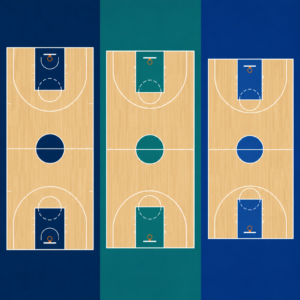
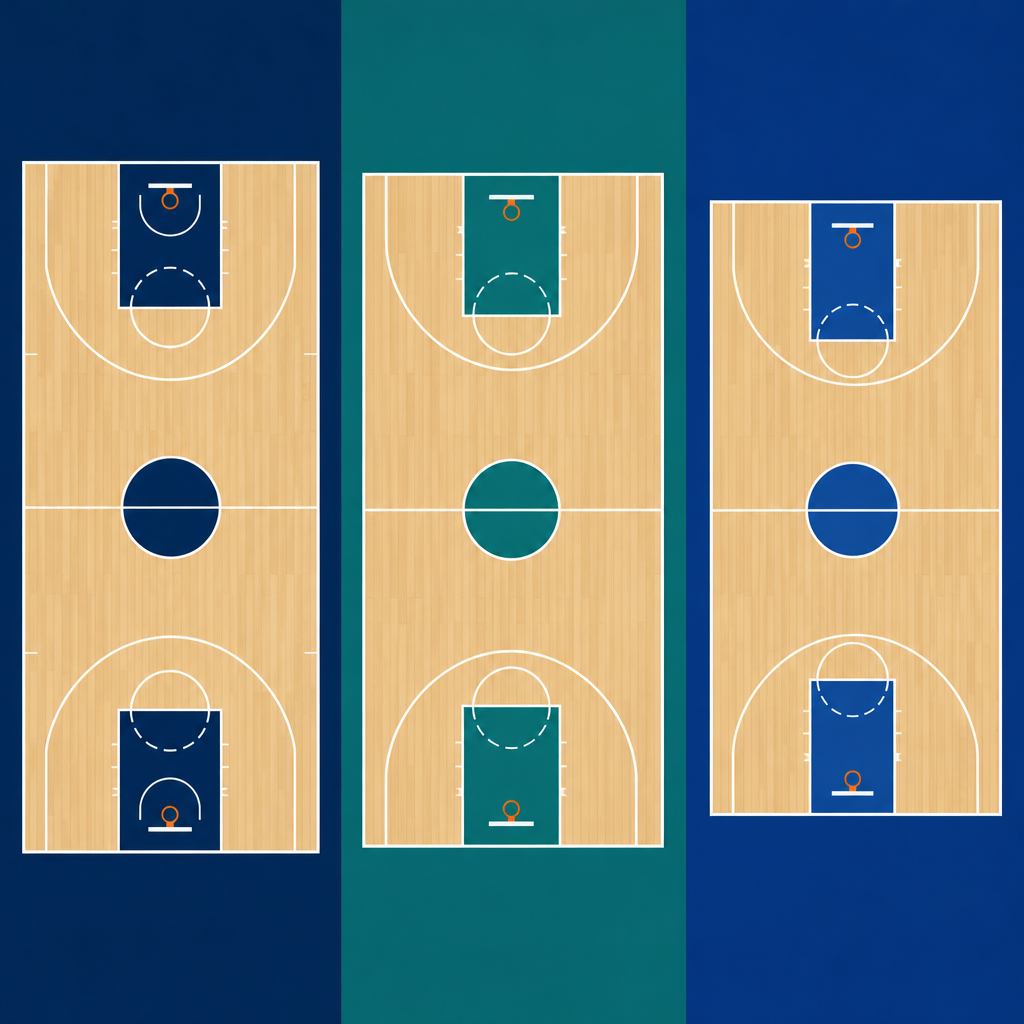
The first and simplest comparison is overall court size. NBA courts measure 94 feet long by 50 feet wide. NCAA courts, for both men and women at the college level, also measure 94 feet by 50 feet. FIBA courts are slightly smaller at 28 meters by 15 meters, which converts to about 91.9 feet by 49.2 feet. That means the international floor is roughly two feet shorter and a little narrower than the NBA and NCAA floor. On paper, that seems minor. In play, it matters. Less total space compresses transition lanes, shortens closeouts, and makes early help defense arrive faster. When I have worked with players preparing for international competition, we spend time recalibrating sprint spacing, especially for wings who are used to running wide lanes in North American gyms.
Those dimensions are measured inside the boundary lines, and line width itself is standardized, typically 2 inches in many competitions. Clearance outside the sideline and baseline also matters for safety and style of play. Professional arenas often provide generous runoff, while smaller school gyms can feel tight even on a regulation court. That difference affects save attempts, corner shooting comfort, and how aggressively defenders pressure near the boundary. If you are just getting started, learn the main idea first: NBA and NCAA use the same full-court footprint, while FIBA is a bit more compact. That compactness encourages physical team defense and slightly reduces the amount of empty space available for isolation basketball.
Three-point line differences and how they change shooting
The three-point line creates the most visible and most discussed spacing difference. In the NBA, the arc is 23 feet 9 inches from the center of the basket at the top, with shortened corners at 22 feet. In NCAA men’s basketball, the arc is 22 feet 1.75 inches. NCAA women now use the same 22 feet 1.75 inches. FIBA sets the line at 6.75 meters, or about 22 feet 1.75 inches, with shorter corner threes where the arc meets straight boundary lines. So the biggest three-point difference is not between FIBA and NCAA, but between those two systems and the NBA.
That extra NBA distance changes roster construction and offensive geometry. A shooter who is reliable from the college line may need more lower-body strength, cleaner footwork, and quicker preparation to become efficient from the NBA line. The floor also stretches horizontally because defenders must honor deeper pull-up range. That creates wider driving gaps and longer closeouts. In contrast, college and FIBA spacing often allows more players to threaten from similar distances, but the shorter line can also pack defenders closer to the lane if a team lacks true shooting. For beginners, the practical lesson is simple: when you hear analysts discuss “NBA range,” they are talking about a materially longer shot, not just reputation.
| Feature | NBA | FIBA | NCAA |
|---|---|---|---|
| Overall court | 94 ft x 50 ft | 28 m x 15 m | 94 ft x 50 ft |
| Three-point line | 23 ft 9 in top; 22 ft corners | 6.75 m / 22 ft 1.75 in | 22 ft 1.75 in |
| Lane width | 16 ft | 4.9 m / about 16.1 ft | 12 ft |
| Restricted area radius | 4 ft | 1.25 m / about 4.1 ft | 4 ft |
| Free-throw line | 15 ft from backboard | 15 ft equivalent | 15 ft from backboard |
The lane, free-throw line, and restricted area
The painted area, often called the key or lane, differs more than many casual fans realize. The NBA lane is 16 feet wide. FIBA uses 4.9 meters, which is about 16.1 feet, essentially comparable to the NBA. NCAA uses a narrower 12-foot lane. All three systems place the free-throw line 15 feet from the plane of the backboard, preserving one of the game’s core constants. The restricted area under the basket is also similar at about 4 feet in the NBA and NCAA, with FIBA at 1.25 meters, roughly 4.1 feet.
Those measurements shape post play and rim protection. A wider lane moves low-block catches slightly farther from the center of the floor, opening cleaner driving channels and changing rebounding angles. It also gives help defenders different stunt distances. The NCAA’s narrower lane can make traditional post entries feel a touch more compact and can alter how teams defend back-to-the-basket scorers. The restricted area matters just as much. It defines where a secondary defender cannot draw a charge, which influences shot blocking timing and help-side positioning. When teaching new players, I explain it this way: the lane controls traffic, and the restricted arc controls collision rules near the rim. If you understand those two ideas, many tactical differences start to make sense.
What the dimension changes mean for offense and defense
Measurements become meaningful when they change decisions. On an NBA floor, the longer three-point line and full 94-by-50 dimensions create more room for spread pick-and-roll, drive-and-kick passing, and isolation scoring. Defenders must cover more ground to contest shooters, especially when the offense stations threats above the break and deep in both corners. That is why elite NBA offenses often value pull-up shooting, rim pressure, and one-pass-away spacing so highly. The court rewards players who can create advantages in wide areas and punish late rotations.
FIBA basketball usually feels denser. The slightly smaller floor reduces recovery distance, and the near-college three-point line allows more lineups to put five credible shooters around the arc. At the same time, international defenses often show excellent nail help, compact shell positioning, and disciplined weak-side tags because there is just a bit less terrain to defend. NCAA basketball sits between those realities. The court is NBA-sized, but the line is shorter, so the floor can feel roomy in transition and tighter in half-court play depending on personnel. Teams with average shooting may not generate true NBA-style spacing even though the floor is the same size. That contrast is important for player development. A guard preparing for the next level cannot rely only on making college threes; he or she must prove the shot extends without losing efficiency or decision speed.
Equipment standards, markings, and facility considerations
Court dimensions do not exist in isolation. They connect to baskets, backboards, shot clocks, and facility layout. Across NBA, FIBA, and NCAA play, the rim height remains 10 feet and the backboard is 6 feet wide by 3.5 feet tall in standard competition. The basket’s horizontal placement from the baseline is also effectively standardized through the backboard support setup, so finishing angles near the rim remain familiar across levels. That consistency helps players transition between rule sets. What changes is everything around the basket: the lane width, the no-charge arc, and the three-point line that frames shot value.
Facility operators must also account for line coexistence. Many school and club gyms paint multiple rule sets on one floor. If you have ever stepped into a gym with overlapping white, red, blue, and black arcs, you know how confusing that can be for beginners. Clear labeling in practice matters. Coaches should tell players exactly which line is live for a drill, especially for corner shooting and closeout work. Organizations such as FIBA publish official court diagrams, and NCAA playing rules specify line placement and measurement tolerance. For anyone building or resurfacing a court, using those diagrams is essential. Small errors in arc placement or lane width can undermine training quality, especially for players preparing for sanctioned competition.
Getting started: how beginners should use this knowledge
If you are new to basketball, do not memorize dimensions just to win trivia. Use them to understand what you are seeing and to train smarter. Start with five anchor facts: NBA and NCAA courts are 94 by 50 feet, FIBA is slightly smaller, the NBA three-point line is longer, the NCAA lane is narrower, and the free-throw line stays the same across all three. Those points explain most visual differences on television and in person. From there, watch how the floor affects style. Notice how NBA offenses pull defenders farther from the basket. Notice how FIBA teams can load to the ball quickly. Notice how college teams vary widely depending on shooting talent and pace.
For coaches and players, the best next step is practical. Measure your training space. Mark the corners accurately. Track shooting percentages from each rule set if you compete in more than one environment. Teach footwork relative to line distance, not just “shoot from deep.” If your program serves youth players with long-term goals, introduce them to both college and professional spacing concepts early. This hub article gives you the foundation for Basketball Basics, but mastery comes from connecting the numbers to real movement, real decisions, and real games. Keep learning the floor, because once you understand court dimensions, the strategy of basketball becomes much easier to read, coach, and play well.
Frequently Asked Questions
What are the official court dimensions for NBA, FIBA, and NCAA basketball?
The biggest starting point is the full-court size. An NBA court measures 94 feet long by 50 feet wide. NCAA courts also measure 94 feet by 50 feet, so at first glance college and NBA floors appear identical in overall playing area. FIBA courts are slightly smaller at 28 meters by 15 meters, which converts to about 91.9 feet long by 49.2 feet wide. That difference may seem minor on paper, but even a few inches to a couple of feet can influence spacing, transition lanes, closeouts, and how much room players have to operate.
Beyond total length and width, the half-court markings create the more meaningful differences. The three-point line, lane dimensions, restricted area, and distance from the basket to key reference points all affect how offenses flow and how defenses rotate. For example, players may stand in familiar spots based on instinct, but those spots can shift slightly depending on whether they are playing under NBA, FIBA, or NCAA rules. That is why coaches, shooters, and defenders often talk about “feeling” a floor right away. The measurements are standardized, but the game experience changes with each set of dimensions.
How does the three-point line differ between NBA, FIBA, and NCAA courts?
The three-point line is one of the most important differences because it directly changes offensive spacing and shot selection. In the NBA, the arc is farthest from the basket, measuring 23 feet 9 inches at the top of the key, with shorter corner threes at 22 feet because the sideline limits how wide the arc can extend. FIBA uses a shorter international three-point line, currently 6.75 meters, or about 22 feet 1.75 inches, with even shorter corner distances. NCAA men’s basketball uses a 22 feet 1.75 inches arc, matching the FIBA top distance, while NCAA women’s basketball uses a shorter line than the men’s game.
These differences matter a lot in real play. A shorter three-point line generally makes the perimeter more dangerous because more players can shoot comfortably from behind it. That can pull defenders farther away from the paint and create wider driving lanes. The NBA’s longer line demands more range, which can reduce efficiency for some shooters but also creates more room inside the arc for ball handlers and screen actions. In FIBA and NCAA competition, the shorter line can compact the floor in one sense, but it also increases the value of spot-up shooting because more players become credible threats. For coaches and developing players, understanding the exact arc matters because the same shot location may be a two in one gym, a long two in another, and a comfortable three somewhere else.
Why do small court dimension differences have such a big effect on spacing and strategy?
Small measurement changes matter because basketball is a timing-and-space sport. A pass that arrives safely on one floor may be easier to deflect on another. A help defender who looks one step late on a larger floor may arrive on time on a slightly smaller one. When the court shrinks even a little, defenders can recover faster, gaps close sooner, and ball movement has to be sharper. When the floor feels more open, offenses often gain more room for drives, kick-out passes, and isolation actions.
This is especially true around the lane and perimeter. If the three-point line is closer, defenders may be more willing to stunt or help because they believe they can still recover to shooters. If the line is farther out, that same help decision becomes riskier. Transition basketball changes too. The width of the floor and the spacing between outlets, wings, and corner runners influence how quickly teams can flow into early offense. Even rebounding angles can shift when shots come from different distances. So while the dimensions may appear close in a rulebook, the strategic consequences are significant. Players notice them in footwork, coaches notice them in game planning, and fans often see the result in pace, shot profile, and floor balance.
Are the key, lane, and paint areas the same in NBA, FIBA, and NCAA basketball?
No, and this is another major area where the game changes. The NBA lane is 16 feet wide, while FIBA and NCAA also use a 16-foot-wide lane in the modern game. However, the surrounding rules and markings, such as the restricted area arc and other painted references, still create different playing conditions. The restricted area under the basket is especially important because it affects charge-block decisions and rim protection positioning. In the NBA, the restricted area arc is set at 4 feet from the center of the basket. FIBA uses a slightly different restricted-area standard, and NCAA also has its own enforcement and court-marking details depending on the level and rulebook updates.
Even when lane width appears similar, post play and interior defense do not automatically feel the same. The relation between the lane, the backboard, the rim, and perimeter spacing affects post entries, double-team timing, and weak-side help. On a court with a shorter three-point line, defenders may crowd the paint more aggressively while still feeling capable of contesting shooters. In the NBA, longer closeouts and greater shooting range can stretch the defense, opening up dunker spot actions, lobs, and kick-outs. For beginners learning basketball basics, the key lesson is that the paint is not just a painted rectangle. It is the center of help defense, rebounding position, interior scoring angles, and many of the most important rule interpretations in the game.
Which court differences matter most for beginners, coaches, and players moving between NBA, FIBA, and NCAA rules?
The most important differences to learn first are overall court size, the three-point line, and the restricted area. Those three elements affect nearly every possession. For beginners, the three-point line is often the easiest difference to recognize, but spacing is the deeper concept to understand. If you are learning how offenses work, start by noticing where shooters stand, how much room ball handlers have coming off screens, and how quickly defenders can help from the weak side. Those observations will make the court dimensions feel practical rather than just theoretical.
For coaches and players transitioning between levels, details become even more important. Shooters may need to adjust range and release timing. Defenders must recalibrate closeout distance and help positioning. Bigs may find that post catches happen a little deeper or a little farther from the rim depending on the floor and the surrounding spacing. Guards may discover that driving lanes open differently, especially in pick-and-roll coverage. The core idea is simple: court dimensions do not just describe the floor, they shape the game itself. That is why understanding NBA vs FIBA vs NCAA court dimensions is such a valuable part of basketball fundamentals. Once you know the measurements and how they influence movement, decision-making, and strategy, the game becomes much easier to read.