
NBA jersey numbers do far more than help referees identify players during a game. In the league, a number is part regulation, part branding, part team history, and part personal mythology. Fans buy numbers, announcers shorthand careers through numbers, and franchises elevate certain numbers into permanent symbols hanging from arena rafters. That is why questions about banned numbers, retired numbers, and the spread of iconic choices such as 23 come up so often when people study NBA teams, arenas, and identity. Understanding NBA jersey number rules means looking at both the official rulebook and the unwritten customs that shape how players and franchises present themselves.
At the most basic level, an NBA jersey number is the numeral displayed on a player’s uniform for identification. A retired number is one a team has taken out of circulation to honor a player or contributor. A banned number can mean two different things: a number prohibited by league uniform rules, or a number effectively unavailable because a team retired it. In practice, most confusion comes from mixing those categories together. I have worked through uniform compliance issues and historical roster checks before, and the pattern is always the same: the rulebook is narrower than people assume, while team culture is much broader and more powerful.
This matters because jersey numbers sit at the intersection of competition, commerce, and memory. A number affects merchandise sales, player image, and even how quickly a fan connects a newcomer to a franchise. It also ties directly to arenas and identity, because retired-number banners are among the most visible storytelling tools inside NBA buildings. Walk into TD Garden, Madison Square Garden, Crypto.com Arena, or United Center, and the rafters tell you which numbers carry weight. For a sub-pillar page under NBA teams, this is the hub topic: arenas display identity, and jersey numbers are one of the clearest ways teams turn history into a living part of the game-night experience.
What the NBA actually allows on jerseys
The first answer many readers want is simple: what jersey numbers are allowed in the NBA? The league permits players to wear most nonnegative whole numbers commonly used on uniforms, including single digits, double digits, and in modern practice even 00. Unlike some lower levels of basketball that historically limited numbers for officiating signals, the NBA has long operated with wider flexibility. That is why you have seen players wear 0, 00, 1, 7, 23, 45, 77, and 99. There is no league-wide rule that makes 23 special, and there is no rule saying players must stay within a narrow range such as 0 through 55.
There are, however, real boundaries. Numbers that conflict with league presentation standards or uniform conventions are not used. Triple-digit numbers are out. Fractional gimmicks are out. Symbols are out. A player also cannot freely switch numbers in the middle of the season without administrative approval, because roster records, merchandising systems, and official statistics all depend on consistency. If a player wants to change numbers, the practical process runs through team operations, league approval, and inventory considerations. That is why offseason changes are common, while in-season changes are unusual.
The other important rule is functional rather than mathematical: a player can only wear an available number on that team. If a franchise has retired 32, then 32 is effectively banned there even though it is legal elsewhere. This team-by-team availability rule explains much of the confusion around NBA jersey number rules. A number may be perfectly acceptable under league standards and still be unobtainable because the arena rafters say it belongs to someone else.
Why some numbers are banned or unavailable
When fans ask why some NBA numbers are banned, the most accurate answer is that there are three distinct reasons: formal league restriction, team retirement, and informal cultural avoidance. Formal league restriction is the smallest category. The NBA does not maintain a long list of forbidden ordinary numbers. Team retirement is far more common. The Boston Celtics, Los Angeles Lakers, Chicago Bulls, New York Knicks, and other legacy franchises have retired so many numbers that new players have fewer practical options than they would on a younger club with a thinner historical record.
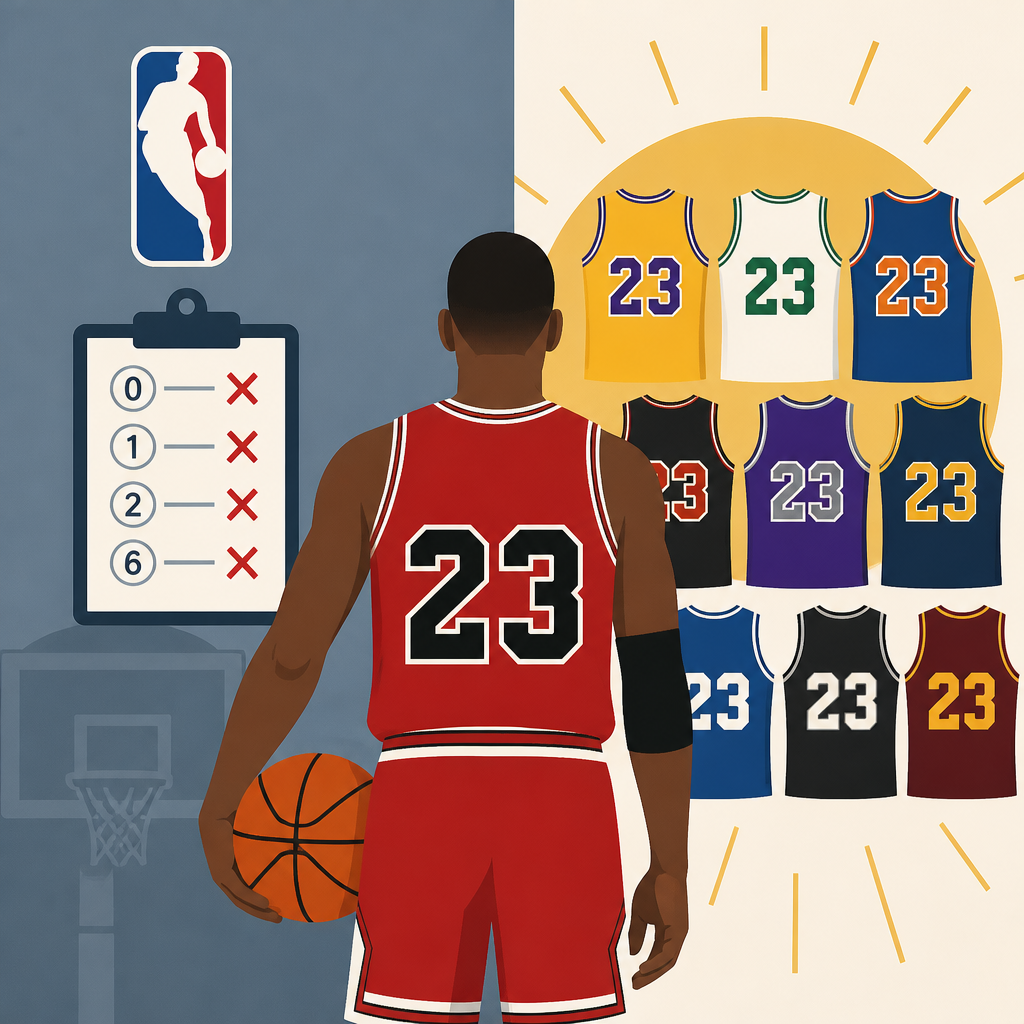
Informal cultural avoidance is subtler but real. A team may not officially retire a number, yet players and team staff may still treat it as off-limits out of respect. The best known example across the league is 6 after Bill Russell. Following Russell’s death, the NBA announced the permanent retirement of number 6 league-wide, an extraordinary honor similar to Major League Baseball retiring 42 for Jackie Robinson. Existing players already wearing 6 were grandfathered in, but new NBA players could not choose it. That is a true league-wide ban in the modern era, and it shows how rare such a step is.
Teams can also create practical barriers when multiple legends share a number’s legacy. A player considering 33 for the Celtics, 32 for the Magic, or 8 and 24 for the Lakers knows that even if a number is technically available in another context, it carries public expectations. Front offices understand this. They think about fan reception, broadcast recognition, merchandise continuity, and whether a number suits a player’s brand. So while the rulebook grants room, the identity of the team often narrows the field.
Why 23 is everywhere in the NBA
Number 23 is everywhere because it became the most transferable symbol of basketball greatness. Michael Jordan made 23 the most marketable jersey number in modern sports, and his influence spread across generations of NBA players long after his peak with the Chicago Bulls. Young players who grew up watching Jordan highlights, buying Jordan Brand shoes, or hearing family stories about the 1990s often chose 23 before they ever reached the league. The number became a shorthand for ambition, scoring flair, competitiveness, and star presence.
LeBron James reinforced that popularity when he wore 23 with the Cleveland Cavaliers and later again after earlier switches. Even though James also wore 6, his long association with 23 helped keep the number central in the NBA’s visual culture. Once two era-defining players are strongly linked to the same number, imitation becomes self-sustaining. High school players choose it, college stars carry it, and by the time they reach NBA teams, 23 already feels like part of their basketball identity.
There is also a practical branding reason. Two-digit numbers with a strong silhouette reproduce well on jerseys, television graphics, social media avatars, and apparel. Twenty-three is visually balanced, instantly recognizable, and loaded with positive basketball meaning. That makes it attractive not just to players but to marketing departments and fans. In the language of arenas and identity, 23 functions like a portable icon. It can travel from one franchise to another while preserving a direct link to the broader mythology of the sport.
Retired numbers, arena rafters, and team identity
Retired numbers matter because they turn an arena into a historical archive. When a franchise raises a number to the rafters, it is making a formal claim about identity: this player, coach, or contributor represents our standards. Every home game then becomes a reenactment of that message. New fans ask about the banners. Broadcast cameras frame them before tipoff. Free agents notice them on visits. Players feel them during introductions. The retired number is not just absent from the locker room inventory; it is actively present in the building’s story.
This is why the strongest NBA arenas feel distinct even when the court dimensions are identical. The Lakers use retired numbers to connect George Mikan, Magic Johnson, Kareem Abdul-Jabbar, Kobe Bryant, Shaquille O’Neal, and others into one lineage. The Celtics do the same with Russell, Havlicek, Bird, McHale, Pierce, and more. The Bulls’ visual identity is inseparable from 23, even though many fans also connect the franchise to 33 for Scottie Pippen and 91 for Dennis Rodman. In each case, numbers become architectural memory.
For NBA teams building or refreshing brand identity, jersey numbers are one of the few symbols that can bridge generations without explanation. Logos can change, arena names can change, and uniforms can be redesigned, but the number in the rafters remains stable. That continuity is why retired numbers are so valuable within the broader arenas and identity conversation.
How players choose numbers today
Players usually choose numbers through a mix of personal history, family influence, basketball idols, and availability. Some pick a number they wore in AAU or high school. Some honor a parent or sibling’s birthday. Some adopt the number of a favorite star. Others choose strategically, looking for a clean visual identity that is not already crowded in the merchandise market. I have seen team staff discuss these choices in practical terms: can the player build a distinct brand around it, is the number available in all jersey sets, and will fans immediately associate it with the new signing?
Availability can force creative decisions. If a player has worn 23 his entire life but joins a franchise where 23 is retired, he may pivot to 3, 32, or another related number. That is one reason certain numbers cluster around similar symbolic meanings. Single digits often suggest modern minimalism or speed. Numbers in the 20s and 30s can feel more traditional. Number changes after trades or free-agent moves often reveal how much of a player’s identity is tied to the number versus the opportunity.
| Factor | How it influences jersey choice | Example |
|---|---|---|
| Childhood identity | Players keep the number worn in formative years | A guard enters the NBA wearing 11 because he used it through high school and college |
| Tribute | Number honors family, mentors, or hometown links | A player selects 21 because it matches a parent’s birthday date |
| Basketball idol | Number reflects admiration for a star | Choosing 23 because of Jordan or James |
| Team history | Retired or sensitive numbers reduce options | A Laker cannot simply claim 24 or 32 |
| Branding | Simple, memorable numbers sell well and photograph clearly | Single digits and iconic double digits often perform best in merchandise |
Famous number stories that shaped the league
Several famous jersey stories explain why numbers carry so much emotional weight. Jordan briefly wore 45 during his return because his original 23 had become sacred and complicated after retirement. Kobe Bryant split his Lakers legacy between 8 and 24, and the franchise eventually retired both, a rare acknowledgment that one player can define two separate number identities. Dennis Rodman wore 91 with the Bulls, giving a nontraditional number cult status because it fit his persona. Luka Doncic made 77 globally recognizable, proving that iconic status is not limited to older numbers associated with American basketball tradition.
Bill Russell’s 6 represents something different: a number elevated beyond one franchise. His league-wide retirement recognized championships, civil rights leadership, and the moral authority he carried in NBA history. That move clarified the difference between local identity and league identity. Most numbers belong to teams and players. A very small number become part of the NBA’s institutional memory.
These stories also show that rarity helps. A number becomes powerful when it combines elite performance, repeat visual exposure, and a compelling narrative. Arena banners preserve that narrative, and fans pass it down. That is the mechanism by which a simple numeral becomes a durable sports symbol.
What fans should know when reading an NBA roster or visiting an arena
If you want to understand an NBA team quickly, study the jersey numbers before the opening tip. First, check which numbers are retired and hanging in the arena. That list reveals the franchise’s heroes, dynasties, and values. Second, note whether current players wear legacy-heavy numbers or avoid them. Third, look for repeated patterns across eras, because some organizations favor continuity while others leave more room for reinvention.
When visiting an arena, the rafters are not decoration. They are part of the team’s identity system, just like the court design, logo package, and pregame video. The best fan guides to NBA teams should always connect roster numbers, retired banners, and arena presentation because they explain each other. A newcomer wearing 1 or 5 might be making a fresh statement. A veteran wearing 23 may be tapping into basketball’s largest shared symbol. A number unavailable on one team may be ordinary on another. Context is everything.
For readers exploring the broader NBA teams topic, this hub is the starting point for understanding arenas and identity. Jersey number rules explain the formal side. Retired banners explain the emotional side. Together they show why some numbers disappear, why 23 remains everywhere, and why the numbers above the court can matter almost as much as the names on the front of the jersey. If you want to read teams more intelligently, start by looking up. The rafters usually tell the truth.
Frequently Asked Questions
Are any jersey numbers actually banned in the NBA?
Yes, but the idea of a “banned” number in the NBA usually needs a little clarification. At the league level, there is no long list of universally forbidden jersey numbers in the modern NBA. Players can generally wear numbers from 00 through 99, as long as the number is approved by the team and the league. That said, some restrictions have existed for practical and symbolic reasons. Historically, certain number rules were influenced by officiating mechanics, especially in eras when referees reported fouls using hand signals and preferred two-digit numbers that were easier to communicate quickly. Over time, those concerns became less rigid, and the league became much more flexible.
The more common source of confusion is team-level retirement rather than league-wide prohibition. When a franchise retires a number, that team effectively removes it from circulation to honor a player, coach, broadcaster, or other major figure in team history. So the number is not banned across the NBA, but it is unavailable on that specific team unless the organization makes a rare exception. That is why one number can be off-limits in one city but completely normal in another.
The most famous near-league-wide example is No. 6, which the NBA retired in honor of Bill Russell. That move gave Russell a unique place in league history, and new players generally cannot choose No. 6 moving forward. However, players who were already wearing No. 6 at the time were grandfathered in. So if people ask whether the NBA bans numbers, the most accurate answer is this: true league-wide restrictions are rare, but team retirements and special honors can make certain numbers effectively unavailable.
Why do NBA teams retire jersey numbers, and does that mean no one can ever wear them again?
Teams retire jersey numbers to permanently honor people who shaped the franchise in a meaningful way. In most cases, that means superstar players whose accomplishments, longevity, championships, or cultural impact became inseparable from the team’s identity. A retired number hanging in the rafters serves as a public statement that this player’s contributions rise above ordinary recognition. It is part tribute, part history lesson, and part branding, because the number becomes a symbol of an era fans never want forgotten.
Retiring a number usually means future players on that team are not supposed to wear it. In practice, the number is taken out of circulation, and that is why some franchises have surprisingly long lists of unavailable numbers. The Boston Celtics, Los Angeles Lakers, New York Knicks, and other older teams with deep histories have retired enough numbers that their available options can feel limited compared with newer franchises. This is one reason jersey numbers in the NBA are not just personal preference; they are also shaped by what a team’s history has already claimed.
However, “retired” does not always mean absolutely impossible to revisit under every circumstance. Exceptions are rare, but they have happened in sports when families, organizations, or honored individuals gave explicit approval. More often, though, retired numbers remain untouched because teams understand that their value comes from permanence. Once a franchise elevates a number into its internal mythology, bringing it back can feel like diminishing the honor. That is why retired numbers carry so much weight in NBA culture: they turn a simple uniform digit into a piece of institutional memory.
Why is No. 23 so common and so iconic in the NBA?
No. 23 is everywhere because Michael Jordan made it one of the most powerful personal brands in sports history. Before Jordan, 23 was just another available uniform number. After Jordan, it became shorthand for greatness, clutch scoring, competitive obsession, championship dominance, and global popularity. His career with the Chicago Bulls transformed the number into an instantly recognizable symbol, not only for basketball fans but for the wider culture. For many players growing up in the 1990s and 2000s, wearing 23 was a way of honoring the athlete who defined basketball excellence in their imagination.
That influence spread well beyond direct imitation. Even players who were not trying to “be Jordan” often saw 23 as a confidence number. It suggested ambition. It carried a built-in aura. Fans understood it immediately, broadcasters referenced it naturally, and the number sold well on jerseys because it already had commercial gravity. In a league where image, identity, and marketability matter, that kind of symbolic power is hard to match.
There is also a practical reason 23 keeps reappearing: unlike some franchise-defining numbers, it is not retired everywhere. Certain teams have retired 23 to honor Jordan or one of their own stars, but many teams still allow it. As a result, generation after generation of players continue choosing it for personal, nostalgic, or branding reasons. So when people ask why 23 is everywhere, the answer is simple: one player turned it into basketball’s most famous number, and the sport has been living in that cultural shadow ever since.
Can NBA players choose any number they want, including 00 or very high numbers?
NBA players have broad freedom, but not unlimited freedom, when selecting a jersey number. In modern practice, players usually choose from 00 to 99, subject to league approval and team availability. Numbers like 0, 00, 1, 3, 7, 11, 23, and 35 are all common examples of how personal taste and brand identity shape choices. What matters most is that the number fits within league standards and is not already restricted by the team, whether because another active player wears it or because the franchise has retired it.
Very high numbers beyond 99 are generally not used in the NBA. The system is designed around recognizable, practical, two-digit numbering that works for scorekeeping, officiating, broadcasts, merchandise, and roster management. While fans sometimes imagine a player choosing a three-digit number for novelty, that would run against standard uniform conventions. The NBA wants numbers that are easy to identify at a glance and easy to integrate into official game operations.
As for 0 and 00, both have been used in the NBA and are treated as distinct jersey numbers. That surprises some fans, but it reflects how flexible the league has become compared with older assumptions about what “counts” as a normal number. Ultimately, the choice is a blend of player preference, team history, aesthetics, superstition, and marketing. A player may want a childhood number, a tribute number, a number tied to a family member, or a number that looks strong on a jersey. In the NBA, those decisions are personal, but they still exist within an organized framework.
What is the difference between a banned number, a retired number, and an unofficially avoided number in the NBA?
This is one of the most important distinctions for understanding NBA jersey rules. A banned number is a number that cannot be newly issued because of a formal rule, either by the league or by a team under special circumstances. Those cases are relatively rare and usually tied to official policy or major honors. A retired number, by contrast, is a ceremonial and historical designation made by a specific franchise. Once retired, that number is no longer worn for that team because it has been permanently linked to an honored figure in franchise history.
An unofficially avoided number is something different. These are numbers that are technically available but often left alone out of respect, sensitivity, or cultural expectation. For example, if a legendary player recently left a team and the franchise has not yet formally retired the number, incoming players may still decide not to touch it. In other cases, a number may be associated so strongly with a local icon that wearing it would invite unnecessary comparison or criticism, even if there is no written rule against it.
That difference matters because NBA number culture is shaped by both regulations and unwritten traditions. The official rules tell you what is allowed. Team history tells you what is respected. And player branding tells you what is desirable. When fans see certain numbers missing from circulation, they often assume the league banned them, when in reality the explanation is usually more layered: a retired jersey in one arena, a league honor in another case, or a quietly understood preference that some numbers are better left to legends.