
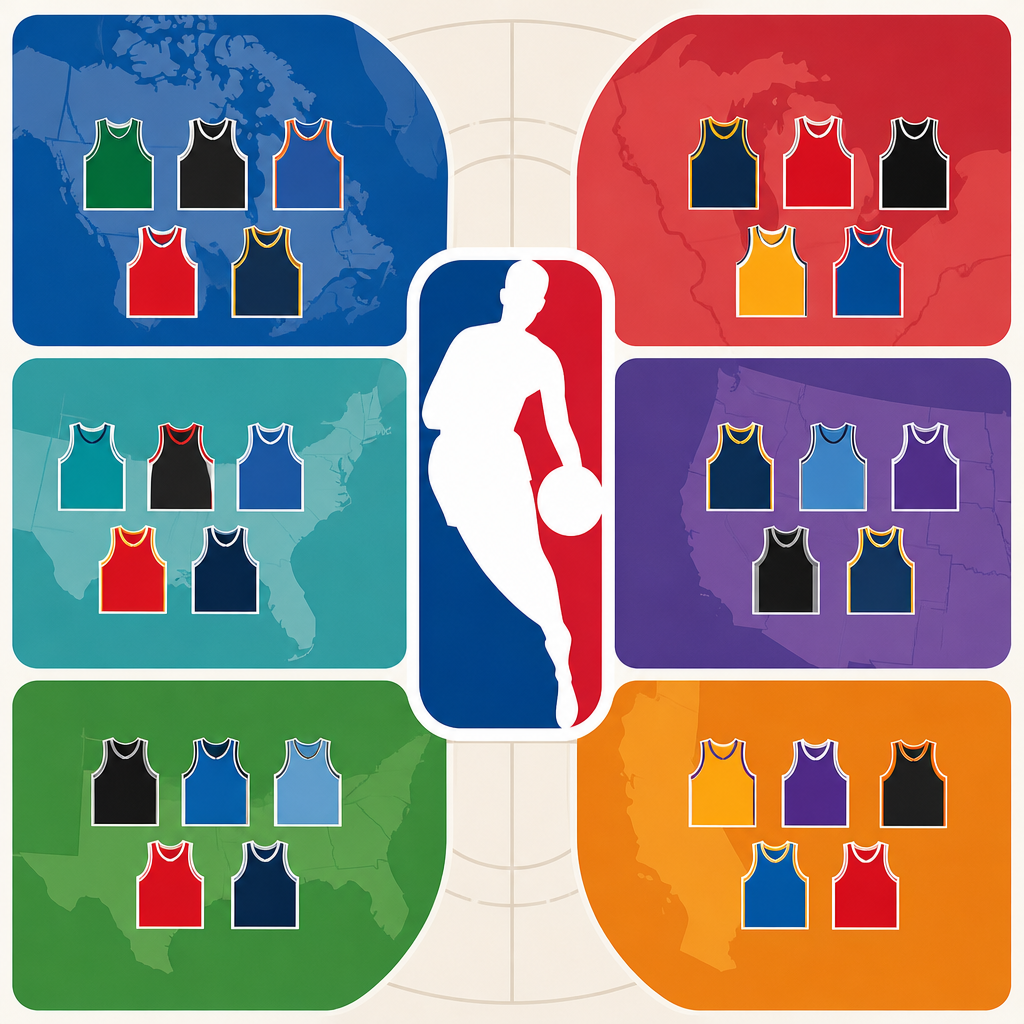
The NBA is organized into two conferences, six divisions, and 30 franchises, and understanding that structure makes the league far easier to follow. When new fans ask how the NBA schedule, standings, rivalries, and playoff races fit together, divisions are usually the missing piece. A division is a five-team subgroup inside a conference, while a conference is the larger 15-team half of the league. The Eastern Conference contains the Atlantic, Central, and Southeast divisions. The Western Conference contains the Northwest, Pacific, and Southwest divisions. Each division includes five teams based primarily on geography, though history, travel, and market considerations also shape the map.
League structure matters because it influences scheduling, helps define traditional rivalries, and gives context to standings throughout the season. Divisions do not carry the same weight they once did, but they still matter as organizational anchors. When I explain the NBA to new readers, I start with divisions because they are the simplest way to turn a 30-team league into manageable groups. They also create a natural path for deeper learning: once you know the divisions, the conference playoff picture, travel demands, and regional storylines make much more sense.
This guide serves as a hub for NBA league structure, covering all six divisions and the five teams in each one. It also explains what divisions do today, what they no longer decide, and why they remain important despite reduced direct playoff impact. If you want a clear, complete answer to how the NBA is grouped, this is it: 30 teams, six divisions, five teams per division, split evenly across East and West.
How NBA divisions fit into league structure
The NBA’s structure is hierarchical. At the top is the league itself, made up of 30 franchises. Those teams are split into the Eastern Conference and Western Conference, 15 teams each. Within each conference are three divisions of five teams. This setup creates six total divisions. The format is simple enough for casual fans but detailed enough to support scheduling balance, regional identity, and long-running rivalries.
Historically, divisions carried more direct competitive importance. Older playoff formats guaranteed stronger seeding for division winners, which could create odd situations where a team with a weaker record earned a higher seed than a better team from another division. The modern system reduced that distortion. Today, playoff qualification is primarily about overall conference record, not division placement. Still, division titles are official accomplishments, tiebreakers can involve division status, and broadcasters, analysts, and team media reference them constantly.
From a practical standpoint, divisions help fans sort information quickly. If you know the Milwaukee Bucks are in the Central Division, for example, you can immediately place them in the Eastern Conference and identify likely regional opponents such as Chicago, Detroit, Indiana, and Cleveland. That matters during the regular season because teams face division opponents more frequently than many non-division teams, making those matchups familiar and often emotionally charged.
Eastern Conference divisions
The Eastern Conference is divided into the Atlantic, Central, and Southeast divisions. These groups cover the Northeast corridor, the industrial Midwest, and the southeastern United States. The geography is not perfectly tight in every case, but the conference grouping generally reduces travel compared with a fully random alignment. More importantly, it preserves historic rivalries that grew over decades of repeated matchups.
The Atlantic Division is one of the most visible groups in the league because it includes major media markets and several legacy franchises. The teams are the Boston Celtics, Brooklyn Nets, New York Knicks, Philadelphia 76ers, and Toronto Raptors. Boston and Philadelphia represent two of the league’s most tradition-rich organizations. The Knicks remain one of basketball’s most watched brands, while Brooklyn gives New York a second franchise. Toronto is the NBA’s only Canadian team, which adds a cross-border dimension unique in the league.
The Central Division includes the Chicago Bulls, Cleveland Cavaliers, Detroit Pistons, Indiana Pacers, and Milwaukee Bucks. This division is closely tied to classic Midwestern basketball culture. Chicago’s global profile was shaped by the Michael Jordan era, Detroit’s identity was forged through the “Bad Boys” championships and later the 2004 title team, and Indiana is deeply associated with grassroots basketball. Milwaukee and Cleveland have more recently delivered championship stories through Giannis Antetokounmpo and LeBron James.
The Southeast Division contains the Atlanta Hawks, Charlotte Hornets, Miami Heat, Orlando Magic, and Washington Wizards. This group stretches across the broader southeastern region and includes franchises with very different histories. Miami has been the division’s most consistent modern standard-bearer, with titles in 2006, 2012, and 2013. Orlando has reached the Finals twice. Atlanta has a long franchise history dating back to before its move south. Charlotte and Washington add important regional balance, even though Washington’s placement can surprise fans who think of it as Mid-Atlantic first.
Western Conference divisions
The Western Conference is split into the Northwest, Pacific, and Southwest divisions. Because the West covers a larger geographic footprint, these divisions are especially useful for understanding travel realities. Anyone who has worked around scheduling knows the difference between a short California trip and a swing through mountain time zones is significant. Divisions cannot eliminate demanding travel, but they help cluster teams into familiar competitive neighborhoods.
The Northwest Division includes the Denver Nuggets, Minnesota Timberwolves, Oklahoma City Thunder, Portland Trail Blazers, and Utah Jazz. Geographically, this is the least intuitive division for many new fans because the teams are spread across mountain, plains, and Pacific Northwest regions. The label reflects the league’s need to balance the broader Western map, not just draw a perfect compass circle. Even so, the group has produced compelling modern basketball, including Denver’s 2023 championship run and Oklahoma City’s rise from rebuilding years into contention.
The Pacific Division consists of the Golden State Warriors, Los Angeles Clippers, Los Angeles Lakers, Phoenix Suns, and Sacramento Kings. In terms of star power, media attention, and late-night national broadcasts, no division consistently draws more visibility. The Lakers are one of the league’s flagship franchises. The Warriors shaped the modern three-point era around Stephen Curry. The Suns have been frequent contenders in recent years, the Clippers have pursued sustained relevance in a crowded market, and Sacramento broke a long playoff drought in 2023, reviving one of the league’s most loyal fan bases.
The Southwest Division features the Dallas Mavericks, Houston Rockets, Memphis Grizzlies, New Orleans Pelicans, and San Antonio Spurs. This division blends Texas basketball weight with nearby regional rivals. Dallas and Houston have large-market reach, San Antonio has one of the strongest organizational reputations in professional sports, Memphis has built a tough defensive identity across multiple eras, and New Orleans remains one of the league’s most intriguing smaller-market teams. The Southwest has often been one of the deepest divisions top to bottom, especially during the Spurs’ long run of excellence.
All six NBA divisions and the five teams in each
If you want the fastest possible reference, the table below lists every NBA division and the five teams assigned to it. This is the core league structure every fan should know.
| Conference | Division | Teams |
|---|---|---|
| Eastern | Atlantic | Boston Celtics, Brooklyn Nets, New York Knicks, Philadelphia 76ers, Toronto Raptors |
| Eastern | Central | Chicago Bulls, Cleveland Cavaliers, Detroit Pistons, Indiana Pacers, Milwaukee Bucks |
| Eastern | Southeast | Atlanta Hawks, Charlotte Hornets, Miami Heat, Orlando Magic, Washington Wizards |
| Western | Northwest | Denver Nuggets, Minnesota Timberwolves, Oklahoma City Thunder, Portland Trail Blazers, Utah Jazz |
| Western | Pacific | Golden State Warriors, Los Angeles Clippers, Los Angeles Lakers, Phoenix Suns, Sacramento Kings |
| Western | Southwest | Dallas Mavericks, Houston Rockets, Memphis Grizzlies, New Orleans Pelicans, San Antonio Spurs |
That breakdown is the simplest way to memorize the league. Start by separating East from West, then learn the three divisions in each conference, then attach the five teams. Most fans retain the structure quickly once they connect it to geography and rivalries rather than trying to memorize all 30 teams at once.
What divisions affect today: schedule, rivalries, and tiebreakers
The most important practical effect of NBA divisions is the regular-season schedule. Teams play division opponents four times each season, twice at home and twice on the road. That means 16 games of an 82-game schedule come against the other four teams in a club’s own division. Conference opponents outside the division are played either three or four times, while teams from the opposite conference are played twice each. This structure keeps local rivalries active while maintaining leaguewide variety.
Divisions also matter in standings interpretation. While division winners no longer automatically receive top playoff seeds regardless of record, winning a division still reflects sustained regular-season success against familiar opponents. It can also appear in tiebreaking procedures. In certain scenarios, being a division winner matters when teams are tied in the standings, though head-to-head record, conference record, and other criteria can come first depending on the tie. The exact order is defined by official NBA tiebreak rules and should always be checked directly when races get tight in March and April.
Rivalries are where divisions retain their strongest cultural value. Celtics versus Knicks, Bulls versus Pistons, Lakers versus Kings, Mavericks versus Spurs, and Heat versus Hawks have all gained extra texture through repeated divisional meetings. Familiarity changes games. Coaches know each other’s sets, scouts build deeper files, and fan bases circle those dates. Even when standings implications are modest, divisional games often feel bigger because they are embedded in shared history.
Common questions about NBA divisions
One common question is whether winning a division guarantees a playoff spot. Under current rules, no team should be viewed as making the playoffs solely because it won its division; playoff position depends on conference standing. Another frequent question is whether divisions are equal in strength. They are not. Some years the Pacific or Atlantic looks stacked, while another division may be rebuilding-heavy. Divisions are fixed groupings, but team quality changes constantly.
Fans also ask why certain teams appear in divisions that do not seem perfectly geographic. The answer is league balance. With 30 teams spread across North America, the NBA cannot create six divisions that are both mathematically even and geographically flawless. Minnesota in the Northwest is the classic example that confuses newcomers, but the broader conference layout works better than many alternatives. Realignment is possible in the future, especially if expansion adds teams, but any change would require leaguewide compromise.
Another useful question is whether divisions still matter to casual viewers. Yes, because they simplify the league. When I build NBA primers for new audiences, division pages consistently help people understand who belongs where, why teams play each other often, and how local identity shapes the season. Divisions may not dominate playoff math like they once did, but they remain the cleanest entry point to league structure.
Why this league structure still matters for NBA fans
NBA divisions are more than labels on a standings page. They provide the framework that makes the league easier to understand, follow, and enjoy. Once you know the six divisions—Atlantic, Central, Southeast, Northwest, Pacific, and Southwest—and the five teams in each, the broader NBA picture becomes much clearer. You can read standings faster, spot rivalries sooner, and make better sense of the regular-season schedule.
For anyone learning NBA basics, league structure is the foundation. Conferences tell you the biggest split. Divisions tell you the neighborhoods within it. From there, everything else connects: playoff races, road trips, media markets, and franchise history. That is why this page works as a hub for the broader topic. It gives you the organizing map first, so every other part of the league is easier to place.
Keep this division breakdown handy as you explore the NBA. If you are building your understanding of the sport, start here, then move next into conference standings, playoff seeding, and the regular-season schedule. Learn the map of the league, and the rest of the NBA will make far more sense.
Frequently Asked Questions
What are the six NBA divisions, and which five teams are in each one?
The NBA has 30 teams split evenly between two conferences: the Eastern Conference and the Western Conference. Each conference is then divided into three five-team divisions, giving the league six divisions total. In the Eastern Conference, the Atlantic Division includes the Boston Celtics, Brooklyn Nets, New York Knicks, Philadelphia 76ers, and Toronto Raptors. The Central Division includes the Chicago Bulls, Cleveland Cavaliers, Detroit Pistons, Indiana Pacers, and Milwaukee Bucks. The Southeast Division includes the Atlanta Hawks, Charlotte Hornets, Miami Heat, Orlando Magic, and Washington Wizards.
In the Western Conference, the Northwest Division is made up of the Denver Nuggets, Minnesota Timberwolves, Oklahoma City Thunder, Portland Trail Blazers, and Utah Jazz. The Pacific Division includes the Golden State Warriors, LA Clippers, Los Angeles Lakers, Phoenix Suns, and Sacramento Kings. The Southwest Division includes the Dallas Mavericks, Houston Rockets, Memphis Grizzlies, New Orleans Pelicans, and San Antonio Spurs. Learning these groupings helps new fans quickly understand where teams fit in the league and why certain matchups feel especially familiar over the course of a season.
What is the difference between an NBA division and an NBA conference?
A conference is the larger organizational level, while a division is a smaller subgroup within that conference. The NBA has two conferences overall: East and West. Each conference contains 15 teams, and those 15 teams are broken into three divisions of five teams each. So when someone refers to the Atlantic Division or the Pacific Division, they are talking about just one slice of a larger conference structure.
This distinction matters because most league-wide conversations happen at the conference level, especially when discussing playoff seeding, the standings, and postseason races. Divisions still matter for league organization, scheduling patterns, and rivalry-building, but teams ultimately compete within their conference for playoff positioning. Put simply, every team belongs to one division and one conference at the same time. For example, the Miami Heat are in the Southeast Division, which is part of the Eastern Conference, while the Los Angeles Lakers are in the Pacific Division, which is part of the Western Conference.
Do NBA divisions still matter for standings, playoff seeding, and the regular-season schedule?
Yes, but not in the same way they once did. Divisions still matter as part of the NBA’s structure, and they influence how often teams see certain opponents during the regular season. Teams generally play divisional rivals multiple times each year, which helps create familiarity and fuels long-running rivalries. That is one reason fans often feel like teams in the same division know each other especially well and have more history packed into their matchups.
When it comes to playoff seeding, however, conference record and overall regular-season performance matter more than simply winning a division. In today’s NBA, division winners are not automatically guaranteed a top playoff seed just because they finished first in their division. Instead, the standings are primarily ordered by each team’s overall record within its conference. That means a team can win its division and still be seeded lower than another team from the same conference with a better record. For new fans, the easiest way to think about it is this: divisions help shape the regular season, but conference standings drive the playoff picture.
Why are NBA divisions useful if the playoffs are based more on conference standings?
Divisions remain useful because they give the league a simple, logical framework that makes teams easier to organize and follow. They create smaller neighborhoods inside each conference, which helps fans make sense of the schedule and quickly identify natural rivals. If you are new to the NBA, it is much easier to remember that the Celtics, Knicks, Nets, 76ers, and Raptors all share the Atlantic Division than to memorize all 15 Eastern Conference teams at once. Divisions make the league feel more structured and approachable.
They also preserve regional identity and historical continuity. Many of the NBA’s most recognizable rivalries have been strengthened by divisional alignment and repeated meetings over many seasons. Even when playoff rules place less weight on divisions than in the past, fans, broadcasters, and analysts still use them as a shorthand for geography, style, and rivalry context. A division title may not carry the same postseason power it once did, but it still means a team finished ahead of four familiar opponents and maintained control of its immediate competitive group. That remains meaningful over an 82-game season.
How can understanding NBA divisions help new fans follow the league more easily?
Understanding divisions gives new fans a roadmap for the entire NBA. Instead of seeing 30 teams as one giant list, you can break the league into manageable layers: two conferences, six divisions, and then five teams in each division. That structure makes standings, news, and schedule analysis much easier to digest. If a broadcaster mentions a tight race in the Central Division or says a team is chasing another club in the Pacific, you immediately know the relationship between those teams and why the games might matter more.
It also helps you interpret recurring matchups and storylines throughout the season. Divisional opponents face each other often enough that trends develop, rivalries deepen, and playoff implications can become clearer over time. For example, if one team is climbing in the Southeast Division while also moving up the Eastern Conference standings, you can better understand both the local and bigger-picture significance. In practical terms, learning the divisions is one of the fastest ways to go from casually watching NBA games to genuinely understanding how the league is organized and how teams are connected across the season.