
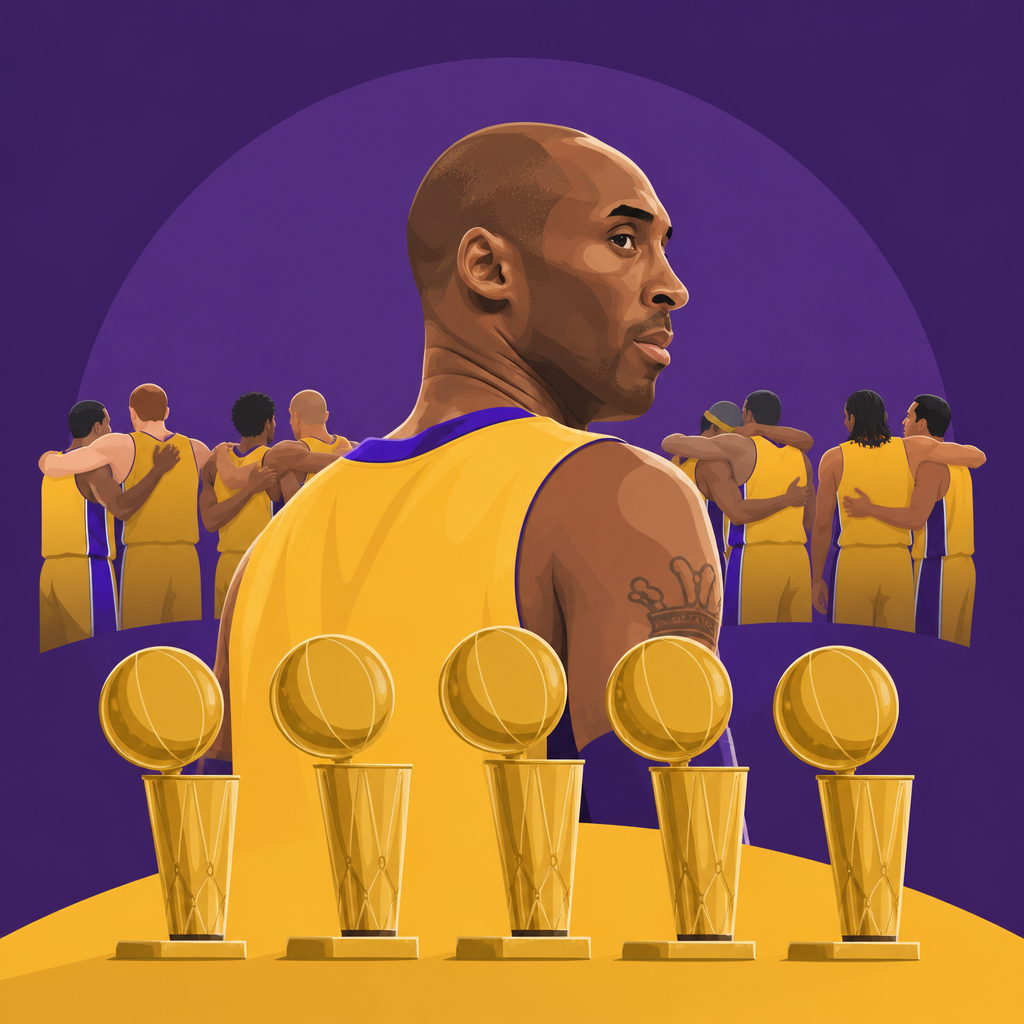
Kobe Bryant’s five NBA championships are the backbone of his player profile, but they also tell a larger story about role evolution, roster construction, coaching philosophy, and how dynasties survive change. Any serious look at Kobe Bryant championships has to go beyond ring counting and examine the five title teams that won them: the 1999-00, 2000-01, 2001-02, 2008-09, and 2009-10 Los Angeles Lakers. Those teams were not copies of one another. They had different strengths, different supporting casts, and different versions of Bryant himself. Early on, he was an explosive secondary star beside Shaquille O’Neal, attacking from the wing, defending elite guards, and changing games with athletic pressure. By the final two titles, he was the franchise’s central offensive engine, a technician who controlled tempo, scored from every level, and carried the emotional identity of the team.
In player profiles, championships matter because they show how talent translates under the hardest conditions. A title run tests shot creation, durability, adaptability, and decision-making over four playoff rounds. Bryant’s résumé is especially useful because it spans two distinct championship eras. He won three straight under Phil Jackson’s triangle offense with O’Neal at peak interior dominance, then won two more after the roster was rebuilt around his leadership and perimeter scoring. That arc helps explain why Bryant remains one of the defining NBA players of his generation. His championships were not accidental products of market size or nostalgia. They were won through elite coaching, Hall of Fame teammates, smart roster fits, high-level defense, and Bryant’s ability to rise from gifted young scorer to complete franchise cornerstone.
This hub article covers the five championships chronologically while also functioning as a player profile guide under the broader NBA Players topic. It defines the context of each title team, identifies the core rotation pieces, and explains what Bryant specifically contributed. It also answers the practical questions readers usually ask: How many rings did Kobe Bryant win? Which Lakers teams won them? Who were his most important teammates? Was he the best player on all five teams? The direct answer is that Bryant won five championships, all with the Lakers, and his role changed meaningfully across those victories. Understanding those changes is the key to understanding the player himself.
The first championship: 1999-00 and the beginning of the Lakers dynasty
The 1999-00 Lakers won 67 games in the regular season and captured the franchise’s first title of the Bryant-O’Neal era. This was Phil Jackson’s first season in Los Angeles, and his arrival gave structure to a roster that had talent but needed hierarchy. The team’s identity started with O’Neal, who won league MVP and was the most physically overwhelming force in basketball, yet Bryant’s importance was already obvious. At 21, he was an All-NBA level perimeter star who could break down defenses, finish in traffic, and defend across backcourt matchups. In my experience analyzing title teams, this Lakers group is one of the clearest examples of a co-star accelerating a dynasty before fully becoming its face.
The supporting cast mattered. Glen Rice provided spacing and veteran scoring. Ron Harper gave size at guard. A.C. Green, Robert Horry, and Rick Fox supplied playoff versatility, while Derek Fisher stabilized late-game possessions. In the Western Conference Finals against Portland, the Lakers nearly collapsed after losing a 3-1 lead, then produced one of the era’s defining fourth quarters in Game 7. The famous Bryant-to-O’Neal alley-oop became the enduring image, but the deeper point is that Bryant had become the team’s change-of-pace creator. When half-court possessions stalled, he could create an advantage from the perimeter in ways few wings of that period could match.
In the 2000 Finals against Indiana, O’Neal was the dominant force, but Bryant had a decisive moment in Game 4 after O’Neal fouled out. Bryant took command in overtime, scoring and controlling action with unusual poise for his age. That stretch showed why the Lakers were harder to solve than teams built around one superstar. Opponents had to handle the league’s most destructive interior scorer and an emerging wing assassin who could attack rotating defenses. Bryant’s first championship established the template for the next two seasons: O’Neal bent the game physically, Bryant bent it dynamically, and the Lakers punished any mismatch in either direction.
The second championship: 2000-01 and one of the most dominant playoff runs ever
If the first title announced the Lakers as champions, the 2000-01 title established them as a dynasty. Los Angeles went 15-1 in the playoffs, still one of the most dominant postseason records in NBA history. This team is often remembered for O’Neal’s force and Jackson’s control, but Bryant’s playoff leap is what made the run historically overwhelming. He averaged 29.4 points, 7.3 rebounds, and 6.1 assists in the postseason, and those numbers only tell part of the story. He was devastating against the Spurs in the Western Conference Finals, repeatedly collapsing San Antonio’s defense, scoring over length, and controlling game rhythm from the perimeter.
The 2001 Lakers were better balanced than the 2000 group. Fisher returned from injury and famously made six three-pointers in Game 5 against San Antonio. Horry remained the ultimate postseason problem-solver, capable of defending bigger players and hitting momentum threes. Fox brought intelligent wing play, while Brian Shaw and Horace Grant added experience and spacing discipline. This mattered because the triangle offense relies on timing, spacing, and players who understand reads rather than simply standing still around stars. Bryant thrived in that environment because he could attack within the structure or rescue a possession after the structure broke down.
Against Sacramento, he punished smaller guards and helped stabilize the series after the Kings challenged Los Angeles with speed and shot-making. Against San Antonio, he effectively became the matchup nightmare that swung the conference. The Spurs had Tim Duncan, David Robinson, and one of the league’s best defenses, but they could not contain Bryant’s blend of first-step explosiveness and difficult-shot confidence. In the Finals against Philadelphia, O’Neal dominated the paint, yet Bryant’s shot creation and defensive work on the perimeter were essential against a team built around Allen Iverson. This championship is crucial to Bryant’s player profile because it was the moment he was no longer merely the second star on a great team. He had become one of the best playoff players in the league, full stop.
The third championship: 2001-02 and the completion of the three-peat
The 2001-02 Lakers were not quite as sharp as the previous playoff machine, but they completed the three-peat, which is one of the hardest accomplishments in professional sports. Sustaining hunger after back-to-back titles is difficult. Opponents study every weakness, the regular season gets heavier, and every road arena treats you like a championship test. Bryant’s role in this title was more mature and more demanding. He was now fully expected to close games, defend primary perimeter threats, and absorb stretches where the offense needed self-generated scoring. O’Neal remained the interior anchor, but Bryant’s command of difficult possessions kept the dynasty moving.
The path was harder. Portland pushed the Lakers in the first round, San Antonio challenged them again, and the Western Conference Finals against Sacramento became one of the most discussed playoff series in league history. The Kings were deep, skilled, and coherent. Chris Webber, Vlade Divac, Mike Bibby, Peja Stojaković, Doug Christie, and Hedo Türkoğlu gave Sacramento playmaking, size, and shooting. The Lakers survived because stars win pressure possessions, and Bryant repeatedly supplied those possessions with drives, mid-range scoring, and late-clock solutions. O’Neal was massive throughout the series, but Bryant’s perimeter creation prevented Sacramento from loading every answer at the block.
In the 2002 Finals against New Jersey, Los Angeles had a talent edge and completed the sweep. Jason Kidd powered the Nets, but the Lakers had the two best players in the series. Bryant’s third championship at age 23 placed him in rare historical company. More important for a player profile, the three-peat years captured the athletic peak version of Bryant: explosive off the dribble, dangerous in transition, aggressive at the point of attack, and fully engaged as a two-way star. When people discuss Kobe Bryant championships, they sometimes flatten these early teams into “Shaq’s Lakers.” That misses the actual competitive reality. Without Bryant’s perimeter shot creation, defensive range, and late-game courage, the Lakers do not three-peat.
The last two championships: rebuilt rosters, Bryant as the unquestioned centerpiece
After the Lakers lost the 2004 Finals and later split the Bryant-O’Neal partnership, Bryant entered the most demanding phase of his career. He had to carry undermanned rosters, absorb criticism, and prove he could lead a champion as the clear first option. The answer arrived with the 2008-09 and 2009-10 titles. These teams looked different from the early dynasty teams. They were longer, more versatile up front, and designed around Bryant’s all-court offensive control rather than around low-post inevitability. Pau Gasol was the essential addition, giving Bryant a highly skilled interior partner who could score, pass, and fit the triangle seamlessly. Lamar Odom added elasticity as a rebounder and secondary creator. Andrew Bynum, when healthy, gave size. Trevor Ariza in 2009 and Metta World Peace in 2010 provided wing defense and timely offense. Fisher remained a trusted late-game guard.
| Championship Season | Finals Opponent | Bryant’s Team Role | Key Supporting Stars |
|---|---|---|---|
| 1999-00 | Indiana Pacers | Explosive co-star, perimeter defender, late-clock creator | Shaquille O’Neal, Glen Rice, Derek Fisher, Robert Horry |
| 2000-01 | Philadelphia 76ers | Elite playoff shot creator and two-way guard | Shaquille O’Neal, Derek Fisher, Rick Fox, Robert Horry |
| 2001-02 | New Jersey Nets | Primary closer beside dominant interior anchor | Shaquille O’Neal, Derek Fisher, Rick Fox, Robert Horry |
| 2008-09 | Orlando Magic | Franchise centerpiece, lead scorer, lead decision-maker | Pau Gasol, Lamar Odom, Andrew Bynum, Trevor Ariza |
| 2009-10 | Boston Celtics | Primary star, emotional leader, late-game controller | Pau Gasol, Lamar Odom, Andrew Bynum, Metta World Peace |
The 2008-09 title was especially important because it answered the biggest career question left around Bryant. After losing to Boston in the 2008 Finals, the Lakers returned sharper and more complete. Bryant won Finals MVP against Orlando, averaging 32.4 points, 7.4 assists, and 5.6 rebounds in the series. Orlando’s defense, anchored by Dwight Howard, challenged the paint, but Bryant controlled the matchup with mid-post work, pick-and-roll patience, and cross-match hunting. This version of Bryant was less dependent on pure burst than the 2001 version, but he was more surgical. He manipulated help defenders, understood when to score and when to facilitate, and punished defensive indecision.
The 2009-10 title may be the most revealing of Bryant’s competitive identity. The Finals rematch against Boston was brutal, physical, and uneven offensively. Bryant shot poorly in Game 7, but he impacted the game with rebounding, pressure creation, and relentless competitive force. Gasol was immense, Artest hit a huge late three, and the Lakers won a grind. That matters because championship basketball is not always about clean efficiency. Sometimes it is about surviving ugly possessions, maintaining belief, and continuing to apply pressure until the game breaks. Bryant’s fifth ring was not his prettiest statistical moment, but it was one of the clearest examples of his leadership imprint on a champion.
What the five championships say about Kobe Bryant’s player profile
Across all five titles, Bryant’s championships reveal a complete player profile rather than a single narrative. He was not one thing. He began as a gifted young co-star on a superteam, evolved into a devastating postseason perimeter force, then later became the unquestioned centerpiece of a rebuilt champion. His skill set also aged well. Early Bryant won with explosion, defensive aggression, and rim pressure. Later Bryant won with footwork, shot-making craft, post scoring, manipulation of help defense, and emotional command. Few NBA players have championship film that shows such different versions of greatness.
The titles also show an important truth about winning in the NBA: championships are team achievements built around stars, not solo acts. Bryant had Hall of Fame help from O’Neal, high-level support from Gasol, and strong role players across every run. That does not weaken his legacy; it clarifies it. The best player profiles explain how superstars fit into winning ecosystems. Bryant’s greatness was real because it translated in multiple ecosystems. He thrived with a dominant center, and he later thrived as the central organizer of the offense. He won in more than one form, which is a meaningful separator in all-time debates.
For readers exploring NBA Players and building out player profiles, Bryant’s championship record is one of the strongest case studies in modern basketball history. Five titles, two Finals MVPs, a three-peat, a repeat, and championship relevance across a full decade make his résumé both deep and instructive. If you want to understand Kobe Bryant championships, study the teams as closely as the rings. The five titles were won by different Lakers groups, under different pressures, with different versions of Bryant at the center of the story. That is why his profile remains essential reading. Use this hub as your starting point, then continue into deeper articles on each season, teammate, and playoff run.
Frequently Asked Questions
How many championships did Kobe Bryant win, and which Lakers teams won them?
Kobe Bryant won five NBA championships, all with the Los Angeles Lakers. The title teams were the 1999-00 Lakers, the 2000-01 Lakers, the 2001-02 Lakers, the 2008-09 Lakers, and the 2009-10 Lakers. That list matters because it immediately shows that Kobe’s championship career came in two distinct phases. The first three titles were part of the Lakers’ early-2000s three-peat alongside Shaquille O’Neal, while the final two came later, when Bryant had become the unquestioned centerpiece of a different championship core.
Looking at the five title teams separately gives a much clearer picture than simply saying Kobe had “five rings.” The 1999-00 team leaned on size, defense, and the inside dominance of Shaq while Bryant emerged as an elite two-way perimeter force. The 2000-01 and 2001-02 teams refined that formula, with Kobe taking on a larger shot-creation burden and becoming more central to how the Lakers survived difficult playoff series. By 2008-09 and 2009-10, the supporting cast, pace, and offensive balance had changed. Pau Gasol, Lamar Odom, Andrew Bynum, Trevor Ariza, Ron Artest, and Derek Fisher all played major roles in title runs that depended less on one overwhelming interior star and more on structure, spacing, and Kobe’s leadership in late-game situations.
In other words, the five championships are not one repeated story. They reflect different roster builds, different playoff paths, and different versions of Bryant as a player. That is why serious discussions of Kobe Bryant championships usually focus not only on the number five, but on how each team won and what Bryant’s role was on each title run.
What was Kobe Bryant’s role during the Lakers’ first three championships from 1999-00 to 2001-02?
Kobe’s role in the first three championships evolved quickly from rising star to essential co-superstar. In the 1999-00 season, he was already an All-NBA level guard, but the Lakers’ identity still began with Shaquille O’Neal’s dominance in the paint. Under Phil Jackson, the team used the triangle offense, controlled games with size and half-court execution, and relied on strong defense. Bryant’s job was to bring elite perimeter scoring, ball-handling, athleticism, and on-ball defense while complementing Shaq rather than replacing him as the offensive focal point.
By the 2000-01 season, Kobe had become much more than a secondary star. He was often the player who bent defenses before the ball ever reached O’Neal, especially against opponents that had stronger perimeter personnel or were better equipped to crowd the post. That postseason, Bryant was outstanding, particularly in the Western Conference playoffs, where his shot creation and all-around play helped the Lakers tear through elite competition. The Lakers went 15-1 in the 2001 playoffs, and Kobe’s ability to attack off the dribble, score in bunches, and guard multiple positions was a huge reason that team looked so overwhelming.
In 2001-02, Bryant’s role remained massive, but the path was tougher. The Lakers were still champions, yet they faced more resistance and had to solve more problems over the course of the season and postseason. Kobe had to carry heavy offensive responsibility in stretches, create difficult shots late in games, and give the team a reliable perimeter answer when defenses loaded up in the half court. Across the three-peat years, the key point is that Bryant was never just along for the ride. He began as a superstar next to a dominant interior force and became increasingly indispensable to the Lakers’ ability to win against top playoff opponents.
How were the 2008-09 and 2009-10 championship teams different from the early-2000s Lakers?
The 2008-09 and 2009-10 Lakers were different from the early-2000s title teams in both roster construction and the way they functioned under pressure. The three-peat teams were built around the extraordinary inside-out combination of Shaquille O’Neal and Kobe Bryant. Their physical profile, especially with Shaq anchoring the offense and defense, gave them a level of interior force few teams in league history could match. The later championship teams, by contrast, were more balanced and layered. They still ran elements of Phil Jackson’s triangle system, but they depended on a broader distribution of skill and decision-making.
Pau Gasol was central to that change. He gave the Lakers a highly skilled big man who could score, pass, rebound, and operate within the triangle without needing the offense to revolve around brute-force post dominance. Lamar Odom added versatility as a rebounder and secondary playmaker, while Andrew Bynum provided size when healthy. In 2008-09, Trevor Ariza supplied athleticism, perimeter defense, and transition energy. In 2009-10, Ron Artest brought strength, toughness, and a more physical defensive presence. Derek Fisher remained important as a stabilizing veteran guard who understood big moments and the team’s offensive system.
Kobe’s role on those later teams was also different. He was no longer sharing the spotlight with a prime Shaq; he was the clear first option, emotional tone-setter, and late-game closer. He had to manage tempo, create offense against loaded defenses, and lead a team whose margin for error often depended on poise and execution rather than overwhelming physical superiority. These Lakers could still punish teams in the post and control the glass, but they won more through balance, adaptability, and Bryant’s command of high-leverage possessions. That is what makes the final two championships such an important part of his legacy: they proved he could lead a title team as the primary centerpiece of a new roster era.
Why is it important to look at the five championship teams individually instead of just counting Kobe Bryant’s rings?
It matters because ring counting flattens context, and Kobe Bryant’s championships are especially rich in context. A player can win the same number of titles in very different ways, and that is exactly what happened across Bryant’s career. The first three championships came as part of a dynasty built around a historically dominant big man, a Hall of Fame coach, and a roster designed to maximize size and half-court control. The last two came after major organizational change, with a different supporting cast, a different competitive landscape, and Bryant carrying a different kind of leadership burden.
When you study the teams individually, you start to see how Bryant evolved. Early in the title years, he was explosive, dynamic, and increasingly essential, but still part of a partnership that shaped the entire team identity. Later, he became the defining offensive and emotional center of the Lakers. You also see how the front office rebuilt around him after the Shaq era, how Phil Jackson’s coaching principles adapted to new personnel, and how different role players affected the Lakers’ championship ceiling. That level of analysis says far more about Bryant than a simple total ever could.
There is also a broader basketball reason to separate the title teams. Championships are team achievements built through lineup fit, health, matchup advantages, coaching, and postseason adjustments. The 1999-00 Lakers did not face the exact same problems as the 2009-10 Lakers, and they did not solve those problems the same way. Understanding those differences helps explain not only Kobe’s career, but how NBA dynasties survive change. In Bryant’s case, the five championships form a timeline of growth, adaptation, and sustained excellence rather than a single repetitive accomplishment.
What do Kobe Bryant’s five championships reveal about his legacy as a player and leader?
Kobe Bryant’s five championships reveal a legacy built on more than scoring totals or individual accolades. They show a player who could fit into a championship structure, grow within it, and later become the central force holding a different championship structure together. That progression is one of the clearest signs of greatness. Bryant was not a static star winning the same way every year. He changed as the Lakers changed, and his game expanded to meet what the team needed in each era.
As a player, the five titles highlight his versatility. In the early championships, he was a devastating perimeter attacker, transition threat, defender, and secondary playmaker who could swing playoff series with his athleticism and skill. In the later championships, he was a more seasoned offensive organizer and closer, capable of controlling difficult possessions, drawing defensive attention, and making the right reads within a complex system. He could win with explosiveness, with footwork, with shot-making, and with competitive pressure applied over the course of long playoff runs.
As a leader, the championships show both durability and standards. Bryant’s teams won in different locker-room environments and with different supporting casts, but the constant was his demand for execution and competitive seriousness. That did not mean leadership was always simple or smooth, but it did mean the Lakers could organize themselves around a player whose expectations never softened. His title resume therefore supports a legacy defined by evolution, resilience, and championship-level impact across multiple team constructions. That is why discussions of Kobe Bryant championships remain so central to understanding who he was as an all-time NBA figure.</p