
NBA Coach’s Challenge rules changed how games are managed in late-game and momentum-heavy situations, giving teams a formal way to ask officials to review specific calls and correct clear errors. In simple terms, a coach’s challenge is an in-game request by the head coach for referees to trigger instant replay on a reviewable event after an on-court call has been made. The rule matters because modern NBA games are decided by tiny margins, and one foul, out-of-bounds ruling, goaltending decision, or possession error can swing win probability, rotation choices, and end-of-game strategy.
I have covered and broken down NBA officiating for years, and the challenge system is one of the easiest rules to misunderstand because fans often assume coaches can challenge any whistle at any time. They cannot. The NBA limits what can be reviewed, when the challenge can be used, and how many challenges a team can receive during a game. Understanding those limits is essential if you want to follow officiating decisions, replay reviews, timeout strategy, and why coaches sometimes hold a challenge too long.
This article explains the NBA coach’s challenge in plain language while placing it inside the broader officiating framework. It covers what plays are reviewable, how many challenges teams get, what happens when a challenge succeeds or fails, why referees still have replay authority without a challenge, and how the rule connects to the larger NBA Rules landscape. If you want one practical hub for NBA officiating, this is the foundation.
What the NBA Coach’s Challenge Is and Why It Exists
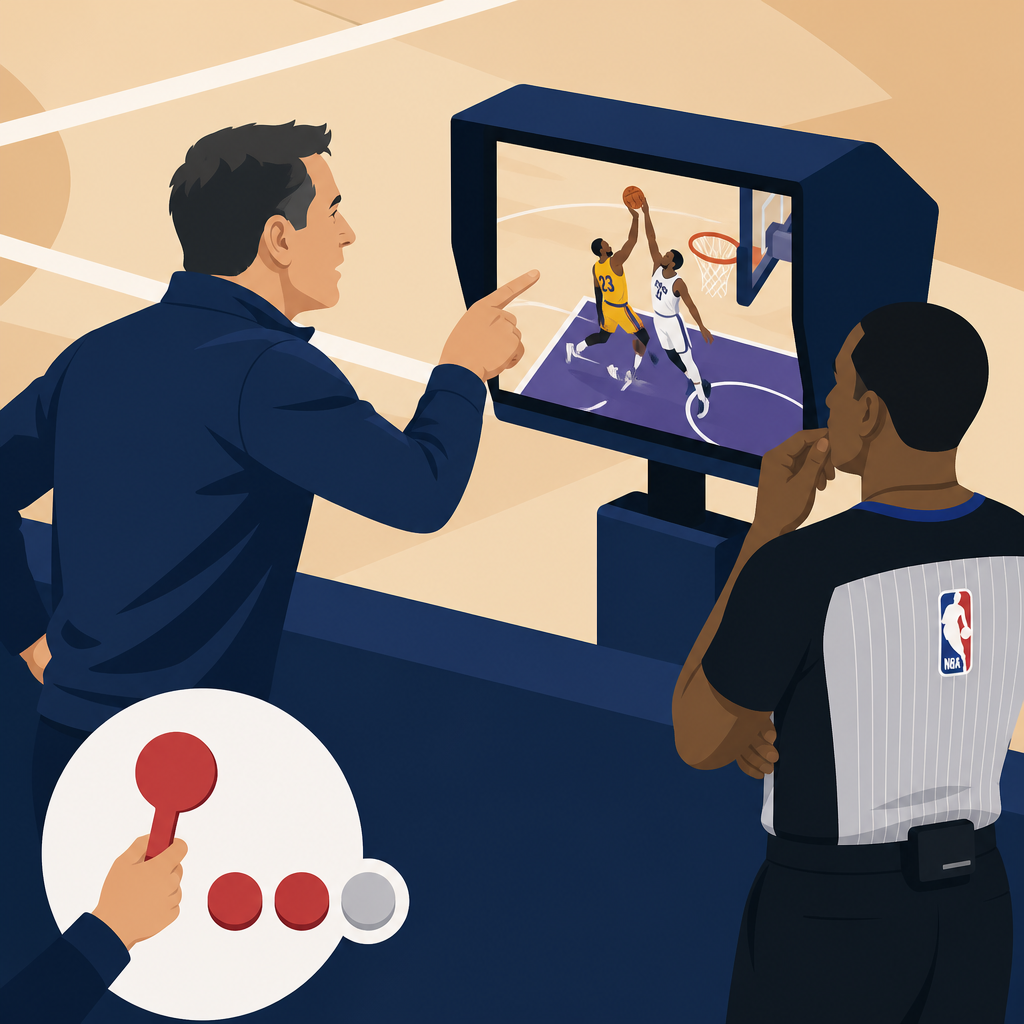
The NBA introduced the coach’s challenge to add a narrow correction tool without turning every disputed call into a prolonged appeal. Before the rule existed, coaches could protest informally, but referees generally could not revisit most judgment calls unless replay rules independently allowed it. The challenge created a structured process: the head coach signals for a challenge after a called foul, an out-of-bounds decision, basket interference, or goaltending, and the replay center and crew chief determine whether the original ruling should stand or be overturned.
The purpose is not to re-officiate every borderline play. It is to fix significant mistakes while preserving game flow. That balance is why the system remains tightly scoped. In practice, it also changed sideline behavior. Coaches and assistants now assign staff to track camera angles, foul counts, timeout inventory, and replay value in real time. On many benches, a video coordinator immediately relays whether a challenge is worth using. That behind-the-scenes process is now a standard part of NBA officiating management.
The challenge also affects players. A star with five fouls in the third quarter can stay aggressive if a sixth foul is overturned. A key defender can avoid sitting. A possession can flip in the final minute. Those are not small margins. In close games, a successful challenge often functions like a hidden extra possession or a saved rotation slot, which is why elite coaching staffs treat it as a strategic resource rather than a reflexive complaint tool.
What Can Be Reviewed on an NBA Coach’s Challenge
The short answer is that the NBA allows a coach’s challenge on three categories of called plays: personal fouls, out-of-bounds calls, and called basket interference or goaltending. That list sounds simple, but each category includes important boundaries. A coach cannot challenge a non-call just because he believes a whistle should have happened. There must be an officiating decision already on the floor. If referees do not call a foul, the coach cannot challenge to create one, except where separate replay authority exists under league rules in certain end-of-period or late-game situations.
Personal fouls are the most commonly challenged calls. These include blocking versus charging decisions, shooting fouls, loose-ball fouls, reach-in contact, and off-ball contact. During review, officials can examine whether illegal contact actually occurred, whether the defender established legal guarding position, whether the offensive player initiated the contact, and whether the timing and location of contact support the whistle. In real games, this is where challenges have the biggest tactical effect because foul trouble shapes substitution patterns.
Out-of-bounds calls are also reviewable. If the official rules that Team A touched the ball last before it crossed the boundary line, Team A’s coach can challenge. Replay can confirm who touched the ball last, whether the ball was already out when contact occurred, and in some cases whether another event changes possession. These reviews often happen in fourth quarters because one possession near the sideline or baseline can become decisive.
Called basket interference or goaltending is the third challenge category. Here, replay determines whether a defender touched the ball illegally on its downward flight, whether the ball had a chance to score, whether it contacted the backboard first, or whether a player interfered with the ball while it was on or above the cylinder. These are highly technical rulings, and slow motion often reveals details invisible at full speed.
How Many Challenges Teams Get and What Happens After One Is Used
NBA teams begin a game with one coach’s challenge, but the current rule includes a path to a second challenge if the first one is successful. To use the first challenge, a team must have a timeout available and the head coach must signal the challenge within the required time after the call. If the challenge is successful, the team retains or is awarded another challenge opportunity later in the game. If the first challenge fails, that team is done; no second chance exists.
The second challenge comes with another key limit: a team does not get a third challenge, even if the second challenge is successful. That cap matters because fans sometimes assume successful challenges can stack indefinitely. They cannot. The league wants accountability and correction, but it still wants scarcity. A challenge is supposed to be meaningful, not routine.
Timeout management is tied directly to challenge strategy. Historically, an unsuccessful challenge cost the team its timeout. Under current structure, teams still need an available timeout to initiate the challenge, and timeout consequences depend on the ruling and league procedures in effect for that season. Coaches therefore weigh two values at once: the chance of overturning the call and the value of preserving timeouts for late-game advance situations, substitution windows, and play design. In games I have tracked, conservative coaches often wait for either a fifth or sixth foul on a key player, a likely possession swing in the fourth quarter, or a high-leverage offensive foul before using the challenge.
| Review Topic | Can Be Challenged? | Common Example | Why It Matters |
|---|---|---|---|
| Personal foul | Yes | Blocking foul on a drive | Can remove foul trouble or erase free throws |
| Out-of-bounds call | Yes | Deflection near the sideline | Changes possession in key moments |
| Called goaltending | Yes | Block near the rim ruled illegal | Can add or remove points immediately |
| Non-call foul | No, by challenge alone | Coach wants a whistle after contact | Challenge cannot create a new foul call |
| Traveling violation | No | Extra step on a drive | Not in challenge categories |
| Double dribble | No | Ballhandler restarts dribble | Not reviewable by coach’s challenge |
When Coaches Use Challenges Best
The best use cases usually involve leverage, not emotion. A first-quarter out-of-bounds call is technically challengeable, but most staffs will not spend the only challenge there unless video is conclusive and the possession is unusually valuable. More often, coaches challenge a shooting foul on a star scorer, an offensive foul that would wipe out a basket, or a sixth foul on a center protecting the rim. These moments affect both the scoreboard and lineup structure.
A common example is the restricted area play. Officials must judge legal guarding position, help timing, and secondary defender location in a fraction of a second. On replay, the review may show the defender’s heel on the restricted arc, which changes a charge into a blocking foul. That one ruling can produce two free throws, an extra team foul, and a major shift in fourth-quarter defense. Coaches know that, so these are among the most heavily evaluated challenge candidates.
Another smart use is on dead-ball loose-ball fouls after missed shots. These whistles often determine not only free throws but also which frontcourt player picks up another foul. If a coach can erase a fourth foul from a rebounder early in the second half, the practical value may exceed a single possession. Over a full game, the challenge becomes roster management as much as score management.
What a Challenge Cannot Do
The biggest misconception is that a coach can challenge anything. He cannot challenge violations such as traveling, double dribble, carrying, kicked ball, three seconds, or eight-second counts unless those situations are reviewable under some other replay provision controlled by the officials, not by the coach. He also cannot challenge a non-call simply because contact looked obvious on television. The challenge process begins only after a reviewable call has been made.
This limitation frustrates fans because some of the most controversial moments involve missed whistles. If a defender appears to hit a shooter’s wrist and referees let play continue, there is no coach’s challenge to manufacture a foul. The same is generally true for missed travels or palming violations. The NBA intentionally kept the rule narrow to avoid constant stoppages and preserve the human judgment that still defines officiating.
Challenges also do not guarantee broad do-overs. Officials review the trigger event and can apply replay rules to correct aspects directly connected to that event, but the process is not an open invitation to inspect every action in the possession. That distinction matters when fans ask why replay corrected who touched the ball last but did not retroactively punish earlier incidental contact. Replay authority is bounded.
How the Replay Process Works on the Floor and in the Replay Center
Once a coach signals for a challenge, the officiating crew confirms the team has a timeout and that the play is challengeable. The crew chief then communicates with the Replay Center Secaucus and reviews available broadcast and arena angles. Officials look for clear visual evidence. If the video is inconclusive, the original call stands. That standard is important because replay is not meant to replace the live call every time there is minor uncertainty.
In my experience watching crews work these reviews, the most efficient officials identify the exact question before they watch the angle. For example: Did the defender establish legal position before torso contact? Did the ball touch the offensive player’s fingertips last? Did the block occur after the ball reached the downward flight toward the rim? Narrowing the question speeds the process and reduces overreach.
The final announcement usually explains whether the challenge was successful and what the corrected ruling is. If a foul is overturned, referees may also address game clock, shot clock, free-throw cancellation, and possession. These administrative details matter because a reversed whistle can require a full reset of the game situation, not just a verbal correction.
How Coach’s Challenge Fits Into NBA Officiating as a Whole
The coach’s challenge is only one part of NBA officiating. The larger system includes live three-person crews, replay review, last two minute reports, referee evaluations, points of education videos, and the playing rules that govern fouls, violations, continuation, verticality, restricted area plays, gather steps, flagrant criteria, and delay-of-game administration. As the officiating hub within NBA Rules, this topic connects directly to related subjects like personal fouls, shooting fouls, offensive fouls, technical fouls, flagrant fouls, goaltending, out-of-bounds rulings, replay reviews, and end-of-game procedures.
That context matters because the challenge does not stand alone. To judge whether a challenge should succeed, you need baseline knowledge of legal guarding position, marginal contact, freedom of movement emphasis, cylinder principles, and replay standards. A fan who understands those concepts will follow reviews far more accurately than someone relying only on crowd reaction or a slow-motion replay stripped of rule context.
For example, many disputed block-charge reviews are not really about force but about position and timing. A defender can absorb heavy contact and still be ruled blocking if he slides under the driver too late. Likewise, a lightly touched shooter may still draw a valid foul if the contact affects rhythm, speed, balance, or quickness. The challenge process tests the rule standard, not the volume of complaint.
Key Takeaways for Fans, Bettors, and Serious NBA Watchers
The practical takeaway is straightforward. NBA teams get one coach’s challenge to start the game, and they can earn a second only if the first challenge is successful. They cannot get a third. Coaches can challenge called personal fouls, out-of-bounds decisions, and called basket interference or goaltending, but they cannot use the challenge to create a foul on a non-call or review every violation they dislike. The team must also have a timeout available to initiate the challenge.
For fans, knowing these boundaries makes broadcasts easier to follow and cuts through common confusion. For bettors and fantasy players, challenge outcomes can affect minutes, possessions, foul trouble, and end-game scoring. For coaches and serious students of the game, the challenge is a resource allocation problem shaped by leverage, evidence quality, and timeout preservation.
If you are building a stronger understanding of NBA Rules, start with officiating because it influences every quarter, every rotation, and every close finish. Learn the challenge categories, then move outward to foul definitions, replay procedures, and late-game administration. That framework will help you read games more accurately, evaluate commentary more critically, and understand why one whistle can change everything.
Frequently Asked Questions
What is an NBA Coach’s Challenge and why was it added to the game?
An NBA Coach’s Challenge is a formal request by a team’s head coach asking the referees to review a specific on-court ruling using instant replay. It was introduced to give teams a structured way to contest certain calls they believe were made in error, especially in high-leverage moments when a single possession can change the outcome of a game. Before the challenge rule, coaches had no direct mechanism to trigger a review on many judgment calls, even if television replays showed the officials may have missed something important. The challenge system was designed to improve accuracy without completely disrupting the flow of the game.
In practical terms, the rule matters because NBA games are often decided by extremely small details: a questionable foul, an out-of-bounds decision, a block-charge call, or a goaltending ruling can swing momentum, alter substitution patterns, affect star players in foul trouble, and ultimately determine who wins. The Coach’s Challenge gives teams at least one opportunity to ask for a second look at a reviewable play. It does not replace officiating, and it does not allow coaches to challenge anything they want at any time. Instead, it functions as a limited corrective tool intended to fix clear and meaningful mistakes while preserving the rhythm and integrity of the game.
What types of plays can be reviewed with an NBA Coach’s Challenge?
A Coach’s Challenge can only be used on specific categories of reviewable calls defined by NBA replay rules. In general, teams can challenge called personal fouls assessed to their own team, out-of-bounds rulings, goaltending or basket interference violations, and certain other reviewable events that the replay system permits officials to examine. The key point is that the challenge applies to an actual on-court call that has already been made. A coach cannot use the challenge to complain about a non-call simply because they think a whistle should have been blown.
That distinction is important. For example, if the officials call a defensive foul and the coach believes the defender was legal, that can potentially be challenged if it falls within the replay rules. If the ball is ruled out on one team and the coach believes it last touched the opponent, that is a classic challenge situation. Likewise, goaltending and basket interference calls can be reviewed because those rulings can directly change the score. However, not every play in the rulebook is challengeable, and not every disagreement qualifies for replay. The challenge system is intentionally narrow so games do not turn into constant stoppages. Coaches and teams must know the replay categories extremely well, because using a challenge on a marginal or non-reviewable issue can waste one of the most valuable strategic tools available during a game.
How many Coach’s Challenges do NBA teams get during a game?
NBA teams begin the game with one Coach’s Challenge available to the head coach. Whether they get another opportunity depends on the outcome of that first challenge under the current league rules. If the first challenge is successful, the team earns a second challenge. However, even if that second challenge is also successful, the team does not continue receiving unlimited challenges. The system is designed to reward a coach for being correct while still imposing a firm cap so replay does not overwhelm the game.
There is also a timeout component tied to the challenge process. A team must have a timeout available in order to initiate a Coach’s Challenge. If the challenge is successful, the team keeps its timeout. If the challenge is unsuccessful, the team loses the timeout used to trigger the challenge. That makes challenge decisions highly strategic, particularly late in games when timeouts are already precious. Coaches must weigh the value of correcting a call against the risk of losing a timeout and being left without a challenge later. In other words, it is not just about whether a coach believes a call is wrong. It is also about game context, replay evidence, foul trouble, score margin, remaining time, and whether holding the challenge for a more decisive moment might be the smarter move.
Who can call for a Coach’s Challenge, and how does the process work during the game?
Only the team’s head coach can initiate a Coach’s Challenge. Assistant coaches, players, and bench staff may urge or recommend it, but the formal signal must come from the head coach. To begin the challenge, the coach typically signals for it immediately after the called play and before the ball is legally put back into play. Timing matters. If the game resumes too quickly and the next live action begins, the opportunity to challenge that prior call is usually gone. That is why teams often have assistants monitoring arena replay angles in real time and communicating instantly with the head coach about whether the video supports a challenge.
Once the challenge is initiated, the officials go to replay review and examine the eligible aspects of the play. They are not simply asking whether the original call “felt” wrong; they are evaluating the available video evidence under the replay standard. After reviewing the footage, the referees either uphold the call or overturn it. In some situations, the review may also allow officials to correct related elements of the play that are reviewable under the rules, but the review is not a free-ranging re-officiation of everything that happened on that possession. The process is meant to be focused and rule-based. From a strategy standpoint, successful teams usually challenge only when they have strong visual evidence and a meaningful reason to intervene, such as protecting a key player from another foul, reversing a possession in a one-score game, or removing points from the opponent in a high-impact sequence.
What happens if a Coach’s Challenge is successful or unsuccessful?
If a Coach’s Challenge is successful, the officials overturn or correct the challenged ruling based on the replay evidence. That means the team preserves the timeout used to initiate the challenge, and under current NBA rules, that successful first challenge also gives the team access to a second challenge later in the game. The practical effect can be enormous. A successful challenge might erase a foul from a star player, reverse possession in the final minute, take points off the board by nullifying goaltending, or stop an opponent from reaching the bonus at a critical stage. Because so many NBA games hinge on narrow margins, one successful challenge can have an outsized impact on rotations, late-game execution, and momentum.
If the challenge is unsuccessful, the original call stands and the team loses the timeout required to make the challenge. Just as importantly, the team also loses that challenge opportunity and cannot get it back. That is why an unsuccessful challenge can be doubly costly: the team fails to change the ruling and gives up a valuable timeout that might have been needed to advance the ball, set up a final play, or stop the clock. In close games, that tradeoff becomes especially significant. Coaches therefore have to balance confidence in the replay evidence with overall game management. The smartest use of the challenge is not always the most emotional one. It is usually the one supported by clear video, meaningful game consequences, and a strong understanding of when a corrected ruling will actually provide a measurable competitive advantage.