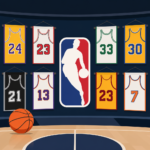

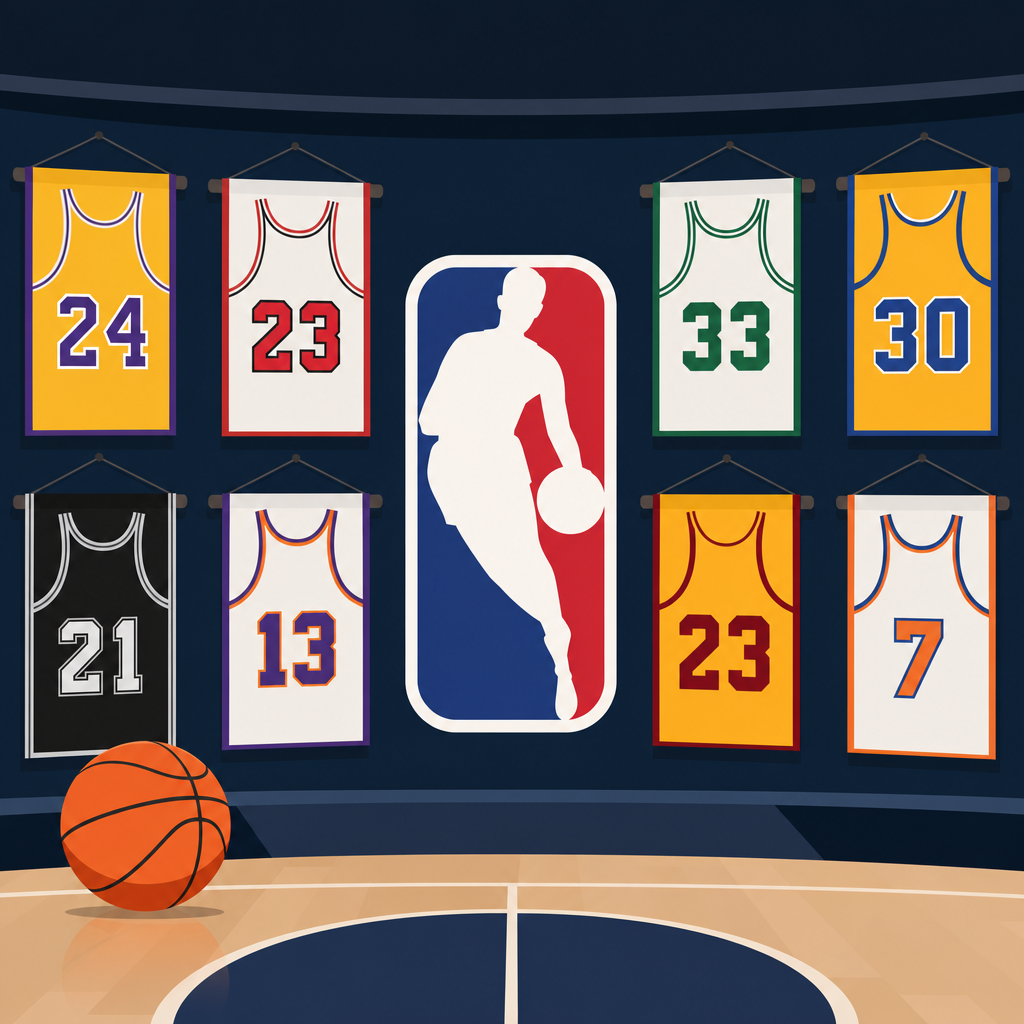
Retired jersey numbers are one of the clearest ways an NBA franchise defines its identity, because they turn history into something visible every night inside the arena. When a team retires a number, it removes that jersey from future player use and raises a banner to honor someone whose impact reached beyond ordinary production. In practice, that usually means a superstar, foundational coach, executive, broadcaster, or owner, although the standards differ widely by franchise. Some clubs are strict and reserve the honor for Hall of Fame level players. Others use retired numbers to tell a broader story about the people who shaped the organization, the city, and the fan experience.
As someone who has built NBA team history resources and cross-checked media guides against arena displays, I can say this topic matters because retired numbers connect roster construction, market culture, relocation history, and fan memory in one place. A banner hanging in TD Garden, Madison Square Garden, Crypto.com Arena, or the Kaseya Center is not just decorative. It signals which eras count most, which players define the brand, and how a franchise wants to present itself to new fans. That makes retired jersey numbers central to any serious discussion of arenas and identity.
For readers looking for the complete list, the most useful approach is team by team rather than league wide. Team lists reveal patterns that a simple master spreadsheet hides. The Celtics and Lakers use retired numbers to emphasize dynastic continuity. The Heat and Suns show how modern franchises build tradition quickly through sustained winning and star association. The Clippers and Raptors, by contrast, illustrate how younger or historically less stable organizations curate identity differently. Even universal honors, especially No. 6 for Bill Russell, gain meaning only when viewed through each team’s arena history and local culture.
This hub article explains what retired jersey numbers are, why teams choose them, how arena presentation shapes their meaning, and how every franchise fits into the broader landscape. It is designed as a strong starting point for deeper team pages covering specific banner histories, arena layouts, and franchise legends. If you want to understand NBA teams through the symbols hanging above the floor, retired numbers are the most direct place to begin.
What retired jersey numbers mean in the NBA
An NBA retired number is an official franchise honor that removes a jersey number from normal circulation and commemorates an individual’s lasting importance to the team. The person honored is usually recognized through an arena banner, a ceremony, and permanent inclusion in franchise history materials. Unlike league awards, retired numbers are controlled by each organization. There is no single NBA rulebook standard for who qualifies, how long a team waits, or whether nonplayers can be honored with a number banner.
That flexibility is why retired numbers vary so much. The Chicago Bulls retired 23 for Michael Jordan because he transformed the franchise into a global brand and delivered six championships. The Dallas Mavericks retired 41 for Dirk Nowitzki because he gave them twenty one seasons, an MVP award, and the 2011 title. The Sacramento Kings retired 6 for their fans, a rare example of a number honoring a community rather than an individual. The Orlando Magic long resisted traditional retirements, then eventually retired 32 for Shaquille O’Neal and later honored 13 for Dennis Scott through a separate path in team storytelling.
A key distinction is between retired numbers, honored numbers, and memorial patches or signage. Some teams retire a jersey formally and remove it forever. Some honor a number without fully retiring it. Others recognize coaches, executives, or broadcasters with banners that look similar to retired jerseys but serve a different purpose. When building a complete list by team, those categories must be separated carefully. That is especially important for franchises with relocations, rebrands, or merged histories, such as the Thunder inheriting SuperSonics records or the Pelicans and Hornets disentangling Charlotte and New Orleans lineage.
How arenas turn jersey retirements into franchise identity
The arena is where a retired number becomes part of a team’s daily identity. A ceremony creates the emotional moment, but the physical banner creates permanence. Banner placement matters. In older venues with rich title histories, retired jerseys can dominate the ceiling and frame the court as sacred ground. In newer buildings, they are often integrated into cleaner, more curated visual systems that emphasize branding consistency. I have found that the difference changes how fans absorb history. In Boston or New York, the banners can feel overwhelming in the best way. In newer arenas, they often function as a guided museum wall above the action.
Retired numbers also influence how broadcasts frame a team. Camera angles regularly capture banners during intros, timeouts, and playoff moments, reinforcing identity for national audiences. That visibility matters for franchises that want to tie current stars to historical greatness. The Golden State Warriors used Chase Center’s presentation to connect the modern Stephen Curry era with earlier icons like Wilt Chamberlain, Rick Barry, Al Attles, and Chris Mullin. The Milwaukee Bucks use Fiserv Forum to bridge Kareem Abdul-Jabbar, Oscar Robertson, Sidney Moncrief, Bob Lanier, and Giannis Antetokounmpo’s era, even before future honors are decided.
Retired number displays can also reveal organizational philosophy. Some franchises prioritize minimalist exclusivity. Others build broad heritage walls. The choice affects perception. A crowded ceiling suggests long memory and institutional depth. A sparse one can suggest either youth or selectivity. Neither approach is inherently better, but each sends a message to fans, free agents, and sponsors about what the team values.
The complete list by team starts with franchise context
A true complete list of NBA retired jersey numbers by team has to start with franchise context, because numbers do not exist in a vacuum. Relocation, expansion, ownership changes, and arena moves all shape what gets retired and why. The Lakers, for example, carry Minneapolis and Los Angeles history together, which is why George Mikan’s legacy sits alongside Magic Johnson, Kareem Abdul-Jabbar, Kobe Bryant, Shaquille O’Neal, Jerry West, Elgin Baylor, and others. The Kings connect Rochester, Cincinnati, Kansas City, and Sacramento history, producing one of the league’s most geographically layered banner collections.
Some franchises retire many numbers because they have long timelines and multiple eras of contention. Others have fewer because they are newer or because success came in shorter bursts. The Miami Heat did not exist until 1988, yet their retired set already reflects Alonzo Mourning, Tim Hardaway, Chris Bosh, Dwyane Wade, Udonis Haslem, and symbolic honors such as Michael Jordan’s 23, which Pat Riley’s organization retired leaguewide from its own perspective before the NBA took separate action on Bill Russell’s 6. That is a reminder that franchise culture can produce unconventional choices.
For team pages under this hub, readers should expect each list to answer four questions directly. Which numbers are officially retired? Who is honored in the rafters but not through a retired number? Which honors came from another city in the franchise timeline? How are the banners displayed in the current arena? Those details separate a shallow listicle from a useful reference resource.
| Franchise type | Typical retired-number pattern | Example teams | Identity takeaway |
|---|---|---|---|
| Legacy dynasty | Large banner count across multiple title eras | Celtics, Lakers | History is a daily part of the brand |
| Modern contender | Selective honors tied to recent stars | Heat, Mavericks, Warriors | Winning quickly builds tradition |
| Relocated franchise | Mixed city histories and inherited icons | Kings, Thunder, Hawks | Identity depends on how history is carried forward |
| Younger expansion team | Smaller list with careful curation | Raptors, Grizzlies, Hornets | Every banner carries outsized symbolic weight |
Which teams have the most retired numbers and why
The Boston Celtics and New York Knicks are perennial reference points because of the sheer visibility of their histories, while the Los Angeles Lakers stand out for the star power attached to their banners. Boston’s retired numbers reflect an unparalleled championship run anchored by Bill Russell, Bob Cousy, John Havlicek, Sam Jones, Tom Heinsohn, Jo Jo White, Larry Bird, Kevin McHale, Robert Parish, Paul Pierce, and more. The point is not only volume. It is continuity. The Celtics use retirements to present a single lineage of excellence stretching from the 1950s to the 2008 title team and beyond.
The Lakers accomplish something similar with a different texture. Their banners read like a roll call of league icons: Mikan, Baylor, West, Wilt Chamberlain, Gail Goodrich, Kareem, Magic, James Worthy, Shaq, Kobe, Jamaal Wilkes, and Pau Gasol. Kobe alone has two retired numbers, 8 and 24, acknowledging the distinct halves of his career. Few teams can match that symbolic density. When fans or players walk into the building, the message is immediate: this is a franchise where superstar legacy is the organizing principle.
At the other end, teams with shorter or more fragmented histories naturally have fewer retired numbers. That does not make those honors less meaningful. Toronto retiring 15 for Vince Carter marks a turning point because it recognizes the player most responsible for putting Raptors basketball into the mainstream. Memphis honoring Zach Randolph, Tony Allen, Marc Gasol, and Mike Conley tells a story about the Grit and Grind era that still defines the franchise’s personality. A smaller set can be more coherent than a larger one if it clearly captures what the team stands for.
Special cases fans should understand before using any complete list
The most important special case is Bill Russell’s No. 6. In 2022, the NBA retired Russell’s number leaguewide, making him the first player to receive that honor across all teams. Players already wearing 6 at the time were grandfathered in, but no new player can choose it. On team lists, that creates a distinction between a franchise-specific retirement and the universal league action. The Boston Celtics had already retired 6 for Russell decades earlier, while other teams now reflect the broader league tribute in different ways around their arena presentation and media materials.
Another special case is Michael Jordan’s 23 with the Miami Heat. Jordan never played for Miami, yet the Heat retired his number in 2003 as a sign of respect for his impact on the game. It remains one of the league’s most unusual honors. Similarly, some teams honor owners, coaches, broadcasters, or fan groups with numbers or banner formats that can confuse readers scanning a list. The Indiana Pacers, for example, have honored key nonplayers in ways integral to franchise identity. The Spurs have used their arena history to spotlight both championship stars and influential figures around the organization.
Relocation creates further complexity. Should a current city embrace honors earned elsewhere? There is no universal answer. The Oklahoma City Thunder include Seattle SuperSonics history in official franchise records, which affects how banners and retired numbers are interpreted, even as many fans believe Seattle’s identity should remain distinct. The Charlotte Hornets and New Orleans Pelicans required a formal historical realignment so Charlotte could reclaim original Hornets records and identity. Any complete list that ignores those nuances will mislead readers.
How to use this hub for deeper NBA teams research
This page works best as a central guide to team-by-team retired jersey numbers within the broader NBA Teams topic, especially the arenas and identity branch. From here, each franchise page should expand on the raw list with ceremony dates, arena names, banner locations, number availability history, and the debate around future candidates. That structure helps casual fans and serious researchers alike. Someone searching for “Boston Celtics retired numbers” wants the list immediately. Someone comparing how teams build tradition wants the surrounding context that explains why the list looks the way it does.
In practical terms, retired numbers are one of the best internal linking anchors for an NBA team content library because they connect naturally to arena guides, franchise timelines, all-time starting five debates, Hall of Fame pages, uniform history, and relocation articles. A Lakers page can link from Kobe Bryant’s retired numbers to Crypto.com Arena history, the Showtime era, and all-time scoring leaders. A Knicks page can connect Walt Frazier and Willis Reed banner coverage to Madison Square Garden’s role in league culture. A Raptors page can connect Vince Carter’s retirement to the franchise’s growth in Canada and Scotiabank Arena presentation.
The main takeaway is simple: retired jersey numbers are not trivia. They are the most concentrated expression of how an NBA team remembers itself. Use this hub to find the complete list by team, then follow into the individual franchise pages for the arena details and historical context that make each banner matter. If you are building, updating, or exploring NBA Teams content, start with the rafters and let the rest of the identity story unfold from there.
Frequently Asked Questions
What does it mean when an NBA team retires a jersey number?
When an NBA team retires a jersey number, it permanently takes that number out of circulation to honor a person whose impact on the franchise was considered exceptional and lasting. In most cases, that means no future player on that team will wear the number again. The honor is usually marked by a banner raised in the arena, making the recognition a visible part of the team’s identity every time fans attend a game. It is one of the highest symbolic honors a franchise can give because it connects the present roster to the organization’s history in a simple, unmistakable way.
Although retired numbers are most often associated with Hall of Fame-level players, teams sometimes retire numbers for coaches, owners, executives, broadcasters, or other figures who shaped the organization in meaningful ways. That is why retired-number lists can vary so much from team to team. Some franchises reserve the honor for only a few all-time legends, while others use it more broadly to recognize multiple eras and contributors. In a complete list by team, those differences are part of the story, because they show how each franchise defines greatness, loyalty, and legacy.
Are retired jersey numbers always given to players?
No, retired jersey numbers are not always given only to players. While star players make up the majority of retired-number honorees across the NBA, several franchises have also recognized non-players whose contributions were considered central to the team’s success or identity. That can include championship-winning coaches, long-serving executives, owners, or even broadcasters who became part of the franchise’s public face for decades. In those cases, the retired number functions as a broader historical tribute rather than simply a recognition of on-court statistics.
This is one reason a team-by-team retired numbers list can be so interesting. It is not just a record of who scored the most points or won the most awards. It also reveals what each organization values. One franchise may focus almost exclusively on player accomplishments, while another may honor foundational figures behind the scenes. For readers, understanding that distinction helps explain why some retired numbers are immediately familiar to casual fans and others require more historical context.
Why do some NBA teams have many retired numbers while others have only a few?
The number of retired jerseys varies widely because there is no single league-wide standard for when a number should be retired. Each franchise decides its own criteria, and those standards are shaped by team age, success, culture, and history. Older franchises with long histories, multiple championship eras, and deep connections to former stars often have longer retired-number lists simply because they have had more time to build tradition. Newer teams, or teams with less sustained success across decades, may naturally have fewer numbers retired.
Philosophy also matters. Some organizations are extremely selective and treat jersey retirement as a once-in-a-generation honor reserved for only the most iconic figures. Others are more expansive and use the practice to celebrate multiple cornerstones from different eras. Relocations, rebrands, and complicated franchise histories can add another layer, especially when teams decide how to handle achievements tied to previous cities. That is why a complete retired numbers list is more than a set of names and digits—it is a window into how each NBA franchise remembers its past and chooses to present that history to fans.
Can a retired number ever be used again by an NBA team?
In general, a retired number is meant to be permanently unavailable for future players on that team, which is what gives the honor its significance. The whole point is that the franchise has decided the number should remain linked to a specific legacy. Once the banner is raised, the expectation is that the number is effectively closed off from regular use. That permanence is what separates jersey retirement from other forms of recognition, such as ring-of-honor displays, statues, or ceremonial acknowledgments.
That said, unusual situations can create exceptions or gray areas. Team history can be complicated by relocations, mergers, shifting ownership philosophies, or special league-wide circumstances. Some numbers may be honored in ways that resemble retirement without being formally retired, and some retired-number histories require context to understand fully. For that reason, a careful team-by-team list should note not just which numbers are retired, but also how the franchise officially classifies them and whether there are any special cases attached to the honor.
Why are retired jersey numbers important when comparing NBA franchise history by team?
Retired jersey numbers matter because they offer one of the clearest and most public records of whom a franchise considers essential to its story. Championships, awards, and statistics help measure success, but retired numbers show how a team chooses to remember that success. They turn abstract history into something visible in the arena rafters, where every banner signals that a player or contributor permanently changed the organization. For fans, that creates a direct link between different generations of the team.
Looking at retired numbers by team also helps explain differences in franchise identity across the league. A team with a long list of retired numbers may be emphasizing continuity, tradition, and the depth of its historical impact. A team with a shorter list may be using a stricter standard, making each retirement feel even more exclusive. Either way, the list tells you something meaningful about the organization’s values. In a complete article on NBA retired jersey numbers by team, these honors are not just trivia—they are one of the best ways to understand how each franchise defines greatness and preserves its legacy.