
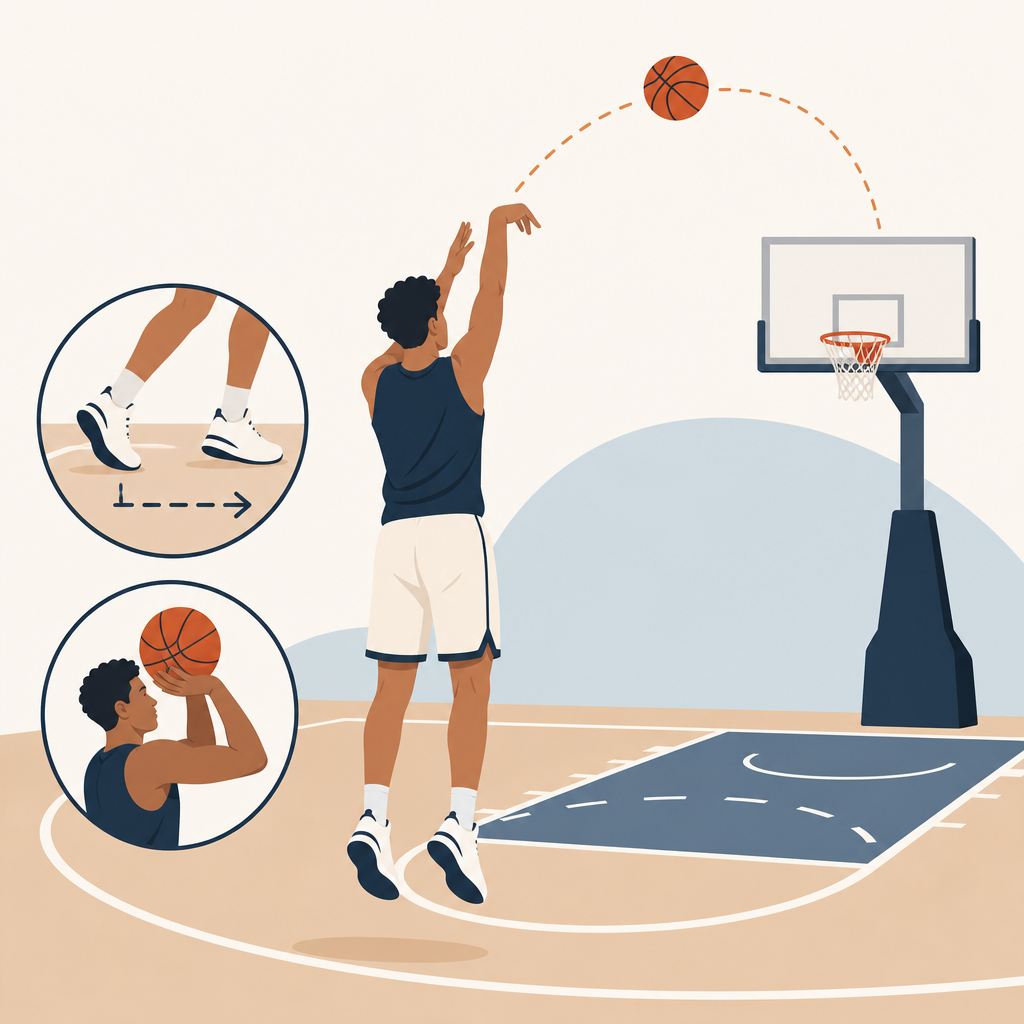
A consistent three-point shot is not a mystery move reserved for elite scorers; it is a repeatable basketball skill built on footwork, balance, alignment, timing, and a reliable release. When players ask how to shoot a three-pointer consistently, they usually focus on the hand that follows through, but in real gym work the shot begins lower, with the feet setting the body and the legs supplying force. The best shooters, from Stephen Curry to Klay Thompson to college specialists who quietly hit 40 percent, create consistency by arriving in the same positions over and over. That is what this guide covers: the mechanics that hold up under speed, fatigue, and defensive pressure.
In practical terms, three-point shooting means making shots from beyond the arc with enough efficiency that defenses must respect it. Consistency does not mean never missing. It means your mechanics are stable enough that misses are predictable, correctable, and less streaky. Coaches often break the shot into a chain: stance, footwork into the catch or dribble pickup, balance at the gather, upward force from the legs and hips, shooting path, wrist snap, and landing. If one link changes from rep to rep, accuracy suffers. In my experience working through shooting workouts, players who think they have a “release problem” often actually have a footwork problem that alters the release without them noticing.
This topic matters because shooting stretches the floor, opens driving lanes, improves spacing in every offensive system, and directly affects playing time. At youth, high school, and adult levels, coaches trust players who can make open threes and understand when they are open. A dependable jumper also ages well as an athletic skill. Vertical pop can fluctuate, but clean mechanics, efficient foot replacement, and fast shot preparation travel to any level. If you want a complete shooting hub, start here: build a base, train the release, learn game-speed reps, and measure progress honestly. Once those pieces connect, three-point shooting becomes less about hope and more about execution.
Build Your Three-Point Foundation with Stance, Alignment, and Balance
The first priority in shooting is organized balance. Before worrying about arc or follow-through, set a stance that allows force to travel straight up through the body. Most reliable shooters start with feet about shoulder width apart, knees flexed, hips loaded slightly, chest tall, and weight balanced through the midfoot rather than on the heels. Your shooting-side foot is often just a few inches ahead of the guide-side foot, creating a mild turn that helps the shooting arm move freely. This is not a dramatic twist. It is a natural alignment that lets the wrist, elbow, and shoulder work without strain.
Alignment answers a common question: should your feet face the rim exactly? For some players, yes, but many better shooters are slightly turned, especially on movement shots. The key is that the hips and shoulders remain organized and the ball rises on a straight path relative to your shooting line. If your feet are too closed, the elbow may flare. If they are too open, the guide hand can push. I usually tell players to find the stance where their upper body feels relaxed and the ball can move from pocket to set point without detours. Film from the front and side to confirm the ball is not crossing the face or drifting off the shooting line.
Balance also includes how you stop. On catch-and-shoot threes, elite shooters arrive on two feet under control, whether from a hop or a one-two step. The right choice depends on the pass angle, your momentum, and your comfort. A hop can be quicker and symmetric when moving straight into a shot. A one-two step often helps on lateral movement because it lets you decelerate and align. Neither is universally better. What matters is repeatability. If your head is bouncing, your torso is leaning, or your feet are landing too narrow or too wide, the release will constantly compensate for a poor base.
Master Footwork on the Catch and off the Dribble
Footwork is the hidden engine of three-point consistency because the feet determine timing. On the catch, the goal is simple: show your hands early, read the ball in flight, and get your feet set before the ball reaches your shooting pocket. Young players often catch first, then adjust the feet, which slows the shot and disrupts rhythm. Better shooters move the feet as the pass travels. That is why quick decisions matter. If you know you are shooting before the ball arrives, the body organizes itself faster and more cleanly.
For stationary catch-and-shoot reps, work on stepping into the shot with minimal wasted movement. If the pass comes to your shooting side, a one-two step can feel natural. If the pass comes on line and you are already loaded, a hop may be cleaner. Coming out of the corner or lifting on the wing, many players benefit from an inside-foot plant followed by quick replacement into a square or slightly turned stance. On relocation threes, think about arriving low and wide enough to absorb momentum. The lower body should act like brakes first, then a launch platform.
Off the dribble, consistency depends on the gather. A good pull-up or step-back three is not just a hand skill; it is controlled foot replacement after the last dribble. On a right-hand pull-up going left to right, for example, many players naturally gather with the right-left pattern, bringing the feet under the hips before rising. The exact pattern can vary, but the important detail is that the ball and feet sync together. If the feet are late, the shot rushes. If the ball is late, you pause and lose rhythm. In workouts, I have seen percentages improve quickly when players train the last two steps of the move as carefully as the release itself.
| Shooting Situation | Preferred Footwork Option | Why It Works | Common Mistake |
|---|---|---|---|
| Stationary catch-and-shoot | Hop or one-two | Lets you load before the catch and rise in rhythm | Catching flat-footed, then adjusting |
| Wing lift from the corner | Inside-foot plant to quick set | Helps decelerate and align shoulders | Drifting sideways through the shot |
| Pull-up three | Controlled last-two-step gather | Keeps ball and feet synchronized | Picking up the dribble too high |
| Step-back three | Push-back, then replace feet under hips | Creates space without fading off line | Leaning backward on release |
| Transition trail three | Quick choppy steps into balanced stop | Controls forward momentum | Shooting while still running |
Refine the Shooting Motion: Ball Path, Release, and Follow-Through
Once the feet create a stable base, the release can become simple. The ball should move from the shot pocket to the set point on a compact, direct path. Unnecessary loops waste time and create moving parts that are hard to repeat. Most high-level shooters keep the guide hand on the side of the ball, use the shooting hand under and slightly behind it, and bring the ball up so the elbow can extend naturally. The set point varies by player, but the principle does not: get the ball to a position where you can shoot over contests without straining the shoulder or pushing with both hands.
A clean release starts with finger control and wrist extension. The last contact should come primarily off the index and middle fingers, though exact finger dominance differs by athlete. What you want is soft backspin and a ball that leaves the hand without side rotation. The cue “reach into the rim” helps many shooters because it encourages full extension and a relaxed wrist snap. The cue “hold your follow-through” can be useful for beginners, but the real goal is not freezing for style points. It is confirming that the arm path was straight, the wrist relaxed, and the guide hand quiet.
Arc matters, but players often misunderstand it. Too flat, and the rim effectively shrinks. Too high, and the shot can lose distance control. Research from Noah Basketball and other tracking systems has shown that an entry angle near the mid-40s tends to be effective on standard jump shots, with many strong shooters clustering around that range. You do not need to think about a number on every rep. Instead, focus on using your legs for power so the upper body stays loose. When players try to force range with the arms, the ball flattens, the elbow flares, and the release becomes inconsistent.
One more essential point is shot timing. Great shooters look smooth because the lower body and upper body work as one sequence. The ball should not dip too late or pause at the top unless that is part of a repeatable personal rhythm. Quick does not mean rushed. A fast release is simply an efficient release with no extra hitch. If defenders are recovering faster than your shot can get off, first examine the footwork and pickup, not just the hand action. In game settings, the fastest legal shot is usually produced by early preparation, compact path, and immediate upward force after the catch.
Train Range, Rhythm, and Game-Speed Repetition
Many players hurt their percentage by practicing threes before they own the mechanics at shorter distances. The smarter approach is to build outward. Start close enough that you can make clean reps with proper arc, balance, and backspin. Then move back a step at a time without changing form. This is how you separate true shooting range from heaving. If your mechanics break down outside a certain distance, that distance is beyond your current game range, even if you occasionally make shots from there in workouts. Honest range assessment saves months of bad habits.
Rhythm is also trainable. In effective shooting sessions, you should rehearse the exact shots you expect in games: corner catch-and-shoots, slot threes, wing lifts, trail threes, one-dribble pull-ups, and relocations after penetration. I like to divide workouts into form shooting, stationary rhythm shooting, movement shooting, and competitive pressure reps. Form shooting teaches line and touch. Stationary rhythm shooting reinforces footwork into the catch. Movement shooting adds realistic speed and angles. Pressure reps, such as “make 8 of 10 from the corners” or “5 in a row before leaving the spot,” reveal whether mechanics survive stress.
Use objective tools when possible. Shot-tracking systems such as Noah Basketball measure arc, depth, and left-right accuracy. Video from a phone on a tripod can still be valuable if you review it with purpose. Track percentages by spot, by type of action, and by fatigue state. For example, if you shoot 68 percent in unguarded corner drills but only 42 percent after sprint entries, that gap tells you your issue is not pure touch; it is movement control and conditioning. Data turns vague feelings into actionable coaching points. It also keeps confidence grounded in evidence rather than emotion.
Volume matters, but only if quality stays high. A player who launches 500 sloppy threes can get worse faster than a player who takes 200 precise reps. Make-miss feedback alone is not enough. Ask whether the rep looked right: Were the feet organized? Did the ball come off the same fingers? Was the landing balanced? I have found that short, focused shooting blocks produce better transfer than marathon sessions with drifting concentration. Especially for younger players, 20 to 30 minutes of concentrated game-speed work, four to six days per week, can create measurable improvement when paired with film review and shot selection discipline.
Avoid Common Shooting Mistakes and Build a Repeatable Routine
The most common three-point mistake is using the arms to generate power instead of the legs and hips. That usually shows up as a push shot, a thumb flick from the guide hand, or a flat ball flight. Another frequent issue is inconsistency in the dip. Some shooters need a small dip to create rhythm; others can shoot almost directly from the catch. The problem is not the dip itself. The problem is changing it based on pressure, fatigue, or pass location. If your preparation varies wildly, the release point will vary too. Consistency comes from repeating the same solutions to the same situations.
Another overlooked error is poor shot selection. Even perfect mechanics cannot rescue low-value attempts taken off balance, against hard contests, or before the offense creates an advantage. Good shooters know the difference between being open and feeling open. They also understand context: corner threes are shorter than above-the-break threes, trail threes often come with forward momentum, and late-clock pull-ups require stronger lower-body control. If you want to become a respected shooter, study your misses. Short miss often means insufficient leg drive or deceleration. Left-right misses often point to alignment or guide-hand interference.
A repeatable routine should cover daily mechanics, weekly progression, and pregame preparation. Before practices or workouts, use a short sequence of close-range swishes, free throws, and step-out threes to establish touch and line. During the week, distribute reps across your most common game actions. Before games, avoid overloading volume; focus instead on seeing the ball go in from your key spots with game-realistic footwork. Confidence grows from familiarity. Build a system, record your percentages, and revisit the fundamentals often. If you want to improve your shooting under the broader Basketball Skills umbrella, start by auditing your footwork and release today, then commit to quality reps that look the same every time.
Frequently Asked Questions
What is the most important part of shooting a three-pointer consistently: footwork or release?
Both matter, but footwork usually deserves more attention because it sets up everything that happens in the release. A three-point shot starts from the floor, not the fingertips. If your feet land in a balanced, repeatable position, your legs can generate force smoothly, your hips and shoulders can stay aligned, and your shooting motion becomes easier to repeat under pressure. That is why great shooters look so efficient: they are not creating power with the upper body alone, and they are not fixing poor balance in the middle of the shot.
Your release is still critical, of course. A clean release controls touch, arc, and direction. But if your base is inconsistent, even a technically sound follow-through will not save the shot often enough. Players who drift sideways, hop too wide, or catch the ball with their feet unprepared usually compensate by rushing the upper body, pushing the ball, or twisting in the air. Those compensations hurt accuracy and make the shot harder to repeat game after game.
For most players trying to become reliable from deep, the smartest approach is to build the shot in order: feet first, then rise, then release. Practice stepping into the shot the same way every time, with a stable base, slight knee bend, and shoulders organized toward the rim. Once that lower-body pattern becomes automatic, the release tends to improve because the rest of the body is no longer scrambling to recover. In simple terms, the release finishes the shot, but footwork often determines whether the shot had a chance in the first place.
How should my feet be positioned when shooting a three-pointer?
Your feet should put you in a strong, comfortable, athletic base that you can repeat without thinking. For most players, that means about shoulder-width apart or slightly narrower, with the knees bent and the weight balanced through the middle of the feet. You want to feel loaded, not stiff. If your stance is too wide, it becomes harder to rise straight up and transfer energy cleanly. If it is too narrow, you may lose balance or feel unstable on the catch.
Many strong shooters also use a slight turn rather than standing perfectly squared to the rim. That often means the shooting-side foot is set just a little ahead of the non-shooting foot, allowing the hips, shoulder, elbow, and ball to line up more naturally. This can reduce tension in the shooting path and help the ball travel on a cleaner line. The key is not copying someone else’s exact angle, but finding a stance that lets your body feel connected and smooth from the floor to the release.
Foot preparation on the catch matters just as much as the final stance. On a catch-and-shoot three, your goal is to get your feet organized before the ball reaches your shooting pocket. That might be a quick one-two step, a hop into your base, or a small adjustment step depending on the pass and your momentum. The best method is the one that helps you get balanced quickly without extra movement. If your feet are late, your shot will feel rushed. If your feet arrive early and under control, your rhythm improves immediately. A simple test is this: when you catch the ball, do you feel like you are already ready to shoot, or do you still need to fix your body? Consistent shooters eliminate that second step.
What are the biggest release mistakes that make three-point shooting inconsistent?
One of the most common mistakes is pushing the ball instead of shooting it with a connected motion. This usually happens when the lower body does not contribute enough force, so the player tries to muscle the ball from the chest or shoulder. The result is often a flat shot, inconsistent touch, and poor accuracy, especially as distance increases. A consistent release should feel smooth and sequential: legs provide lift, the ball rises efficiently through the shot path, the elbow extends, and the wrist snaps naturally through the finish.
Another major problem is an inconsistent release point. If the ball starts from a different position every time, or if the elbow flares too far out, your accuracy suffers because the line to the basket changes from shot to shot. Good shooters do not necessarily all look identical, but they do repeat their own mechanics very well. The ball should move upward with minimal wasted motion, and the release should happen at a point where you feel balanced, strong, and in control.
Players also hurt themselves by dropping the guide hand too late, rotating the torso during the shot, or failing to hold a clean follow-through. The guide hand should support the ball without adding side force. Your shooting hand should finish relaxed, with fingers pointed down and the wrist soft, not tense. Just as important, your body should land under control. If you consistently fall backward, kick the legs forward dramatically, or drift sideways, that is often a sign that the release is compensating for balance problems earlier in the motion. The fix is usually not just “snap the wrist more.” It is to reconnect the release to better footwork, posture, and timing.
How can I improve my three-point shot off the catch versus off the dribble?
The two shots are related, but they demand different types of preparation. On the catch, consistency comes from getting shot-ready before the ball arrives. Your hands should be prepared, your eyes should find the rim early, and your feet should move into your base quickly and efficiently. The best catch-and-shoot players make the shot simple: clean catch, quick dip if needed, straight rise, clean release. There is very little wasted motion. To train this, use game-speed reps from different spots and angles, and make footwork part of every repetition rather than just focusing on whether the shot goes in.
Off the dribble, the biggest challenge is regaining balance after movement. Many players can shoot well standing still but lose consistency once they have to stop from a drive, crossover, or step-back. The key is learning how to decelerate into your shot. That means controlling your last one or two steps, getting your hips underneath you, and avoiding extra lean or drift. If you pull up going left or right, your feet still need to bring you back into a stable base before the release. Great off-the-dribble shooters are not just skilled with the ball; they are excellent at stopping under control.
In practice, separate the two skills before blending them. For catch-and-shoot work, rehearse one-two steps, hop footwork, corner catches, wing catches, and relocation threes. For off-the-dribble work, practice pull-ups after one dribble, two dribbles, side-steps, and retreat dribbles, always emphasizing balance at the stop. Then combine them in realistic drills that force quick decisions. If your percentage drops sharply off the dribble, do not assume your release is broken. Often the issue is that your feet and torso are arriving late, which makes the shot feel rushed and unstable.
What drills help build a repeatable three-point shot with better footwork and timing?
The best drills are the ones that isolate the details of your shot while still teaching you to perform them at real speed. Start with form shooting, even if your goal is deep range. Close to the basket, focus on balance, alignment, smooth lift, and a clean one-hand finish supported properly by the guide hand. This builds awareness of your release without forcing you to generate extra power. From there, gradually step back while keeping the same mechanics. If the shot changes dramatically as you move to the three-point line, that is a sign you are reaching for distance instead of scaling up the same coordinated motion.
Next, add footwork-specific shooting. Practice one-two step threes from both sides of the floor, hop footwork threes, and shots after small adjustment steps from imperfect passes. Use drills where you start slightly off balance, then organize your feet before shooting. That teaches you to become shot-ready in realistic situations. You can also use relocation drills, where you pass, move, catch, and shoot, to improve rhythm and lower-body preparation. The goal is to make footwork automatic so you do not have to think through every step in a game.
Timing drills are especially valuable. Try catch-to-shot drills with a focus on getting the ball out quickly without rushing the mechanics. Work on catching with your feet already loading into the floor. Add a defender or a countdown to simulate pressure, but only after your form remains sound. Another excellent method is makes-based shooting: instead of taking a random number of shots, require yourself to make a set number from each spot while maintaining your mechanics. This encourages concentration and accountability.
Finally, film your shot regularly. Players often believe they are balanced and aligned when they are actually fading, twisting, or bringing the ball across the body. Video helps connect feel to reality. If possible, track patterns in your misses too. Short misses may point to poor leg drive or hesitation, left-right misses may reveal alignment issues, and inconsistent depth may suggest timing problems. The more clearly you understand how your feet, rise, and release work together, the easier it becomes to build a dependable three-point shot that holds up beyond practice and into games.