

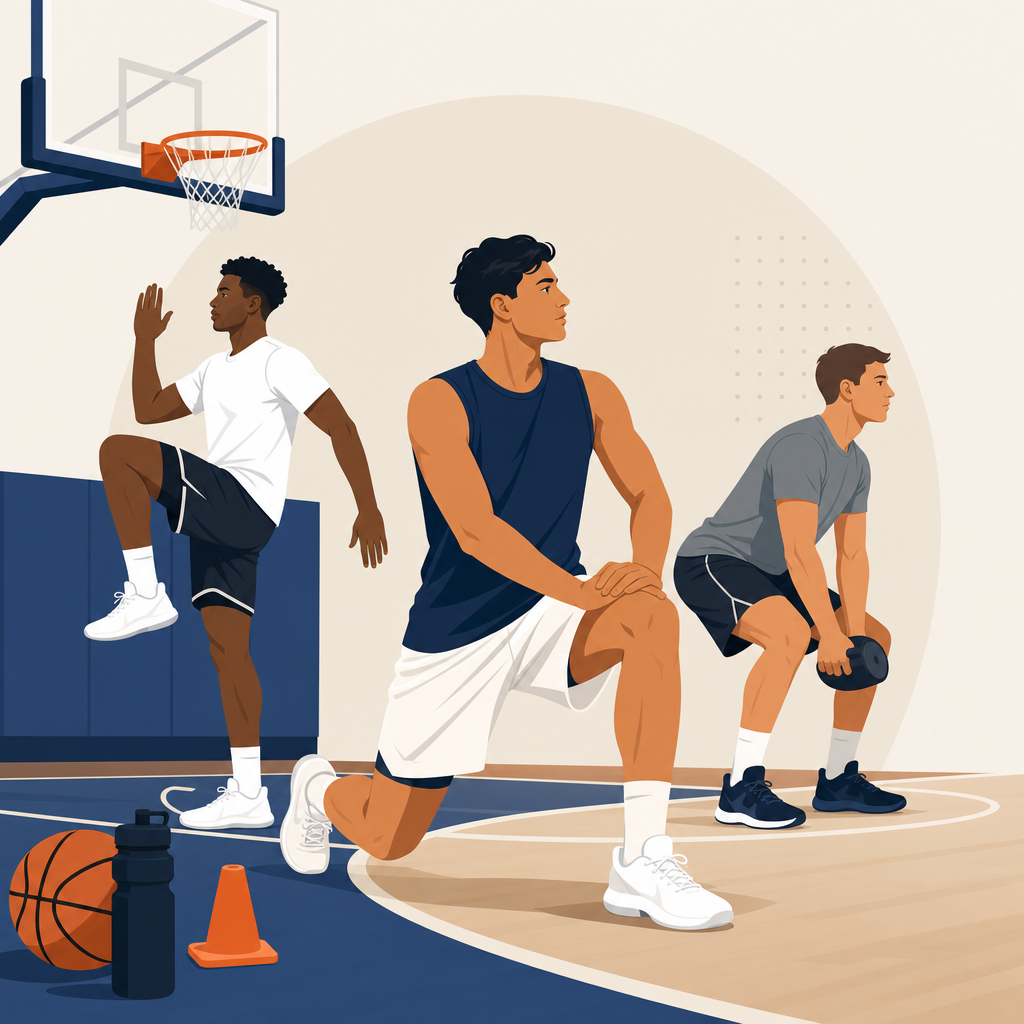
Basketball injuries rarely come from one dramatic play alone; most develop when fatigue, poor movement quality, and inadequate preparation collide during repeated sprints, cuts, jumps, and landings. Knowing how to prevent basketball injuries starts with understanding that prevention is not a single exercise but a system of warm-up, strength training, workload management, and recovery habits that support athletic development across an entire season. In practical terms, a warm-up raises tissue temperature, improves joint mobility, activates key muscle groups, and rehearses basketball-specific movement patterns before intense work begins. Strength routines build the force capacity and control needed to absorb contact, decelerate safely, maintain alignment, and produce power without overloading vulnerable tissues.
I have worked with youth, high school, and adult players who assumed injury prevention meant stretching for five minutes before pickup runs. That approach misses the real problem. Basketball places high demand on the ankles, knees, hips, groin, lower back, and shoulders because players accelerate, stop, pivot, contest rebounds, and land in crowded spaces. Common injuries include lateral ankle sprains, patellar tendinopathy, hamstring strains, adductor strains, finger injuries, and overuse pain related to sudden spikes in training load. The strongest prevention programs address the entire chain, from foot stability and calf strength to hip control, trunk stiffness, and landing mechanics.
This athletic development hub explains the routines that matter most, why they work, and how to organize them so they transfer to the court. The goal is not to eliminate all risk, because no sport can promise that, but to reduce preventable injuries and improve performance at the same time. Players searching for basketball training advice usually want direct answers: What should a basketball warm-up include, how often should strength work happen, which exercises protect the knees and ankles, and how do you balance lifting with games and practices? The sections below answer those questions in plain language and provide a framework you can use whether you are a beginner, a parent, a coach, or an experienced player building a full basketball training plan.
Why Basketball Players Get Hurt and What Prevention Actually Means
Basketball is a multidirectional power sport with repeated stretch-shortening cycle demands. Players rarely move in straight lines for long. They decelerate from a sprint into a jump stop, plant off one leg on a drive, rotate through the trunk on a pass, then backpedal into a defensive slide. Those actions create high forces at the ankle, knee, hip, and trunk. If the athlete cannot control those forces, tissue stress rises quickly. Injury prevention therefore means increasing the body’s capacity to tolerate game demands while refining the movement patterns used under speed and fatigue.
The most common lower-body issue in basketball is the ankle sprain, especially inversion sprains during landing or foot contact. Knee problems are also frequent, including patellar tendon pain from repetitive jumping and, less commonly but more seriously, ACL injury during cutting or awkward landings. In my experience, many athletes also underestimate adductor and hamstring strains, which often appear when conditioning volume jumps too fast or when players return from rest periods without rebuilding sprint exposure. Overuse matters as much as contact. A player can be technically sound and still break down when week-to-week load changes are poorly managed.
Good prevention programs target modifiable factors. These include limited ankle dorsiflexion, weak calf complex, poor single-leg balance, low eccentric hamstring strength, inadequate hip abductor and adductor capacity, trunk instability, and flawed landing mechanics such as knee valgus and stiff, noisy landings. Prevention also includes practical decisions: monitoring minutes, rotating hard and easy days, improving sleep, wearing appropriate footwear, and using progressive return-to-play criteria after an injury instead of guessing. Standards from sports medicine and strength and conditioning consistently support multicomponent programs over isolated drills.
The Ideal Basketball Warm-Up Before Practice or Games
An effective basketball warm-up lasts about 10 to 15 minutes and moves from general activation to specific movement rehearsal. It should elevate heart rate, increase muscle temperature, mobilize joints used in basketball, activate the glutes, calves, trunk, and scapular stabilizers, then progress into skipping, shuffling, acceleration, deceleration, jumping, and landing tasks. Static stretching is not the foundation here. Dynamic preparation produces better readiness because it prepares the nervous system and rehearses the exact patterns the athlete will use on the court.
The biggest mistake I see is spending too much time on random mobility and not enough on force absorption and change of direction. If a player will cut, jump, and land within the first five minutes of practice, the warm-up must include those patterns at rising intensity. A useful sequence starts with light jogging or skipping, then ankle rocks, hip openers, and thoracic rotations, followed by mini-band lateral walks, pogo hops, snap-downs, lateral shuffles, closeout footwork, and short accelerations. For taller athletes, I often add calf isometrics and adductor rock-backs because they commonly arrive stiff through the ankles and groin.
The warm-up should also teach mechanics. On landing drills, cue players to land quietly, absorb through the hips, and keep the knee tracking over the foot rather than collapsing inward. On deceleration drills, teach a lower center of mass, chest stacked over hips, and multiple small steps into a stop instead of one uncontrolled plant. These details matter because prevention is skill-based as much as strength-based. Repeating quality movement every day builds patterns that hold up better under pressure.
Strength Training That Protects Ankles, Knees, Hips, and Hamstrings
Strength training is the backbone of basketball injury prevention because stronger tissues handle higher forces with less strain. The best routines are not bodybuilding splits built around fatigue. They are athletic development programs organized around movement patterns: squat, hinge, split squat or lunge, push, pull, carry, calf work, trunk stability, and controlled plyometrics. For basketball players, unilateral strength is especially valuable because the sport is played one leg at a time during layups, cuts, and many landings.
For knee resilience, I rely on split squats, rear-foot-elevated split squats, step-downs, Spanish squats, and isometric or slow eccentric work for the patellar tendon when needed. For ankle protection, standing and seated calf raises are nonnegotiable because the gastrocnemius and soleus help control landing and deceleration forces. Tibialis raises and balance work help, but they do not replace heavy calf training. For hamstrings, Romanian deadlifts, hip thrusts, and Nordic hamstring variations build posterior chain capacity that supports sprinting and late-game deceleration. For the groin, Copenhagen planks and controlled lateral lunges are highly effective.
Hip and trunk strength tie everything together. Side planks, anti-rotation presses, carries, and single-arm loading improve the ability to transfer force without losing alignment. Upper-body work matters too. Push-ups, rows, landmine presses, and chin-up progressions support shoulder integrity, rebounding contact, and total-body robustness. Players do not need maximal complexity. They need consistently executed basics, progressed over months, with enough load to create adaptation and enough recovery to stay fresh for on-court work.
| Training Goal | Primary Exercises | Why It Helps Prevent Injury | Typical Weekly Dose |
|---|---|---|---|
| Ankle and lower-leg resilience | Standing calf raise, seated calf raise, pogo hops | Improves force absorption, stiffness, and landing control at the ankle | 2 to 4 sessions |
| Knee control and tendon capacity | Split squat, step-down, Spanish squat isometric | Builds quadriceps strength and supports deceleration and jumping tolerance | 2 to 3 sessions |
| Hamstring protection | Romanian deadlift, Nordic curl, hip thrust | Raises posterior chain strength for sprinting and stopping | 2 sessions |
| Groin and hip stability | Copenhagen plank, lateral lunge, mini-band walks | Improves frontal-plane control during cuts and slides | 2 to 3 sessions |
| Trunk and total-body control | Side plank, Pallof press, suitcase carry, row | Helps maintain posture and alignment under contact and fatigue | 2 to 4 sessions |
Sample Weekly Routines for In-Season and Offseason Athletic Development
The best basketball strength routine depends on the calendar. In the offseason, players can push adaptation with two to four lifting sessions per week, more sprint work, and a larger plyometric menu. In season, the goal shifts from building aggressively to maintaining strength, managing soreness, and keeping tissue capacity high enough to survive practice and games. That is why copying an offseason plan into a heavy game week usually backfires. The routine must match the stress already coming from basketball.
For a typical in-season high school or club player with two games per week, I prefer two concise full-body lifts of 35 to 50 minutes. Day one might include a trap-bar deadlift or squat pattern, split squat, row, calf raise, side plank, and low-volume jumps. Day two might use a Romanian deadlift, step-up or lunge, push-up or landmine press, chin-up regression, Copenhagen plank, and isometric quadriceps work. If game minutes are high, reduce volume before reducing intensity; one or two hard sets often maintain strength better than high-repetition fatigue work.
In the offseason, a player can use a four-day structure with lower-body emphasis twice and upper-body plus speed or jump emphasis twice. This is the phase to address movement restrictions, regain asymmetries after a season, and progressively overload tendons and muscles. It is also the right time to teach landing mechanics, acceleration positions, and true strength progressions. Young athletes especially benefit from learning how to hinge, squat, brace, and lunge correctly before chasing advanced plyometrics. Athletic development is long-term. The players who stay healthy are usually the ones who master basics early and repeat them year after year.
Workload, Recovery, and Return-to-Play Decisions
Even the best warm-up and strength program will fail if workload is chaotic. Sudden spikes in court time, tournament density, extra skill sessions, and conditioning added on top of games are major drivers of overuse pain. I track weekly basketball exposures, jump contacts when possible, lifting sessions, and a simple wellness check covering sleep, soreness, and energy. The exact system can be basic, but it must be consistent. If a player goes from two moderate sessions a week to five intense sessions plus weekend games, the body notices even if motivation remains high.
Recovery is not passive. It starts with sleep, hydration, and adequate nutrition, particularly carbohydrates around training and enough daily protein to support tissue repair. For sore patellar tendons or calves, strategic isometrics can reduce pain and maintain loading tolerance. Soft tissue work may improve comfort, but it does not replace progressive strength loading. Footwear and bracing also matter. Lace-up ankle braces have evidence for reducing recurrent ankle sprains, especially in players with prior history, though they should complement, not replace, strength and balance work.
When returning from injury, athletes need criteria, not optimism. Pain should be minimal, swelling controlled, range of motion restored, and strength near the uninjured side where comparison is appropriate. More importantly, the player must tolerate basketball actions in sequence: straight-line running, acceleration and deceleration, lateral movement, jumping, single-leg landing, reactive cutting, and then unrestricted practice. Returning to games before rebuilding those layers is one of the clearest ways to create repeat injuries. Coaches, parents, and players should treat return to play as a progression, not a date on the calendar.
Common Mistakes and How to Build a Sustainable Prevention System
The most common mistake in basketball injury prevention is inconsistency. Players do a great warm-up for one week, then rush through it once games begin. The second mistake is choosing flashy exercises over dependable ones. A teenager will gain more from split squats, calf raises, hinges, rows, and controlled jumps than from unstable circus drills on social media. Another mistake is chasing soreness as proof of quality. Prevention training should make athletes more prepared, not constantly fatigued.
To build a system that lasts, anchor the week around a repeatable warm-up, two strength sessions, and a basic workload review. Keep records of exercises, loads, soreness trends, and missed practices. If one area repeatedly causes trouble, investigate the real bottleneck. Recurring ankle sprains may point to limited dorsiflexion, weak calves, poor landing position, or premature return after the first injury. Ongoing knee pain may reflect tendon overload, weak quadriceps, or too many high-volume jump sessions stacked together. Good programs solve causes, not just symptoms.
As the athletic development hub within basketball training, this page should guide your next steps: refine movement quality, strengthen the tissues that absorb force, and manage training stress with the same discipline you apply to shooting or ball handling. Start with a 10 to 15 minute dynamic warm-up before every session, lift two or more times each week according to the season, and monitor how much total basketball stress you are accumulating. Those habits reduce preventable injuries and support better speed, power, and durability. Build the routine, keep it simple, and follow it long enough for the benefits to show on the court.
Frequently Asked Questions
What is the best warm-up to help prevent basketball injuries?
The best warm-up for basketball injury prevention is one that prepares the body for the exact demands of the sport instead of relying on a few casual stretches or light jogging alone. Basketball asks athletes to accelerate, decelerate, cut, jump, land, rotate, and react repeatedly, so an effective warm-up should gradually increase body temperature, improve joint mobility, activate key muscle groups, and rehearse game-speed movement patterns. A strong sequence often starts with general movement such as jogging, skipping, shuffling, or low-intensity court movement to raise tissue temperature and increase blood flow. From there, players benefit from dynamic mobility work for the ankles, hips, thoracic spine, and shoulders, since restrictions in those areas can affect landing mechanics, change-of-direction control, and shooting or passing posture.
After mobility, the warm-up should include activation drills that target the glutes, hamstrings, calves, trunk, and shoulder stabilizers. Mini-band lateral walks, glute bridges, calf raises, plank variations, and controlled single-leg balance drills are all useful because they reinforce the muscle groups that help stabilize the knees, hips, and ankles. The next step is movement prep, where players practice mechanics they will need in training or competition. This might include snap-downs, jump-and-stick landings, deceleration drills, closeout footwork, lateral shuffles, short accelerations, and controlled changes of direction. These drills teach the body to absorb force with better alignment and timing, which is a major part of reducing overuse stress and non-contact injury risk.
To finish, the warm-up should progress into higher-speed basketball-specific actions such as short sprints, defensive slides, reactive footwork, and submaximal jumps. This final phase helps the nervous system switch on before intense play begins. In most settings, a complete warm-up takes about 10 to 20 minutes, depending on the athlete’s age, training level, and the intensity of the session ahead. The key is consistency. A well-designed warm-up done before every practice, game, and lifting session is far more protective than an occasional “perfect” routine done once in a while.
How does strength training reduce the risk of common basketball injuries?
Strength training reduces basketball injury risk by improving an athlete’s ability to tolerate force, control movement, and maintain technique under fatigue. Every sprint, jump, landing, rebound, and defensive slide places stress on muscles, tendons, ligaments, and joints. When players are not strong enough to absorb and redirect those forces efficiently, the body often compensates with poor mechanics, especially late in games or during busy stretches of the season. That is when issues like patellar tendon irritation, ankle sprains, hamstring strains, knee pain, and low back discomfort become more likely.
A well-rounded basketball strength program typically includes lower-body strength, single-leg control, posterior chain development, trunk stability, and upper-body support work. Squats, split squats, deadlift variations, step-ups, and lunges build strength through the hips and legs, helping athletes produce force on the court while also improving shock absorption when landing. Single-leg work is especially important because basketball is rarely played from a perfectly balanced two-leg position. Movements like rear-foot elevated split squats, single-leg Romanian deadlifts, and lateral lunges help improve balance, pelvic control, and knee tracking during unilateral tasks.
The posterior chain deserves special attention. Strong glutes and hamstrings support sprinting, deceleration, and hip stability, while helping reduce excess stress on the knees. Calf strength and foot-ankle capacity also matter because the lower leg takes on a huge workload during jumping and repeated changes of direction. In addition, trunk strength helps athletes transfer force and stay stable during contact, rotation, and awkward landings. The goal is not bodybuilding for its own sake. It is building a body that can repeatedly handle basketball demands without breaking down. When strength training is progressed sensibly and maintained across the season, it improves durability as much as performance.
Which body areas should basketball players focus on most for injury prevention?
Basketball players should pay the closest attention to the ankles, knees, hips, hamstrings, calves, feet, and trunk because those areas absorb and transfer most of the stress created by sprinting, jumping, cutting, and landing. The ankle is a common starting point. Limited ankle mobility or poor ankle stability can affect how an athlete lands, squats, and changes direction, often pushing extra load up to the knees and hips. Balance work, calf strengthening, ankle stiffness control, and foot intrinsic exercises can all support better lower-limb function.
The knees are another major concern, not just because of traumatic injuries, but because of repetitive stress. Patellar tendon pain, general anterior knee discomfort, and irritation from high jump volumes are common when workload rises faster than tissue capacity. Strengthening the quadriceps, hamstrings, glutes, and calves helps the knee handle force more effectively, while landing mechanics and deceleration technique help reduce unnecessary strain. Players should also develop strong and mobile hips, since the hips play a central role in alignment, force production, and control during direction changes. Weakness or poor control at the hip can contribute to knees collapsing inward or the trunk drifting out of position.
Hamstrings and calves are often overlooked until something goes wrong, yet they are heavily involved in sprinting and repeated explosive efforts. The foot and lower leg are especially important during long seasons because they manage constant impact exposure. Finally, trunk and pelvic control matter more than many athletes realize. A stable trunk supports efficient movement and helps players stay organized during contact, rebounding, and off-balance situations. Rather than isolating one “problem area,” the smartest approach is to view the body as a connected system. Injury prevention improves when players train these regions together instead of trying to fix pain only after it appears.
How often should basketball players do warm-up and strength routines during the season?
Warm-ups should be performed before every basketball activity, including practices, games, skills workouts, and strength sessions. That may sound basic, but consistency is what makes preventive routines work. The body responds well to repeated preparation, especially in a sport with high-impact, high-speed demands. A short, purposeful warm-up done daily is much more effective than an occasional long routine. For most players, 10 to 15 minutes before standard sessions and 15 to 20 minutes before high-intensity practices or games is a practical target. On heavy competition days, the warm-up may need to be adjusted so it activates the athlete without creating unnecessary fatigue.
Strength training during the season is also essential, but the dosage has to match the competition schedule. In general, two well-planned strength sessions per week is enough for many athletes to maintain or slightly improve strength without interfering with recovery. During lighter weeks, some players can handle three sessions. During dense game schedules, one brief maintenance session may be more realistic. The priority in-season is usually quality over volume. That means keeping core lifts in the program, reducing excessive soreness, and focusing on enough intensity to preserve tissue capacity, movement quality, and force production.
It is also important to think beyond the weekly calendar and monitor total workload. Hard practices, tournament weekends, travel, sleep disruption, and extra individual workouts all add stress. If a player is lifting hard, doing multiple skill sessions, and playing heavy minutes, even a good program can become too much. The best injury-prevention plans are flexible. They account for fatigue, soreness, performance trends, and the athlete’s training age. In-season work should support readiness, not compete with basketball demands. When warm-ups and strength routines are adjusted intelligently, they help players stay available across the full season rather than peaking early and wearing down later.
Can recovery habits really make a difference in preventing basketball injuries?
Yes, recovery habits make a significant difference because even the best warm-up and strength plan cannot protect an athlete whose body never gets a chance to adapt. Basketball injuries often appear when accumulated fatigue outpaces recovery. Players may still be able to practice and compete, but their movement quality, reaction time, coordination, and force control begin to decline. That is when sloppy landings, slower deceleration, poor positional awareness, and overuse symptoms become more common. Recovery is not passive or optional; it is a core part of the injury-prevention system.
Sleep is usually the most powerful recovery tool. Consistent, high-quality sleep supports tissue repair, hormone regulation, cognitive sharpness, and nervous system recovery. Nutrition matters as well, especially adequate total calories, protein for tissue repair, and carbohydrates to restore energy stores after intense sessions. Hydration is another overlooked factor. Even mild dehydration can affect performance and concentration, which can indirectly increase injury risk during fast, reactive play. Beyond those basics, players should pay attention to soreness patterns, lingering joint stiffness, and unusual fatigue. Those are often early warning signs that workload and recovery are out of balance.
Active recovery can also help when used appropriately. Light movement, mobility work, walking, cycling, low-intensity shooting, and tissue care strategies may reduce stiffness and help athletes feel better between sessions. Just as important is scheduling. Consecutive high-intensity days with little rest can be manageable for short stretches, but over time they increase strain, especially in younger athletes or players with limited training history. Recovery does