
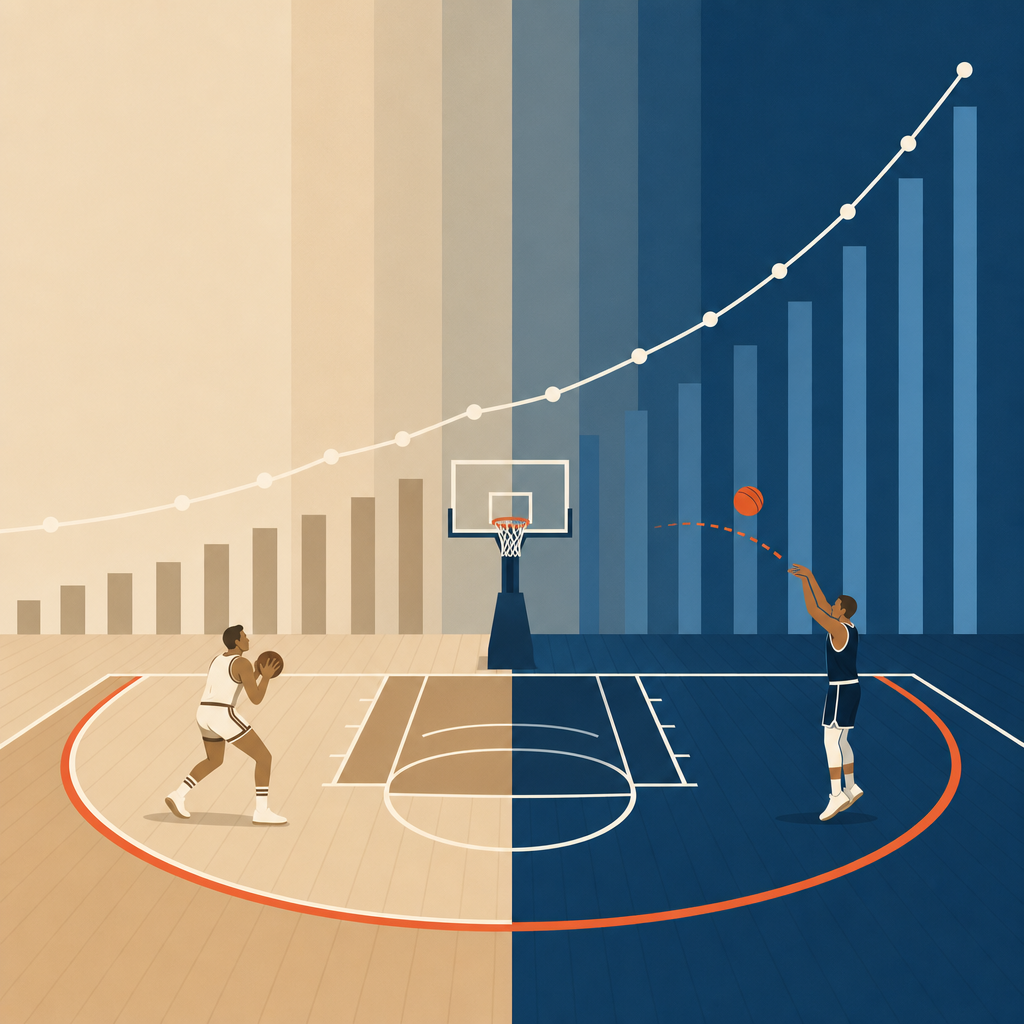
The three-point line changed the NBA more profoundly than any rule added after the shot clock. Introduced for the 1979-80 season after years in the ABA, the arc did more than create a new scoring option. It altered spacing, roster construction, player development, defensive schemes, shot valuation, and even what fans expect from great offense. In league history, no strategic innovation has spread as completely from novelty to necessity.
At its simplest, a three-pointer is a field goal worth three points if the shooter releases the ball from beyond a designated arc. That extra point sounds modest, but in basketball economics it is enormous. Coaches and analysts evaluate shots by expected value, meaning points per attempt rather than points per make. A two-point shot made at 50 percent yields 1.0 point per attempt. A three-point shot made at 34 percent yields 1.02. Once teams understood that math, the geometry of the sport changed.
I have spent years studying old game film, team media guides, and play-by-play archives, and the pattern is unmistakable. Early NBA teams treated the three as a situational weapon, usually for late-clock heaves or comeback attempts. Modern teams treat it as a foundational tool. That evolution matters because it explains why the league moved from bruising post-ups and midrange isolations to spread pick-and-rolls, drive-and-kick actions, and offenses built around pace and space. It also explains why specialists once considered one-dimensional became central to winning basketball.
This article serves as a hub for NBA league history through the lens of the three-point line. It covers where the rule came from, how usage changed across eras, which players accelerated the trend, how the line influenced defense, and why the numbers behind efficiency became impossible to ignore. Understanding that history gives context for nearly every major offensive development of the last four decades, from Larry Bird’s shot creation to Stephen Curry’s deep-range revolution and the analytically driven systems that reshaped front offices.
From ABA Experiment to NBA Rulebook
The three-point line did not begin in the NBA. It was popularized by the ABA, which launched in 1967 and embraced a more open, entertainment-first style. The ABA used the long-distance shot to differentiate itself from the established league, and stars such as Louie Dampier and Julius Erving helped prove it could be both exciting and strategically useful. When the NBA absorbed four ABA franchises in 1976, it inherited not only players and markets but also pressure to modernize. Three years later, the NBA adopted the shot on a one-year trial basis.
The line’s dimensions were specific and consequential: 23 feet 9 inches at the top of the arc, shortening to 22 feet in the corners because of court width. Those measurements still shape modern offense because corner threes are shorter, easier attempts that influence where shooters stand and how defenses rotate. In 1979-80, however, most coaches did not build systems around that geometry. Teams averaged just 2.8 made threes per game on 7.1 attempts. For comparison, recent teams often exceed 13 makes and 35 attempts per game. The rule existed, but its implications were barely explored.
Part of the hesitation was cultural. Basketball orthodoxy still prized getting the ball inside, drawing fouls, and taking what coaches called a “good shot,” usually meaning a layup or open jumper from closer range. The long ball looked risky and, to traditional minds, slightly gimmicky. Many big men could anchor offenses on the block, and hand-checking rules gave perimeter creators less freedom than today. In that environment, there was little incentive to reorganize an entire offense around a shot many decision-makers still distrusted.
The Slow Adoption of the Long Ball in the 1980s and 1990s
The 1980s introduced the first true three-point specialists, but the league remained selective rather than committed. Larry Bird won the first three NBA Three-Point Contests starting in 1986 and showed that elite shooting could be a star skill, not just a bench weapon. Yet even Bird, one of the era’s best shooters and scorers, never attempted threes at anything close to modern superstar volume. Teams were improving at the margins, not yet transforming their identities. Offenses still flowed through post entries, transition opportunities, and midrange pull-ups.
By the early 1990s, attempts rose as coaches discovered practical uses for spot-up shooting around dominant interior players. Michael Jordan’s Bulls benefited from floor spacing created by shooters like John Paxson and later Steve Kerr. Hakeem Olajuwon’s Rockets surrounded the post with reliable perimeter threats, forcing double-team decisions that became more costly with every kick-out pass. This was a crucial phase in league history because it taught front offices that shooting amplified superstar value. The three-pointer was not replacing great big men or slashers; it was making them harder to guard.
The NBA briefly accelerated adoption by moving the line closer from 1994-95 through 1996-97, standardizing it at 22 feet all the way around. Predictably, percentages and attempts jumped. League-wide three-point percentage reached 36.7 in 1995-96, and several role players posted career highs. But the temporary line also created noisy data. It encouraged more attempts without proving that teams had fully solved long-term spacing principles. When the original distance returned in 1997-98, percentages dipped and usage growth slowed again, showing that strategy had advanced, but not yet irreversibly.
| Season or Era | League 3PA per Team per Game | League 3P% | Historical Meaning |
|---|---|---|---|
| 1979-80 | 7.1 | 28.0% | Rule introduced; mostly experimental usage |
| 1985-86 | 3.3 makes per team | 35.4% | Specialists emerge, but volume remains low |
| 1994-95 to 1996-97 | Rising sharply | Mid-30s | Shortened line boosts acceptance |
| 2004-05 | 14.9 | 35.6% | Spacing grows with perimeter rule changes |
| 2014-15 | 22.4 | 35.0% | Analytics era reaches mainstream coaching |
| 2023-24 | About 35.1 | 36.6% | Three-point volume becomes central offense |
Analytics, Rule Changes, and the Efficiency Revolution
The biggest leap came in the 2000s, when rule changes and analytics aligned. Illegal defense restrictions had already been loosened in 2001, zone principles became more viable, and hand-checking on the perimeter was further limited in 2004. I remember front-office conversations from that period turning more explicitly mathematical. Executives were no longer asking only who could score; they were asking from where, at what efficiency, and in what lineup context. Dean Oliver’s work on offensive efficiency, combined with public analytics growth, made shot distribution impossible to ignore.
The central concept was simple: not all field goals are equal. Shots at the rim and shots behind the arc generally produced better returns than long twos. A 40 percent shooter from three matches a 60 percent shooter from two. Even modestly accurate three-point shooting could bend a defense because help defenders had to cover more ground. As tracking improved, teams also saw that many threes were created by dribble penetration, extra passes, and transition cross-matches rather than individual isolation brilliance. The best three-point offense was often a system, not merely a shooter.
The Phoenix Suns under Mike D’Antoni were one of the first modern teams to push this logic at scale. With Steve Nash orchestrating spread pick-and-rolls, Amar’e Stoudemire diving to the rim, and wings spaced to the arc, Phoenix attacked before defenses were set and preferred efficient looks over conservative convention. The Suns did not invent spacing, but they operationalized it in a way the entire league had to study. Their influence can be traced through later offenses in Houston, Golden State, Dallas, Boston, and across much of today’s NBA.
Stephen Curry and the Point of No Return
If analytics built the case for the three, Stephen Curry made it emotionally undeniable. Great shooters existed before him, including Reggie Miller, Ray Allen, Glen Rice, Peja Stojakovic, and Steve Nash. Curry’s difference was range, release speed, off-ball movement, and volume combined at an unprecedented level. Defenses had to react several feet beyond the line, which stretched the court horizontally and vertically in ways prior schemes were not designed to handle. He did not just make more threes; he changed where coaches believed a good shot could come from.
The statistical milestones are now part of league history. Curry made 272 threes in 2012-13, then shattered his own standard with 286, 261, and 402 from 2013-14 through 2015-16. That 2015-16 season remains a landmark: 45.4 percent from three on 11.2 attempts per game while leading a 73-win team. Those numbers broke conventional risk models. High-difficulty pull-up threes were supposed to be inefficient. In Curry’s hands, many became elite offense. Once that became visible nightly, youth development changed, shot selection changed, and defensive game-planning changed with it.
Golden State’s dynasty also showed that three-point basketball was not simply bombing away. The Warriors paired shooting with cutting, screening, defensive versatility, and quick decision-making. Klay Thompson’s gravity, Draymond Green’s short-roll passing, and the team’s split-action sets created a complete ecosystem. This distinction matters. Teams that copied only the volume without the underlying process often stalled into contested jump shooting. The real lesson was to generate clean threes through movement, force rotations, and maintain enough defensive integrity to survive misses on the other end.
How the Three-Point Line Reshaped Positions, Defense, and Team Building
The three-point line changed what every position looks like. Point guards are now expected to shoot off the dribble and from deep pull-up range. Wings must space the floor, attack closeouts, and defend multiple actions. Power forwards who once lived in the mid-post increasingly became stretch fours. Centers are judged not only by rim protection and rebounding, but also by screening angles, handoff timing, short-roll passing, and in some cases pick-and-pop range. A player who cannot threaten the arc often needs elite compensating skills to stay on the floor late in games.
Defensively, the changes have been just as dramatic. Coaches now prioritize nail help, low-man rotations, X-out closeouts, and pre-switching to prevent open corner threes. Drop coverage remains common against many ball handlers, but teams must mix in blitzes, switches, and late scram actions against elite pull-up shooters. The rise of the three has also increased the importance of transition defense. One missed assignment in semi-transition can yield a corner attempt before a defense is matched. In film rooms, that counts as a major breakdown because the expected value is so high.
Roster construction followed the same logic. Front offices place premium value on “3-and-D” players because they fit beside stars without demanding the ball and because they preserve lineup flexibility in the playoffs. The archetype became one of the most valuable non-star roles in the sport. At the same time, the three-point era created tradeoffs. More spacing can mean fewer offensive rebounds if lineups are too perimeter-oriented. Heavy switching can leave teams vulnerable on the glass. And relying on high-volume shooting introduces variance, which can swing a playoff series when shots stop falling.
What the Numbers Really Say About the Three-Point Era
The statistical history of the three-point line is not a story of blind volume. It is a story of optimization. League-wide offenses learned to replace many low-efficiency long twos with either rim attempts or threes. Offensive ratings climbed over time because teams improved shot quality, spacing, and decision-making. Yet the best evidence is contextual. Championship teams still need balance. The 2014 Spurs used beautiful ball movement to create threes, but they also finished at the rim. The 2020 Lakers won with size and defense while taking fewer threes than some rivals, though they still needed credible spacing around LeBron James and Anthony Davis.
The key takeaway for NBA history is that the three-point line did not eliminate other styles; it reordered priorities. Post play still matters when it creates efficient offense or forces double teams. Midrange shots still matter for elite creators such as Kevin Durant, Chris Paul, and Kawhi Leonard, especially in late-clock playoff possessions. But the baseline assumptions changed permanently. A team now needs a clear reason not to take threes, rather than a clear reason to take them. That reversal is the clearest sign of how thoroughly the line transformed the league.
For anyone exploring league history, the three-point line is the organizing thread that connects rules, analytics, stars, and strategy across eras. It explains why old spacing looks cramped on film, why modern role players train differently, and why front offices talk constantly about shot profile. The complete statistical history shows a progression from skepticism to selective use, then to system-wide adoption, and finally to a league built around spacing pressure. Use this article as your starting point for deeper NBA history, then follow related team, player, and era studies to see how one curved line redrew the sport.
Frequently Asked Questions
When was the three-point line introduced to the NBA, and why was it considered such a major change?
The NBA adopted the three-point line for the 1979-80 season, borrowing an idea that had already been used in the ABA and in earlier experimental leagues. At first, the rule looked simple: any made shot from beyond a set arc would count for three points instead of two. But the long-term significance was far greater than the extra point itself. The three-point line changed the geometry of the court. Before its arrival, defenses could compress into the lane more aggressively because there was less punishment for sagging off perimeter players. Once the arc became part of the NBA rulebook, teams gained a structural incentive to space the floor wider, stretch defenders farther from the basket, and create new kinds of driving lanes and passing angles.
What made the rule especially transformative is that it did not just add one more shot type. It changed how every other shot was valued. A long two-pointer, for example, suddenly became less efficient than a shot taken just a step behind the line. That forced coaches, front offices, and players to rethink offense in more mathematical terms. Over time, the three-point line also influenced which skills were rewarded. Shooting range became more valuable, traditional interior lineups became harder to sustain, and even stars who once dominated from mid-range had to adapt to a league increasingly organized around spacing and efficiency. In that sense, the three-point line was not merely a scoring gimmick. It became one of the most important strategic tools in basketball history.
How did NBA teams use the three-point shot in the early years compared with today?
In the early years after 1979, most NBA teams treated the three-pointer as a specialty weapon rather than the foundation of an offense. Usage was modest, and many coaches still preferred traditional shot profiles built around post play, mid-range jumpers, and attacking the basket. Three-point attempts were relatively rare, and players who specialized in long-range shooting were often seen as role players rather than central offensive engines. Statistically, the contrast with the modern game is dramatic. Early NBA teams might take only a handful of threes per game, while contemporary teams routinely attempt several dozen.
The shift happened gradually. Through the 1980s and much of the 1990s, the three-pointer grew in relevance but remained secondary to more established offensive systems. Even as elite shooters emerged, many teams still viewed the shot as situational: useful when trailing, valuable in transition, or effective as a kick-out option, but not yet something to organize an entire offense around. By the 2000s and especially the 2010s, that mindset changed. Analytics, shot-tracking data, and offensive innovation made it increasingly clear that three-pointers, when combined with shots at the rim, often produced the most efficient offense. As a result, modern teams do not simply take more threes; they design possessions specifically to generate them. Ball movement, drive-and-kick action, pick-and-roll spacing, and five-out alignments all reflect this evolution. The statistical history shows a clear arc from reluctance to acceptance to dependency.
Why did the three-point line have such a big impact on spacing, roster construction, and player development?
The three-point line changed spacing because it forced defenders to cover more ground. Once a shooter can score efficiently from 23 feet or more, the defense cannot crowd the paint without consequence. That stretches help defenders outward, opens driving lanes for guards and wings, and creates cleaner passing windows across the floor. In practical terms, one good shooter in the corner can distort an entire defense. Multiple shooters can completely reshape the game. The court feels larger, not because its dimensions changed, but because the threat of three-point shooting makes every inch of space more valuable.
That shift had a direct effect on roster construction. Teams began prioritizing players who could shoot, defend in space, and make quick decisions with the ball. The classic low-post-heavy lineup, once a staple of NBA offense, became harder to maximize unless surrounded by perimeter threats. Big men who could stretch the floor gained enormous value because they pulled rim protectors away from the basket. Wings who could both hit open threes and switch defensively became some of the league’s most sought-after pieces. Even bench roles evolved, with “3-and-D” specialists becoming essential in playoff rotations.
Player development changed along with team-building philosophy. Young guards now grow up training deep range, off-the-dribble shooting, and quick-release mechanics. Forwards and centers are increasingly expected to handle the ball and shoot from the perimeter, not just finish inside. The result is a broader skill distribution across positions. In earlier eras, a center taking frequent threes might have been considered unusual or even misguided. In today’s NBA, that same skill can be central to an offense. The three-point line did not just alter strategy at the professional level; it changed what aspiring players practice and what coaches teach at every stage of development.
What do the statistics say about how the three-point shot changed offensive efficiency in the NBA?
Statistically, the three-point shot changed offensive efficiency by altering the reward structure of shot selection. A made three is worth 50 percent more than a made two, which means even a lower field-goal percentage can still produce excellent scoring efficiency if the attempt volume and shot quality are high enough. This insight became one of the driving forces behind modern NBA analytics. Teams began comparing expected value more carefully. For example, a mid-range shot made at a decent rate might still be less efficient than a three made at a slightly lower rate because the three produces more points per attempt. Once front offices and coaching staffs fully embraced that logic, offensive priorities shifted quickly.
The numbers also show that the rise in three-point shooting was not just about taking more difficult shots from farther away. It was about creating better shots through spacing, pace, and passing. As teams spread the floor, they generated more open catch-and-shoot opportunities, more corner threes, and more drive-and-kick actions that put defenders in rotation. This often improved overall offensive ratings, not merely three-point totals. In other words, the threat of the three increased efficiency everywhere else too, especially at the rim.
Another important statistical effect is variance. Because three-pointers produce more points and often come in larger volume, they can create bigger scoring swings from game to game. That has changed how underdogs compete, how playoff series unfold, and how teams manage risk offensively. A hot shooting night can overwhelm even a strong defense, while a cold stretch can sink a superior team. Over the long run, however, the statistical trend is unmistakable: offenses built around efficient threes, rim pressure, and smart spacing have consistently outperformed systems that rely heavily on low-value long twos. The complete statistical history of the NBA in the last several decades is, in many ways, the story of teams learning that lesson.
Did the three-point line change what fans, coaches, and players think great NBA offense looks like?
Yes, and that cultural shift may be just as important as the statistical one. Before the three-point era fully matured, great offense was often associated with dominant post scorers, physical interior play, and elite mid-range shot-making. Those skills still matter, but the definition of offensive excellence has expanded. Today, fans and analysts expect high-level offenses to feature pace, space, ball movement, and long-range shooting. A team that cannot consistently threaten defenses from beyond the arc is often viewed as strategically incomplete, no matter how talented it may be in other areas.
For coaches, the three-point line changed both design and identity. Offensive systems are now judged not only by whether they score, but by how they create efficient attempts. Actions that generate corner threes, pull-up threes, and kick-out passes are central to modern playbooks. Defensively, coaches have had to respond with more switching, more closeout discipline, and more emphasis on containing dribble penetration without surrendering perimeter looks. The tactical arms race created by the three-point line has made the game more interconnected than ever.
For players, the three-pointer became a marker of versatility and star power. Guards are expected to shoot off the dribble from deep. Wings are expected to punish help defense. Bigs are increasingly expected to at least threaten the perimeter. Some of the most influential players in modern NBA history helped push that expectation further by proving that high-volume, high-difficulty three-point shooting could anchor championship-level offense. As a result, fans now often see spacing and shooting not as supplementary traits, but as defining features of elite basketball. The three-point line changed the NBA statistically, strategically, and aesthetically, reshaping not only how the game is played, but how greatness in the game is recognized.