
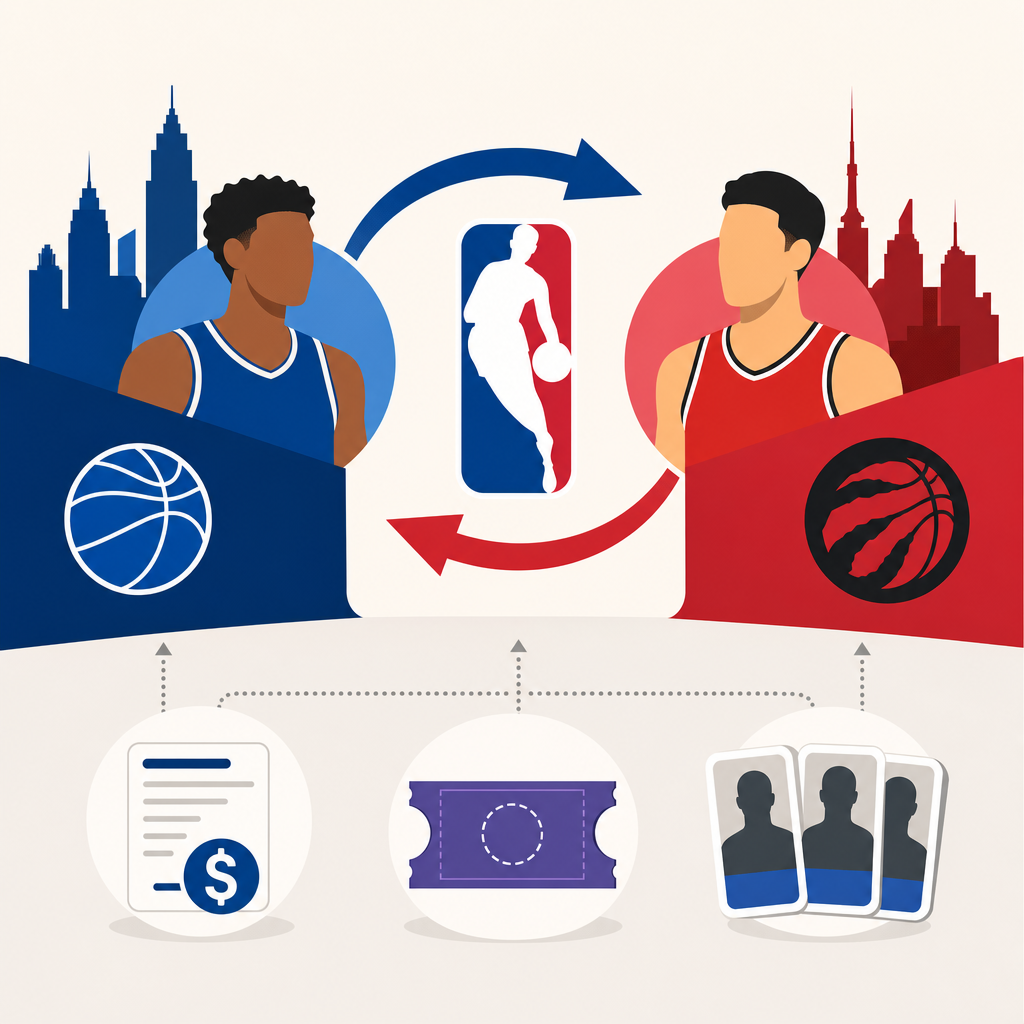
NBA trades look simple on social media, but every completed deal is governed by a dense set of salary rules, timing restrictions, and draft pick regulations that front offices must navigate precisely. A trade in the NBA is the transfer of player contracts, draft rights, cash, or exceptions between teams under the Collective Bargaining Agreement, usually called the CBA. Salary matching is the requirement that teams over the salary cap send out enough salary to legally acquire incoming salary. A trade exception is a bookkeeping mechanism created when a team sends out more salary than it receives, allowing limited future acquisitions without sending matching salary back. Draft picks are tradable assets, but they carry their own limits, protections, and timing rules.
This matters because the league is not a pure free market. The NBA uses a soft cap, a luxury tax system, and several aprons above the tax line to restrain spending while still allowing roster movement. I have worked through trade structures during deadline coverage and cap-analysis projects, and the same lesson appears every year: the headline is usually the easiest part of the deal, while the legal path is the hard part. Fans ask why a trade agreed to in principle gets expanded, delayed, or rerouted through a third team. The answer is almost always in salary matching, aggregation restrictions, hard-cap concerns, or the treatment of first-round picks years into the future.
For anyone following the NBA business side, understanding trades explains why some stars move quickly and others never do, why expiring contracts matter, why teams value cap space, and why second-round picks are often used as grease in negotiations. This hub article covers the full trade landscape: the salary rules teams must satisfy, the mechanics of trade exceptions, the way draft picks can and cannot move, and the strategic choices that separate a legal trade from a realistic one.
Salary matching is the foundation of most NBA trades
The first question in any NBA trade is not whether the basketball fit works. It is whether the incoming salary is legal under the CBA. Teams that are below the salary cap can often absorb contracts using cap room, which is the cleanest path. Most teams, however, operate above the cap, and that triggers salary-matching rules. In plain terms, an over-the-cap team cannot simply add salary without sending enough salary out, unless it has a specific tool such as a trade exception or minimum-salary exception that fits the transaction.
The exact matching limits depend on a team’s payroll tier. Teams under certain tax thresholds have more flexibility than teams above the tax or above an apron. Under the current CBA structure, teams near or above the first apron face tighter operating conditions, and teams above the second apron face the harshest trade restrictions. Those higher-spending teams can no longer rely on the old habit of stacking contracts freely to bring back a bigger number. In many cases, second-apron teams cannot take back more salary than they send out, which dramatically narrows the market for expensive players.
Here is the practical front-office view. If Team A wants a player making $30 million and is already over the cap, it must line up outgoing contracts, exceptions, or space to satisfy league rules. That may mean trading one $28 million player, or two players at $12 million and $16 million, depending on its apron status and aggregation rights. This is why midsize contracts are valuable. A roster full of minimum deals and one max contract is hard to reshape, because there are fewer legal paths to match a large incoming salary.
Timing also affects matching. Newly signed free agents often cannot be traded immediately. Recently extended players can be subject to trade restrictions. A player acquired in one trade may face aggregation limitations for a period afterward, meaning his salary can be traded again, but not bundled with another player to match for a larger incoming number. Those details regularly explain why a trade becomes official weeks after reports first surface.
Trade construction depends on cap position, aprons, and player-specific restrictions
Once the broad salary test is understood, the next layer is transaction design. Front offices must account for roster size, hard-cap triggers, no-trade clauses, poison pill rules, base year compensation, and sign-and-trade limitations. Only a small number of NBA players have a true no-trade clause, but when one exists, player consent is mandatory. More commonly, players have indirect leverage through extension eligibility, trade bonuses, or preferred destinations that influence negotiations even when they lack formal veto power.
Sign-and-trades deserve special attention because they are widely misunderstood. A team uses a sign-and-trade when a free agent re-signs with his prior team and is immediately traded to a new team. This allows the new team to acquire a player it could not sign outright with cap room. The catch is severe: the receiving team becomes hard-capped at the first apron. That one consequence alone kills many speculative trade ideas. If a contender is already close to that apron, a sign-and-trade is often impossible regardless of player interest.
Another key rule involves base year compensation, a mechanism that can distort a re-signed player’s outgoing salary for matching purposes while his new team still counts the full incoming amount. This often creates the illusion that a trade should work when the books say otherwise. Poison pill rules create a similar disconnect for recently extended rookie-scale players. For the trading team, the outgoing salary may count at the old number, while the receiving team must count the player at a much higher figure that includes future salary. In negotiations, this can make a talented young player harder to move than fans expect.
Basketball logic matters too. The legal package has to be attractive. An overpaid veteran may be matchable on paper but unattractive in reality unless attached to draft compensation. An expiring contract has value because it can clear future money. A non-guaranteed contract can help teams match salary without locking in future obligations. Front offices do not just ask, “Can we trade this player?” They ask, “Can we trade this player under our apron, without hard-capping ourselves, while preserving optionality for the next move?”
Trade exceptions are useful, limited, and often overstated
A traded player exception, commonly called a trade exception or TPE, is created when a team sends out more salary than it receives in a legal trade. The team does not get a player slot. It gets a temporary exception, usually lasting one year, that can be used to absorb one or more players whose combined salary fits within the exception amount plus permitted wiggle room under league rules. This tool is powerful for teams that want to add talent later without immediately sending salary back.
Trade exceptions are also one of the most misunderstood assets in NBA business. They cannot be combined with player salaries to acquire a more expensive player. They generally cannot be aggregated with another exception. They do not help a team bypass apron restrictions. If a team above the second apron holds a large TPE, that does not mean it can use it freely. The broader spending restrictions still apply. I have seen many trade deadline discussions treat a $10 million exception like cap space. It is not cap space. It is a narrow transaction tool with a clock.
Teams create TPEs strategically. Suppose a rebuilding team sends out a veteran making $18 million and takes back only a second-round pick. If done correctly, it may create an $18 million trade exception. Over the next year, that team can absorb a player making up to the allowable amount without sending matching salary, provided it has the roster room and remains within applicable hard-cap or apron limits. That can turn financial flexibility into an asset. Teams have used exceptions to take on rotation players, facilitate three-team trades, or absorb contracts from tax-paying teams seeking relief.
| Mechanism | What it does | Main limitation | Typical use |
|---|---|---|---|
| Cap room | Absorbs salary directly | Available only below the cap | Rebuilding teams taking contracts |
| Trade exception | Absorbs salary up to exception amount | Cannot be freely combined with player salaries | Later acquisition without outgoing salary |
| Matching salary trade | Brings back salary by sending salary out | Depends on tax and apron rules | Most veteran-for-veteran deals |
The best way to value a trade exception is as optionality, not certainty. Many expire unused because the right player never becomes available, the team’s priorities change, or the exception is too small to matter. Still, competent front offices try to preserve them. An unused exception may look invisible on the court, but it can be the difference between participating in a deadline opportunity and watching another team seize it.
Draft picks are trade currency, but the rules sharply limit how teams can move them
Draft picks are the other half of modern NBA trade building. First-round picks carry the highest value because they can produce star talent on inexpensive rookie-scale contracts, and they can also be used as premium trade sweeteners. Second-round picks are less valuable individually, but they have become highly liquid assets in multi-team deals, salary dumps, and late-stage negotiations. Under the CBA, however, not every pick can be traded at any time.
The best-known restriction is the Stepien Rule, named after former Cleveland owner Ted Stepien. This rule prevents teams from trading away first-round picks in consecutive future drafts. A team can trade a first in 2028 and another in 2030, but not both 2028 and 2029 if that would leave it without first-rounders in back-to-back future years. Teams work around this by using pick swaps, protections, or timing language tied to whether an owed pick conveys. This is why trade terms can read like legal documents.
Protections matter enormously. A top-10 protected first-round pick means the receiving team gets the pick only if it falls outside the top 10. If it lands inside the top 10, the original team keeps it and the obligation may roll over to the next year with the same or revised protection. Sometimes protections gradually loosen, such as top-14 in year one, top-10 in year two, top-8 in year three, then converting to second-round picks if never conveyed. These structures balance risk between a team trying to contend now and a team demanding long-term value.
Pick swaps are subtler but potent. In a swap, one team gains the right to exchange first-round positions with another team in a specified year if it benefits them. No pick leaves the draft entirely, so swaps can fit where outright first-round trades would trigger restrictions. The Brooklyn-Houston aftermath of the James Harden trade made swaps famous because they preserved upside for Houston even in years when Brooklyn still retained a first-round pick of its own.
Draft-night trades add another wrinkle. Because teams trade the rights to selected players rather than the pick itself once the draft has started, the announced player name may differ from the team that ultimately negotiated the selection. Cash considerations can also be included, though the league caps how much cash can be sent in trades during a season. For front offices, picks are not abstract lottery tickets. They are time-stamped assets with protections, conveyance conditions, and strategic consequences years into the future.
How real NBA trades come together in practice
Most trades develop in layers, not in one dramatic phone call. A front office begins by setting competitive goals: win now, reduce tax, clear future cap space, or accumulate picks. Then it identifies legal pathways. If the desired player makes $40 million, the team’s cap staff will model every valid combination of contracts, exceptions, and apron outcomes before basketball executives seriously debate the offer. Only after that does the negotiation turn to price: how many picks, how many swaps, and what protections.
Three-team and four-team trades are common because they solve mismatched incentives. One team wants the star. Another wants picks. A third is willing to absorb unwanted salary for compensation. The 2023 trade deadline provided several examples of this logic across the league, with teams using extra second-round picks and modest exceptions to bridge gaps that a two-team structure could not solve. In practice, the best trade architects think like air-traffic controllers. Every contract, roster spot, and future obligation has to land in the right place at the right time.
Medical review is another critical stage. A trade agreement is not truly finished until players report and physicals are reviewed, unless teams explicitly waive parts of that process. If a medical issue appears, the deal can collapse or be amended. Trade calls with the league office then formalize the terms. For draft picks, protections and contingencies must be written with precision, because one ambiguous clause can affect obligations several years later.
For fans using this trades hub as a starting point, the key habit is to evaluate every rumor with four questions. Is the incoming salary legal for each team? Do apron or hard-cap rules block it? Are there player-specific restrictions such as aggregation, poison pill treatment, or trade bonuses? And do the picks comply with future draft rules? If the answer to any of those is no, the rumor is not close, no matter how many insiders repeat the basketball logic.
NBA trades work because the league combines competitive ambition with a strict financial rulebook. Salary matching determines whether teams above the cap can legally exchange contracts. Trade exceptions create useful but limited flexibility when teams move out more salary than they take back. Draft picks provide long-term value, yet protections, swaps, and the Stepien Rule sharply shape how they can be used. Once you understand those three pillars, most trade headlines become much easier to decode.
The main benefit of learning NBA trade mechanics is clarity. You can separate realistic proposals from impossible ones, understand why certain contracts are prized, and see why front offices often involve third teams or delay formal completion. This page is the hub for the broader trades topic within NBA Business, so it should serve as the baseline for deeper reading on sign-and-trades, apron strategy, trade season calendars, and draft-pick valuation. Use this framework the next time a blockbuster rumor appears, and you will read the deal like a cap analyst, not just a fan.
Frequently Asked Questions
What does “salary matching” mean in an NBA trade?
Salary matching is the basic rule that keeps teams above the salary cap from freely taking on more money than they send out in a trade. In practical terms, if a team is over the cap, it usually cannot just absorb a larger contract without meeting the league’s trade rules under the Collective Bargaining Agreement. Instead, it must send out enough salary so that the incoming salary falls within the allowed range. The exact amount a team can take back depends on its payroll position and the current CBA framework, but the core idea is simple: over-the-cap teams must balance outgoing and incoming salary closely enough for the trade to be legal.
This is why many NBA deals are built around contract math as much as player talent. A team may love a player, but if the salaries do not line up properly, the trade cannot be approved by the league office. Front offices therefore look at every detail of a player’s current salary, whether bonuses are likely to be earned, whether the team is above certain tax or apron thresholds, and whether exceptions are available. Fans often see the headline first and the accounting second, but for team executives, the accounting is often what makes the headline possible in the first place.
How do trade exceptions work in the NBA?
A trade exception is a mechanism that allows a team to acquire salary in a later trade without sending out matching salary in that later deal, but only under specific conditions. Most commonly, a traded player exception is created when a team sends out more salary than it takes back in a trade. Rather than losing that outgoing salary slot entirely, the team can receive an exception roughly equal to the amount of salary it shed. That exception can then be used later to absorb one or more player contracts, up to the exception amount, without having to match salary in the usual way.
Trade exceptions are useful, but they are often misunderstood. They are not extra cap space, and they do not let a team ignore every roster-building rule. They cannot be combined with player salaries to bring in a more expensive player, and they generally must be used within a limited time window. Teams also have to fit the incoming player into an existing roster spot and may still face tax or apron-related restrictions depending on their payroll status. In short, a trade exception is best thought of as a targeted tool that gives a front office flexibility, not a blank check to add salary whenever it wants.
Why can’t teams just trade any draft picks they want?
Draft picks are highly valuable trade assets in the NBA, but they are tightly regulated. The most famous restriction is the Stepien Rule, which prevents teams from trading away first-round picks in consecutive future drafts. The purpose is to stop franchises from stripping themselves of too much long-term talent. As a result, teams often trade picks with protections, swap rights, or picks far enough into the future that they stay compliant. This is why trade reports frequently mention phrases like “top-10 protected” or “first-round pick swap” instead of a simple unconditional pick transfer.
There are also limitations on how far into the future teams can trade first-round picks, and the exact ownership of a pick can become complicated if prior trades already involve protections or obligations. A team cannot promise the same pick to multiple teams, and it must account for what happens if a protected pick does not convey right away. Front offices spend a great deal of time mapping these scenarios because one unresolved future obligation can affect several later drafts. For fans, draft-pick language can sound like legal code, but for teams, it is a critical part of making sure a deal is valid and strategically sound.
What kinds of assets can actually be included in an NBA trade?
NBA trades can include much more than active players. Teams can trade player contracts, draft picks, draft rights to certain players, pick swaps, cash considerations in limited amounts, and trade exceptions. In some cases, a team may also include the rights to an international player who has not yet joined the NBA or the rights to a recently drafted player who has not signed under certain circumstances. The transaction rules are detailed, but the broad concept is that teams can move several categories of contractual and draft-related assets as long as the deal complies with the CBA.
What teams cannot do is treat trades like a free-form marketplace with no structure. Every asset has rules attached to it. A player may have recently signed and be temporarily ineligible to be traded. A draft pick may be protected or already committed in a prior deal. Cash can be sent, but only within league limits. Sign-and-trade deals trigger their own set of restrictions. Even when two teams agree on basketball value, the legal packaging still matters. That is why many trades expand from a simple one-player concept into multi-player, multi-pick constructions designed to satisfy both competitive goals and league rules.
Why do NBA trades sometimes take days to become official even after they are reported?
A trade can be agreed to in principle before it is officially completed because several steps still have to happen behind the scenes. The league office reviews the transaction to confirm that it complies with salary rules, roster limits, hard-cap or apron restrictions, draft-pick regulations, and any special trade conditions. Teams also have to submit the required paperwork, verify contract details, and make sure all moving parts line up properly. If the trade involves multiple teams, sign-and-trade elements, or protected draft picks with complicated future outcomes, that review can take even longer.
There are also timing restrictions that affect when certain trades can be finalized. A player who was recently signed may not yet be trade-eligible. A moratorium period may delay official processing. Physicals can matter, and in some cases trades are reworked if a medical issue arises. So when fans see a trade announced on social media, what they are usually seeing is the agreement point, not the final legal completion. The delay does not necessarily mean something is wrong; it usually means the teams and league are making sure the transaction fits every requirement of the CBA before it becomes official.