
Centers have defined every era of professional basketball, and no position better explains how the NBA has changed than the men who played in the middle. In any serious discussion of position rankings, the center spot is where arguments about scoring, defense, longevity, and championship value become clearest. A center traditionally anchors the paint, protects the rim, rebounds in traffic, screens in half-court offense, and punishes smaller defenders near the basket. Yet the best centers did far more than fill a role. They bent schemes, forced rule adjustments, and shaped roster construction across decades.
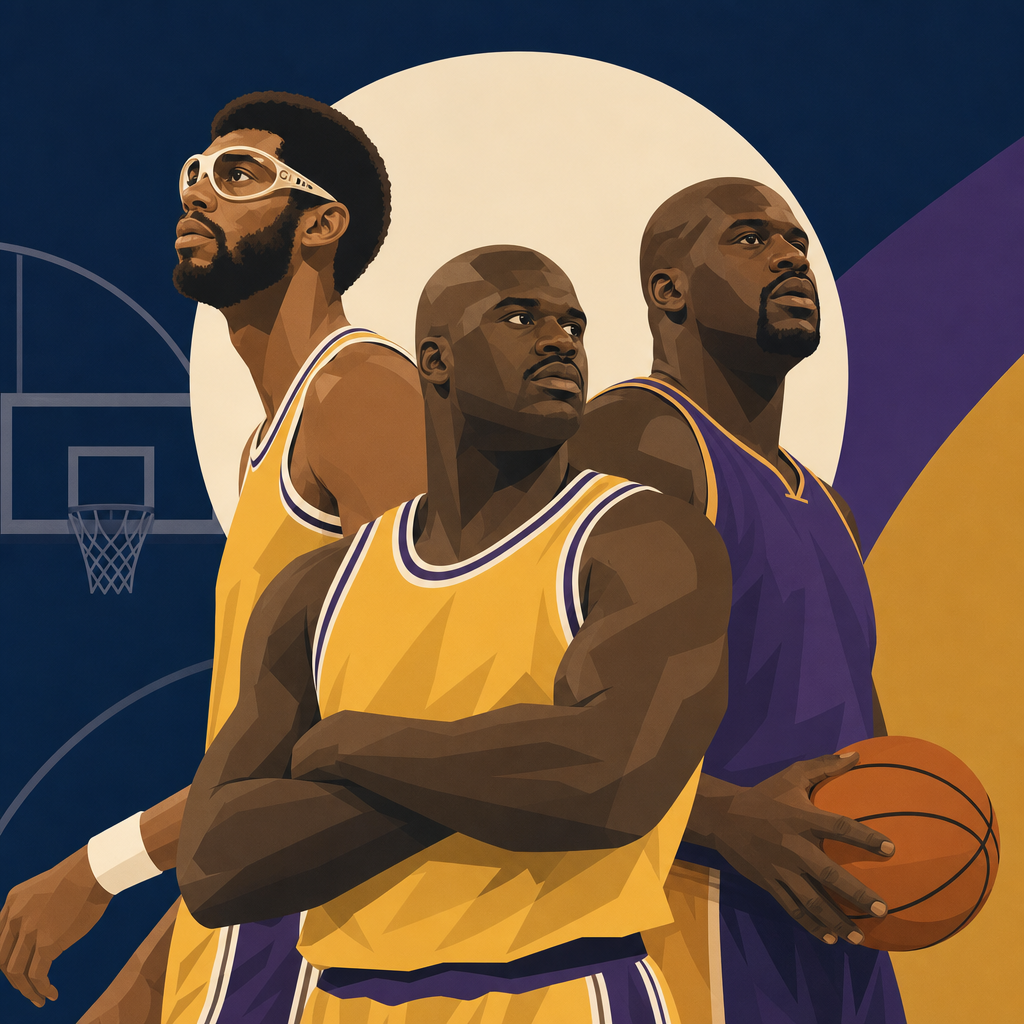
This hub article examines the big man legacy through Kareem Abdul-Jabbar, Shaquille O’Neal, and the wider line of dominant centers who set the standard for greatness. Kareem represents sustained excellence at a level the league may never see again: six MVP awards, six championships, unmatched scoring longevity, and a signature move, the skyhook, that remained essentially unguardable. Shaq embodies peak force. At his best, he was not simply productive; he was strategically overwhelming, generating constant foul pressure, paint touches, and defensive collapse. Around them stands a lineage that includes George Mikan, Bill Russell, Wilt Chamberlain, Hakeem Olajuwon, David Robinson, Moses Malone, Patrick Ewing, Nikola Jokić, and others who each redefined what the center position could be.
For readers exploring NBA players by position, this page serves as the central guide to position rankings at center. It explains what makes a center great, how eras affect evaluation, and why different all-time lists prioritize different traits. I have worked through enough historical film, playoff series, and statistical profiles to know that ranking centers is never just about points per game. It requires balancing regular-season volume against postseason translation, individual brilliance against team structure, and peak dominance against year-over-year durability. That balance matters because center remains the most structurally important defensive position in basketball, even in an age of spacing, pace, and switch-heavy lineups. If you want to understand NBA history through a single position, start here.
What Defines Greatness at the Center Position
The simplest definition of a great center is a player who controls the game closest to the rim on both ends, but in practice the evaluation is more layered. The best centers create efficient offense, either through post scoring, offensive rebounding, vertical spacing as a lob target, or high-post passing. Defensively, elite centers erase mistakes. They deter drives before the shot even goes up, finish possessions with rebounds, and communicate coverages that keep the back line organized. Modern analysis also values screening angles, handoff timing, and short-roll decision-making, because center play now extends into spacing geometry and possession creation.
When I build center rankings, I start with five pillars: peak performance, longevity, playoff scalability, two-way impact, and historical influence. Peak performance asks how unstoppable a player was at his best. Longevity measures how long that level lasted. Playoff scalability tests whether regular-season strengths held up against targeted game plans. Two-way impact matters because the all-time greats at center almost always affect both offense and defense. Historical influence recognizes that some players changed how the position was coached or officiated. Russell turned defense into a championship engine. Wilt redefined statistical possibility. Kareem proved skill and durability could coexist for two decades. Shaq made front offices carry extra size just to survive a series.
Era adjustment is essential. Mikan dominated before the shot clock, Russell and Wilt battled in a compressed league, Kareem thrived across the 1970s and 1980s, Hakeem ruled in a more global and tactically mature environment, and Jokić is excelling in a perimeter-oriented league that asks centers to facilitate offense from the elbows and above the break. Raw numbers alone can mislead. Pace, rules on hand-checking, defensive three seconds, illegal defense, and shot distribution all change the job description. Good position rankings account for those variables rather than flattening every generation into one statistical pool.
Kareem Abdul-Jabbar and the Case for Complete Greatness
Kareem Abdul-Jabbar remains the most complete long-view argument for the greatest center ever. He entered the NBA in 1969 after an extraordinary college career at UCLA, then immediately became an elite professional. By his second season, he won MVP and a championship with the Milwaukee Bucks. Across twenty seasons, he collected six MVP awards, six titles, fifteen All-NBA selections, eleven All-Defensive selections, and nineteen All-Star appearances. For decades he held the NBA’s all-time scoring record, not through empty accumulation but through durable, efficient production across multiple team contexts.
His offensive profile was broader than casual summaries suggest. The skyhook is the headline, and rightly so, because it was one of the most reliable weapons in basketball history. Kareem could launch it over either shoulder, using length, timing, and footwork to create a release point defenders rarely reached. But he also ran the floor well in his early years, finished with touch, passed cleanly out of pressure, and understood spacing before that word became central to player evaluation. He was not a bruising power center in the Shaq mold; he beat defenders with angles, stamina, and precision.
Defensively, Kareem offered major value as a rim protector and rebounder, particularly in his Milwaukee prime and early Lakers years. Film from the 1970s shows him covering space better than many people remember, contesting with discipline instead of chasing every block. His longevity is what separates him from nearly every rival. Most centers peak hard and decline quickly due to the physical toll of size. Kareem remained a championship-level contributor into his forties. That matters in position rankings because availability at a high level is itself a skill. When a player can anchor winning for twenty seasons, he is not just elite; he is historically stabilizing.
Shaquille O’Neal and the Meaning of Peak Dominance
Shaquille O’Neal represents the strongest peak argument at center outside perhaps prime Wilt or prime Russell depending on how one values offense versus defense. From Orlando to Los Angeles to Miami, Shaq forced opponents into constant adjustment. At roughly 7-foot-1 and well over 300 pounds in his dominant years, he combined rare mass with explosive footwork, quick second jumps, soft hands, and unusual passing vision out of double teams. Defenders did not simply lose to Shaq; entire rotations collapsed under the pressure of containing him near the restricted area.
His best stretch came with the Lakers from 1999-2002, when he won an MVP award, three straight Finals MVPs, and served as the engine of a repeat-proof offense in the postseason. In the 2000 Finals against Indiana, he averaged 38.0 points and 16.7 rebounds. During that three-year title run, many teams used starting centers whose main qualification was six fouls and enough size to absorb contact. That is a real measure of dominance. Opponents changed personnel because traditional coverage solutions were inadequate.
Shaq’s limitations must be acknowledged to rank him honestly. His free-throw shooting invited intentional fouling, his conditioning varied by season, and he was not as defensively versatile away from the basket as the very best mobile bigs. Still, those weaknesses did not erase his value because his interior efficiency was so overwhelming. In playoff settings, he generated layups, dunks, foul trouble, and open threes for teammates simply by sealing deep position. Few players in league history have bent a championship environment more dramatically. If Kareem is the standard for total career center value, Shaq is the standard for destructive force at the position.
The Big Man Lineage: Russell, Wilt, Hakeem, and Beyond
No center hub is complete without the pillars surrounding Kareem and Shaq. Bill Russell built the most decorated defensive résumé in basketball history, winning eleven championships in thirteen seasons with the Boston Celtics. His genius was not just shot blocking, which was not officially tracked, but anticipation, help timing, outlet passing, and command of team defense. Russell proved that a center could dominate a game without leading the league in scoring. Wilt Chamberlain, his great rival, remains the sport’s most extravagant statistical outlier. A 100-point game, 50.4 points per game in a season, and massive rebounding totals still sound fictional. Yet Wilt’s legacy is more nuanced because his role changed over time, from solo scoring machine to lower-usage facilitator and defender on title teams.
Hakeem Olajuwon may be the most technically gifted two-way center ever. His footwork, counters, and balance made the “Dream Shake” devastating, while his defensive mobility let him protect the rim and survive in space. In 1994 he won MVP, Defensive Player of the Year, and Finals MVP in the same season, a rare alignment of total impact. David Robinson brought elite transition speed and disciplined defense. Moses Malone weaponized offensive rebounding like no one else. Patrick Ewing carried New York through deep playoff battles. Modern readers should also place Nikola Jokić in this lineage because he has transformed center offense through processing speed, touch passing, and efficiency from every level of the floor.
| Center | Primary Strength | Legacy Marker |
|---|---|---|
| Bill Russell | Team defense and leadership | 11 championships |
| Wilt Chamberlain | Statistical production and physical dominance | 100-point game |
| Kareem Abdul-Jabbar | Longevity, scoring skill, complete résumé | 6 MVP awards |
| Shaquille O’Neal | Interior force and playoff pressure | 3 straight Finals MVPs |
| Hakeem Olajuwon | Two-way technique and mobility | 1994 MVP, DPOY, Finals MVP |
| Nikola Jokić | Playmaking and offensive orchestration | Multiple MVP-level seasons |
Each of these players answers a different ranking question. If you want championships and defense, Russell has a historic claim. If you prioritize box-score extremity, Wilt stands alone. If you value balanced excellence over the longest period, Kareem is almost impossible to top. If postseason peak matters most, Shaq and Hakeem gain ground quickly. That is why center rankings remain the richest debate within NBA players by position.
How Position Rankings for Centers Should Be Built
A useful hub for position rankings should not force one rigid formula, but it should explain the criteria clearly. Start with role difficulty. Centers are responsible for the highest-leverage defensive area on the floor: the rim. A mediocre perimeter defender can often be hidden. A mediocre defensive center usually cannot. That is why rebounding rate, block rate, foul discipline, contest frequency, and lineup-level defensive performance matter. Public tools such as Basketball-Reference, Cleaning the Glass, and NBA tracking data help, but film study remains necessary because deterrence often does not appear in the box score.
On offense, context is everything. Post scoring was once a primary engine; now many centers create value as screeners, passers, and finishers rather than first-option scorers. That shift should not punish older stars who thrived in low-post systems, nor should it minimize modern playmaking bigs. Instead, ask a cleaner question: how much offensive advantage did the player create relative to his era? Kareem’s skyhook, Shaq’s deep seals, Hakeem’s face-up counters, and Jokić’s passing all produced defensive compromise in different ways. The underlying principle is the same.
For this sub-pillar under NBA players, the best internal path is to treat this article as the center gateway, then branch into deeper profiles and era-specific comparisons. Readers looking for all-time lists need the framework first. Readers looking for player debates need context on rules, schemes, and postseason translation. The hub function of this page is to connect those needs: history, ranking logic, and the names that define the position. When those pieces are clear, center debates become more informed and far less dependent on nostalgia or isolated highlights.
Why the Big Man Legacy Still Shapes Today’s NBA
The modern league may look more perimeter-driven, but the big man legacy remains visible in every serious contender. Teams still need rim protection, defensive rebounding, screening, and interior finishing. Even stretch systems rely on centers to organize coverages and create efficient shots through contact or passing. The difference is that today’s best centers often blend traditional paint control with perimeter skill. Jokić runs offense like a point center. Joel Embiid combines face-up scoring with rim pressure. Anthony Davis, when deployed at center, changes a defense with mobility and length. The position has evolved, not disappeared.
Kareem and Shaq still matter because they represent the two most enduring archetypes in center history. Kareem shows the value of refined skill, conditioning, and adaptable greatness over time. Shaq shows the value of unanswerable force at peak form. Every later big man is measured against one or both models. Can he anchor a title defense? Can he command double teams? Can he stay effective in May and June? Can he age into a different version of himself without losing championship value? Those are center questions because the position has always demanded structural impact, not just individual production.
The clearest takeaway from any study of centers who dominated the NBA is that the position remains the backbone of basketball history. Kareem Abdul-Jabbar built the strongest career case, Shaquille O’Neal delivered one of the most frightening peaks, and the broader big man lineage explains how the sport moved from paint warfare to modern versatility. For anyone studying position rankings, center is the essential starting point because it ties together offense, defense, strategy, and winning at the highest level. Use this hub as your foundation, then continue into deeper player-by-player comparisons to sharpen your own all-time list.
Frequently Asked Questions
Why are centers so important in NBA history and in debates about the greatest players ever?
Centers sit at the crossroads of nearly every major basketball conversation because the position has traditionally influenced both ends of the floor more directly than any other. A dominant center can control the paint offensively, erase mistakes defensively, finish possessions with rebounds, and shape the way an entire opponent game plan is built. For decades, teams were often judged by whether they had a big man who could score efficiently near the rim, protect the basket, and survive the physical demands of playoff basketball. That central responsibility is one reason the history of the NBA can almost be told through its elite centers.
When people argue about greatness, the center position naturally becomes a testing ground for every standard: peak performance, longevity, championships, statistical dominance, and two-way value. Great centers do not just put up points; they often anchor entire systems. Their presence affects shot selection, spacing, rebounding margins, foul trouble, and tempo. From old-school low-post offenses to modern defensive schemes built around rim deterrence, the best centers force strategic adjustments that smaller positions often do not. That is why legendary names at the position carry such weight in all-time rankings. Their impact is visible in scoring titles, MVP races, championship runs, and in the way the game itself evolved around them.
What made Kareem Abdul-Jabbar such a dominant center across multiple eras?
Kareem Abdul-Jabbar stands out because he combined elite skill, remarkable consistency, and extraordinary longevity in a way very few players in any position ever have. His signature skyhook remains one of the most unstoppable shots in basketball history. It gave him a reliable scoring weapon against size, physical defense, and different generations of opponents. Unlike big men who depended purely on strength or athletic explosion, Kareem built his dominance around precision footwork, touch, balance, timing, and a deep understanding of angles. That made his game age exceptionally well.
What truly separates Kareem is that he was not merely a scorer. He was a complete center who rebounded, defended the rim, ran the floor effectively for a player of his size, and served as the structural backbone of winning teams. He succeeded in different circumstances, from his early years as the centerpiece of a title team to his later role on championship Lakers teams where he remained elite while adapting to changing responsibilities. That flexibility matters when evaluating all-time greatness. He was dominant in the 1970s, still highly effective into the 1980s, and accumulated a resume built on sustained excellence rather than a brief peak.
His legacy is also strengthened by the breadth of his accomplishments. Kareem’s combination of MVP awards, championships, scoring production, and staying power makes him one of the clearest examples of how a center can define an era while also transcending it. He was a traditional paint anchor, but his finesse and intelligence gave him a style that feels timeless. In conversations about the greatest centers ever, he is often the benchmark because he delivered almost every quality that people value: individual dominance, team success, durability, and unmatched polish.
How did Shaquille O’Neal change the way people viewed center dominance?
Shaquille O’Neal represented a different kind of greatness from Kareem, but no less historic. Where Kareem overwhelmed opponents with skill and economy of movement, Shaq imposed his will through a blend of size, power, agility, and finishing ability that basketball had rarely seen. He was not just big; he was explosively big. Defenders could know exactly what was coming and still fail to stop it. In his prime, he established position deep in the paint, absorbed contact without losing balance, and finished through double teams as if they were minor inconveniences. That level of interior force changed how teams built rosters and defensive game plans.
Shaq’s dominance also highlighted the value of physical pressure in an era that still prized half-court execution and interior scoring. He collapsed defenses, generated fouls, created open looks for teammates, and put opposing frontcourts in constant trouble. His championship years, especially with the Lakers, showed what happens when a center becomes the most unavoidable problem on the floor. Opponents often had to dedicate extra bodies just to keep him from catching the ball where he wanted it, and even then they often failed. That level of attention is one of the clearest signs of true superstar impact.
At the same time, Shaq changed the conversation around centers by reminding everyone that dominance does not have to look elegant to be historically valuable. He was a devastatingly efficient scorer near the basket, a strong rebounder, and a defender who could control the lane with size alone. His weaknesses, especially free-throw shooting, are part of any honest evaluation, but they do not erase how overwhelming he was at his peak. In legacy debates, Shaq is often cited as one of the most physically dominant players ever, regardless of position. His career reinforced a simple truth about the center spot: when a truly elite big man can own the paint, the entire sport bends around him.
How has the role of the NBA center evolved from the eras of Kareem and Shaq to today?
The role of the center has changed dramatically, but the core responsibilities have never fully disappeared. In earlier eras, centers were often the focal point of offense. Teams fed the post, played through interior touches, and expected their big men to score with back-to-the-basket moves, offensive rebounding, and close-range finishing. Defensively, centers were still asked to protect the rim, rebound, and provide a physical backbone. Players like Kareem and Shaq fit that model in different ways, but both represented a time when the middle of the floor was still the most important battleground in the sport.
Modern basketball has spread the floor with more shooting, faster pace, and more perimeter creation, which has changed what teams ask from their centers. Today’s big men are often expected to defend in space, switch or hedge in pick-and-roll coverage, pass from the high post, and in some cases stretch the floor with outside shooting. Even so, the old duties remain essential. Rebounding, screening, rim protection, interior finishing, and paint deterrence still define center play at the highest level. What has changed is the range of acceptable styles. A center no longer has to dominate strictly on the block to be elite.
This evolution is one reason the legacies of classic greats remain so interesting. Kareem and Shaq thrived in systems built to maximize interior power, yet their impact still helps explain today’s game. Modern teams may use centers differently, but the strategic value of controlling the paint has not vanished. It has simply been reframed. The best current centers often combine traditional size advantages with perimeter skill, decision-making, and mobility. Looking back at earlier legends helps fans understand that the position has not become less important; it has become more versatile.
What is the lasting legacy of great centers like Kareem and Shaq on the NBA and on player rankings today?
The lasting legacy of great centers is that they established the standards by which basketball greatness is measured. Kareem and Shaq each proved, in very different ways, that a center can be the foundation of a dynasty, the focal point of an offense, and the most important defender on the floor. Their careers continue to shape how fans, analysts, and historians think about peak value versus longevity, skill versus force, and individual brilliance versus team success. When people rank centers all time, they are not just sorting numbers. They are comparing different models of dominance.
Kareem’s legacy is deeply tied to endurance and completeness. He represents the ideal of sustained excellence, where a player can remain impactful across changing teammates, systems, and eras. Shaq’s legacy is tied more to inevitability at his best. He showed what it looks like when a player’s physical advantages are so overwhelming that opponents must redesign their entire approach. Both models remain influential in modern debates. One asks how long a player ruled; the other asks how terrifying that player was at absolute peak form.
More broadly, the big man legacy remains central to understanding the NBA itself. The league has evolved stylistically, but the accomplishments of dominant centers still form the backbone of basketball history. Championships, MVPs, scoring records, playoff runs, and defensive identities have often flowed through elite play in the middle. That is why the conversation never really ends. Every new generation of centers is measured against the giants who came before, and Kareem and Shaq remain two of the clearest reference points for what true dominance looks like. Their influence is not just historical. It is active in every serious discussion about who mattered most, who changed the game, and what greatness at center really means.