
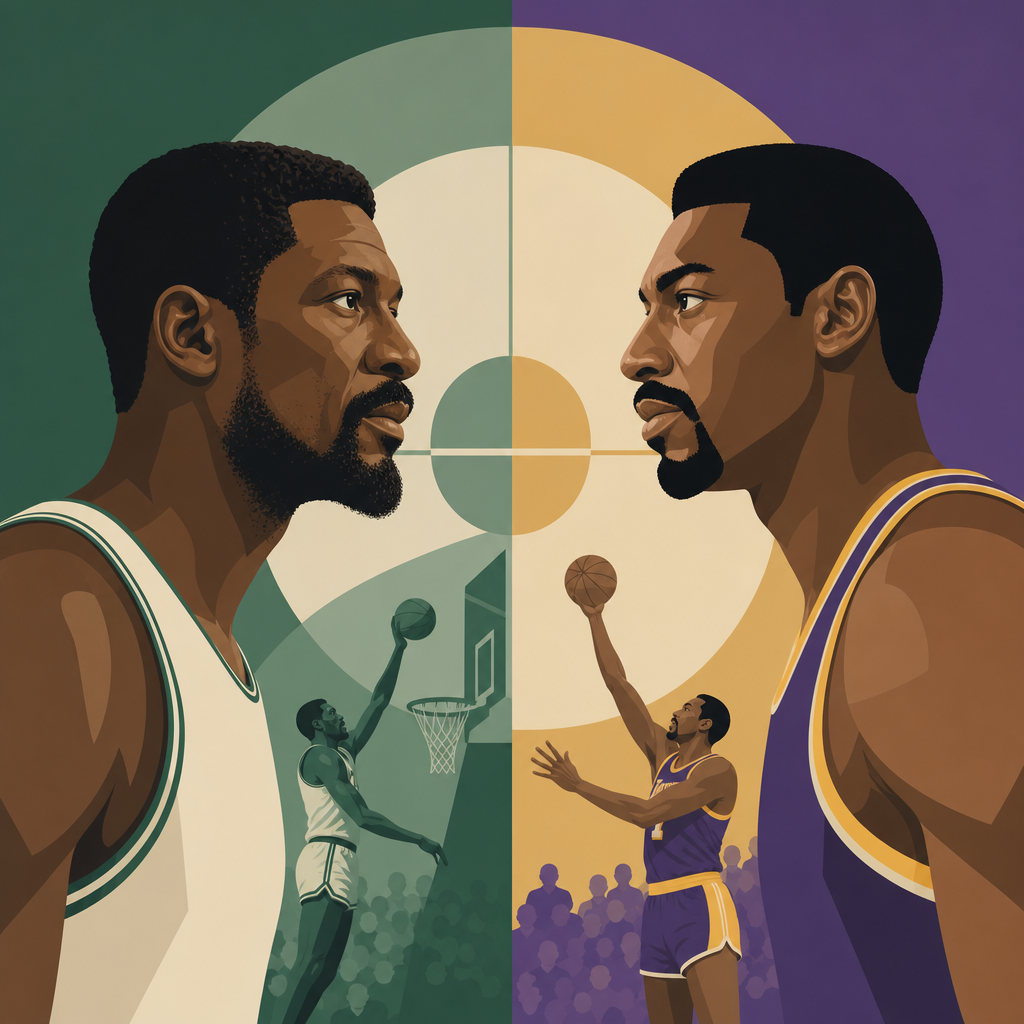
Bill Russell vs Wilt Chamberlain remains the defining rivalry of NBA history because it forces one question that still shapes every debate about greatness: do you value individual dominance more, or winning impact under pressure? In the “Legends and Eras” branch of NBA History, no matchup better explains how basketball evolved from raw athletic spectacle into a mature team sport built on defense, spacing, coaching, and role definition. Russell and Chamberlain were not simply stars from the 1960s. They were opposing basketball theories in human form, and every later comparison—Magic versus Bird, Jordan versus everyone, LeBron versus the field—borrows language first sharpened by their battles.
Russell, the Boston Celtics center, stood about 6-foot-10 and built his legacy on defense, rebounding, leadership, and championship execution. Chamberlain, who starred for the Philadelphia/San Francisco Warriors, Philadelphia 76ers, and Los Angeles Lakers, was a 7-foot-1 athletic marvel whose scoring and statistical records still look unreal. Key terms matter here. Pace refers to possessions per game, and the 1960s played at a much faster pace than modern basketball, inflating counting stats. Efficiency measures how productively a player used possessions, often through field-goal percentage and later true shooting percentage. Context means roster strength, coaching, rules, travel, integration, schedule density, and playoff format, all of which affect what statistics really mean.
This rivalry matters because box scores alone cannot settle it. Chamberlain averaged more points and rebounds. Russell won more titles and regularly solved the biggest game in the sport. Both facts are true, and serious analysis has to hold them together rather than forcing a lazy answer. I have spent years reviewing game logs, playoff series, and coaching accounts from this era, and the clearest conclusion is that Russell versus Chamberlain works best as a history lesson in how basketball value can appear in different forms. If this article is your entry point into NBA History, it is also the right hub for understanding legends, eras, and why context must sit beside statistics in every all-time argument.
The Numbers: What the Head-to-Head Stats Actually Say
Chamberlain owned the louder regular-season numbers. In head-to-head regular-season matchups against Russell, he averaged roughly 29.9 points and 28.2 rebounds per game, while Russell averaged about 14.2 points and 23.4 rebounds. Those figures immediately explain why basic stat readers lean toward Wilt. Across his career, Chamberlain won seven scoring titles, led the league in rebounding eleven times, and even led the NBA in assists in 1967-68 to silence criticism that he could not adapt. His famous 1961-62 season produced 50.4 points and 25.7 rebounds per game, including the 100-point game, records that remain among the most untouchable in American team sports.
Russell’s regular-season stat line looks modest by comparison: 15.1 points, 22.5 rebounds, and 4.3 assists for his career. Yet those averages hide his actual function. He was the defensive system, transition trigger, and emotional center of a Celtics dynasty that won 11 championships in 13 seasons, including eight straight from 1959 to 1966. Blocks were not officially recorded during his career, but film study and opponent testimony strongly suggest Russell would have posted elite block totals. More important, he treated shot blocking as a possession play. Instead of swatting shots into the seats, he often directed them to teammates, preserving control and starting fast breaks. That is advanced defensive thinking decades before advanced metrics existed.
The playoff split sharpens the rivalry. Russell’s teams beat Chamberlain’s teams in seven of their eight postseason meetings. Wilt’s individual playoff numbers against Russell remained enormous, but Boston usually won the series. That repeated outcome is the core of Russell’s case. In elimination settings, the Celtics executed more cleanly, defended more cohesively, and trusted Russell’s command of timing and rotations. Head-to-head data matters, but it matters most when tied to game state. Chamberlain could overwhelm a game statistically; Russell more often determined who survived it.
Why Raw Stats Need Era Context
The 1960s were extreme by modern pace standards. Teams routinely took more shots, missed more shots, and generated more rebounding chances. In 1961-62, NBA teams averaged about 126 possessions per game, far above the modern norm, which generally sits near 99 to 101. That is why rebound totals from the era look so massive. More possessions created more opportunities for points, boards, and minutes. Chamberlain famously averaged 48.5 minutes per game in 1961-62 because he played every minute plus overtimes. That workload was real and astonishing, but it also happened within a smaller league, a different travel environment, looser substitution habits, and strategic assumptions unlike today’s game.
League structure also shaped legacy. During much of Russell and Chamberlain’s prime, the NBA had far fewer teams, which concentrated talent. Expansion had not yet diluted rosters, and playoff paths were shorter but often more brutal because elite teams collided earlier. Integration and talent development were still evolving as well. Russell helped normalize Black leadership at the center of the sport, while Chamberlain challenged assumptions about size, speed, and offensive scale. Coaching methods were less specialized, sports medicine was primitive by current standards, and there was no three-point line to stretch defenses or alter shot value. Centers operated close to the rim in a crowded paint, where rules on lane violations, offensive fouls, and physical contact created a harsher interior game.
Context does not excuse or diminish either player. It clarifies what their numbers mean. Chamberlain’s volume was partly a product of pace and usage, but his efficiency was still remarkable for the time. Russell’s lower scoring was partly role choice, but his impact on defense and winning was still extraordinary. When evaluating legends and eras, the right method is not to dismiss old numbers or worship them blindly. The right method is to compare each player to his own environment, then study how his style changed the sport around him.
Russell’s Case: Defense, Leadership, and the Geometry of Winning
Russell is the best historical example of a player whose value exceeds his scoring totals. On film, his genius appears in anticipation. He read angle, release point, and secondary action before most big men reacted to the first move. Celtics coach Red Auerbach built a dynasty around that skill. Boston could pressure the ball because Russell erased mistakes behind the play. Teammates could leak out because he secured rebounds and fired accurate outlet passes. That transformed defense into offense and made the Celtics devastating in transition.
Leadership was not a soft add-on to Russell’s profile; it was central to it. He captained lineups loaded with Hall of Famers, which sounds easy until you remember that star-heavy teams often fail because status has to be organized. Russell accepted lower scoring volume, demanded defensive accountability, and set emotional terms for close games. In 1966, he became the NBA’s first Black head coach while still playing, a monumental responsibility that added strategic and social pressure. Boston then won championships in 1968 and 1969 with Russell as player-coach, including the 1969 Finals upset over the favored Lakers.
Russell’s supporters are not arguing that he was a better scorer than Chamberlain. They are arguing something more important: that he was better at converting talent into wins when the stakes peaked. In modern language, Russell functioned like an entire defensive infrastructure. He protected the rim, ended possessions, covered teammates, and controlled tempo without needing shots called for him. That package is why many historians place him in the top tier of all-time players despite modest scoring numbers.
Chamberlain’s Case: Statistical Supremacy and Evolution Beyond Scoring
Chamberlain’s case begins with the obvious point: no player in league history has combined size, strength, speed, durability, and production at his level. He did not merely lead the league; he distorted what seemed physically possible. Defenses loaded the paint against him every night, rules were adjusted partly because of his dominance, and he still produced scoring seasons that remain unmatched. His 100-point game in March 1962 is the most famous single-game record in NBA history, but it can overshadow the broader truth that Wilt authored entire seasons of superhuman output.
What is often missed is that Chamberlain evolved. Early in his career, he carried huge scoring burdens on teams that depended on him to create offense almost every trip. Later, especially under coach Alex Hannum, he became more selective and more team-oriented. The 1966-67 76ers are one of the greatest teams ever, winning 68 games and ending Boston’s eight-year title streak. Chamberlain averaged 24.1 points, 24.2 rebounds, and 7.8 assists that season while shooting 68.3 percent from the field, a record at the time. That season matters because it proves Wilt was not trapped inside one style. When asked to defend, pass, screen, and dominate efficiently rather than endlessly score, he could do all of it.
| Category | Bill Russell | Wilt Chamberlain |
|---|---|---|
| Championships | 11 | 2 |
| MVP Awards | 5 | 4 |
| Career Points Per Game | 15.1 | 30.1 |
| Career Rebounds Per Game | 22.5 | 22.9 |
| Head-to-Head Playoff Edge | Won 7 of 8 series | Won 1 of 8 series |
Chamberlain also won titles with two different franchises, first with Philadelphia in 1967 and then with the Lakers in 1972, when Los Angeles won a then-record 33 straight games. That late-career Lakers run showed another version of Wilt: lower scoring, elite rebounding, elite rim protection, and disciplined anchoring of a veteran contender. His critics point to occasional playoff dips in aggression or free-throw weakness, both fair concerns. But the strongest pro-Wilt argument is simple and durable: if basketball starts with the ability to physically dominate the game, no historical player reached a higher ceiling.
Why Russell Won More: Teams, Coaching, and Clutch Reality
Championship counts are team outcomes, yet team outcomes are not random. Boston’s roster continuity, Red Auerbach’s system, and a deep bench gave Russell structural advantages over much of Wilt’s career. The Celtics had Bob Cousy, Bill Sharman, Tom Heinsohn, Sam Jones, John Havlicek, K.C. Jones, and later others who understood their roles inside a disciplined machine. Russell amplified that machine because his defense covered for mistakes and his unselfishness lowered friction. Chamberlain’s early teams were less stable, and he changed franchises more often, which matters in an era when continuity strongly shaped execution.
Still, saying Russell had better teammates does not finish the discussion. Great players are partly judged by what their teams become around them. Russell’s teams consistently became smarter, tougher, and more resilient late in games. Chamberlain’s teams did not always. A key example is Game 7 of the 1969 Finals, when an aging Russell-led Celtics team beat Chamberlain, Jerry West, and Elgin Baylor in Los Angeles. Chamberlain left late with a knee issue, asked to return, and did not re-enter after coaching decisions intervened. That moment became symbolic, fairly or not, because Russell’s teams repeatedly looked steadier in chaos.
Clutch performance in this rivalry is not mythology. Boston won 10 winner-take-all games during Russell’s career, and Russell was central to that composure. Chamberlain had big playoff performances too, but the historical pattern favors Russell when every possession tightened. If you are building a title favorite, that distinction matters as much as any per-game average.
The Legacy Across NBA History and the Legends-and-Eras Map
Russell and Chamberlain anchor the first true superstar rivalry in pro basketball, and their influence runs through every later NBA era. Russell established the model for the championship-defining defender, the player whose communication, rim protection, and sacrifice raise everyone else. Modern descendants include Hakeem Olajuwon, Tim Duncan, Kevin Garnett, and Draymond Green in smaller lineups. Chamberlain established the template for overwhelming interior force, a line that stretches through Shaquille O’Neal, dominant MVP centers, and every prospect described as physically unguardable.
As a hub for Legends and Eras, this rivalry also connects to broader NBA History topics: the rise of the Celtics dynasty, the evolution of center play, the social significance of Black superstars and coaches, the changing value of efficiency versus volume, and the tension between individual awards and championships. Russell won five MVPs because contemporaries understood his effect even without modern metrics. Chamberlain won four because his dominance was impossible to deny. Their careers remind us that greatness can be measured through different lenses without becoming arbitrary.
The best takeaway is not to force a final verdict that erases complexity. If you prioritize winning translation, defensive command, and leadership under pressure, Russell has the stronger case. If you prioritize peak production, physical superiority, and statistical authority, Chamberlain has the stronger case. Study both. Then use this rivalry as your starting point for every other era debate in NBA History, because no comparison teaches the relationship between stats and context more clearly.
Frequently Asked Questions
Why is Bill Russell vs Wilt Chamberlain still considered the greatest rivalry in NBA history?
Bill Russell vs Wilt Chamberlain still stands as the most important rivalry in NBA history because it was never just about two great centers putting up numbers. It represented two competing ideas of basketball greatness. Chamberlain embodied overwhelming individual dominance: unmatched size, scoring explosions, rebounding volume, and statistical records that still feel almost unreal. Russell represented something very different: defense, leadership, sacrifice, chemistry, and the ability to make winning the central measure of value. Every modern debate about all-time rankings, playoff performance, and whether stats tell the whole story can be traced back to the tension between those two players.
The rivalry also mattered because it unfolded at the exact moment the NBA was developing its identity. The league in the 1960s was evolving from a faster, more chaotic game into one that increasingly rewarded defensive structure, coaching, and role clarity. Russell became the symbol of that evolution. His Celtics were organized, disciplined, and relentlessly focused on execution. Chamberlain’s teams often had to answer a different question: how do you best use the most physically dominant player on the floor without allowing the offense to become predictable or disconnected? That strategic contrast made their matchups feel bigger than one-on-one competition.
Just as important, their rivalry produced real stakes. These were not occasional marquee games inflated by media nostalgia. Russell and Chamberlain met repeatedly in crucial moments, especially in the playoffs, where legacies were shaped. Russell’s teams consistently won those defining battles, which gave the rivalry its enduring weight. Chamberlain often produced the louder box-score lines, but Russell repeatedly left the floor with the result that mattered most. That is why this rivalry remains central to basketball history: it asks a question the sport still cannot stop debating.
Who had better stats, Bill Russell or Wilt Chamberlain?
If the question is strictly about raw individual statistics, Wilt Chamberlain had the more overwhelming numbers by a wide margin. He was one of the most productive players in sports history, not just basketball history. Chamberlain led the league in scoring, rebounding, and efficiency at different points in his career, averaged 50.4 points per game in the 1961-62 season, scored 100 points in a single game, and produced rebounding numbers that seem almost impossible by modern standards. In purely statistical terms, he was one of the most dominant athletes the NBA has ever seen.
Bill Russell’s statistical profile looks modest by comparison if someone focuses mainly on scoring. Russell was never a high-volume scorer and did not build his legacy around offensive totals. His value showed up more in rebounding, defense, transition play, passing from the center position, and the ability to organize the floor on every possession. The challenge is that many of Russell’s greatest strengths are not fully captured by the basic box score, especially because blocks, advanced defensive metrics, and modern lineup-impact tools were not officially tracked during most of his career. That means any direct stat comparison can unintentionally favor Chamberlain because the easiest measurable categories align more naturally with Wilt’s style.
The better way to frame the question is that Chamberlain had the superior individual numbers, while Russell had the superior record of translating his overall impact into team success. Chamberlain’s statistics are larger, louder, and historically unique. Russell’s case depends more on context: defensive control, psychological edge, adaptability, and how his game elevated everyone around him. So if someone asks who had “better stats,” the answer is Wilt. If they ask whose total basketball impact more consistently drove championships, the conversation becomes much more complicated, and that is exactly why the rivalry still matters.
Why did Bill Russell’s teams win more often than Wilt Chamberlain’s teams?
Russell’s teams won more often because his style was perfectly aligned with the demands of championship basketball. He was the anchor of an elite defensive system, one of the best rebounders ever, and perhaps the greatest team defender the sport has seen. Russell turned blocked or altered shots into fast-break opportunities, covered for teammates, directed traffic, and made the Celtics’ entire structure work. He understood that his job was not to outscore the opponent by himself, but to control the conditions of the game so Boston could consistently execute under pressure.
Coaching, roster continuity, and organizational strength also played major roles. Russell benefited from playing on well-built Celtics teams with strong supporting talent, smart role players, and a culture built around sacrifice and winning. That context matters and should never be ignored. However, it is too simplistic to say he won only because he had better teammates. Russell was the engine that made those teams function at their highest level. His leadership, competitiveness, and defensive intelligence transformed talent into a repeatable championship formula. He was not just part of a dynasty; he was the reason its identity held together.
For Chamberlain, the issue was not lack of greatness but how that greatness fit into team basketball at different stages of his career. Early on, his teams often leaned heavily into his scoring, which could produce incredible individual output but also made offenses easier to load up against in the biggest moments. Later in his career, especially with the 76ers and Lakers, Chamberlain became more team-oriented and had major success, including championships. Even so, Russell’s teams were generally more consistent in close playoff situations, and Russell himself had a reputation for understanding exactly what the game required in those moments. That is the key distinction: Wilt could dominate a game, but Russell more reliably bent the game toward winning.
Did Bill Russell actually outplay Wilt Chamberlain in their head-to-head matchups?
Head-to-head, Wilt Chamberlain usually produced the more eye-catching individual stat lines. He often scored more, grabbed huge rebound totals, and looked like the more physically imposing player. If someone watched only for sheer force, individual skill, and statistical volume, Chamberlain frequently appeared superior. That is one reason the rivalry has remained so fascinating for decades: the player who looked more dominant on paper was not the one who usually advanced when everything was on the line.
Russell’s argument in the matchup is based on a different kind of outplaying. He focused on disrupting timing, limiting efficiency, controlling defensive possessions, and forcing Chamberlain into a game that served Boston’s larger strategy. Russell did not need to “beat” Wilt in the traditional sense of scoring more points. He needed to make Chamberlain work, reduce easy opportunities for others, and keep the game in the zone where Boston’s discipline could take over. In that sense, Russell often succeeded even when Wilt’s box score remained enormous. Basketball is not a duel in isolation, and Russell understood that earlier and more completely than almost anyone of his era.
The playoff record is what gives Russell the stronger historical case in the rivalry. Russell’s teams repeatedly defeated Chamberlain’s teams in high-pressure postseason series, which matters because that is where legacies are most heavily judged. That does not mean Russell was individually better in every game or every category. It means his approach proved more effective in the environments that defined championship basketball. So the fairest answer is this: Wilt often had the bigger numbers, but Russell more often had the bigger impact on the outcome.
What does the Russell-Chamberlain rivalry tell us about how to judge greatness today?
More than any other rivalry, Russell vs Chamberlain teaches that greatness cannot be judged by one metric alone. If a person values peak physical dominance, scoring records, and statistical authority, Chamberlain becomes one of the strongest cases in sports history. If a person values leadership, defense, adaptability, and the ability to repeatedly win under pressure, Russell becomes nearly impossible to dismiss. Their rivalry shows that basketball greatness sits at the intersection of production, context, and results. Remove any one of those categories, and the evaluation becomes incomplete.
The rivalry also reminds modern fans to be careful when comparing eras. The 1960s game had a different pace, different strategic priorities, different roster structures, and less sophisticated statistical tracking than today’s NBA. Chamberlain’s numbers came in a context that allowed for enormous volume, but they were still extraordinary even within that environment. Russell’s value came through defensive impact and team orchestration in an era that did not preserve those contributions in the same detail we expect now. That means any honest comparison must blend the numbers with film, era knowledge, competitive context, and the outcomes that followed.
Ultimately, Russell and Chamberlain still shape every GOAT discussion because they define the central tension of basketball history. Is the greatest player the one who demonstrates the highest individual ceiling, or the one who most reliably converts talent into championships? The truth is that both standards matter, which is why this rivalry has never faded. Russell and Chamberlain were not simply stars from the 1960s. They were the first enduring case study in how basketball forces us to choose, or at least balance, between dominance and winning.