
The best NBA playoff upsets in history are more than surprise wins; they are turning points that reshaped reputations, front offices, and the league’s understanding of postseason pressure. In NBA terms, an upset happens when a lower-seeded team defeats a higher-seeded favorite, usually against clear odds, superior regular-season records, and public expectation. A first-round upset carries extra force because it destroys assumptions immediately, before a contender can settle into a playoff rhythm. As someone who has spent years studying playoff film, game logs, and coaching adjustments, I have seen the same pattern repeat: the regular season establishes hierarchy, then one bad matchup, one injury, or one fearless underdog tears it apart. These series matter because they reveal which teams were truly built for playoff basketball.
First-round shockers are especially significant in playoff history because the opening series often frames the entire postseason. When a No. 8 seed knocks out a No. 1 seed, it is not just a bracket-buster. It changes coaching futures, accelerates rebuilds, and creates lasting myths around stars who failed to advance. Fans remember Dikembe Mutombo clutching the ball in 1994, Baron Davis soaring over Andrei Kirilenko in 2007, and Jimmy Butler outworking the top-seeded Bucks in 2023 because those images symbolize belief defeating structure. They also remind us that playoff basketball is more tactical and less forgiving than the regular season. Teams can game-plan for one opponent, target defensive weaknesses, and ride shortened rotations in ways that magnify every flaw.
This hub on playoff history focuses on the first-round upsets that changed everything. It defines why certain series rank above others, explains the context around famous shocks, and connects those results to broader trends in NBA playoff history. The key terms matter. Seeding reflects regular-season performance. Net rating measures point differential per 100 possessions and often predicts postseason strength better than raw wins. Pace, half-court offense, defensive versatility, and late-game execution become more important in a seven-game series. Before 2003, the first round was best-of-five, which created more variance and made some early upsets easier to pull off. After the league shifted to best-of-seven in every round, top seeds gained a larger margin for error, making modern first-round surprises even more impressive.
What makes an upset historic is not only the seed line but the aftershock. Some underdogs merely stole a series. Others changed franchise identity, altered coaching careers, or exposed a fading contender. The most important first-round upsets in NBA playoff history did all three. They gave overlooked players immortal moments, forced elite teams into uncomfortable self-assessment, and expanded how analysts think about playoff matchups. For readers exploring the broader NBA Playoffs topic, this page serves as a hub: a foundation for understanding why certain postseason losses still define teams decades later and why the best playoff stories often begin with a supposedly impossible result.
How to Judge the Best First-Round NBA Playoff Upsets
Not every lower-seed win belongs on the same level. To rank the best NBA playoff upsets, I look at five factors: seed gap, regular-season record gap, title expectations, matchup dynamics, and long-term impact. Seed gap is the obvious starting point. An 8-over-1 result is historically rare and immediately significant. Record gap adds context, because some fourth and fifth seeds are essentially equal while others are separated by ten games. Title expectations matter because eliminating a true contender means more than knocking out a respectable but flawed top-four team. Matchup dynamics explain how the upset happened: maybe the underdog had a dominant interior defense, elite shot creation, or a switch-heavy scheme the favorite never solved. Long-term impact separates memorable from transformative.
That framework helps explain why a few series are referenced constantly in discussions of playoff history. The 1994 Denver Nuggets were the first No. 8 seed to defeat a No. 1 seed, which alone would secure their place. The 2007 Golden State Warriors over Dallas became iconic because the Mavericks had won 67 games and the league MVP was on the losing side. The 2023 Miami Heat over Milwaukee stands out because the Bucks were recent champions, Giannis Antetokounmpo was at his peak, and Miami advanced all the way to the Finals. In each case, the upset did more than interrupt one postseason. It permanently changed how those teams, stars, and eras are remembered.
| Series | Seed Matchup | Why It Mattered |
|---|---|---|
| 1994 Nuggets vs. Sonics | No. 8 over No. 1 | First 8-over-1 upset in NBA history |
| 1999 Knicks vs. Heat | No. 8 over No. 1 | Launch point for a Finals run |
| 2007 Warriors vs. Mavericks | No. 8 over No. 1 | Defeated a 67-win team and reigning MVP |
| 2011 Grizzlies vs. Spurs | No. 8 over No. 1 | Marked a generational shift in the West |
| 2023 Heat vs. Bucks | No. 8 over No. 1 | Exposed a title favorite and reshaped the bracket |
One more point matters when comparing eras: playoff format and roster construction. Best-of-five first rounds favored volatility, while best-of-seven demands sustained execution. Older teams often relied more heavily on one interior star or one lead guard, making them vulnerable if that focal point was neutralized. Modern teams face different pressure points, such as three-point variance, transition defense, and whether big lineups can survive against spread pick-and-roll attacks. That is why the strongest playoff history analysis combines numbers with film. The seed line tells you the shock. The strategic details tell you why it happened and why it mattered afterward.
1994 Denver Nuggets vs. Seattle SuperSonics: The Original 8-over-1 Earthquake
The 1993-94 Seattle SuperSonics won 63 games, finished first in defensive rating, and looked built for a deep run behind Gary Payton, Shawn Kemp, and coach George Karl. The Denver Nuggets finished 42-40 and entered as the eighth seed. On paper, this should have been brief. Instead, Denver became the first No. 8 seed in NBA history to eliminate a No. 1 seed, winning the best-of-five series in five games. That result changed playoff history immediately because it shattered the assumption that top seeds were practically untouchable in the first round.
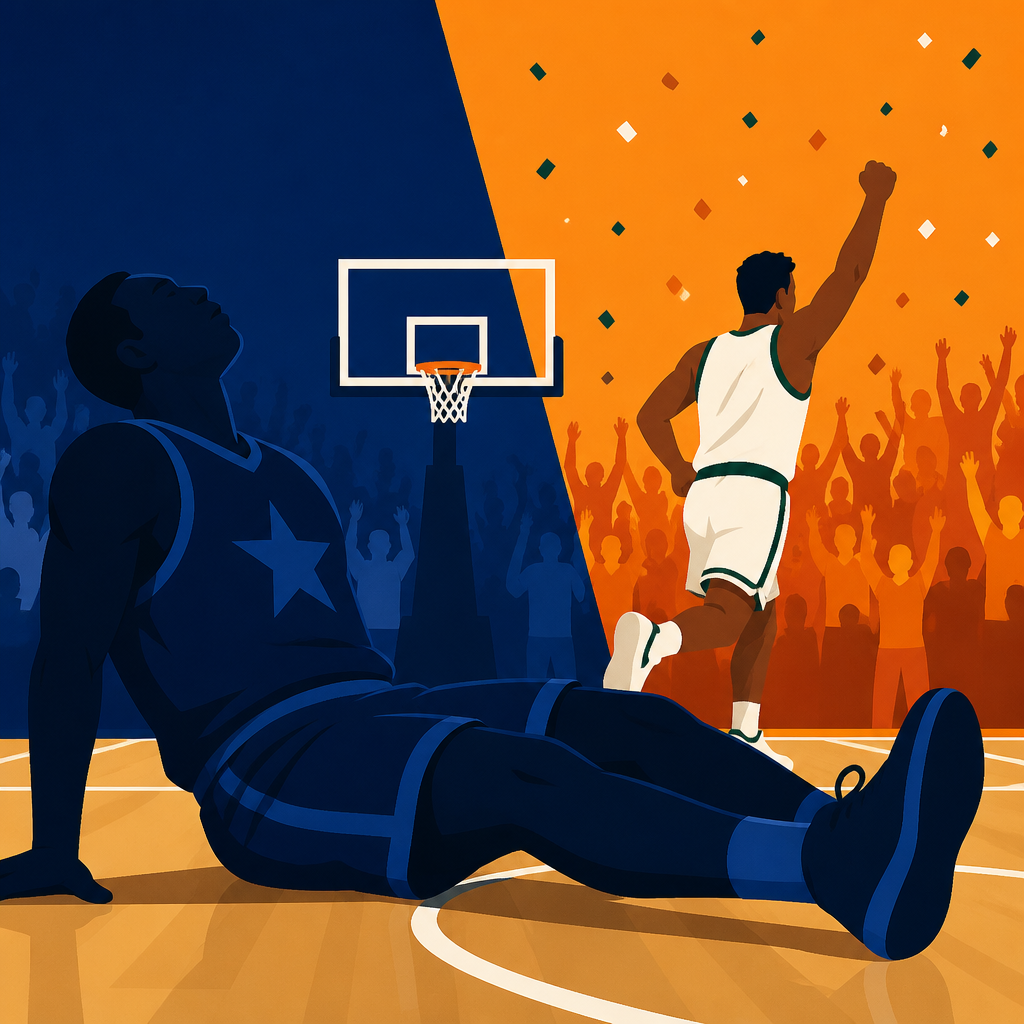
Denver’s path was rooted in defense, rim protection, and composure under pressure. Dikembe Mutombo anchored everything. Seattle struggled to finish consistently in the half court once Denver slowed the pace and turned games into physical battles. The Nuggets lost Game 1, then stole Game 2 in Seattle and gradually made the favorite tense. In Game 5, Denver won 98-94 in overtime, and Mutombo’s image lying on the floor holding the ball became one of the defining photographs in NBA postseason history. That single image still appears in nearly every discussion of playoff upsets because it captured disbelief, exhaustion, and joy at once.
The upset also exposed a recurring issue for Seattle’s era: elite regular-season energy did not always translate cleanly into playoff offense. Denver was not more talented overall, but it had a clear identity and a superstar defender who could bend an entire series. For the Nuggets, the upset gave legitimacy to a young group and remains a foundational memory in franchise history. For the league, it opened the door to believing that first-round certainty was an illusion.
1999 New York Knicks vs. Miami Heat: An Eighth Seed Reaches the Finals
The 1998-99 season was shortened by lockout, which made seeding less stable and compressed evaluation, but the New York Knicks’ first-round win over the top-seeded Miami Heat was still monumental. The Knicks entered as the No. 8 seed after a turbulent year that included injuries and uneven play. Miami, coached by Pat Riley, was disciplined, defensive, and expected to advance. Instead, New York won the series 3-2 in the last year of the best-of-five opening round. Allan Houston’s series-clinching runner in Game 5 remains one of the most famous shots in Knicks history.
What made this upset historically important was what followed. New York did not simply spring one surprise and exit. The Knicks rode that momentum all the way to the NBA Finals, becoming the only No. 8 seed ever to reach the Finals. In practical terms, this transformed the upset from a single-series shock into one of the central stories of modern playoff history. Latrell Sprewell gave the Knicks dynamic perimeter creation, Houston provided late-game scoring, Marcus Camby added energy inside, and the roster embraced a gritty, defensive identity perfectly suited for postseason play.
From a matchup standpoint, the Knicks were comfortable playing ugly games. Miami preferred structure and execution, but close, low-scoring contests created room for randomness and clutch shot-making. I have always considered this upset one of the clearest examples of how playoff environment can override regular-season hierarchy. Once games tighten and possession value rises, a battle-tested underdog with creators who are not afraid of the moment becomes dangerous. That principle still applies every April.
2007 Golden State Warriors vs. Dallas Mavericks: We Believe Became Basketball Mythology
If one first-round upset has become cultural shorthand for playoff chaos, it is the 2007 Golden State Warriors beating the 67-win Dallas Mavericks. Dallas entered as the No. 1 seed, had the league’s MVP in Dirk Nowitzki, and had reached the 2006 Finals. Golden State, coached by Don Nelson, grabbed the eighth seed on the final day and immediately became the favorite upset pick among serious analysts because Nelson knew Dallas intimately and the Warriors’ style was uniquely disruptive.
Golden State spread the floor, pushed pace, and attacked Dallas with small-ball lineups, dribble penetration, and relentless emotion. Baron Davis controlled the tone, Stephen Jackson added shot creation and toughness, Jason Richardson punished defensive mistakes, and the Oracle Arena crowd created one of the loudest home environments the league had seen. Dallas had the better record, size, and résumé. Golden State had the better psychological and tactical setup for that specific matchup. The Warriors had also won all three regular-season meetings, a detail many dismissed until it became impossible to ignore.
The series ended 4-2, but the emotional swing felt even larger. Dallas never looked fully comfortable. Golden State fronted Nowitzki, sent quick help, and forced the Mavericks into rushed decisions. This upset changed conversations around roster flexibility and playoff matchup hunting. It also foreshadowed the league’s eventual movement toward speed, spacing, and positionless lineups. Long before the Warriors became a dynasty, this team proved a lower seed could weaponize style itself. That is why “We Believe” still stands as one of the most influential first-round shockers in NBA history.
2011 Memphis Grizzlies vs. San Antonio Spurs and Other Defining Shockers
The 2011 Memphis Grizzlies upsetting the top-seeded San Antonio Spurs was a signal that the Western Conference order was shifting. San Antonio won 61 games and leaned on Tim Duncan, Tony Parker, Manu Ginobili, and one of the smartest systems in basketball. Memphis entered as the No. 8 seed but had a brutally physical frontcourt with Zach Randolph and Marc Gasol, plus Mike Conley’s control at point guard and Tony Allen’s perimeter defense. The Grizzlies won 4-2, and Randolph was the best player in the series, punishing San Antonio’s interior with power, touch, and confidence.
This upset mattered beyond the bracket because it introduced “Grit and Grind” to a national audience. Memphis turned every game into a half-court wrestling match, exactly the kind of environment that can neutralize a favorite’s rhythm. In film study, the defining element is how clearly Memphis knew its advantage. It did not try to imitate San Antonio’s precision. It imposed strength, rebounding, and patience. That conviction is common in great upsets: underdogs win when they lean harder into identity than favorites do.
Several other first-round series deserve hub-level recognition in playoff history. The 1981 Kansas City Kings over the Portland Trail Blazers is often overlooked, but it showed how vulnerable strong records can become in short series. The 1987 Seattle SuperSonics, a 39-win seventh seed, beat Dallas and then upset Houston, showing that late-season form sometimes matters more than seeding. The 2006 Los Angeles Lakers nearly upset the second-seeded Phoenix Suns and are remembered because Kobe Bryant’s 3-1 lead collapse influenced years of legacy debate, even though it was not completed. The 2012 Philadelphia 76ers beat the top-seeded Chicago Bulls after Derrick Rose suffered a catastrophic knee injury, a reminder that health is an inseparable part of playoff history, even when fans prefer cleaner narratives.
The 2023 Miami Heat over the Milwaukee Bucks belongs near the top tier because it combined tactical brilliance, star shot-making, and major consequences. Milwaukee won 58 games and had championship pedigree. Miami survived the Play-In Tournament, entered as the eighth seed, and then watched Jimmy Butler average 37.6 points per game in the series. Butler’s 56-point masterpiece in Game 4 was one of the greatest playoff performances ever. Miami targeted Milwaukee’s drop coverage, punished slow rotations, and repeatedly created efficient looks in late-clock situations. The Bucks’ loss accelerated coaching change and reopened questions about scheme rigidity in the postseason.
Across these examples, one lesson is consistent: historic first-round upsets are rarely random. They usually emerge from a blend of matchup pressure, elite individual performances, injuries or availability concerns, and a favorite that cannot adjust quickly enough. That pattern is exactly why fans, analysts, and teams keep revisiting these series. They are not just surprises. They are case studies in what playoff basketball really rewards.
Why These Upsets Still Shape NBA Playoff History
The best NBA playoff upsets in history endure because they explain the postseason better than any slogan can. Regular-season dominance matters, but it does not guarantee half-court scoring under stress, defensive adaptability, or healthy stars in late April. The Nuggets in 1994, Knicks in 1999, Warriors in 2007, Grizzlies in 2011, and Heat in 2023 each proved that a lower seed can win when it owns a real structural edge and believes in it completely. Some had a singular defensive anchor. Others had a shot creator no scheme could contain. All of them forced favorites into discomfort and made that discomfort visible.
For anyone building a deeper understanding of playoff history, these first-round shockers are essential reference points. They reveal how seeding can mislead, how matchups can outweigh records, and how one series can alter the path of franchises for years. They also connect naturally to every other NBA Playoffs discussion, from coaching adjustments and superstar legacy to bracket volatility and Finals runs. If you are exploring the broader playoff landscape, start with these upsets, then follow the threads into the teams, tactics, and turning points they created. That is where NBA playoff history becomes most vivid and most useful.
Frequently Asked Questions
What qualifies as a true first-round NBA playoff upset?
A true first-round NBA playoff upset happens when a lower-seeded team eliminates a higher-seeded opponent despite entering the series with fewer wins, less public confidence, and usually less star power on paper. In practical terms, it is not just about the number next to each team’s name. The strongest upsets involve a clear gap in regular-season expectations, where the favorite was viewed as a legitimate contender and the underdog was expected to exit quickly. That is why these series carry so much weight in league history. They expose how different playoff basketball can be from the regular season, where matchups, coaching adjustments, half-court execution, injuries, and pressure often matter more than overall record.
First-round upsets are especially powerful because they happen before a favorite has time to build postseason momentum. A top team can spend six months looking dominant, only to have its entire season and reputation undone in a week or two. When that happens, the result usually becomes bigger than the series itself. It changes how coaches are judged, how front offices build rosters, and how fans evaluate regular-season success. In many of the best-known examples, the lower seed did not simply get hot for a few games. It exploited a weakness the favorite could not solve, whether that was lack of shot creation, poor interior defense, shallow depth, or a system that did not translate under playoff pressure.
Why are first-round shockers often remembered more vividly than later-round upsets?
First-round shockers tend to stick in basketball memory because they deliver immediate chaos. A championship hopeful can go from respected to ridiculed almost overnight, and there is no conference finals run or hard-fought second-round battle to soften the blow. The contrast is what makes these upsets so dramatic. One team arrives with expectations of a deep playoff journey, while the other is often treated as a dangerous but limited opponent. When the underdog wins, the story feels larger than the bracket because it overturns months of assumptions in the very first postseason test.
These upsets also reshape narratives faster than later-round surprises. If a contender loses in the conference finals, it is disappointing, but it still validated some of the regular season. A first-round exit says something harsher: the team may never have been as playoff-ready as people believed. That is why moments like a No. 8 seed beating a No. 1 seed become part of league folklore. They force a reassessment of stars, systems, and organizational direction. In many cases, those early exits lead to coaching changes, roster overhauls, or a broader league-wide lesson about what actually wins in April and May. The shock lands harder because the failure is so sudden and so public.
Which first-round NBA upsets are usually considered the most important in league history?
Several series come up again and again because they were not just surprising; they changed how the league was viewed. The 1994 Denver Nuggets defeating the Seattle SuperSonics remains one of the defining examples. Seattle was a 63-win No. 1 seed, while Denver entered as a No. 8 seed and became the first team in NBA history to eliminate a No. 1 seed in the opening round. That upset gave the league one of its most iconic playoff images and permanently established the idea that seeding alone could not guarantee survival.
The 2007 Golden State Warriors over the 67-win Dallas Mavericks is another landmark shocker. Dallas had the league MVP in Dirk Nowitzki and looked like a title favorite, but Golden State’s speed, confidence, and specific matchup advantages completely disrupted the series. “We Believe” became more than a slogan; it became shorthand for a lower seed imposing style and belief on a superior regular-season team. The 2011 Memphis Grizzlies beating the top-seeded San Antonio Spurs also deserves mention because it showed how a physical frontcourt, disciplined defense, and matchup control could overwhelm an established power. More recently, the 2023 Miami Heat eliminating the Milwaukee Bucks added another unforgettable chapter, largely because it happened to a championship-caliber favorite with one of the league’s best records. What ties these upsets together is not just the seed gap, but the aftershock. Each one changed reputations, raised difficult questions, and reminded everyone that playoff vulnerability can appear much earlier than expected.
What usually causes a heavily favored team to lose in the first round?
There is rarely just one reason. Most major first-round upsets happen because several problems converge at once. Matchups are often the biggest factor. A lower-seeded team may have a style that specifically attacks the favorite’s weakness, such as elite guard penetration against slow perimeter defenders or bruising interior play against a jump-shot-heavy team. In the regular season, a contender can survive certain flaws across 82 games. In a playoff series, those flaws get targeted possession after possession until they become defining. That is why an upset can look shocking from a standings perspective but make perfect sense once the basketball details are clear.
Health and pressure are just as important. A favorite dealing with injuries, fatigue, or lineup instability can suddenly lose its edge. At the same time, the underdog often plays freer because expectations are lower. If it steals one road game early, pressure can swing hard onto the higher seed, especially if that team has past playoff disappointments or a star under extra scrutiny. Coaching adjustments matter too. Some underdogs are better prepared, more flexible, and quicker to recognize what is working. Others simply have the best player in the series when it matters most, even if they had the worse record. In the end, first-round upsets usually happen when the lower seed combines belief, matchup clarity, and execution while the favorite struggles to adapt before the season slips away.
How do historic first-round upsets change teams, players, and the league afterward?
The aftermath is often as important as the upset itself. For the underdog, a breakthrough series can redefine an entire era of the franchise. Players gain credibility, coaches earn trust, and a team that was previously overlooked becomes part of the larger NBA conversation. Even if that underdog does not go on to win the championship, it can change how the organization sees its own ceiling. Confidence grows, national attention increases, and the series often becomes a reference point for future playoff identity. Some teams use that moment as a launching pad, while others at least secure a permanent place in postseason history.
For the favorite, the consequences are usually more severe. First-round collapses force harsh evaluations because they suggest that a team’s regular-season formula was not strong enough under playoff conditions. Front offices may respond with major trades, coaching changes, or a complete philosophical shift in roster construction. Star players can see their reputations altered for years, fairly or unfairly, because postseason narratives tend to outlast regular-season success. On a league level, these upsets also influence strategy. Executives study why the lower seed succeeded, whether it was pace, spacing, toughness, switchability, or a willingness to attack a specific weakness. That is why the best NBA playoff upsets in history matter so much. They do not just produce a surprise result; they leave behind lessons that shape how contenders are judged and built for years afterward.