

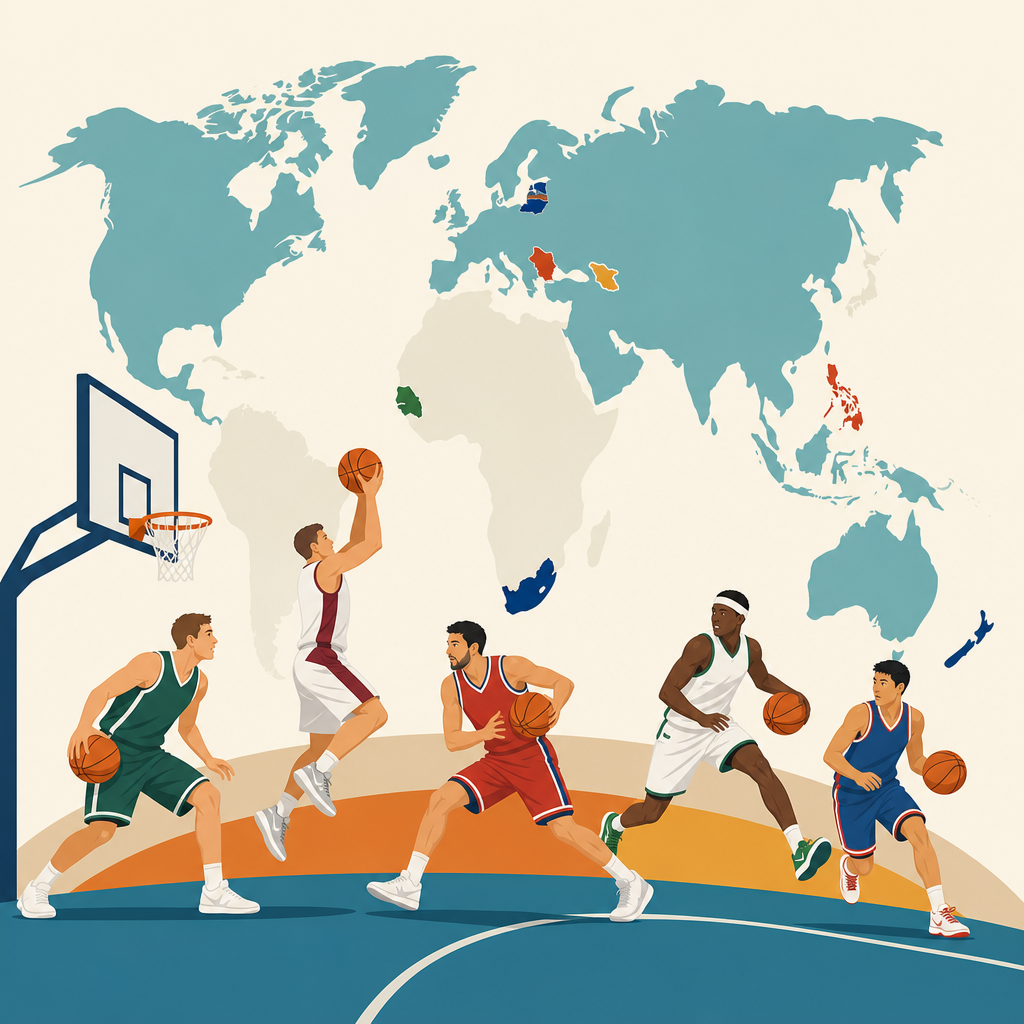
Basketball around the world is no longer a story dominated only by the United States. It is a genuinely global game shaped by countries with small populations, limited resources, or modest domestic leagues that still produce elite players, strong national teams, and outsized cultural influence. In basketball terms, “punch above their weight” describes nations that achieve more than their demographic, economic, or structural profile would predict. Some do it by producing NBA stars. Others build disciplined national programs, export coaches, or consistently compete for medals against far larger countries.
This global growth matters because modern NBA history cannot be understood without it. The league’s talent pipeline, playing styles, scouting systems, and commercial reach have all been transformed by international basketball. When I have worked through old tournament film, youth development models, and FIBA competition cycles, one pattern keeps reappearing: sustained success rarely happens by accident. Countries that outperform usually share a clear basketball identity, strong coaching education, repeatable player development, and national pride tied to team play rather than celebrity alone.
For readers using this page as a hub, the key idea is simple. Global growth is not just about where basketball is popular; it is about where the sport is organized effectively enough to create durable results. That includes the former Yugoslav pipeline, the Baltic model, the rise of West African and Oceanian contributors, and the way European club systems prepare players differently from the American high school and college route. It also includes how FIBA rules shape player habits, why Olympic and World Cup cycles matter, and how international success feeds directly into NBA history through stars, tactics, and front-office strategy.
Countries that consistently punch above their weight usually excel in one or more of four areas: technical skill development, continuity in coaching, competitive international exposure, and institutional support. Serbia is the clearest example. With a population under seven million, it has produced MVP-level talent, elite playmakers, and medal-winning teams through a system that emphasizes passing reads, footwork, spacing, and game intelligence from a young age. Lithuania, with fewer than three million people, treats basketball as a civic institution. Croatia, Slovenia, Latvia, and Montenegro have all produced world-class talent despite tiny player pools. Argentina built a golden generation that changed how international team basketball was perceived. Australia leveraged infrastructure and geography to become a stable producer of NBA contributors. Canada, while larger in population, exceeded long-standing expectations by turning scattered talent into a coordinated pipeline.
The lesson for NBA History is profound: the league’s evolution is intertwined with international ecosystems. Today’s stretch bigs, jumbo initiators, multi-action offenses, and unselfish read-based systems owe a visible debt to global basketball culture. This article maps the countries, methods, and trends that define that growth so readers can navigate the wider subtopic with context and precision.
Why Some Countries Overperform in Basketball
Population alone does not determine basketball success. If it did, countries such as India, Indonesia, or Nigeria would dominate every generation. Instead, overperformance usually comes from alignment between grassroots coaching, club competition, federation planning, and a style of play that fits available talent. In practice, small countries often gain an advantage because they centralize development faster. Coaches know one another, top prospects face each other repeatedly, and national federations can install a shared philosophy across youth levels.
FIBA competition also rewards habits that many smaller programs teach well. The international game places a premium on decision-making, compact spacing, off-ball movement, physical help defense, and comfort in structured half-court possessions. Nations that drill these details from childhood often look more cohesive than more athletic opponents. That is why technically sharp teams can challenge countries with deeper player pools. For hub readers, this is the core lens to apply across every regional article: basketball growth becomes durable when a country turns talent identification into system-wide repetition.
Europe’s Small Nations and Their Development Edge
No region has produced more examples of basketball overachievement than Europe. Serbia, Slovenia, Croatia, Lithuania, and Latvia are the headline cases, and each reflects a slightly different model. Serbia’s system is deeply influenced by the old Yugoslav school, where practices center on skill under pressure, manipulative passing angles, screening reads, and positional versatility. Nikola Jokic is the most famous modern outcome, but he is not an anomaly. Serbia has long produced guards and bigs who process the game one step ahead.
Slovenia offers a different lesson. With roughly two million people, it produced Luka Doncic, Goran Dragic, and a EuroBasket title in 2017. The country benefits from close integration between clubs, youth national teams, and nearby elite competition. Doncic’s development at Real Madrid also shows how transnational European pathways matter. A player may be born in one country, trained in another club structure, and tested in continental competition years before entering the NBA.
Lithuania remains one of the strongest examples of basketball culture outweighing population. Courts, coaching traditions, and public attention create an environment where fundamentals matter early. Arvydas Sabonis and Sarunas Marciulionis helped define a modern identity, while later generations kept Lithuania competitive in Olympic and World Cup play. Latvia’s recent surge, highlighted by strong FIBA results and players such as Kristaps Porzingis, reflects long-term investment finally paying off rather than a sudden breakthrough.
| Country | Approximate Population | Why It Overperforms | Notable Output |
|---|---|---|---|
| Serbia | Under 7 million | Elite coaching tradition, read-based development, strong national identity | Jokic, Bogdanovic, repeated FIBA medals |
| Slovenia | About 2 million | Integrated youth pipeline, access to top club competition | Doncic, Dragic, 2017 EuroBasket title |
| Lithuania | Under 3 million | Deep basketball culture, fundamentals-first coaching | Sabonis lineage, frequent major tournament appearances |
| Latvia | Under 2 million | Improved federation planning, skilled perimeter development | Porzingis, strong recent World Cup performance |
These countries also benefit from professional club systems that expose teenagers to adult basketball sooner than many American prospects experience. That matters historically. Players trained in high-level European leagues enter the NBA with advanced timing, screen craft, and team-defense discipline. For the broader global growth story, Europe proves that concentrated expertise can outweigh scale.
The Former Yugoslav Influence on Modern Basketball
Any serious discussion of basketball around the world must isolate the former Yugoslav space because its influence exceeds any single national border. Coaches, training methods, and tactical ideas developed in Yugoslavia spread into Serbia, Croatia, Slovenia, Montenegro, and Bosnia and Herzegovina after the breakup. The common thread was an educational approach that treated basketball intelligence as trainable. Practices emphasized small-sided decision-making, two-hand passing, pivot work, and collective problem solving. Big men were expected to handle and pass. Guards were expected to feed the post and organize weak-side action.
I keep returning to this region when studying NBA stylistic change because many ideas now celebrated in the league were routine there decades ago. The use of high-post facilitators, split cuts, horns sets flowing into second actions, and patient exploitation of mismatches all have deep roots in European and especially Yugoslav coaching culture. Toni Kukoc previewed the modern oversized playmaker. Vlade Divac normalized connective passing from the center spot. Doncic and Jokic represent the mature version of that lineage in today’s NBA.
Just as important, the region built resilience through competition. Domestic leagues were demanding, youth tournaments were intense, and making a national team was difficult. That scarcity sharpened standards. Even after political fragmentation, the coaching base remained rich. Small countries inherited a development DNA powerful enough to keep producing talent across generations.
South America’s Benchmark: Argentina and the Value of Cohesion
Argentina is the clearest South American example of a country outperforming structural expectations. It has a strong sports culture but competes nationally with football for attention, sponsorship, and imagination. Despite that, Argentina produced one of the greatest national teams in modern basketball history. The golden generation led by Manu Ginobili, Luis Scola, Andres Nocioni, Fabricio Oberto, and Pablo Prigioni won Olympic gold in 2004 and beat a United States team stacked with NBA talent.
That success was not a miracle run. Argentina combined club experience, technical skill, and rare continuity. Players understood spacing, timing, and sacrifice, and they had years of chemistry. Ginobili became the global symbol because his creativity translated to the NBA, but the broader lesson is that cohesive national programs can close athletic gaps. Argentina forced stronger opponents to guard every action and make every rotation.
For NBA history, Argentina matters beyond medals. Ginobili accelerated acceptance of euro steps, unconventional angles, and improvisational driving craft. Scola showed how polished footwork and touch could offset limited vertical explosion. Their influence reminds us that global growth does not only add new passports to the league; it expands the game’s vocabulary.
Oceania, Africa, and the New Geography of Talent
Australia has become one of the steadiest exporters of basketball talent because it built infrastructure before its player boom. The Australian Institute of Sport, strong state programs, and a competitive domestic pathway created a base that later fed the NBA. Players such as Andrew Bogut, Patty Mills, Joe Ingles, Josh Giddey, and Dyson Daniels emerged from a system that values feel, toughness, and role clarity. Australia’s national team, the Boomers, finally won an Olympic medal in Tokyo, but they had been close for years because their habits were consistent.
Africa presents a different pattern. Several countries possess immense raw talent but less uniform infrastructure. Nigeria and Senegal have repeatedly fielded competitive teams, often drawing on diaspora players and overseas development. Cameroon has produced Joel Embiid and Pascal Siakam, two of the most significant international stars of the era. Their stories show both the opportunity and the limitation: elite individuals can emerge from less developed local ecosystems, but sustained national overperformance usually requires stronger domestic coaching networks, facilities, and youth competition.
The Basketball Africa League may help change that. By improving club visibility, standards, and investment, it can strengthen the bridge between local development and the global professional game. In the wider hub context, Africa is one of the most important future chapters in basketball around the world because the talent ceiling is obvious, while the system-building work is still ongoing.
What Global Growth Means for the NBA and Future Fans
Global growth has changed the NBA at every level. Scouting is wider, draft boards are more international, and front offices now evaluate professional experience abroad with far more sophistication than they did in the 1990s. Teams no longer treat international prospects as novelties. They study club context, league strength, shot diet, translation of role, and decision-making under FIBA rules. That shift helped pave the way for stars such as Dirk Nowitzki, Tony Parker, Pau Gasol, Giannis Antetokounmpo, Jokic, Doncic, and Shai Gilgeous-Alexander to be understood not as exceptions but as central figures in league history.
Fans also benefit from following the global game directly. EuroLeague, Olympic qualifying, the FIBA World Cup, youth tournaments, and domestic leagues such as Spain’s ACB or Australia’s NBL reveal trends before they fully arrive in the NBA. They show how coaching philosophies travel and why certain countries keep producing players who look advanced in feel and fundamentals. For a sub-pillar hub under NBA History, that is the main takeaway: the history of the league is now inseparable from basketball ecosystems across the world.
The countries that consistently punch above their weight do so through design, not luck. They teach skills early, trust coaches, create demanding competition, and build identities that survive individual generations. If you want to understand where the NBA has been and where it is going, study those systems closely. Use this hub as your starting point, then dive deeper into the country profiles, tournament histories, player pipelines, and tactical evolutions that define global basketball growth today.
Frequently Asked Questions
What does it mean when a country “punches above its weight” in basketball?
In basketball, a country is said to “punch above its weight” when it achieves far more success than its size, wealth, player pool, or domestic infrastructure would normally suggest. That success can show up in different ways. Some countries regularly produce NBA and EuroLeague talent despite having relatively small populations. Others consistently field competitive national teams even though they do not have the commercial power, media influence, or developmental depth of traditional basketball giants. In many cases, these nations are not expected to contend with powers such as the United States, Spain, or France on paper, yet they repeatedly prove they belong in the conversation.
The phrase is especially useful because basketball success is not determined by population alone. A country with millions of people can still underperform if its coaching systems are weak, facilities are uneven, or other sports dominate the culture. Meanwhile, a smaller nation can outperform expectations by building a strong identity around skill development, disciplined team play, continuity in coaching, and early investment in youth pathways. Countries that punch above their weight often maximize every part of the pipeline. They develop fundamentals early, create clear progression from junior teams to the senior national side, and teach players how to thrive in structured, high-IQ systems.
It is also important to understand that “punching above their weight” does not always mean winning global tournaments. Sometimes it means remaining consistently competitive, qualifying regularly for major events, upsetting deeper teams, or producing a remarkable number of professional players relative to population. In other words, the label is less about occasional surprise and more about sustained overachievement. That is what makes these countries so fascinating in the modern global game.
Which countries are most often cited as basketball nations that consistently outperform expectations?
Several countries come up again and again in this discussion, and each has its own reason for being included. Serbia is one of the clearest examples. It has a relatively modest population compared with major powers, yet it continuously produces elite guards, playmakers, big men, and coaches. Its basketball culture emphasizes decision-making, passing, toughness, and technical precision, which helps explain why Serbian teams and players translate so well at both club and international levels.
Lithuania is another classic case. With a small population, it has maintained an extraordinary basketball identity for decades. The sport holds a near-sacred status there, and that cultural importance feeds player development from an early age. Lithuania’s national teams are rarely easy to beat, and the country has developed a long line of high-level professionals despite its limited size.
Slovenia deserves mention as well, especially given how small it is. Producing a generational star like Luka Doncic would already be notable, but Slovenia’s real achievement is broader than one player. The country has built a competitive basketball environment capable of supporting international success and producing skilled, adaptable talent. Croatia, although more uneven in recent years, has historically overproduced basketball talent relative to its size and remains part of the larger former Yugoslav basketball tradition that has had an enormous global impact.
Outside Europe, Australia is frequently included because it has turned a geographically isolated basketball ecosystem into a reliable source of NBA talent and international competitiveness. Argentina belongs in the conversation because of its historic golden generation and its lasting influence as a basketball nation that proved collective intelligence and cohesion could overcome deeper rosters. Canada is no longer a surprise in pure talent terms, but for many years it fit this profile by producing world-class players despite operating in the shadow of hockey and the United States. More recently, countries such as Latvia and Montenegro have also strengthened the case that smaller basketball nations can remain relevant through smart development and strong basketball cultures.
How do smaller or less-resourced countries manage to produce elite basketball players so consistently?
The short answer is that they tend to be exceptionally efficient. Countries that overperform in basketball usually cannot rely on sheer volume, so they rely on precision. They build systems that identify talent early, train players in the fundamentals, and expose them to meaningful competition at the right stages of development. Instead of trying to create highlight-driven stars too soon, many of these programs focus on footwork, passing, shooting mechanics, spacing, decision-making, and reading the game. That approach produces players who are technically sound and tactically versatile.
Coaching quality is another major factor. In many successful smaller nations, coaches are highly influential and deeply involved in player education from the youth level onward. Players are often taught to think the game rather than simply react athletically. That matters because international basketball rewards timing, structure, and team execution. A player raised in that environment is often better prepared to adapt to different roles, systems, and levels of competition. These countries may not always have the largest gyms or biggest budgets, but they often have a remarkably coherent teaching philosophy.
Cultural clarity also plays a big role. In nations that punch above their weight, basketball is often more than just a popular sport; it becomes part of national identity. Young players see a clear path from local clubs to junior national teams to professional opportunities abroad. They grow up watching previous generations succeed and understanding what is valued in their system. That continuity reduces developmental waste. Rather than chasing trends, these countries often know exactly what kind of player they want to develop and exactly how to get there.
Finally, adversity can become an advantage. Players from smaller markets often have to compete harder for visibility, opportunities, and contracts. That can create a tougher, more resilient developmental environment. When combined with disciplined coaching and strong fundamentals, that edge helps explain why so many players from these countries arrive on the global stage looking polished, competitive, and ready to contribute.
Is international basketball success mainly about producing NBA stars, or are there other ways countries can overachieve?
Producing NBA stars is one highly visible marker of success, but it is far from the only one. In fact, some countries punch above their weight less through superstar production and more through national team coherence, style, and consistency. International basketball is a different ecosystem from the NBA. It rewards chemistry, continuity, role acceptance, and tactical discipline in ways that can narrow the gap between countries with massive talent pools and those with smaller ones.
A country can overachieve by repeatedly qualifying for the Olympics, the FIBA World Cup, or continental championships. It can do so by beating more physically gifted teams through execution and composure. It can also build a reputation for developing certain types of players exceptionally well, such as elite guards, floor-spacing bigs, or cerebral wings. Some nations are especially good at creating professional players who may not become NBA household names but enjoy long, high-level careers in Europe and strengthen the national team for years.
There is also cultural influence to consider. Some countries shape the global game through coaching ideas, player archetypes, and tactical trends that spread across leagues and borders. Former Yugoslav basketball schools are a strong example of this. Their influence is visible in the premium placed on ball movement, skill development for big men, and the idea that all five players should be able to read the floor. A nation does not need a constant stream of top-10 draft picks to matter enormously in basketball terms.
So while NBA representation is important and often reflects developmental strength, it should not be treated as the only measure. A country truly punches above its weight when it creates durable basketball relevance across multiple levels: player development, national team performance, club success, and long-term influence on how the sport is played.
Why has basketball become so global, and what does that mean for countries trying to compete with traditional powers?
Basketball has become more global because the barriers that once limited talent development and visibility have weakened dramatically. International scouting is more sophisticated than ever, digital media allows players to be discovered earlier, and top prospects can move through academies, professional clubs, and international competitions with greater ease. The NBA has also played a major role by investing in global outreach and by embracing international players not as exceptions, but as central figures in the league’s present and future. That shift has validated basketball development pathways far beyond the United States.
For smaller countries, this globalization creates both opportunity and pressure. The opportunity is clear: a great player no longer has to be born in a traditional power to reach the top. If a country has a strong coaching culture and a smart development model, its best players can now find elite competition and professional platforms much more easily. That opens the door for nations with modest domestic leagues to remain relevant internationally. Their players may train locally, mature in European club systems, and then take the final step to the NBA or other top competitions.
The pressure comes from the fact that more countries are now competing intelligently. It is no longer enough to have passion alone. Nations that want to keep punching above their weight need organized federations, modern coaching education, investment in youth development, and a clear style of play. The global field has become deeper, more tactical, and more interconnected. A country that once relied on one golden generation or a single transcendent star may struggle if it does not build lasting structures behind that success.
Still, the broader meaning is positive. The globalization of basketball has made the sport richer, more unpredictable, and more representative of different playing cultures. It has also made stories of overachievement more compelling. Today, a small nation with the right system can influence the