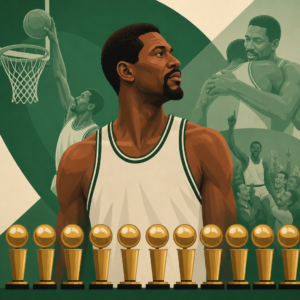

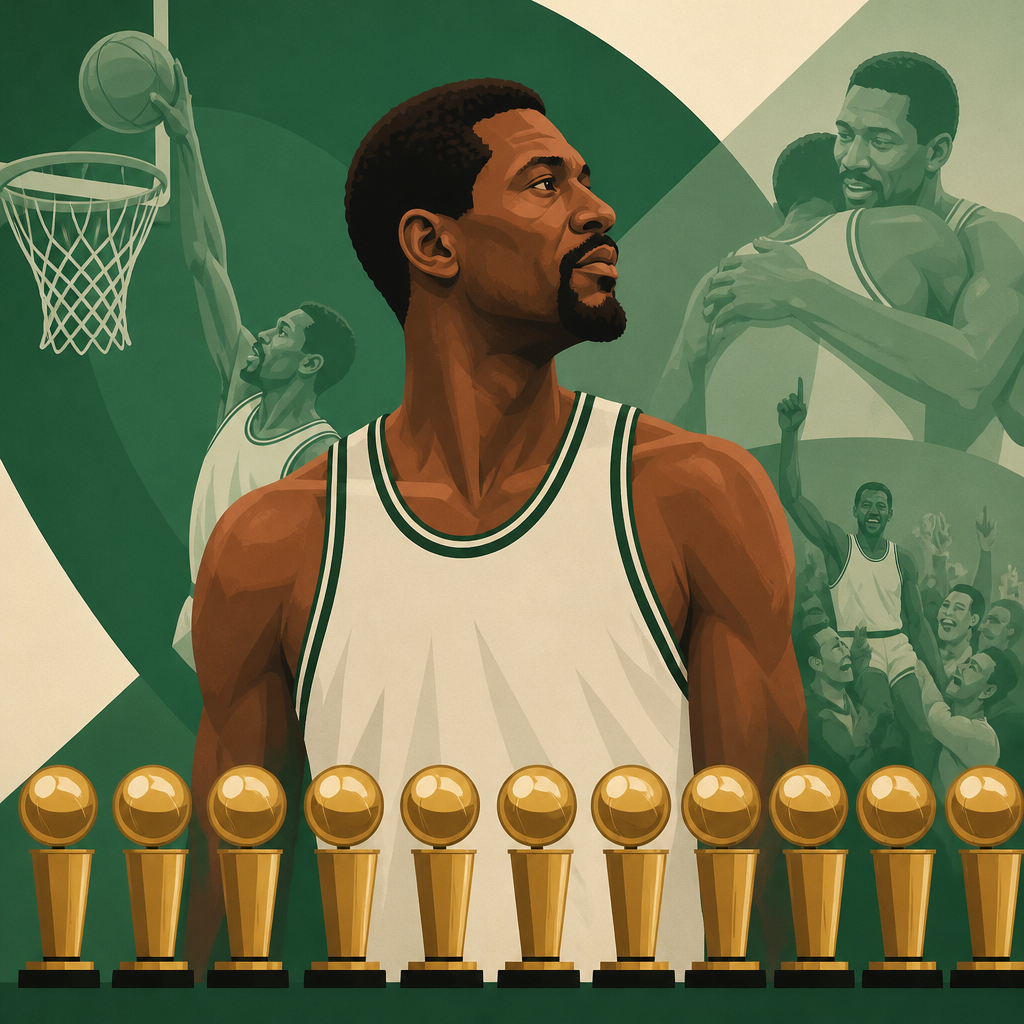
Bill Russell Legacy: Eleven Championships and the Greatest Winner in Team Sports stands at the center of any serious discussion about NBA history, because his career links individual greatness, dynastic success, civil rights leadership, and the evolution of modern team defense. In the language of basketball history, a legacy is the lasting competitive and cultural impact a player leaves behind, while an era is a period defined by distinct styles, rivalries, rules, and stars. Russell shaped both. From 1956 to 1969, he helped the Boston Celtics win eleven championships in thirteen seasons, including eight straight titles, a standard unmatched in North American team sports. Those numbers matter, but they only begin the story. Russell changed how winning was built. He proved that rebounding, rim protection, outlet passing, communication, conditioning, and emotional control could be as decisive as scoring totals. In working through NBA archives, game film, biographies, and the statistical record, I keep returning to the same conclusion: Russell is the hub figure for understanding legends and eras because he connects the league’s formative years to every later debate about value, leadership, and championship basketball.
That is why this page serves as a hub for the broader Legends and Eras branch of NBA History. If a reader wants to understand how George Mikan established the early big man template, how Wilt Chamberlain expanded individual statistical possibility, how Magic Johnson and Larry Bird revived the league, how Michael Jordan turned excellence into global myth, or how LeBron James redefined longevity, Russell provides the reference point. He was the ultimate team anchor before advanced metrics existed to describe what he did. He was also the first Black head coach in major American professional sports, guiding Boston as player-coach from 1966 to 1969. His career sits at the intersection of tactics and social history. Studying Russell clarifies a larger question that runs through every era: what kind of superstar raises a franchise, a league, and the meaning of winning itself? The answer begins with his eleven championships, but it expands into a blueprint for how basketball legacies are measured across generations.
Why Bill Russell Is the Defining Hub for Legends and Eras
Russell is the ideal hub subject because his career touches every major category used to interpret NBA legends. Start with team success. The Celtics won titles in 1957, 1959, 1960, 1961, 1962, 1963, 1964, 1965, 1966, 1968, and 1969. That run spans multiple roster versions, changing competitors, and shifts in league structure. It also includes iconic playoff battles against Wilt Chamberlain, Jerry West, Elgin Baylor, Oscar Robertson, Bob Pettit, and Willis Reed’s Knicks at the edge of Russell’s career. When historians compare eras, they usually ask which players dominated their own time and altered what future teams copied. Russell passes both tests decisively.
He also forces a more sophisticated definition of greatness. Box score culture often prioritizes points per game, but Russell’s value lived in possession control and shot deterrence. Official blocked-shot tracking did not exist during his career, yet contemporaries, coaches, and film all point to his extraordinary impact as a help defender and rim protector. He rarely blocked shots out of bounds for spectacle. Instead, he directed them to teammates, turning defense into immediate transition offense. That principle is standard coaching today. In Russell’s time, it was revolutionary in execution. His outlet passing after rebounds created fast-break chances for guards and wings such as Bob Cousy, Bill Sharman, Sam Jones, and John Havlicek. In plain terms, Russell did not just end possessions; he began winning ones.
As a hub for Legends and Eras, Russell also demonstrates how context sharpens rather than weakens his case. The league had fewer teams, which meant title paths often required defeating rosters loaded with Hall of Fame talent. Boston’s own roster was excellent, but that does not diminish Russell; it explains part of his genius. He made elite teammates fit into a disciplined defensive system and accepted a role that maximized championships rather than individual scoring prestige. That tradeoff sits at the core of many later era debates, from Tim Duncan’s Spurs to Stephen Curry’s Warriors. Russell remains the clearest early example of a superstar choosing scalable impact over statistical vanity.
The Winning Architecture: Defense, Rebounding, and Transition
To understand why Bill Russell won at a level no other player has matched, focus on the mechanics of how Boston played. Red Auerbach’s Celtics attacked with pace, but pace alone did not create a dynasty. Russell supplied the architecture. He controlled the defensive glass, protected the paint without fouling recklessly, switched assignments when needed, and directed teammates like a coordinator calling coverages before that language was common. His track-and-field background mattered. He was quick off the floor, light on his feet, and able to recover after helping on a drive. Opponents often believed they had an open look until Russell closed the distance in a stride and a half.
Rebounding was his first superpower. Possessions were noisier in that era because shooting percentages were lower, creating more rebound opportunities, but that only increased the value of positioning and anticipation. Russell led the league in rebounds four times and averaged 22.5 rebounds per game for his career. Numbers alone cannot capture the effect. A defensive rebound by Russell often became an instant fast break because he could fire accurate outlet passes ahead of the field. Teammates ran knowing the ball would arrive. That habit turned stops into points before defenses were set, which is why Boston repeatedly outpaced talented opponents in pressure moments.
| Legacy Dimension | What Russell Did | Why It Still Matters |
|---|---|---|
| Rim protection | Blocked and altered shots while keeping the ball in play | Modern centers are taught to convert blocks into controlled possessions |
| Rebounding | Secured misses and ended second chances | Defensive rebounding remains the foundation of playoff basketball |
| Outlet passing | Started transition immediately after boards | Big-man passing is now prized from Nikola Jokic to Bam Adebayo |
| Leadership | Organized teammates and set standards for sacrifice | Championship teams still depend on vocal and tactical anchors |
| Versatility | Defended space, switched matchups, and covered mistakes | Playoff defenses now prioritize mobile back-line defenders |
Russell’s defensive intelligence separated him even from other great centers. He studied opponent tendencies, understood angles, and treated defense as a collective craft. Teammates trusted him to erase mistakes, which let Boston pressure the ball more aggressively. In current terms, he raised the team’s error tolerance. He also excelled under playoff stress. The 1962 Finals against the Los Angeles Lakers and the 1969 Finals, when an aging Russell outmaneuvered a favored Lakers team loaded with stars, show that his influence was most visible when possessions tightened and nerves frayed. Winning, for Russell, was not an abstract quality. It was a repeatable system built on disciplined advantages.
Russell and Wilt: The Rivalry That Defined an Era
No NBA history hub on legends and eras is complete without the Russell-Wilt Chamberlain rivalry, because it framed the league’s first great debate between individual dominance and team dominance. Chamberlain was bigger, a more prolific scorer, and statistically overwhelming in ways the sport had never seen. Russell was the superior organizer of winning basketball. They faced each other repeatedly in high-stakes playoff series, and Boston usually survived. That repeated outcome shaped both players’ public images for decades.
The rivalry is often oversimplified into rings versus numbers. In reality, it was a clash of styles and priorities. Chamberlain could overwhelm single coverage and control the glass, but Russell focused on forcing difficult decisions around him. He baited offenses into less efficient patterns, relied on timing rather than brute force, and accepted that his own scoring could remain secondary if the scoreboard favored Boston. Their battles in the Eastern Division Finals routinely felt like championship rounds. In several series, the margin between them was razor thin. The famous 1965 Game 7 ended 110-109 after John Havlicek stole an inbounds pass, but Boston was in position because Russell had managed the game’s emotional and tactical flow.
For readers exploring this sub-pillar, that rivalry opens pathways to other era-defining comparisons. Russell versus Wilt anticipates later discussions such as Bird versus Magic, Jordan versus Isiah’s Pistons, Kobe Bryant versus Tim Duncan, and LeBron James versus the Warriors. Every generation asks a version of the same question: is greatness best seen in volume, versatility, peak force, longevity, or titles? Russell’s answer is demanding. Greatness must scale to the highest-pressure team environment. That standard does not erase individual production, but it insists that production be judged by its effect on collective outcomes.
Player-Coach, Civil Rights Leader, and Standard-Setter
Russell’s legacy extends beyond tactics because he carried responsibilities few athletes in any era have faced. In 1966, after Auerbach moved upstairs, Russell became player-coach of the Celtics, the first Black head coach in major American professional sports. He did not inherit a ceremonial title. He had to command a championship locker room, handle strategy, and perform as the team’s defensive centerpiece at the same time. Boston then won championships in 1968 and 1969. That alone would secure a singular place in sports history.
His leadership also unfolded against sustained racism. Russell spoke openly about mistreatment in Boston, supported civil rights causes, and stood with figures such as Muhammad Ali, Jim Brown, Kareem Abdul-Jabbar, and other prominent Black athletes in moments that carried real professional risk. He was not interested in being comfortable for the public. He was interested in being principled. That honesty matters when assessing legacy, because legends are not only remembered for trophies. They are remembered for what they defended when popularity and morality pointed in different directions.
Within team culture, Russell set standards that later dynasties echoed. He demanded preparation, defensive accountability, and emotional resilience. Teammates understood roles because Russell made the larger purpose unmistakable. When I review championship teams across eras, the pattern repeats: the most durable winners usually have one figure who gives sacrifice moral authority. For the Celtics, that figure was Russell. He did not ask others to do what he would not do himself. That is one reason his credibility lasted through aging legs and changing rosters.
How Russell Connects the Great NBA Eras
As a hub article for Legends and Eras, Russell works because his story connects backward to the league’s origins and forward to modern basketball. Before him, George Mikan established the dominant center as the axis of team construction. Russell transformed that axis from offense-first to defense-first. After him, Kareem Abdul-Jabbar expanded the center position with scoring elegance and extraordinary longevity. Hakeem Olajuwon refined footwork and two-way versatility. Tim Duncan carried the Russell model of understated leadership and system-first excellence into the modern era. Draymond Green, though undersized, reflects Russell’s principle that elite defense can coordinate an entire championship scheme.
His influence also appears in how front offices evaluate impact. Today, analysts use defensive rating, on-off splits, rebound percentage, lineup data, and film-based tagging to estimate what Russell provided intuitively and visibly. No metric can fully reconstruct his prime because the necessary play-by-play and tracking data do not exist, but the logic is clear. A mobile anchor who ends possessions, protects the rim, ignites transition, and stabilizes teammates is among the most valuable assets in basketball. Russell embodied that archetype before the sport had the vocabulary to explain it cleanly.
For readers building a map of NBA history, this hub naturally branches into related subjects: the Celtics dynasty, Red Auerbach’s innovations, the Russell-Chamberlain rivalry, the integration of the NBA, the rise of player activism, and the evolution of defensive strategy. It also frames later legendary debates with needed discipline. Not every all-time great must resemble Russell, but every claim to ultimate winning has to pass by him. His record demands it.
Why the Greatest Winner Argument Endures
Calling Russell the greatest winner in team sports is a strong claim, yet it holds up because the evidence is cumulative. Eleven NBA championships are the headline. Add two NCAA titles at the University of San Francisco and a gold medal with the 1956 U.S. Olympic team, and the pattern becomes overwhelming. He did not merely join successful teams; he transformed environments into title programs. In championship evaluation, repeatability matters more than isolated peaks. Russell repeated elite outcomes under different pressures, against elite opponents, and while carrying strategic and emotional burdens most stars never shoulder.
There are fair limitations to acknowledge. The NBA was smaller, travel and sports science were different, and offensive systems were less spaced than they are now. Cross-era comparison will always involve uncertainty. But those caveats apply to every legend. The proper question is whether a player dominated the demands of his own context and introduced principles that still matter. Russell did both at the highest possible level. That is why his case remains durable even as the game changes.
The clearest takeaway from Bill Russell’s legacy is that winning has a structure, and he mastered it better than anyone. He made defense a star skill, made sacrifice look intelligent rather than passive, and made leadership measurable through championships. As the central figure in any Legends and Eras guide, he helps readers connect numbers to meaning and history to modern basketball. If you are exploring NBA History seriously, start with Russell, then follow the paths his career opens: Celtics dynasty, Wilt rivalry, civil rights leadership, and the evolution of team-first superstardom. That journey explains not only why Russell won eleven championships, but why his standard for winning still defines the sport.
Frequently Asked Questions
Why is Bill Russell’s legacy considered so important in NBA history?
Bill Russell’s legacy matters because it reaches far beyond championships alone. He is central to NBA history because he changed how greatness is measured. Before and during his rise, many conversations about star players centered on scoring totals, individual flair, and offensive dominance. Russell expanded that definition by proving that defense, rebounding, leadership, sacrifice, and team-first decision-making could drive a dynasty just as powerfully as points per game. His career with the Boston Celtics showed that a player could be the most important force on the floor without needing to lead the league in scoring, and that idea permanently reshaped how basketball people evaluate winning impact.
His importance also comes from the scale of his success. Eleven championships in thirteen seasons remains one of the most extraordinary achievements in professional sports, not just basketball. That record is not simply a statistical curiosity; it reflects sustained excellence across changing opponents, playoff pressure, and the physical demands of a very different era. Russell anchored a team that became the defining dynasty of its time, and he did so while repeatedly facing elite rivals, including Wilt Chamberlain, Jerry West, Elgin Baylor, and others who would be remembered as all-time greats.
Just as important, Russell helped define the modern understanding of team defense. He mastered rim protection, help defense, shot alteration, communication, transition defense, and rebounding positioning in ways that were ahead of his time. Even when a block was not officially recorded, his defensive influence was visible in how offenses changed their decisions around him. He made teammates better by organizing the defense behind the scenes, covering mistakes, and turning stops into fast-break opportunities. In that sense, Russell was not just a great defender; he was the defensive system.
His legacy also matters culturally. Russell was a major figure in the civil rights movement and one of the most outspoken athletes of his generation on race, dignity, and equality. He used his platform with courage at a time when doing so came with real personal consequences. That means his historical significance cannot be separated from his social impact. When people discuss Bill Russell’s legacy, they are talking about a player who influenced championships, strategy, leadership, and American sports culture all at once.
How did Bill Russell win so many championships, and what made him the greatest winner in team sports?
Bill Russell won so many championships because he possessed a rare combination of physical tools, basketball intelligence, emotional discipline, and an absolute commitment to team success. Winning at that level is never the result of one factor. Russell was an elite athlete with exceptional timing, anticipation, and stamina, but what truly separated him was how completely he understood what his teams needed in order to win. He embraced the hardest and least glamorous responsibilities: protecting the paint, controlling the glass, directing teammates, setting the tone defensively, and making the extra play rather than hunting personal statistics.
One of Russell’s defining traits was that he understood the geometry and psychology of winning basketball. He knew where shots would come from, where rebounds would bounce, when to challenge a shot, and when to stay grounded and force a miss. He treated defense as a proactive art rather than a reactive chore. That allowed Boston to dominate possession, disrupt rhythm, and create easy offense in transition. His defense did not just stop opponents; it generated momentum and structure for the entire team.
He was also a supreme leader. Russell made teammates believe in a shared mission, and he demanded accountability without losing sight of the collective goal. The Celtics of that era were loaded with talent, but many talented teams do not become dynasties. Russell’s presence gave Boston its competitive identity. He accepted pressure, steadied the group in the biggest moments, and consistently delivered in playoff situations where execution and resilience mattered most. His value was especially visible in close games, where decision-making, communication, and trust often determine outcomes more than raw scoring.
Calling him the greatest winner in team sports is not just a tribute to the number eleven. It reflects the way he won: repeatedly, against elite competition, over many seasons, while serving as the foundational piece of the greatest dynasty in NBA history. His winning was systematic, not accidental. He created conditions that allowed others to thrive, and he measured success by results that the entire team could share. That mindset is a major reason his reputation as the ultimate winner has endured for generations.
How did Bill Russell change the way defense is understood in basketball?
Bill Russell changed basketball by proving that defense could be the organizing principle of a championship team. Today, fans regularly discuss rim protection, defensive versatility, help rotations, recovery speed, communication, and the value of ending possessions with rebounds. Russell helped establish those ideas at the highest level long before modern analytics or advanced tracking existed. He made defense visible as a form of control. Opponents were not just missing shots against him; they were being pushed into uncomfortable choices, altered angles, and rushed decisions.
One of his greatest innovations was his understanding of shot blocking as more than a highlight play. Many players chase blocks for spectacle, but Russell used timing and discipline to block or alter shots in ways that benefited his team. He often redirected the ball to teammates or to spaces the Celtics could control, turning defensive plays into immediate offensive opportunities. That is a crucial distinction. He was not just erasing scoring chances; he was beginning fast breaks and changing possession value.
Russell also mastered the role of back-line quarterback. He read the floor, anticipated actions before they developed, and guided teammates into better positions. In modern terms, he functioned as a defensive anchor who covered space, protected the rim, switched attention seamlessly, and coordinated team structure. His mobility made all of that possible. For a center of his era, he moved with extraordinary agility, allowing him to defend in space, recover to the basket, and influence multiple actions in the same possession.
Perhaps most importantly, he helped establish the idea that the best defender in the game could also be the most impactful player in the game. That was revolutionary. Russell’s career forced observers to recognize that defense is not secondary to offense; it can be equally decisive, especially in the postseason. Every great defensive center who followed, from later generations of rim protectors to modern versatile anchors, exists in part within the blueprint Russell helped draw. His style was not just effective in his era; it shaped how basketball strategy evolved afterward.
What was Bill Russell’s relationship to his era, and how should fans compare him to stars from other generations?
Bill Russell’s era was unique, but that does not make his greatness less meaningful. In fact, understanding his era is essential to appreciating how dominant and influential he was. He played in a period with different rules, fewer teams, different travel conditions, a faster pace, and a more physically demanding style in many respects. Training methods, medical care, and media coverage were also radically different from today. Comparing players across eras always requires care, because no great player performs in a vacuum. Russell must be judged both within the conditions of his own time and through the lasting qualities that would translate to any generation.
Within his era, Russell was transformative. He was not merely successful inside an existing system; he altered the competitive standards of the league. He helped define what elite defense looked like, what a championship anchor could be, and how a superstar could dominate without centering the game on individual scoring. That matters enormously in historical evaluation. Greatness is not just about fitting into an era; it is also about shaping it. Russell did both.
When comparing him to stars from other generations, fans should avoid overly simplistic arguments such as points per game alone or ring counts alone. Russell’s impact was structural. He controlled possessions, elevated teammates, organized defenses, and delivered results at a level almost no one else in sports history has matched. His game would likely look different in a modern system, just as modern stars would look different under 1960s conditions. The better question is not whether he would post the same box score in another era, but whether his defining strengths—intelligence, mobility, competitiveness, leadership, and defensive command—would still matter. The answer is yes, emphatically.
That is why Russell remains secure in any serious all-time discussion. Even if stylistic comparisons vary, his influence, adaptability, and record of winning make him impossible to dismiss. He represents a form of greatness rooted in function, impact, and leadership rather than only in accumulation. For many historians, that makes him one of the most valuable players to ever live, regardless of era.
How did Bill Russell’s leadership and civil rights activism strengthen his legacy beyond basketball?
Bill Russell’s legacy extends beyond basketball because he was not only a champion athlete, but also a principled public figure who understood the responsibilities that came with fame. He lived and spoke with unusual honesty, particularly on issues of race, justice, and human dignity. In an era when many athletes were expected to remain quiet, Russell chose to confront prejudice directly. That decision came at a cost, especially in a country and a sports culture that were often hostile to outspoken Black athletes. Yet he remained unwavering, and that courage is a major reason his legacy carries such weight today.
Russell’s activism was not symbolic or convenient. He supported civil rights leaders, participated in major causes, and used his platform to challenge hypocrisy and discrimination. He understood